
Most people arrive in New Zealand having sorted a job and a visa, but without a solid plan for where they will actually sleep. Renting a house in New Zealand operates under its own rules, its own terminology and its own unwritten expectations. Getting the basics right before you start viewing properties saves a lot of stress and, in some cases, a significant amount of money.
The good news: tenants have legal protections here and several fees that feel routine in other countries are outright illegal. The less comfortable news: the housing stock is older than most newcomers expect and competition in the main cities means a well-organised application matters more than people realise before they arrive.
What renting a house in New Zealand actually costs
Rent here is quoted and paid weekly, not monthly — the single biggest adjustment for newcomers from monthly-rent countries. Tenancy Services confirms rent is charged and paid on a weekly or fortnightly basis, never monthly, under the charging rent rules. When a landlord advertises a property at $650 per week, that means 52 rent payments per year. The annualised cost is higher than it looks when you mentally divide by four and compare it to a monthly figure from home.
The national median weekly rent was NZ$625 in April 2026 — its first month-on-month rise after five months of flat or falling rents — according to the Trade Me Property Rental Price Index. That figure masks significant regional variation. Auckland and Bay of Plenty remain the most expensive regions on the mainland. Wellington’s market kept softening into 2026: the capital’s median weekly rent fell to NZ$600 in April, down NZ$40 on a year earlier, which Trade Me attributes largely to public-sector hiring freezes and budget pressure. Nationally, though, supply was tightening over the same period — listings were down roughly 5% year-on-year while enquiry-based demand rose about 8%, per the same Trade Me report — which points to upward pressure building in other regions even as Wellington stayed soft. Christchurch remains the most affordable main centre.
| City | 1-bedroom (weekly) | 3-bedroom (weekly) | Notes |
|---|---|---|---|
| Auckland | $380–$600 | $678–$790 | Wide range; outer suburbs vs CBD |
| Wellington | $440 | $773 | Falling through 2025 and into April 2026 |
| Christchurch | $370–$380 | $460–$495 | Most affordable main centre |
| Hamilton | $400 | $550 | |
| Dunedin | $373 | $525 | |
| Queenstown | $750+ | — | Tourism premium across all property types |
| Bay of Plenty | — | $670 | Most expensive region nationally, April 2026 |
Sources: Trade Me Property Rental Price Index (April 2026); Lifetimes NZ rental price data. For suburb-level precision, the Tenancy Services market rent tool at tenancy.govt.nz gives a useful local picture. For a full comparison of rent, jobs and liveability across all five cities, see our guide to the best cities in New Zealand.
The other number that surprises newcomers is the upfront cost — see our cost of living in New Zealand guide for how rent fits into a full monthly budget. A landlord can require a bond of up to four weeks’ rent, plus up to two weeks’ rent in advance before you get the keys — the maximums set out in Tenancy Services’ guidance on bonds and rent in advance. On a $683-per-week Auckland rental, that is more than NZ$4,000 before you spend a single night in the place. Have that cash ready — a strong application with no bond funds available will lose to a weaker one that can pay immediately.
Bond rules: who holds your money
The bond maximum is four weeks’ rent. More importantly: the landlord does not keep your bond. By law, they must lodge it with Tenancy Services within 23 working days of receiving it. Tenancy Services holds the money in a government account until the tenancy ends. A landlord who holds onto the bond instead of lodging it is breaking the law — check your bond has been lodged online at tenancy.govt.nz. From 29 June 2026, bond lodgement, refunds and change-of-tenant or change-of-landlord transactions moved fully online through Tenancy Services’ Bond Hub, replacing the old paper forms — see tenancy.govt.nz for how this now works.
If you have a pet and the landlord consents to it, they may charge an additional pet bond of up to two weeks’ rent — a rule in force from 1 December 2025 under changes announced by the Ministry of Housing and Urban Development and administered through Tenancy Services’ Bond Hub. Bond is returned at the end of the tenancy if nothing is owed. Any deductions require either your agreement or a Tenancy Tribunal ruling.
Fees landlords cannot charge
New Zealand banned letting fees from 12 December 2018, under the Residential Tenancies (Prohibiting Letting Fees) Amendment Act 2018. An agent who charges you anything before a signed tenancy agreement is running an illegal charge. The legal penalty is up to $1,000 in exemplary damages. What is also illegal: application fees, key money and credit check fees charged to tenants. The landlord bears all of those costs. The contrast with pre-2019 United Kingdom practice is significant — UK government guidance on the since-passed Tenant Fees Act 2019 put average letting fees at £200 to £300 per tenancy, with some agents charging £400 or more — and community reports suggest this is the single most pleasant surprise for migrants from the UK and parts of Europe.
The application process and the no-NZ-history problem
New Zealand landlords move fast. In a competitive market, the person who shows up to an open home with their paperwork already prepared has the edge. The sensible move is to take a printed pre-tenancy application to every viewing rather than asking whether one is needed.
A standard pre-tenancy application asks for: name and contact details, current living situation, rental history, references, ID and consent for a credit check. As a new arrival, you will have no NZ credit file. That is expected — explain it upfront and offer bank statements and overseas financial evidence instead.
What landlords cannot do: ask for a photograph, discriminate on any of the 13 protected grounds under the Human Rights Act 1993 (ethnicity, family status, religious belief, employment status and others), or demand more personal information than is reasonably necessary under the Privacy Act 2020.
Requiring references is a lawful tenant-selection criterion in New Zealand and landlords are entitled to weigh a local, verifiable reference more heavily than an overseas one. What is unlawful, under the Human Rights Act 1993’s protected grounds, is rejecting an applicant because of their national origin, ethnicity, or religion, or using “no NZ reference” as a pretext for that. A reference from a previous landlord in India, the Philippines, or the UK is legitimate evidence, even if a property manager cannot verify it as quickly as a local one — that speed difference is the practical, competitive obstacle newcomers face, not an explicit legal bar on overseas references. Practical workarounds that have worked for newcomers: an overseas landlord or agent reference (translated where needed), an employer reference confirming income and character, overseas bank records as financial evidence and proactively offering a New Zealand-resident guarantor. Students who spend a year in university halls first gain an NZ institutional reference, which makes entering the private market considerably easier.
A brief cover letter is well received. Half a page explaining your visa type, employment situation and why you want to live in the area adds context that a standard form cannot carry.

Tenancy types: fixed-term vs periodic
A fixed-term tenancy runs for a specified period (usually 6 or 12 months). Neither party can unilaterally walk away before the end date — ending one early requires either a mutual agreement (called a variation) or the formal assignment process described in the next section. This gives you certainty of tenure: the landlord cannot ask you to leave mid-term without a valid reason. Most landlords start newcomers on fixed-term.
A periodic tenancy has no end date and continues until one party gives written notice. This offers flexibility — useful if a job takes you to a different city. If a fixed-term expires and neither party gives notice in the correct window (between 90 and 21 days before the end date), it converts automatically to periodic.
The Residential Tenancies Amendment Act 2024 (in force from 30 January 2025) adjusted some landlord and tenant notice rights for periodic tenancies. Check the current Tenancy Services guidance at tenancy.govt.nz/law-changes before acting on any notice situation — these changes are still bedding in.
Ending a fixed-term tenancy early
“Break lease” does not appear once in the Residential Tenancies Act. It is an industry phrase with no legal definition, used loosely to describe leaving a fixed-term tenancy before it expires. Understanding what the Act actually provides changes how you approach the situation and what you are obliged to pay.
The standard landlord approach is to treat it as a variation: both parties agree in writing to bring the tenancy end date forward. Most property managers will present a form with a clause requiring you to pay their fees for finding a replacement. Those clauses have a legal problem. The same letting fee ban that applies at the start of a tenancy (see above) also covers variations. Section 17A of the Residential Tenancies Act bans any fee charged to a tenant for the services of a letting agent and a variation is explicitly included. Property managers who charge for viewings, drafting a new agreement, or processing a replacement tenant’s application are collecting an illegal fee, whether or not they present it as an itemised expense breakdown. Tenants are only liable for the landlord’s actual out-of-pocket costs paid to an independent third party, typically an advertising invoice and possibly a credit check fee, with proof of payment required. Not management time. Not a fixed “break fee” regardless of labelling.
The Act also provides a second mechanism: assignment under section 43B. Rather than handing the problem to the landlord, you advertise the property yourself, find a suitable replacement, vet them and formally request that the landlord transfer the existing tenancy to the new person. A landlord cannot unreasonably refuse. They must give a substantive reason and “the owner does not want to change tenants” is not one. If they refuse without good reason, you can leave as of the date the replacement tenants would have taken over and the landlord cannot recover rent beyond that point. The practical advantage is timing: you control the pace rather than waiting on an unmotivated property manager to re-tenant the property. Tenancy Services has a template request form for assignment at tenancy.govt.nz.
Two things apply in any end-of-tenancy situation regardless of which route you take. Professional cleaning clauses are unenforceable: the Tenancy Tribunal has ruled consistently that a property need only be returned in a “reasonably clean and tidy state” — a standard an average, reasonable person would consider satisfactory, not a commercially spotless or professional one, or an agent’s preferred specification. Clean thoroughly, fix anything you damaged and take timestamped photographs of every room before handing back the keys. Any formal notice or dispute communication must also be in writing — email works, but text messages and tenancy-portal messages do not carry the same weight before the Tribunal. Start the paper trail from the beginning of the conversation.
Landlord access and the property inspection report
The right to quiet enjoyment is explicit in the Residential Tenancies Act 1986. Under Tenancy Services’ inspection rules, landlords must give at least 48 hours’ written notice before a routine inspection, inspections can happen at most once every four weeks and must be conducted between 8am and 7pm only. Unannounced entry outside actual emergencies is unlawful. In many countries the landlord dropping in unannounced is simply the norm and the instinct is not to push back. In New Zealand, you are entitled to.
At the start of a tenancy, the landlord and tenant should inspect together and complete a Property Condition Report — a room-by-room record of existing damage. Tenancy Services doesn’t set a fixed deadline for flagging something the report missed, just that you should raise it with the other party as soon as possible, with photo evidence. Take your own dated photographs at move-in: every room, every mark on the wall, every worn patch of carpet. This is the primary protection against unfair bond deductions at the end of the tenancy and it is the most common source of disputes when it is skipped.
New Zealand housing quality: the straight picture
The common story that newcomers absorb — that New Zealand is a clean, green, well-built country — does not translate into “the houses are warm and dry.” Wall insulation only became mandatory for new houses in 1978 and a large share of New Zealand’s rental stock predates that, often built with no wall insulation, single-glazed windows and no central heating (per NZ History, Ministry for Culture and Heritage and Tenancy Services’ insulation standard page, which explains why so much of the older stock needed retrofitting under Healthy Homes). The norm is to heat one room at a time, typically via a heat pump in the living area, while the rest of the house stays cold.
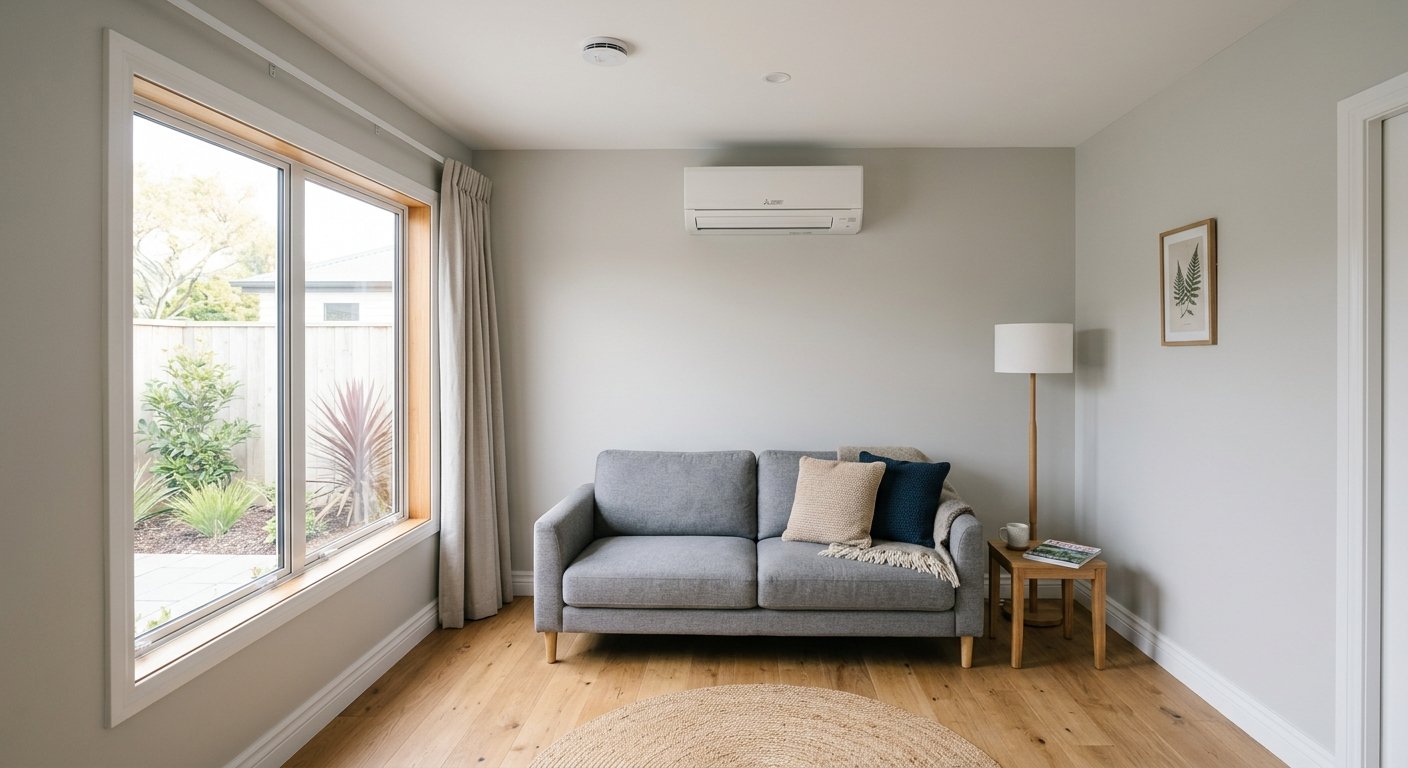
Growing up here since the seventies, I have obviously experienced this throughout most of my life, villas that have not been modernised are generally the worst, in rural areas I have experienced mist in the hallway in the morning and this is just how most of NZ was when I was growing up. However standards have improved significantly, especially with the recent healthy homes changes (in particular to stopping drafts) so this is not very common any more. The downside of reducing the drafts is the reduced airflow, which in New Zealand can result in mould, to combat this just open your windows for a good hour or more daily.
The Healthy Homes Standards, fully mandatory for all rentals from 1 July 2025, require: a fixed heater capable of warming the main living room to 18°C minimum (typically a heat pump); ceiling and underfloor insulation to climate-zone R-values; openable ventilation in all habitable rooms and extractor fans in kitchens and bathrooms; proper drainage and moisture barriers in enclosed subfloors; and draught sealing for gaps larger than 3mm. Penalties reach NZ$7,200 per breach. Every new tenancy agreement must include a Healthy Homes compliance statement and the landlord is responsible for signing off and owning this, it cannot be transferred.
Compliance has improved. The share of renters reporting at least one form of acceptable heating rose from 67% to 88% between 2020 and 2025, according to The Spinoff’s review of the data. Damp and mould remain more common in rental homes than owner-occupied ones in every health district measured, per EHINZ’s 2025 tenure-based analysis of 2023 Census data, though the gap varies significantly by region rather than sitting at one flat national number. On raw cold, a separate BRANZ study monitoring around 260 homes from 2022 to 2025 found renters fared markedly worse than owners: 32% of renters said they could sometimes see their breath indoors in winter, against 13% of homeowners, BRANZ reported in 2026. A compliance statement does not guarantee a warm property. When viewing, check heating sources, look for condensation marks around windows and inspect bathroom ceiling corners for mould staining.
One thing that trips up Northern Hemisphere newcomers: in New Zealand, north-facing rooms get the most sun, not south-facing ones. The sun tracks across the northern sky here. A north-facing bedroom or living room is meaningfully warmer in winter — factor this into which properties you prioritise.
Finding a rental and the flatting option
Trade Me Property (trademe.co.nz/property) is the dominant platform for both full rentals and flatmates-wanted listings. Realestate.co.nz is a secondary option. For flat-sharing specifically, Flatmates.co.nz and NZ Flatmates (nzflatmates.co.nz) are the targeted platforms. Facebook groups — national “Flatmates Wanted NZ” groups and city-specific ones — are active and informal. There are no rental brokers in New Zealand in the way that exist in some Asian and European markets. Tenants search independently.
Flatting — sharing a house or flat with others — is a normal adult living arrangement here, not just a student option. Young professionals flatting into their 30s is unremarkable in Auckland and Wellington. For newcomers, flatting is far cheaper than renting solo, bypasses the need for the full bond up front for the whole property (the head tenant handles that) and provides an immediate social network. The legal position to understand, per Tenancy Services’ guidance on flatting: the head tenant carries all liability to the landlord. Flatmate disputes go to the Disputes Tribunal, not the Tenancy Tribunal, because a flatmate who hasn’t signed the tenancy agreement isn’t a party to it under the Residential Tenancies Act. If the head tenant is evicted, flatmates must also leave. Choose your flat and your head tenant with some care.
For newcomers who have read older accounts of the New Zealand rental market: the peak-COVID era of sixty people at a single open home is largely gone. In 2021 and 2022, competition was such that I would list a room in my Auckland apartment and have to take it down fairly quickly — not because I had found someone, but because the volume of responses was too large to handle respectfully and it was clear from the messages how stressful that market was for the people looking. That level of urgency has eased considerably. The market today still requires a prepared application and some persistence, particularly for newcomers without a local rental history, but the relentless pressure of those years is not what you will encounter now.
What this article cannot tell you
Rental conditions vary significantly at the suburb level and a national or city-level figure may not reflect what you find in your specific target area. The Tenancy Services market rent tool at tenancy.govt.nz gives the most accurate local picture. For a broader picture of what to expect on arrival, including visas, healthcare and costs, see our complete guide to moving to New Zealand.
The 2024 Amendment Act changes to periodic tenancy notice rights were still bedding in as of mid-2026. Tenancy Services guidance is the authoritative current reference. This article does not cover emergency or transitional housing, Kainga Ora social housing, boarding houses (which have a separate legal regime), or short-term accommodation platforms — all of which operate under different rules.
Frequently asked questions
Q: Can I rent in New Zealand without a NZ rental history?
Yes, in practice, though landlords are entitled to treat a local, verifiable reference as stronger evidence — requiring references at all is a lawful selection criterion. What’s unlawful, under the Human Rights Act 1993’s protected grounds, is rejecting you because of your national origin, ethnicity, or religion, or using “no NZ reference” as a pretext for that. A reference from an overseas landlord or property agent is legitimate evidence. The practical difficulty is competitive, not legal — a landlord may prefer a reference they can verify quickly. The workarounds are: overseas landlord references (translated where needed), employer references, overseas bank records and proactively offering a NZ-resident guarantor. The first tenancy is the hardest. A year in university halls is one of the most effective ways to build a NZ reference before entering the private market.
Q: Do I have to pay a letting agent fee when renting in New Zealand?
No. Letting fees charged to tenants have been illegal since 12 December 2018, under the Residential Tenancies (Prohibiting Letting Fees) Amendment Act 2018. Any landlord or agent who asks for payment before a signed tenancy agreement is making an illegal charge, carrying up to $1,000 in exemplary damages. Application fees and credit check fees charged to applicants are also illegal. If you are asked for any payment before a signed agreement, treat it as a red flag — it may be a scam.
Q: Are New Zealand rental properties warm in winter?
Many are not, particularly older properties built before wall insulation became mandatory in 1978. New Zealand has no tradition of central heating, with the exception of a fire in the main living room, we all grew up being told to put a jumper on or use a blanket, this comes from New Zealands history where there was not a lot of money to go around — nowadays the norm is a single heat pump or wood burner in the main living area, with the rest of the house staying cold. The Healthy Homes Standards (fully mandatory from July 2025) have improved heating compliance significantly — from 67% to 88% of rentals between 2020 and 2025, per The Spinoff — but damp and mould remain more common in rentals than owner-occupied homes nationwide, per EHINZ’s 2025 analysis and a 2026 BRANZ study found 32% of renters could sometimes see their breath indoors in winter, against 13% of homeowners. When viewing a property, check the heating source, look for condensation marks around windows and inspect bathroom ceilings for mould. A compliance statement is not a guarantee of a warm, dry home.

