
Most people searching for information about working in New Zealand are not really asking about the job market in the abstract. They are asking something more specific: will I actually be able to find work in my field, will my qualifications count and is the process as complicated as it looks from the outside? The current market has cooled compared with three years ago and it looks different from what the recruitment brochures suggest.
The unemployment rate sat at 5.3% in the March 2026 quarter, according to Statistics New Zealand — easing marginally from 5.4% in December 2025, which was the highest rate since March 2015. That context matters. The post-pandemic surge of 2021 to 2022 created a very different labour market from the one immigrants encounter today. Green List occupations are still short-staffed, but competition in mid-level and lower-skilled roles has increased. Starting with an accurate picture of where the market is right now is more useful than the perennial optimism that surrounds NZ immigration promotion. If you are still weighing the wider move — visas, costs, the first few weeks — our complete guide to moving to New Zealand covers that ground.
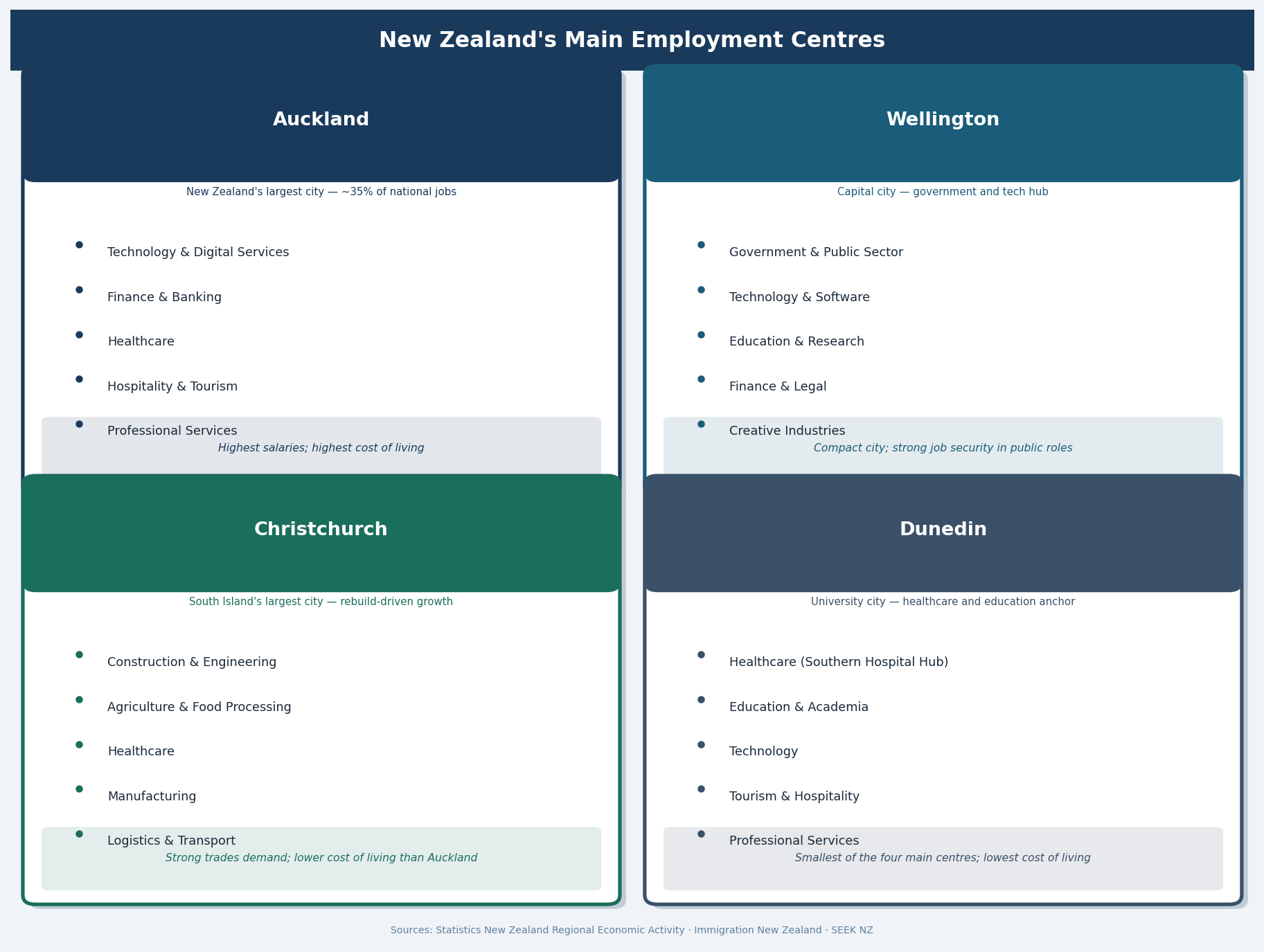
Which Industries Are Hiring Immigrants
Immigration New Zealand identifies healthcare, education, engineering, construction, business and finance, science, energy, health technology, tourism and hospitality and agriculture and forestry as the main sectors where immigrants fill workforce gaps. Of those, healthcare and construction have the most structured pathways, because both are represented heavily on the Green List.
MBIE’s medium-to-long-term employment outlook (published August 2019) projected business services adding roughly 6,100 jobs per year and construction and utilities combined adding around 4,800 per year through to 2028. Both figures predate the pandemic and should be read as directional, not current. Both are dominated by highly-skilled roles. The growth is not evenly spread — a general labourer role and a structural engineer role both sit within “construction,” but their immigration pathways and market conditions are entirely different.
The August 2025 expansion of the Green List added ten trade occupations including metal fabricators, fitters, welders and panel beaters. A March 2026 update clarified chef role classifications and added 47 newly recognised occupations to the National Occupation List (NOL), released in November 2024 to progressively replace ANZSCO, with visa assessments transitioning gradually through 2025–26. If you are checking occupation lists from before late 2024, they may reference codes that are no longer current.
The Green List: What It Actually Means for Working in New Zealand
The Green List is widely misunderstood. Being on the Green List does not mean you can move to New Zealand immediately. It means your occupation is in the list of roles NZ has identified as short-supplied and it unlocks a faster residency pathway — but you still need a job offer from an accredited employer, must meet the role’s specific qualification, registration and pay requirements and must go through a visa application process.
There are two tiers. Tier 1 (Straight to Residence) allows you to apply for permanent residence directly once you have a qualifying job offer. The pay floor for Tier 1 is NZD $35.00 per hour as of March 2026 (the current median wage), or the role-specific rate specified on the list, whichever is higher. Examples of Tier 1 roles include general practitioners, speech-language therapists, structural engineers and construction project managers.
Tier 2 (Work to Residence) requires 24 months of NZ work experience in a qualifying role within a 30-month window before you become eligible for a Work to Residence Visa. Examples include electricians, plumbers, special education teachers and construction equipment operators. The distinction matters enormously when planning your timeline. For occupations off the Green List entirely, the Skilled Migrant Visa points system is the usual residence route instead.
The Accredited Employer Work Visa
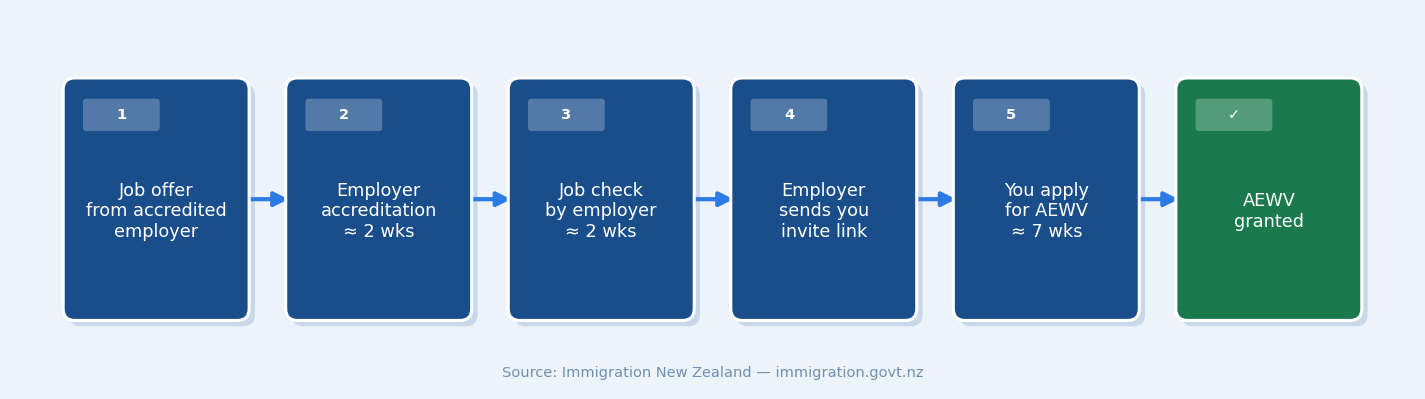
The Accredited Employer Work Visa (AEWV) is the primary work visa for most skilled migrants arriving now. It is a three-step process: the employer gets accreditation from Immigration NZ, the employer completes a job check (demonstrating no NZ resident or citizen could fill the role, for skill-level 4 and 5 roles) and then the worker applies for the visa itself.
The visa costs from NZD $1,540. Immigration NZ’s published wait times show 80% of applications completed within 7 weeks (average 4 weeks), though this varies by sector. The visa can run up to five years depending on the role, skill level and pay. “The AEWV is employer-tied — a constraint many migrants do not anticipate.” If you change employer, job title, or location, you need to apply for a variation. It is not portable the way some other work visas are.
“The median wage requirement that used to apply to AEWV was removed from 10 March 2025.” You will still see references to the $35.00/hour median wage threshold, but that now applies specifically to the Tier 1 Green List Straight to Residence pathway — not to AEWV in general. If you have been researching this for more than a year, the rules have changed.
Under the AEWV, accredited employers are required to provide settlement support to new migrant workers within the first month. This includes information about getting an IRD number, accommodation, transport, cost of living, healthcare access, Citizens Advice Bureau and community groups. In practice, the quality of this support varies considerably between employers.
Whether Your Qualifications Are Recognised
Most international qualifications require an International Qualification Assessment (IQA) conducted by the New Zealand Qualifications Authority (NZQA) before they can be used in a NZ visa application or for occupational registration — a step many immigrants don’t anticipate. Receiving a positive IQA result does not mean you are registered to practise — it means your qualification has been assessed as equivalent to a NZ level on the NZ Qualifications Framework. Occupational registration is a separate process run by each profession’s own body: the Medical Council, Nursing Council, Engineering NZ, Teaching Council and so on.
The IQA fee is NZD $445 for a standard assessment; NZD $610 for a Skill Shortage List assessment; NZD $746 for the Teaching IQA. Third-party document verification can add further costs. The average wait is around ten weeks in total, though NZQA’s own figures show that 90% of complete applications are processed within three weeks (15 business days) once all documentation is submitted. The bottleneck is document completeness, not NZQA’s processing speed. Delays are almost always caused by missing or incorrectly certified documents at submission.
Some qualifications are exempt from the IQA requirement. Engineering degrees accredited by the Washington or Sydney Accords do not need an IQA for visa purposes, though Engineering NZ’s professional registration process is still separate. The SMC Resident Visa also has its own exemption list. Check the current exemptions on the Immigration NZ website before applying, as the list is updated periodically.
Finding a Job: The Realistic Picture
SEEK and Trade Me Jobs are the two main job boards and they are a reasonable starting point. But treating them as the whole picture is a mistake. A significant share of NZ roles — particularly at senior and specialist levels — are filled through recruitment agencies and personal networks before they are ever advertised. “In a small labour market, relationships carry more weight than in larger economies and expat forums consistently report the same pattern.”
Recruitment agencies are widely used for specialist and higher-level roles. Workers pay nothing; agencies are paid by the employer. You can register with multiple agencies simultaneously. Sector-specific resources are useful alongside the general boards: Kiwi Health Jobs for healthcare roles, the Education Gazette for teaching positions and Engineering NZ for engineers.
The government runs Tahatū Career Navigator, which includes CV writing tools, interview preparation resources and job search guidance. It is not a job board but a useful orientation resource, particularly for migrants unfamiliar with NZ CV conventions.
“Many NZ job listings specify “must have the right to work in New Zealand.”” This is not always a firm barrier — it is sometimes a default phrase in job templates — but it does mean offshore applicants may be filtered before interview stage. Expat forum discussions suggest that visiting on a visitor visa (the NZeTA allows stays of up to three months for most nationalities) and doing in-person interviews is considerably more effective than applying remotely from overseas. It signals commitment and removes the visa paperwork uncertainty that some smaller employers are reluctant to take on.
What NZ Workplace Culture Is Actually Like
The flat hierarchy that NZ is known for is structural, not rhetorical. In small to medium firms — which make up the vast majority of NZ employers — employees routinely report directly to senior decision-makers. First-name address with managers is standard at all levels from day one. That adjustment matters for migrants arriving from workplaces with formal hierarchy and it goes in both directions: the informality can read as a lack of seriousness at first, but it is simply a different social register.
Directness is valued but aggressive self-promotion is not. The cultural expectation in NZ is that work speaks for itself more than in some markets. Workers who oversell their expertise or push their seniority strongly can be received poorly, particularly in smaller offices. The flip side is that contributions are generally visible in a way that can be harder to achieve in large bureaucratic organisations.
NZ firms tend to be smaller than equivalents in the UK, Australia, or the United States. Workers typically cover a wider range of tasks than their job title might suggest. This can be an adjustment for specialists used to well-defined role boundaries, but it can also accelerate skill development in ways that narrow role definitions in larger firms do not.
Employment Law: Your Rights as a Migrant Worker
NZ employment law applies equally to migrants and citizens. Employers must offer migrants the same pay and conditions as NZ workers doing the same job. A written employment agreement is legally required for every employee under the Employment Relations Act 2000 and must include the role description, salary, hours, place of work and dispute resolution process. If you are not offered a written agreement, that is a warning sign.
The adult minimum wage from 1 April 2026 is NZD $23.95 per hour ($19.16 for starting-out and training wages). A full-time worker at the adult minimum wage earns approximately NZD $49,800 per year before tax. The previous rate of $23.50 applied to 31 March 2026.
Leave entitlements under the Holidays Act 2003 include four weeks’ paid annual leave after 12 months of continuous employment, ten days’ paid sick leave per year and eleven national public holidays (plus regional anniversary days). Worked public holidays attract time-and-a-half pay and a day in lieu. There is also paid bereavement leave, ten days’ paid family violence leave per year and government-paid parental leave of up to 26 weeks for primary carers.
The Employment Leave Bill introduced in March 2026 proposes a significant reform: accrual of annual leave in hours from day one, rather than the current annual-block structure. This will not come into force until approximately two years after Royal assent, so it does not yet affect new arrivals — but it is coming.
Employers who breach employment standards are placed on a non-compliant employers (stand-down) list maintained by the Labour Inspectorate. An employer on that list cannot support new visa applications for a set period. Before accepting a job offer, check this list on the Immigration NZ website. Exploitation of migrant workers is a criminal offence in NZ — not merely a civil matter.
| Entitlement | Detail | Source |
|---|---|---|
| Adult minimum wage (from 1 Apr 2026) | NZD $23.95/hour | MBIE / employment.govt.nz |
| Annual leave | 4 weeks after 12 months continuous employment | Holidays Act 2003 |
| Sick leave | 10 days paid per year | Holidays Act 2003 |
| Public holidays | 11 national + regional anniversary days; worked = 1.5× + day in lieu | Holidays Act 2003 |
| Family violence leave | 10 days paid per year | Holidays Act 2003 |
| Parental leave (primary carer) | Up to 26 weeks government-paid | Parental Leave and Employment Protection Act |
| KiwiSaver employer contribution (minimum, from 1 Apr 2026) | 3.5% of gross pay | ird.govt.nz |
IRD Numbers and KiwiSaver: The Practical First Steps
Getting an IRD number is a first-week priority. Without one, your employer must deduct tax at the “no notification rate,” which is higher than any standard tax bracket. The process: open a NZ bank account first (you need two forms of ID and proof of address), then apply via ird.govt.nz using form IR742 (the form for non-resident/offshore individuals). If you do not yet have a NZ bank account, the form can be verified in person at an AA branch, NZ Post, or an IRD office. Applications can also be submitted by email to [email protected].
KiwiSaver is NZ’s workplace retirement savings scheme. New employees aged 18 to 65 are automatically enrolled unless they are already members or fall into exempt categories. Following the Budget 2025 changes, the default employee and minimum employer contribution rates both rose from 3% to 3.5% of gross pay from 1 April 2026 (rising again to 4% from 1 April 2028). Many migrants on temporary visas are enrolled without realising they are receiving a compulsory employer contribution — which is, effectively, additional compensation on top of salary.
For how these deductions fit into a full monthly budget, see our cost of living in New Zealand guide. The practical consideration for temporary visa holders is that KiwiSaver funds are normally locked in until age 65. However, if you emigrate permanently from NZ (other than to Australia), you can apply to withdraw your balance. This is not automatic — it requires an application and a statutory declaration. Check the current rules on ird.govt.nz, as the eligibility conditions for temporary visa holders are specific and have changed over time.
Unions and Collective Rights
Union membership in NZ stood at 14.5% of the employed labour force as of March 2024, according to MBIE’s annual union membership returns. That is low by European standards but represents meaningful collective bargaining power in healthcare, education and some construction trades. The right to join a union is protected by law. Employers cannot prevent workers from contacting or joining a union and all workers — including migrants on temporary visas — have the same union rights as NZ citizens.
What This Cannot Tell You
This article covers the general framework. It cannot tell you whether your specific occupation — with your specific qualifications, from your specific country — will be assessed as meeting the requirements for the visa pathway you have in mind. That requires an assessment against the current Green List or NOL, your NZQA IQA result (if needed) and where relevant the registration requirements of your profession’s own body. Immigration NZ’s online tools and an immigration adviser are the right resources for that level of specificity.
It also cannot predict how the labour market in your field will look by the time you arrive. The figures in this article are from March to June 2026. The Green List and NOL are reviewed annually. The AEWV rules have changed twice in three years. Check Immigration NZ directly for the current version of anything that governs your visa pathway.
Finally, the community sentiment in this article draws on expat forum discussions that skew toward skilled tech and engineering migrants from the 2014 to 2020 period. Some of that advice predates the AEWV (introduced 2022) and reflects a different visa landscape. The general networking and interview advice remains valid; the specific SMC points mechanics discussed in those threads may not.
Frequently Asked Questions
Q: Can I apply for jobs in New Zealand before I have a visa?
Yes and for many skilled roles it is the required sequence — the Accredited Employer Work Visa requires a job offer before you can apply for the visa itself. The challenge is that many NZ employers, particularly smaller ones, are reluctant to sponsor visa applications for candidates they have not met. Expat forums consistently report that visiting on a visitor visa (the NZeTA allows stays of up to three months for most nationalities) to interview in person significantly improves the outcome. You can also file a visa application while in NZ on a visitor visa without leaving the country.
Q: Are my overseas qualifications recognised in New Zealand?
Most international qualifications require an International Qualification Assessment (IQA) from NZQA before they can be used in a visa application or for professional registration. The assessment takes an average of ten weeks in total and costs NZD $445 for a standard assessment (NZD $610 for a Skill Shortage List assessment), though the bottleneck is almost always document completeness rather than processing time. A positive IQA result establishes level equivalence on the NZ Qualifications Framework — it is not the same as occupational registration, which is a separate process with your profession’s own registration body. Some qualifications are exempt, including engineering degrees accredited by the Washington or Sydney Accords.
Q: What are my rights as a migrant worker in New Zealand?
NZ employment law applies to all workers equally, regardless of visa status. Your employer must offer you the same pay and conditions as an NZ citizen doing the same role, provide a written employment agreement and pay at least the adult minimum wage (NZD $23.95 per hour from 1 April 2026). Exploiting migrant workers is a criminal offence. Before accepting a job offer, you can check whether an employer appears on Immigration NZ’s non-compliant employers list — employers on that list cannot support new visa applications. If you believe your rights are being breached, Employment NZ and the Labour Inspectorate are the right contacts.
Sources
- Statistics New Zealand — Unemployment rate at 5.3 percent in the March 2026 quarter
- MBIE / Employment New Zealand — Minimum wage rates and types
- Employment New Zealand — Leave and holidays (Holidays Act 2003)
- Employment New Zealand — What a written employment agreement must contain
- Immigration New Zealand — Accredited Employer Work Visa
- Immigration New Zealand — Employer accreditation, job check and AEWV wait times
- Immigration New Zealand — Changes to the AEWV and median wage (2025 reforms)
- Immigration New Zealand — Accredited employer requirements to help settle AEWV workers
- Immigration New Zealand — Immigration stand-down (non-compliant employers) list
- Immigration New Zealand — Main job sectors in New Zealand
- Immigration New Zealand — Green List pathway to residence
- Immigration New Zealand — Green List roles — Tier 1 and Tier 2 detail
- Immigration New Zealand — Ten trades occupations added to the Green List Work to Residence pathway (August 2025)
- Immigration New Zealand — New NOL occupations and annual median wage increase (March 2026)
- Immigration New Zealand — NZeTA (NZ Electronic Travel Authority)
- Immigration New Zealand / NZQA — Check if you need an International Qualification Assessment (exemptions)
- NZQA — Apply for an International Qualification Assessment
- NZQA — IQA fees
- MBIE — Medium to Long-Term Employment Outlook: Looking Ahead to 2028 (August 2019)
- Companies Office / MBIE — Annual union membership returns
- MBIE — Employment Leave Bill (Holidays Act reform)
- Inland Revenue (IRD) — IRD number application for non-residents/offshore individuals (IR742)
- Inland Revenue (IRD) — How KiwiSaver works
- Inland Revenue (IRD) — KiwiSaver changes (contribution rate rising to 3.5%, then 4%)
- Inland Revenue (IRD) — Getting my KiwiSaver savings when I move overseas

