
You typed “New Zealand digital nomad visa” into a search box and the results contradict each other. Some pages announce that New Zealand launched one in January 2025. Others insist no such thing exists. A few outlets ran headlines about a “new long-term working visa.” All of them are describing the same policy change and the disagreement comes down to what that change actually was. If you are trying to work out whether you can spend a few months living in New Zealand while keeping your overseas job, the good news is that the answer is now yes. The challenge is that it does not work the way the phrase you searched for suggests.
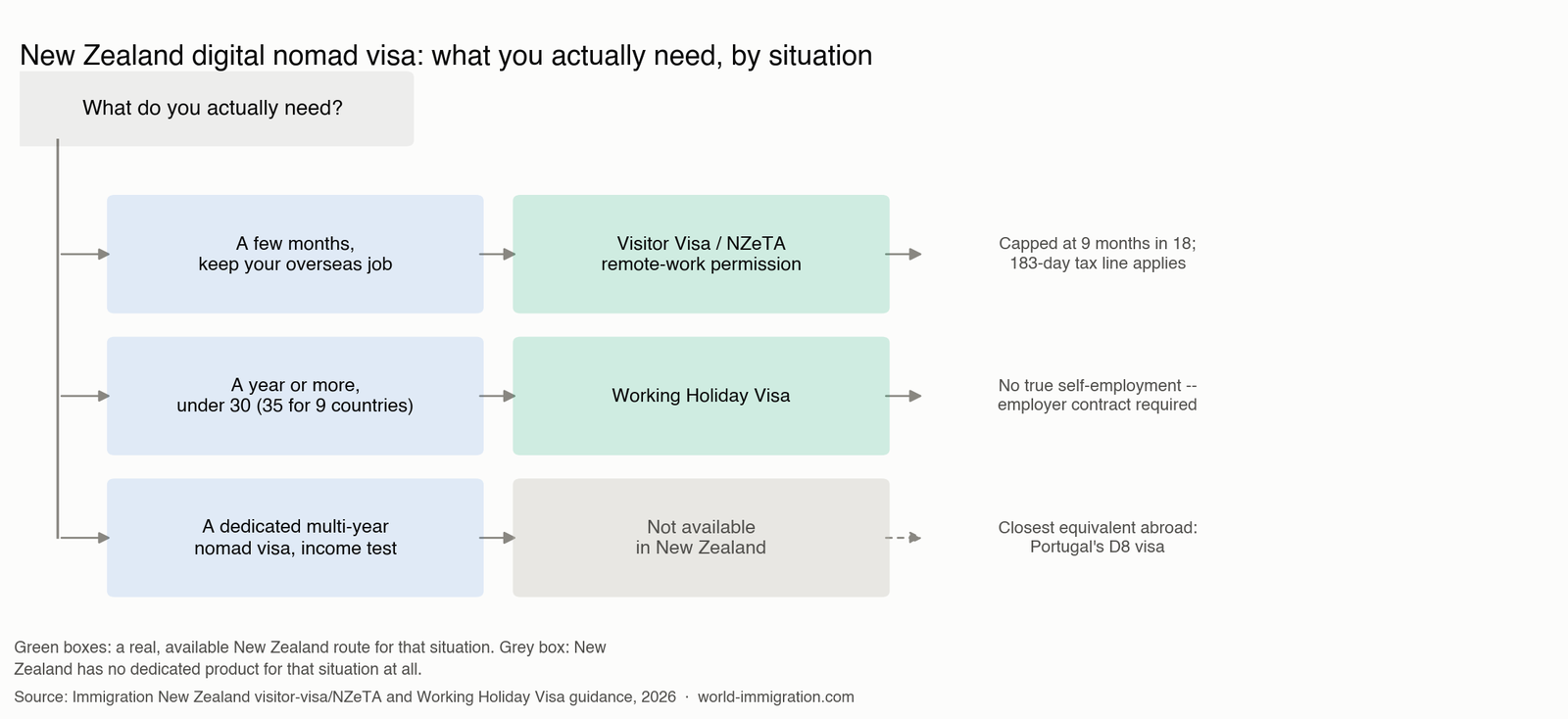
At time of writing, New Zealand has no dedicated digital nomad visa. There is no visa category by that name, no separate application and no minimum-income threshold to clear. What changed on 27 January 2025 is minor and, for most people, entirely sufficient: Immigration New Zealand added a remote-work permission to the ordinary Visitor Visa and to the NZeTA (the electronic travel authority most visa-waiver nationalities use). It is a condition riding on a tourist visa, not a new visa type. This article separates what the policy lets you do from what people assume it lets you do and points you to the constraints that actually matter. For the wider set of ways to live and work here, the moving to New Zealand hub maps the full range.
Why “New Zealand Digital Nomad Visa” Returns Contradictory Answers
Almost everyone typing that phrase is really asking one of two questions. The first is “does New Zealand have a dedicated visa like Portugal’s, with an income test and a multi-year stay?” The answer to that is no. The second is “can I legally work on my laptop for my overseas employer while I am visiting New Zealand?” The answer to that, since 27 January 2025, is yes, under specific conditions. The pages that say a visa exists and the pages that say it does not are usually both talking about the same January 2025 change, just labelling it differently.
The labelling is not helped by the coverage. Several outlets described the change as a new working visa when it was reported. Aggregator and travel sites file it under a “New Zealand Digital Nomad Visa” heading for search reasons, even where their own body text concedes no such visa exists. Inland Revenue (New Zealands Tax Department), oddly, uses the term itself. Its regulatory paperwork on the tax side is literally titled “Tax treatment of digital nomads and other visitors,” which lends the phrase a semi-official ring that Immigration New Zealand’s own visa pages never give it. The term has stuck to the policy from the outside and the policy has quietly declined to adopt it.
What the 27 January 2025 Policy Actually Allows
From 27 January 2025, Immigration New Zealand updated the standard conditions attached to Visitor Visas and NZeTAs so that visitors are automatically permitted to work remotely for an employer or client based outside New Zealand. That covers tourists, people visiting family and partners or guardians on longer visitor visas. It applies to applications received from that date forward, so it is not retrofitted onto a visa granted before it.
Immigration New Zealand defines the permitted activity as work done “for gain or reward for a company, employer or client that is not in New Zealand.” Its own examples are concrete: answering emails and calls, coding and testing, writing reports, attending meetings or giving presentations to colleagues overseas and creating social-media content for gain (as long as you are not promoting a New Zealand business). The permission applies equally to salaried employees, the self-employed and freelancers or contractors, provided the party paying you sits offshore. There is no cap on how much of this work you do while your visa is valid and there is no separate permit, endorsement, or notification to lodge. It is baked into the visa from the moment it is granted.
The exclusions are where you might trip up. Immigration New Zealand’s own guidance rules out work for a New Zealand employer, supplying goods or services to a person or business located in New Zealand and any work that requires you to be physically present at a New Zealand workplace. The subtler constraint is that remote work cannot be the primary reason for the visit. Every Visitor Visa still requires a genuine visitor purpose, tourism, seeing family, attending business meetings, with the laptop work sitting alongside that, not standing in for it. Immigration New Zealand’s own remote-work page does not spell this out in so many words, but international tax advisers who track the policy closely, including KPMG and EY, both read the condition the same way: remote work has to stay incidental to a genuine visitor purpose, not become the purpose itself. In practice that distinction rarely matters to a short-stay visitor, but it is the line the policy draws and building a months-long stay whose only purpose is remote work isn’t covered.
The Constraint That Actually Limits You: Visitor-Visa Duration
Here is the point the “no cap on remote work” wording obscures. The permission has no time limit of its own, but the visa carrying it does and that is what caps your stay. A remote-work allowance riding on a tourist visa can only last as long as the tourist visa lasts.
A multiple-entry Visitor Visa allows up to six months in any 12-month period. A single-entry Visitor Visa can run up to nine months across an 18-month period, but it expires the moment you leave the country, with no re-entry. The absolute ceiling across visitor-visa types is nine months in an 18-month period. An NZeTA is shorter still: it commonly allows up to three months per visit for most nationalities (British passport holders can get up to six), is valid for two years of multiple entries and carries its own annual limit in the region of six months within any 12 months. Those NZeTA figures move around by nationality, so confirm your own on immigration.govt.nz before planning around a specific number.
“No digital nomad visa” does not translate to “unlimited remote work from New Zealand.” A year-plus of laptop life from a lakeside town is not available through this route at all. The ceiling is measured in months, not years and it applies before the tax question below even enters the room. Anyone whose plan needs a long, settled base overseas is describing a different kind of visa than the one New Zealand offers.
The Tax Trap: Immigration Permission Is Not Tax Clearance
This is the single most important practical point and it is easy to miss because it lives in a different system entirely. The remote-work permission is administered by Immigration New Zealand. Your tax position is administered by Inland Revenue. They do not talk to each other for your benefit and reading “you can legally work remotely on a visitor visa” as “and there are no tax consequences” is the mistake most likely to cost a remote worker money.
New Zealand’s general test is the 183-day rule. Spend more than 183 days in New Zealand across any 12-month period and you become a New Zealand tax resident. Three details make this harder than it first looks. Parts of days count as whole days, including your arrival day and your departure day. The 183 days do not have to be consecutive. And once you cross the threshold, tax residency backdates to the first of those days, not the day you passed the threshold. Trigger it and Inland Revenue can treat you as resident from the start of the count.
Before 1 April 2026, a couple of reliefs ease this for short stays. If your visit is 92 days or fewer in a 12-month period and your remote income is already taxed at home, that income is not subject to New Zealand tax. If you are tax resident in one of the 40-plus countries New Zealand holds a double tax agreement with, that window stretches to as much as 183 days, though this route is built around employees under the standard treaty wording and self-employed contractors sit in murkier ground under the older rules.
From 1 April 2026, a new “non-resident visitor” tax status comes into effect, created specifically for remote workers who would otherwise trip the 183-day test. It exempts qualifying people from New Zealand income tax on employment or contracting income earned remotely for an offshore employer or client. To qualify, broadly, you must be in New Zealand for 275 days or fewer in any 18-month period, not have been a New Zealand tax resident immediately beforehand, not be drawing a Family Scheme entitlement, be lawfully present on a valid visa and be tax resident in a jurisdiction whose income tax is substantially similar to New Zealand’s. This is very recent law, enacted in the closing days of March 2026, so treat the detail as provisional and confirm it is in force and unchanged before you lean on it.
One nuance keeps the 275-day figure in proportion. It is more generous than the 183-day general test, but it does not extend how long you can physically stay, because the immigration duration limit, nine months in an 18-month period on a visitor visa and less on an NZeTA, runs out well before 275 days. Nobody legitimately reaches 275 days in New Zealand on a visitor visa before the visa itself expires. The 2026 reform stops medium-length visitors from being caught in an income-tax net they never intended to fall into — it does not open a longer stay. The visa, not the tax code, is what limits your time on the ground.
Why People Expect a Dedicated Visa: the Portugal D8 Comparison
The reason “New Zealand digital nomad visa” feels like it should return a clean answer is that plenty of other countries do offer exactly that. Portugal’s D8 is the tidy comparison. It is a named visa category with a published minimum income requirement, in the region of €3,400 to €3,700 a month depending on the year, pegged to a multiple of the Portuguese minimum wage. It comes in two forms: a temporary-stay version lasting a year and renewable and a long-stay residence-permit version that counts toward Portuguese permanent residency after five years, though a 2026 reform to Portugal’s nationality law pushed the citizenship timeline out to ten years for most non-EU applicants (seven for EU/CPLP nationals). Spain, Croatia, Costa Rica, Thailand and others run similarly structured schemes with their own income tests and durations.
New Zealand offers none of that architecture. No income floor, no dedicated application, no residence pathway, no multi-year stay, just a work permission attached to an ordinary short-stay tourist visa. If your mental model is the D8, the New Zealand arrangement will feel like it is missing most of the visa. That is because it is a different instrument doing a smaller job: it legalises the laptop and stops there. Having watched remote work go from a fringe arrangement to a default over my years managing IT teams, I can say the New Zealand approach fits how a lot of remote work now actually happens, short stints, keep the offshore job, rather than the “relocate your tax life to a new country” model the dedicated visas are built around.
The Longer-Stay Option for Under-30s: Working Holiday Visa
If a few months on a visitor visa is not enough and you are young enough to qualify, the Working Holiday Visa is the pathway to a longer stay. Immigration New Zealand’s own eligibility page puts the standard age range at 18 to 30, “but 18 to 35 in a select few countries,” which country-specific INZ pages confirm includes Argentina, Canada, Chile, the Czech Republic, Finland, Hungary, Slovakia, the United Kingdom and Uruguay. It runs up to 12 months for most nationalities, up to 23 months for Canadians and up to 36 months for British citizens. It needs no job offer and costs from NZD $770 according to visa-fee trackers, though the exact fee varies by citizenship and where you apply from, so check Immigration New Zealand’s own fee lookup tool for yours. Our New Zealand working holiday visa guide covers the country list, quotas and application in full.
The Working Holiday Visa was not built as a remote-work visa and its work conditions are more restrictive than the visitor-visa permission in one decisive way. Immigration New Zealand’s wording requires you to work for an employer under an employment contract or a contract for services and it states outright that you cannot operate a business as an owner. That rules out true self-employment: a sole trader or freelancer running their own book of overseas clients does not fit the condition the way they do under the visitor-visa remote-work rule. The Working Holiday Visa page does not expressly restrict where your employer is based, so a contract-for-services arrangement with an offshore client is not spelled out as banned, but it is untested ground compared with the visitor-visa policy, which states the overseas-employer allowance explicitly.
So the candid framing is this, the Working Holiday Visa gives a much longer stay than any visitor-visa remote-work arrangement and plenty of holders do some freelance or remote work informally alongside local casual jobs. But it was designed for working in New Zealand, the holiday-plus-local-work model, not as a sanctioned channel for sustained remote work for an overseas employer. If you want a year or more of New Zealand-based remote work, do not assume the Working Holiday Visa gives you the same explicit legal cover the 27 January 2025 visitor-visa policy does. It is a different visa with a different purpose and using it as a de facto long-stay nomad visa carries more ambiguity, not less.
What This Cannot Tell You
This article maps the remote-work rules as they stand in mid-2026. It cannot tell you the exact NZeTA duration and annual limit for your specific nationality, because those vary by passport and Immigration New Zealand adjusts them; check your own on immigration.govt.nz before you count on a figure. It cannot tell you how your home country’s tax authority will treat income you earn while sitting in New Zealand, because that depends on your own residency, the relevant double tax agreement and rules outside New Zealand’s control. And it cannot give you a settled reading of the 1 April 2026 non-resident visitor tax status while that law is this new, so confirm its current status and detail before relying on it.
It also cannot tell you whether a contract-for-services arrangement on a Working Holiday Visa with an overseas client would survive scrutiny, because Immigration New Zealand has not published its own position on employer location under that visa and that grey area is exactly why the visitor-visa route is the cleaner one for remote work. The figures and rules here draw on Immigration New Zealand and Inland Revenue’s own published pages and the enacting tax legislation. For a stay whose tax or immigration position is complicated, licensed immigration advice is regulated in New Zealand and searchable on the Immigration Advisers Authority register and tax questions are best put to an accountant who handles cross-border residency.
Frequently Asked Questions
Q: Does New Zealand have a digital nomad visa?
No. There is no visa category by that name, no dedicated application and no minimum-income requirement. What exists instead, since 27 January 2025, is a remote-work permission automatically attached to the ordinary Visitor Visa and NZeTA. It lets visitors work remotely for an employer or client based outside New Zealand while they are here, but it is a condition on a tourist visa rather than a separate visa type and it does not offer the multi-year stay or residence pathway that dedicated nomad visas elsewhere do.
Q: How long can I work remotely from New Zealand as a visitor?
There is no cap on the amount of remote work, but your stay is limited by the visa carrying the permission. A multiple-entry Visitor Visa allows up to six months in any 12-month period and the overall ceiling across visitor-visa types is nine months in an 18-month period. An NZeTA is typically shorter, commonly up to three months per visit. A long-term stay of a year or more for remote work is not available this way at all.
Q: Do I have to pay New Zealand tax if I work remotely while visiting?
Possibly and this is separate from the visa permission. Spend more than 183 days in New Zealand in any 12-month period and you can become a New Zealand tax resident, backdated to the first of those days. Shorter stays may be covered by the sub-92-day exemption or a double tax agreement and from 1 April 2026 a new non-resident visitor status can exempt qualifying remote workers who stay 275 days or fewer in an 18-month period. Because the immigration duration limit is well under 275 days anyway, most visitors are capped by the visa long before the tax threshold matters. Take advice on your own position, since it depends on your home-country residency.
Q: Can I work for a New Zealand company on the visitor remote-work permission?
No. The permission covers work for an employer or client based outside New Zealand only. Working for a New Zealand employer, supplying goods or services to a person or business in New Zealand, or doing any work that requires you to be physically present at a New Zealand workplace all fall outside it. Local work of that kind needs a work visa, such as the Accredited Employer Work Visa, which the moving to New Zealand hub covers.
Sources
- Immigration New Zealand — Working remotely in New Zealand on a visitor visa
- Immigration New Zealand — Working remotely from New Zealand (news centre announcement)
- Immigration New Zealand — Visitor Visa
- Immigration New Zealand — New Zealand Electronic Travel Authority (NZeTA)
- Immigration New Zealand — Who can apply for a Working Holiday Visa
- Immigration New Zealand — Fees, decision times and where to apply
- Immigration New Zealand — Genuine intentions to visit or work in New Zealand
- Inland Revenue — Tax residency status for individuals
- Inland Revenue — Double tax agreements (DTAs)
- Inland Revenue — Tax for non-resident taxpayers
- Inland Revenue — Non-resident employees (92-day short-term exemption)
- Inland Revenue Tax Policy — Tax treatment of digital nomads and other visitors (Regulatory Impact Statement)
- Portugal Ministry of Foreign Affairs — Type of Visa (D8 remote work / digital nomad visa)
- Portugalist — Portuguese Citizenship Now Takes 10 Years
- Forbes — Digital Nomad Visas — New Zealand Launches New Long-Term Working Visa
- KPMG — GMS Flash Alert 2025-031: Introduction of Remote Work Provisions on New Zealand Visitor Visas and NZeTAs
- EY — New Zealand announces new visa conditions for working remotely

