
The question that brings most people to the Skilled Migrant Category is, ‘Do I actually have enough points?’ You have read the Immigration New Zealand page, added up what you think you qualify for, landed somewhere around three or four and now you are not sure whether that is close or nowhere near. It is an anxious place to be, because the number decides everything and the arithmetic is easy to get wrong. This article is about getting that arithmetic right, so you know where you actually stand before you spend money on an application.
The short version: the New Zealand skilled migrant visa runs on a single threshold of six points and the most common mistake is assuming the different ways of earning points add together. They mostly do not. Most people who think they have six actually have three or four, because they have counted a degree and an income and a job as separate contributions when the rules treat two of those as the same slot. Below is how the points combine, three worked examples with the maths done properly and what to do if you come up short.
This piece expands on the Skilled Migrant Category section in our wider New Zealand work visa guide and sits under the broader moving to New Zealand hub if you are still weighing the country as a whole. The figures here come from Immigration New Zealand’s own Skilled Migrant Category pages, current to mid-2026.
The New Zealand Skilled Migrant Visa: The Six-Point Threshold and Why It Is Not a Race
Since the system was overhauled in October 2023, Skilled Migrant Category eligibility is one absolute number: six skilled resident points. There is no ranking, no score that rises and falls with demand and no quota competing you against other applicants. You either reach six points or you do not. If you do, you receive a direct Invitation to Apply. That is the entire test at this stage and it is a far calmer proposition than the pool system it replaced (more on that below).
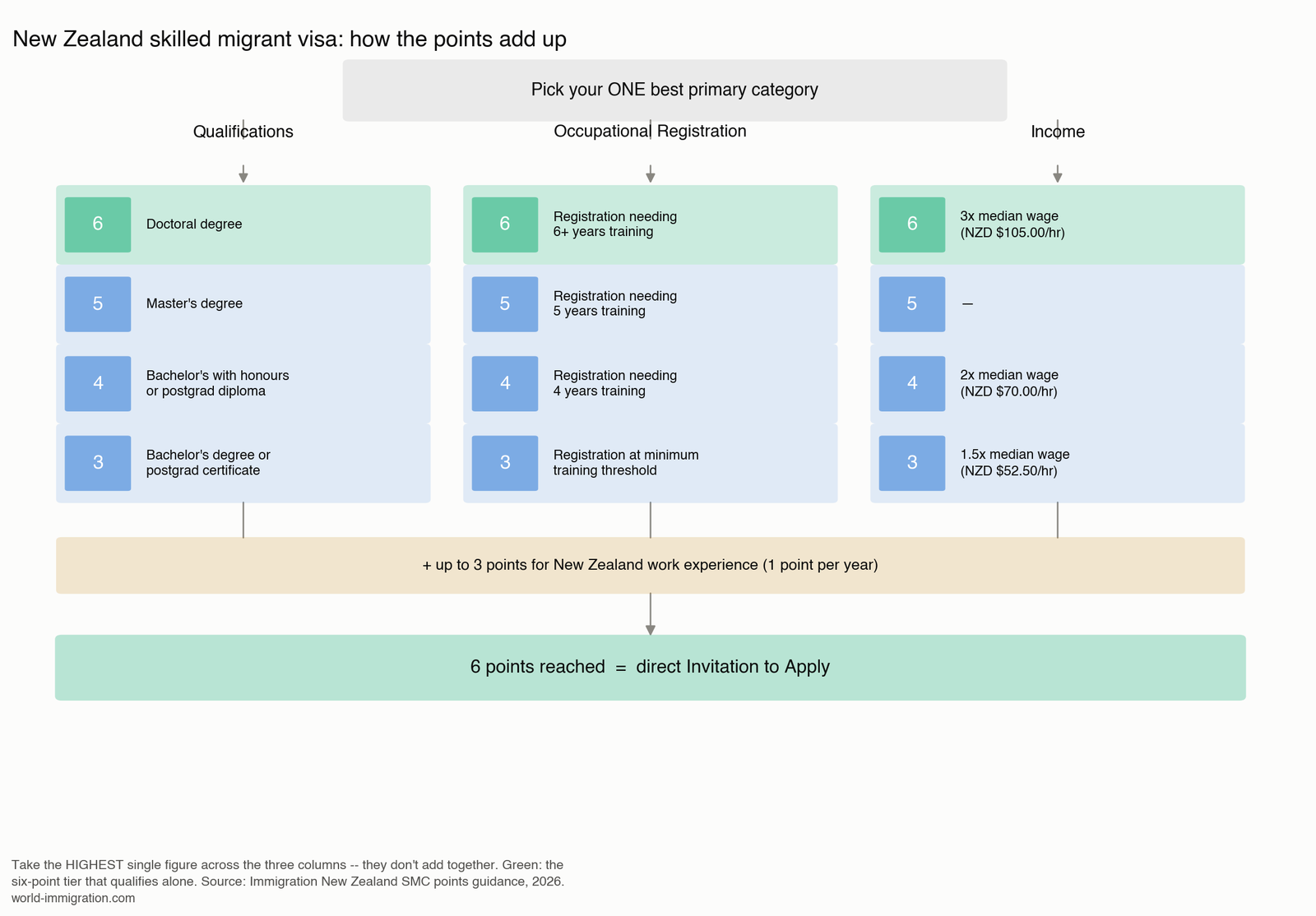
Where it gets misread is in how the six are built. Points come from exactly two sources and only one of them is a menu you choose from:
- One primary category — whichever single route of the three (occupational registration, qualifications, or income) you qualify for and scores you highest. You claim one. These three do not add to each other, per Immigration New Zealand’s own Skilled Migrant Category rules.
- New Zealand work experience — one point per year of skilled work actually done in New Zealand, capped at three points, added on top of your primary category.
So the mechanism is: pick your best primary category, then add up to three points of local work experience. That is it. A doctoral degree does not stack onto a high income which does not stack onto a professional registration. You take the strongest one and build from there. This single rule is where most self-calculations go wrong and getting it right usually lowers a person’s actual total rather than raising it, which is uncomfortable but better learned now than at the application desk.
The Three Primary Categories and Their Point Values
Here are the three primary categories side by side, with the current (pre-24 August 2026) point values. Read down whichever column applies to you, take the highest single figure you can substantiate with evidence and that is your primary-category score before any work-experience points.
| Points | Qualifications | Occupational registration | Income (multiple of median wage) |
|---|---|---|---|
| 6 | Doctoral degree | Registration requiring 6+ years of training | 3x median (NZD $105.00/hr) |
| 5 | Master’s degree | Registration requiring 5 years of training | — |
| 4 | Bachelor’s with honours, or a postgraduate diploma/certificate | Registration requiring 4 years of training | 2x median (NZD $70.00/hr) |
| 3 | Bachelor’s degree, or a postgraduate certificate | Registration at the minimum training threshold | 1.5x median (NZD $52.50/hr) |
Source: Immigration New Zealand — Pay rates for the Skilled Migrant Category Resident Visa, current as at 9 March 2026.
The median wage sits at NZD $35.00 per hour as at March 2026, which is where those income multiples come from.
First, look along any row. A bachelor’s degree and an income at 1.5 times the median both sit on the three-point row. They are the same tier. Holding both does not give you six points, because they are competing entries in the same primary-category slot, not two separate contributions. To reach six points on income alone you need three times the median wage, which is NZD $105.00 an hour. That is a senior-executive or specialist-contractor pay band, well above what most skilled roles pay, so income is rarely the factor that carries an ordinary applicant over the line by itself.
Second, the exact training-year cutoff for the lowest registration tier varies by profession and the figure has shifted with the 2026 rule changes, so treat “minimum training threshold” here as a placeholder and check the specific number for your occupation against INZ’s operational instructions rather than assuming a flat value.
On the income column specifically, there is a separate trap I will come back to under job requirements: the income points thresholds are not the same test as the job’s minimum wage floor, even though the number $52.50 happens to appear in both. Keep them mentally separate for now.
October 2023: The Pool Is Gone
If you have read older advice about the Skilled Migrant Category, you will have seen references to a 180-point ranking, an Expression of Interest pool and periodic selection draws. Set all of that aside. It described the system as it worked until 16 August 2023, when the final selection round under the old pool ran.
Under that arrangement, you scored your profile, submitted an Expression of Interest and sat in a pool competing against everyone else in it. Immigration New Zealand drew from the top down, so a fully qualified applicant could wait a long time, or indefinitely, if the pool was crowded with higher scorers. From the new settings in October 2023, that pool was scrapped. The six-point threshold replaced it as a flat pass-or-fail. Meet six points and the Invitation to Apply issues directly. There is no draw to wait for and no one else’s score to beat.
This is the single most consequential difference between current reality and the large volume of forum posts, blog articles and immigration-agent pages online that still describe the ranking-and-pool model. If a source is talking about your “EOI score” as a competitive ranking, it predates October 2023 and should be read as history, not instruction.
What Changes on 24 August 2026
Three sets of changes land together on 24 August 2026, confirmed across several Immigration New Zealand news-centre releases. They do not tear up the points system, but they widen it in ways that materially help two groups: ordinary degree-holders and tradespeople the points route never suited.
Two new pathways that sit alongside the points calculation
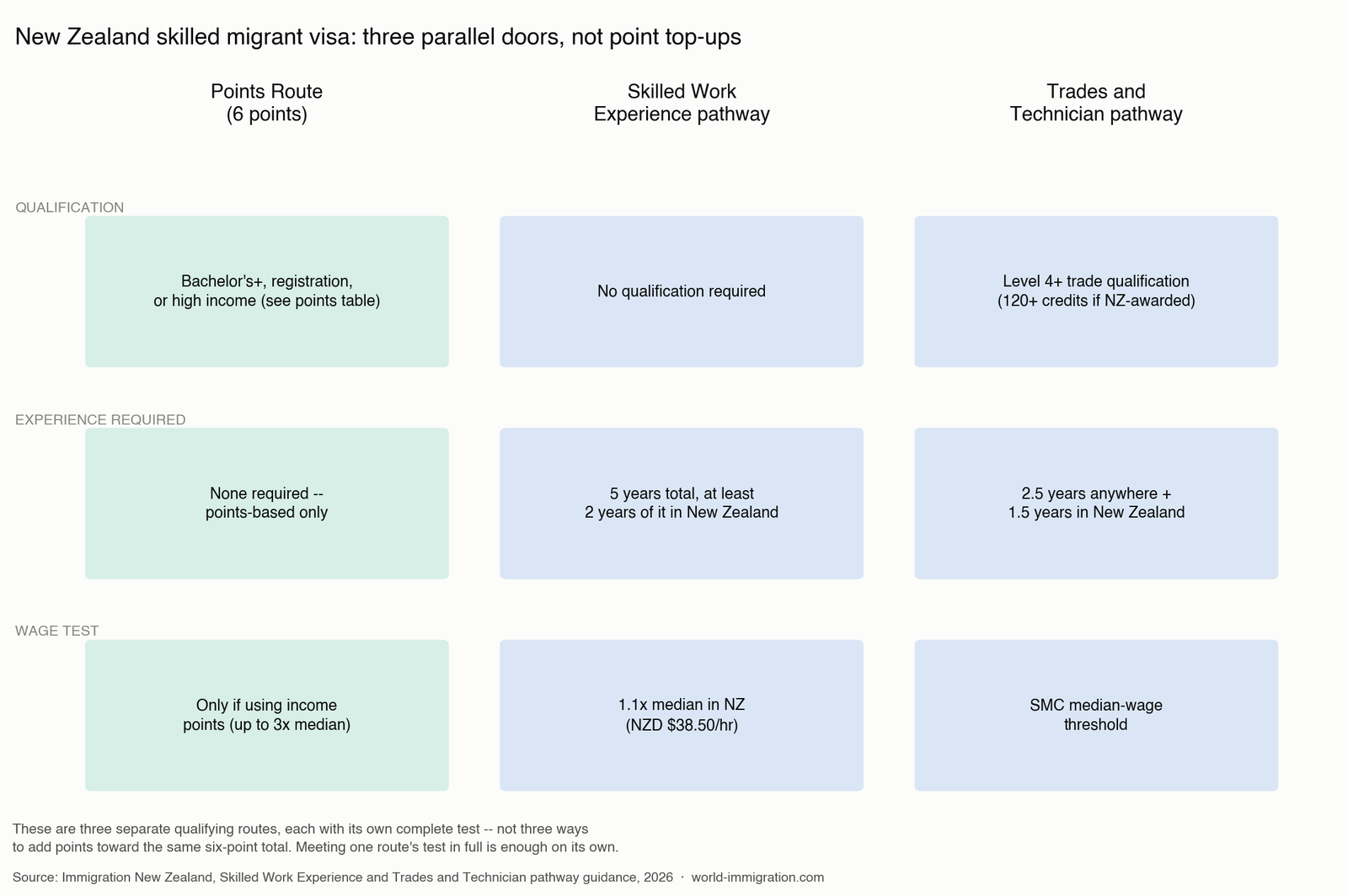
The first change adds two parallel qualifying routes. These are not new ways to earn points inside the six-point sum. They are separate doors with their own experience-and-wage tests and you do not need to reach six points to use them:
- Skilled Work Experience pathway — for people in ANZSCO skill level 1 to 3 roles. It needs at least five years of directly relevant work experience in total, of which at least two years must be in New Zealand, paid at a minimum of 1.1 times the median wage (NZD $38.50 an hour). The New Zealand portion has to fall within the four years immediately before you apply.
- Trades and Technician pathway — for occupations on INZ’s specific eligible-roles list of around 150 trades spanning construction, automotive, electrical, plumbing and HVAC, metalwork and related fields. It needs a Level 4 or higher qualification (120-plus credits if awarded in New Zealand; overseas qualifications are not held to the credit count), at least 2.5 years of relevant post-qualification experience gained anywhere within the previous ten years, plus a further 1.5 years of that experience specifically in New Zealand, paid at the SMC median-wage threshold.
Both pathways exclude self-employment as qualifying experience. The reason they matter is that a tradesperson without a bachelor’s degree, a New Zealand professional registration, or a high income was often never able to assemble six points through the ordinary route at all. These pathways give that person a route that is built around what they do have: a trade qualification and years on the tools.
A stronger qualification score and a New Zealand study premium
The second change lifts the value of qualifications and introduces a deliberate incentive to study in New Zealand:
- An overseas or general bachelor’s degree rises from three points to four.
- A qualification completed in New Zealand is generally worth one point more than the identical qualification completed overseas. The confirmed exception is doctoral degrees, which stay at six regardless of country.
- The clearest case: a New Zealand master’s degree, held with a supporting bachelor’s, reaches the full six points on its own — enough to qualify with no local work experience and no elevated income. The same master’s completed overseas is worth five, one short on its own.
There is also a tightening to note alongside the boost: applicants claiming points for Level 8 or 9 qualifications will generally need a supporting bachelor’s degree too, with the five-point New Zealand master’s-without-bachelor’s variant as the stated exception. So a postgraduate certificate on its own does not automatically clear the bar.
Wage-threshold timing moves in your favour
The third change is that until now, the wage threshold you had to meet could effectively track the median wage as it rose, so a person part-way through their qualifying years risked being retroactively disqualified if the median moved up. From 24 August 2026, the applicable threshold is generally the one in effect when you started accruing the relevant skilled work experience, not the possibly higher figure in force on application day. A grace period of a few months applies around the visa-grant date if work starts shortly after.
A few smaller items ride along with the same date. English test results become valid for five years instead of two for applicants holding an eligible occupational registration. Accountants who can do Qualified Statutory Accountant work in New Zealand and hold CPA Australia membership become eligible for the registration category. And looking further ahead, from 2027 an Accredited Employer Work Visa holder who needs up to twelve more months of skilled experience to reach SMC eligibility will be able to extend that visa to cover the gap — announced, but not yet live, so plan around the 2026 rules rather than that.
Worked Examples: How the Points Actually Add Up
These are illustrative sums using the confirmed point values above. They are the arithmetic, not case studies of named individuals and they are deliberately built around the profile most people arrive with: an overseas degree and no professional registration.
Example 1 — Overseas bachelor’s degree, no New Zealand work yet (current rules)
- Qualification, overseas bachelor’s degree: 3 points
- No registration claimed, no elevated-income job
- New Zealand work experience, 0 years: 0 points
- Total: 3 points. Three short of the threshold. No Invitation to Apply.
This is where the “one primary category” rule bites hardest. If this person also earns 1.5 times the median wage, they are still on three points, because income at that level and the bachelor’s degree are the same tier, not two. Adding a $52.50-an-hour salary to a bachelor’s degree changes nothing about the total.
Example 2 — The same person, two years into a New Zealand job (current rules)
- Qualification: 3 points
- New Zealand work experience, 2 years: 2 points
- Total: 5 points. Still one short.
Two full years in a qualifying New Zealand job is not quite enough on its own for a bare bachelor’s-degree holder under today’s rules. A third qualifying year takes work experience to its three-point cap and closes the gap exactly: 3 plus 3 equals 6. So under current settings, this profile is looking at three years of local skilled work, not two, before an application is viable.
Example 3 — The same profile, applying from 24 August 2026
- Qualification, overseas bachelor’s degree: 4 points (up from 3)
- New Zealand work experience, 2 years: 2 points
- Total: 6 points. Qualifies.
The single extra qualification point brings this very common profile (overseas bachelor’s degree, no registration, ordinary skilled pay) across the line a full year earlier than under today’s rules. For most ordinary applicants, this is the most concrete effect of the 2026 changes and it gets far less attention than the trades pathways because it is undramatic. It is also the change most likely to affect the person reading this.
Example 4 — New Zealand master’s degree, from 24 August 2026
- Qualification, New Zealand master’s degree held with a supporting bachelor’s: 6 points
- Total: 6 points on the qualification alone. Qualifies with zero New Zealand work experience and no elevated income.
The same master’s earned overseas, with a supporting bachelor’s, is worth five and needs one more year of New Zealand skilled work to reach six. That one-point difference is the whole point of the study premium and it speaks directly to the large number of people already here on a New Zealand student visa weighing whether to finish a postgraduate qualification here rather than back home. From a management vantage, I would add a practical caveat that the paper is only half of it: a locally completed qualification may also (depending on your trade) carry more weight with New Zealand employers at hiring time, because they recognise the institution and do not have to interpret an unfamiliar overseas credential. The visa premium and the hiring reality point the same way.
If You Are Short of Six Points: Which Lever to Pull
Coming up at three, four, or five points is the normal starting position, not a dead end. The question is which option actually moves your total and that depends entirely on which primary category is currently your best one. Picking the wrong option is common and wastes time. My read on each, below.
- More New Zealand work experience. The most widely available lever, worth up to three points at one a year, but capped and slow by definition — it takes calendar years and only counts if you are already in an accredited-employer job at a qualifying wage. For most degree-holders this is the route that eventually works, but it is measured in years, not months.
- Higher income, but only if it changes your best category. Because the three primary categories do not stack, a pay rise only helps if the income category would then outscore your current best one. A bachelor’s-degree holder already on three points gains nothing from a rise that lands them at the three-point income tier. To make income the lever, you need to clear 2x median ($70/hr, 4 points) or ideally 3x median ($105/hr, 6 points on its own). Most mid-level roles simply do not reach those bands, which is why income is rarely the answer for an ordinary applicant.
- A further qualification, ideally completed in New Zealand. With the study premium from August 2026 (generally one extra point over the same qualification overseas and a New Zealand master’s-with-bachelor’s reaching six on its own), local postgraduate study is a stronger lever than it used to be, particularly for someone already in the country on a student or work visa.
- New Zealand professional registration, where your occupation allows it. This can jump you from a low qualification-only score straight into the four-to-six-point registration band in one step, with no extra work-experience years needed. The registration process itself is the risk: which professional body and how long their assessment takes, is often a longer wait than the visa. Start it early.
- The two new pathways, from 24 August 2026, for the people they are built for. A tradesperson with a Level 4-plus qualification and solid overseas-plus-New Zealand experience, or a skill-level-1-to-3 worker with five-plus years of relevant experience including two in New Zealand, may find the pathway route more achievable than forcing a six-point sum that was never going to favour someone without a degree, registration, or high income.
Across the migrant colleagues I have worked with in New Zealand IT over the years, the pattern is consistent with the arithmetic above: the ones who got to residence did it on accumulated local work-experience years, not on income, because mid-level technical salaries rarely reach the multiples the income category rewards. That is a general observation about which lever actually tends to do the work, not a claim about any one person’s file.
Job and Wage Requirements
Points are only half the test. To claim work-experience or income points at all and for a role to count as skilled employment in the first place, the job itself has to meet a set of conditions:
- The employer must be accredited with Immigration New Zealand — the same accreditation that underpins the Accredited Employer Work Visa.
- The role must be at least 30 hours a week.
- It must be permanent, or a fixed-term contract of at least 12 months. INZ’s page references shorter contract-based work in some circumstances, but 12 months is the figure to plan around.
- It must pay at least the wage floor for its ANZSCO skill level: NZD $35.00 an hour for skill levels 1 to 3, or NZD $52.50 an hour for levels 4 to 5.
- Red List occupations are excluded from the two new pathways (Skilled Work Experience and Trades and Technician) from 24 August 2026, not from the Skilled Migrant Category as a whole — someone in a Red List occupation can still qualify through the ordinary points route (qualifications, registration, or income) if they meet the threshold.
Now the trap mentioned earlier. That $52.50-an-hour wage floor for skill levels 4 to 5 is the same number as the 1.5x-median income-points threshold and the coincidence misleads people constantly. They are two different tests. One asks whether the job counts as skilled employment at all; the other asks whether your pay alone earns primary-category points. A level 4 to 5 job that meets its $52.50 wage floor has cleared the “is this skilled work” bar, but it has not automatically earned income-category points. The income category is assessed against your actual pay, on its own terms. The matching numbers are arithmetic accident, not a shared rule.
One practical friction that INZ pages do not surface: not every New Zealand employer understands that a role has to clear a specific wage floor and hours threshold for a migrant employee’s time in it to count toward their points. From the hiring-manager side I have seen this misunderstood in both directions, so if your points plan depends on a particular job qualifying, confirm the accreditation, the hours and the pay band explicitly rather than assuming a reasonable-looking job automatically counts.
Processing Time, Cost and the Application Itself
Reaching six points earns a direct Invitation to Apply. You then have four months to lodge the full application and there is no separate competitive “wait for a draw” stage, because the pool is gone.
- Cost: from NZD $6,450, being the application fee plus the immigration levy.
- Processing: around four months at the 80th percentile; INZ’s resident-visa wait-times page separately cites an average nearer eleven weeks.
- Interim visa: if your current visa expires while the SMC application is being processed, an interim visa issues automatically — no separate application needed.
- Age and health: the age cap is 55 at the time of application. Standard health checks (medical exam, chest X-ray) and character requirements (police certificates less than six months old) apply.
Six points does not equal a granted visa. It removes the old queue and gets you the invitation. The full application still has to clear the job requirements, health, character and the age cap. Those are pass-or-fail hurdles in their own right and a strong points score does not carry a weak one.
What This Cannot Tell You
This article explains how the points are structured and does the arithmetic straight, but a few things it cannot resolve for your specific case. It cannot tell you how Immigration New Zealand will assess an overseas qualification — whether a degree from your country maps to a bachelor’s, an honours degree, or a master’s in INZ’s eyes depends on recognition agreements and, in some cases, an individual assessment. That single judgement can move you a whole point either way, so confirm it before you plan around a figure.
It also cannot tell you the exact minimum training-year threshold for your particular occupational registration, which varies by profession and shifted with the 2026 changes; nor how long your professional body will take to assess and register you, which is outside INZ’s control entirely. And it cannot account for settings that change after publication. New Zealand has revised these rules more than once in the past three years and the 24 August 2026 package is itself a live example of how much can move. Check the Skilled Migrant Category pages at immigration.govt.nz directly before acting and for a borderline points calculation, a Licensed Immigration Adviser (regulated in New Zealand and searchable on the Immigration Advisers Authority register) is money well spent before you pay the $6,450 application fee.
None of this matters without an accredited employer willing to hire you at a qualifying wage in the first place. Our working in New Zealand guide covers which industries are actually hiring and how the job market works for newcomers.
Frequently Asked Questions
Do my degree, my income and my job all add together for points?
No and this is the most common miscalculation. Qualifications, occupational registration and income are three competing entries in one primary-category slot. You claim whichever single one scores you highest, not all three. The only thing that adds on top is New Zealand work experience, at one point per year up to three. So a bachelor’s degree (3 points) plus an income at 1.5 times the median (also the 3-point tier) is still 3 points, not 6.
Can I reach six points on salary alone?
Only at three times the median wage, which is NZD $105.00 an hour as at March 2026. Income at 1.5x median is worth 3 points and 2x median is worth 4, so neither reaches the threshold on its own. Three times the median is a senior or specialist pay band that most skilled roles do not touch, which is why income is rarely the deciding factor for an ordinary applicant. For most people the realistic route to six is a qualification plus accumulated New Zealand work-experience years.
Is there still an Expression of Interest pool and a selection draw?
No. The pool and the 180-point ranking ended in August 2023, with the new settings live from October 2023. Since then the Skilled Migrant Category is a flat six-point threshold: meet it and you receive a direct Invitation to Apply, with no ranking against other applicants and no waiting for a draw. Any advice describing a competitive EOI score predates the change and should be read as history.
Do the August 2026 changes make it easier for me?
For many people, yes. From 24 August 2026 an overseas bachelor’s degree rises from 3 points to 4, so the very common profile of a degree-holder with two years of New Zealand work reaches six a year sooner than under today’s rules. A New Zealand-completed qualification is generally worth one point more than the same qualification earned overseas. And two new pathways (Skilled Work Experience and Trades and Technician) open parallel routes for people the points calculation never suited, especially tradespeople. Whether it helps you specifically depends on your qualification, occupation and where you studied.
Sources
- Immigration New Zealand — Skilled migrant category pathway to residence
- Immigration New Zealand — Skilled Migrant Category Resident Visa
- Immigration New Zealand — Pay rates for the Skilled Migrant Category Resident Visa
- Immigration New Zealand — Claiming skilled resident points from occupational registration
- Immigration New Zealand — New occupations recognised under the National Occupation List and annual median wage increase
- Immigration New Zealand — Overview of skilled residence pathways
- Immigration New Zealand — Changes to the Skilled Migrant Category Resident Visa announced
- Immigration New Zealand — 2026 changes to the Skilled Migrant Category Resident Visa
- Immigration New Zealand — Final details about changes to the Skilled Migrant Category Resident Visa and work to residence visas
- Immigration New Zealand — Further changes to the Skilled Migrant Category to come into effect on 24 August 2026
- Immigration New Zealand — How much visa applications cost and when to pay
- Immigration New Zealand — Who can give immigration advice
- Immigration New Zealand — Skilled Migrant Category (EOI pre-16 August 2023), operations manual
- Immigration New Zealand — Eligible occupations for the SMC Trades and Technician pathway (August 2026)
- Immigration New Zealand — Resident visa wait times
- Immigration New Zealand — Skilled Migrant Category Interim Visa
- Immigration New Zealand — Accredited employer list

