
Most people searching for the cost of living in New Zealand are not curious in the abstract. They have a job offer, a visa application in progress, or a partner who has already made up their mind. The question underneath the search is simpler: can we actually afford to live there? Growing up here, I have watched the numbers shift over the last thirty years and what I can tell you directly is that New Zealand is no longer cheap (our complete guide to moving to New Zealand covers the wider picture beyond cost). It is liveable, in the right cities, on the right incomes. The cost of living in New Zealand varies significantly by city — which is what this guide maps, city by city. The gap between what people expect and what they actually spend in the first year is significant and the surprises are specific enough that a generic “NZ is expensive” warning does not prepare you for them.
This article gives you monthly figures for Auckland, Wellington, Christchurch, Dunedin and Queenstown, drawn from Statistics NZ, Tenancy Services bond lodgement data and the Ministry of Business, Innovation and Employment. The ranges are wider than you might want, because there is no single number and anyone who gives you one is hiding the variation that actually matters.
The biggest misconception: rent is quoted weekly
Before the numbers, one structural fact that trips up nearly every new arrival. Rent in New Zealand is universally quoted and paid weekly. A listing at $500 per week is not $500 per month. It is NZ$2,150 per month (multiply weekly rent by 4.3, not 4, to get the accurate monthly figure). The bond, paid upfront before you move in, is capped by law at four weeks’ rent — lodged with Tenancy Services, a government agency and held in trust rather than by your landlord. On a $500/week apartment, that is NZ$2,000 due before you have spent a single night there, on top of your first week’s rent in advance.
Community reports from expat forums consistently flag this as the single most disorienting aspect of the rental market for people arriving from monthly-rent countries. Once you know the conversion, the figures below will make sense.
Rent by city: what you will pay in 2025–2026
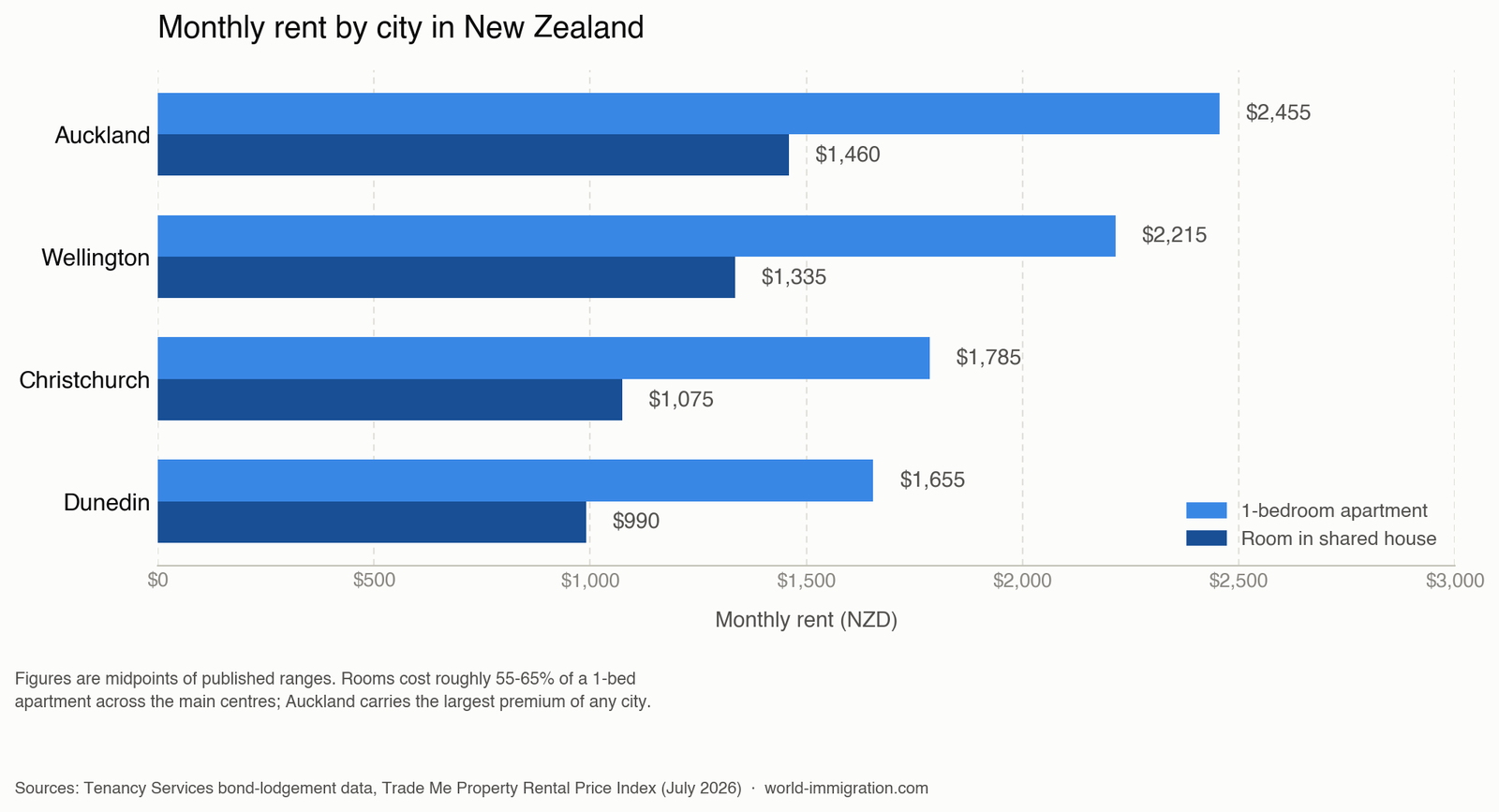
Rent varies more between New Zealand cities than most people expect. The Auckland premium is substantial and persistent, driven entirely by housing rather than wages. Wellington and Christchurch are materially cheaper and Dunedin more so. Queenstown is in a category of its own — tourism and short-stay demand have pushed rents to levels that make Auckland look moderate.
| City | 1-Bed (monthly) | 2-Bed (monthly) | 3-Bed (monthly) | Room in shared house |
|---|---|---|---|---|
| Auckland | $2,240–$2,670 | $2,800–$3,050 | $3,010–$3,350 | $1,330–$1,590/month |
| Wellington | $2,060–$2,370 | $2,540–$2,800 | $2,580–$2,920 | $1,250–$1,420/month |
| Christchurch | $1,630–$1,940 | $2,020–$2,280 | $2,150–$2,410 | $990–$1,160/month |
| Dunedin | $1,500–$1,810 | $1,680–$1,940 | $1,940–$2,190 | $900–$1,080/month |
| Queenstown | $2,370–$2,800 | $3,010–$3,440+ | $3,650–$4,300 | $1,420–$1,680/month |
Source: Trade Me Property Rental Price Index and MBIE tenancy bond data, weekly figures converted at 4.3x for May–June 2026. For tenant rights, bond rules and what to check in a tenancy agreement, see our complete renting in New Zealand guide. Bedroom-count medians move month to month and vary by data source and suburb mix; treat these as a working range rather than an exact figure. Inner-city or premium suburb properties sit at or above the upper end, while outer suburbs and older houses sit below it.
According to the Trade Me Property Rental Price Index, Auckland’s median fell NZ$10 over the year to $660/week; Wellington’s fell $40 to $600/week; Christchurch was essentially flat. After several years of relentless growth — Statistics NZ confirmed housing costs rose approximately 31% nationally between June 2020 and June 2024 — the market has largely stabilised. For renters already in place, this is a relief. For new arrivals, the absolute level is still high relative to wages. According to Statistics NZ’s housing affordability data for the year ended June 2024, 45.9% of renters spend more than 30% of their income on housing — the standard affordability threshold. That is nearly half of all renters already stretched.
Second, flatting — taking a single room in a shared house — remains the dominant budget option for singles and young couples. Based on the room-in-shared-house figures in the table above, expect to pay roughly $210–$390 per week per person across the main cities (more in Auckland and Queenstown, less in Dunedin), depending on the suburb and house quality. For many people arriving on work visas, this is the practical starting point.
Groceries: which supermarket you choose matters more than which city you live in
A single person spending carefully on groceries will spend around NZ$90–$130 per week. A couple will spend NZ$150–$200 per week. A family with two adults and two children will land between NZ$200 and NZ$280 per week, assuming home cooking most nights. These figures build on Statistics NZ’s Household Economic Survey baseline food spending, adjusted for food-price inflation since the survey was last run; treat them as a considered estimate rather than an official current figure, since Stats NZ does not publish a live weekly grocery number.
The single biggest lever on grocery spend in New Zealand is which supermarket chain you use. Pak’nSave is consistently the cheapest. It is New Zealand-owned, operates in a warehouse format and you bag your own groceries. There is nothing wrong with the food — the quality is the same (sometimes better actually) — but the no-frills format keeps prices down. Countdown (now rebranding as Woolworths NZ) sits in the middle. New World is the premium end. Consumer NZ’s basket surveys have consistently found Pak’nSave the cheapest of the three, on the order of $5–$14 a week cheaper than New World or Woolworths on a standard basket of goods — a modest gap per trip, but one that can add up to several hundred dollars a year on a full weekly shop for a family. For anyone moving to New Zealand on a moderate income, that choice is worth factoring in.
Reference prices from Numbeo (a user-contributed price database, so treat these as indicative rather than official): milk NZ$3.13/litre, bread NZ$3.25 for 500g, eggs NZ$10.74 per dozen, chicken fillets NZ$16.24/kg, beef NZ$24.35/kg. Fruit and vegetables are expensive by international standards. Tomatoes run NZ$8.36/kg; apples NZ$4.87/kg. According to Statistics NZ’s Food Price Index, annual food inflation eased to 2.6% for the year to April 2026, but meat, poultry and fish rose 7.4% and fruit and vegetables rose 9.4% in the year to their respective late-2025/early-2026 readings — those categories bit hard through the back half of 2025.
Utilities: electricity is the standout cost to watch
Electricity is running at a national average of around 39 cents per kilowatt-hour, following a 12.1% annual rise reported in Statistics NZ’s Household Living-Costs Price Indexes for the December 2025 quarter — the largest single contributor to household living-cost inflation for lower-expenditure households that year. This is not a minor fluctuation. For cold-climate regions, the impact is pronounced.
Typical monthly electricity costs by household type, based on Powerswitch/Electricity Authority average consumption data at the current 39c/kWh rate:
- Single apartment: NZ$90–$130/month
- Two-person apartment: NZ$150–$205/month
- House, two to three people: NZ$225–$300/month
- Family of four: NZ$300–$410/month
Regional variation is significant, according to Powerswitch’s regional price comparisons: Christchurch runs lower at around NZ$184/month for a four-person household. Wellington averages NZ$189/month. Auckland is NZ$216–$250/month. Otago and Southland run NZ$267–$333/month — the South Island is colder. If you are choosing between cities, Otago and Southland winters are hard on the power bill.
Water is a pleasant surprise for renters. Under Tenancy Services’ water-and-wastewater-charges rules, your landlord generally pays the fixed charges; as a tenant, you pay only the volumetric metered use where a meter is installed. In most Wellington rentals, there are no meters at all — a citywide rollout is planned to begin from 2028 and take five to seven years, so Wellington renters currently pay nothing for water in the large majority of properties. Auckland properties are more commonly metered, but the cost is still modest compared to the UK, Australia, or the US. Budget NZ$0–$50/month depending on location.
Internet is good and widely available. Standard unlimited fibre at 300/100 Mbps runs NZ$65–$85/month. Numbeo’s national average broadband figure is NZ$87/month. Rural and remote areas may rely on fixed wireless at NZ$70–$100/month, or Starlink, which as of mid-2026 runs NZ$85/month for the entry-level Residential Lite plan or NZ$170/month for the standard Residential plan — check current pricing for your address, as Starlink has raised prices more than once in the past year.
One housing note for renters: the Healthy Homes Standards became fully mandatory for all private rentals on 1 July 2025, per Tenancy Services. Every rental property is now required to have fixed heating capable of reaching 18°C in the main living room, adequate ceiling and underfloor insulation and draught-stopping measures. Non-compliance carries fines of up to NZ$7,200 per breach. The practical result is that the cold, single-glazed, poorly heated rental stock that was a welfare problem for decades is being pushed out of the market. Properties advertised post-2025 should carry a Healthy Homes compliance statement — ask for it if it is not provided.
Transport: the city shapes the cost more than anything else
Auckland, Wellington and Christchurch have public transport networks, but they are not equivalent and the city you choose will determine whether a car is a luxury or a practical necessity.
Auckland’s AT HOP card public transport costs NZ$3.00 for a one-zone trip and NZ$7.90 for four or more zones. As of 1 February 2026, there is a NZ$50 seven-day cap — once you reach $50 in a week, further trips are free until Sunday midnight. For a daily commuter, the maximum weekly cost is NZ$50, or NZ$215/month. This is a meaningful improvement over the previous uncapped structure.
Wellington’s Metlink/Snapper fares run NZ$2.12 for a one-zone trip and NZ$4.67 for three zones at peak times, with a 20% off-peak discount (cut from 30% in the May 2026 fare review). A typical commuter spending two trips per day, five days a week, will spend around NZ$200/month. Christchurch’s Metro is the most straightforward: a flat NZ$3.00 fare regardless of distance, with a NZ$30/week cap — effectively NZ$130/month maximum for a daily commuter.
Petrol prices have been volatile through 2026. A Middle East conflict that began in late February 2026 disrupted shipping through the Strait of Hormuz and pushed 91 octane petrol to a wartime peak of around NZ$3.48/litre in mid-April. Since then, prices have fallen substantially as the crisis eased: the NZ Herald reported the national average at NZ$2.99/litre on 29 June 2026, its lowest level since mid-March and it has continued drifting lower since. Budget on the current national average of roughly NZ$2.90–$3.10/litre for 91 unleaded, but check a live tracker (Gaspy or AA Fuelwatch) before relying on a specific figure, given how much this has moved in a single year. Auckland has a regional fuel tax on top of the national rate. Total car ownership costs — fuel, registration, warrant of fitness, insurance and maintenance — run roughly NZ$330–$550/month excluding the purchase price, based on typical published running-cost breakdowns. The warrant of fitness (WoF) is the NZ equivalent of a vehicle safety check, required annually for most vehicles at around NZ$50–$90.
What you will actually spend each month: complete budget tables
These are mid-range estimates of the cost of living in New Zealand. The floor is meaningfully lower if you flat with others, shop at Pak’nSave and commute by public transport. The ceiling is considerably higher if you live alone in the inner city, own a car and eat out regularly.
| Expense | Auckland | Wellington | Christchurch | Dunedin |
|---|---|---|---|---|
| Rent — 1-bed apartment | $2,450 | $2,220 | $1,790 | $1,660 |
| Alt: room in shared house | $1,460 | $1,335 | $1,075 | $990 |
| Groceries (single) | $460 | $440 | $430 | $420 |
| Electricity | $150 | $160 | $130 | $175 |
| Internet (fibre) | $80 | $80 | $75 | $75 |
| Water (renter) | ~$15 | ~$0 | ~$20 | ~$20 |
| Mobile phone | $35 | $35 | $35 | $35 |
| Public transport (commuter) | $215 | $200 | $130 | $90 |
| Eating out and social | $250 | $230 | $200 | $180 |
| Total (1-bed apartment) | ~$3,655 | ~$3,365 | ~$2,810 | ~$2,655 |
| Total (flatting) | ~$2,665 | ~$2,480 | ~$2,095 | ~$1,985 |
Note: no car assumed; healthcare not included (publicly funded for eligible residents — see the income context below). Eating out and social is an allowance, not a fixed cost. Auckland groceries run 5–12% higher than regional cities due to distribution costs, per typical retail cost-of-living comparisons, reflected above.
For a couple sharing a two-bedroom apartment:
| Expense | Auckland | Wellington | Christchurch | Dunedin |
|---|---|---|---|---|
| Rent — 2-bed apartment | $2,925 | $2,670 | $2,150 | $1,810 |
| Groceries (couple) | $750 | $720 | $700 | $680 |
| Electricity | $210 | $220 | $180 | $240 |
| Internet | $80 | $80 | $75 | $75 |
| Water | ~$20 | ~$0 | ~$30 | ~$30 |
| Mobile (2 phones) | $70 | $70 | $70 | $70 |
| Public transport (2 commuters) | $430 | $400 | $260 | $180 |
| Eating out and social | $400 | $380 | $340 | $300 |
| Total (couple, 2-bed) | ~$4,885 | ~$4,540 | ~$3,805 | ~$3,385 |
In Dunedin and other smaller centres, many couples find public transport insufficient and add a car — that adds roughly NZ$450/month to running costs at current petrol prices. Adjust accordingly.
Income context: what New Zealand pays
The adult minimum wage from 1 April 2026 is NZ$23.95 per hour. A 40-hour week on minimum wage earns approximately NZ$958 gross, or roughly NZ$795–$820 take-home after PAYE tax and the ACC earner levy — call it NZ$3,400–$3,500/month take-home. Against a single-person budget in Auckland of around NZ$3,655/month for a one-bedroom apartment, or NZ$2,665/month flatting (from the table above), minimum wage alone does not clear a solo one-bedroom tenancy in Auckland without other income or savings and even flatting leaves very little margin for savings, unexpected costs, or debt repayment.
The average full-time wage is considerably higher. According to Statistics NZ’s Wage and Salary Earnings release for the December 2025 quarter, average weekly earnings for a full-time employee (see our guide to working in New Zealand for sector-by-sector pay and employment conditions, or our average salary in New Zealand guide for the full regional and industry breakdown) were NZ$1,712 gross — around NZ$6,800/month before tax, or approximately NZ$5,300/month take-home at that level. On that income, Auckland is workable if not comfortable, though at the corrected 1-bed rent figures above it is a tighter fit than a headline income comparison suggests. Wellington and Christchurch offer more breathing room.
The income-to-cost comparison that comes up consistently in expat community discussions and that is structurally accurate, is this: New Zealand wages are lower than Australia, the United Kingdom, the United States and much of Western Europe, while the cost of living is comparable, particularly in Auckland. Pace, environment, space and safety are the trade-off — but check the financial arithmetic on its own terms, not the lifestyle pitch.
Statistics NZ reports that housing costs rose 31% between June 2020 and June 2024, while average disposable income rose only 24% over the same period. The squeeze is a documented fact, not a perception. The good news is that rent growth has since slowed sharply from its 2021–2022 peak: the Trade Me Property Rental Price Index shows the national median rent essentially flat to slightly down year-on-year through the first half of 2026, a marked change from the double-digit annual rent growth seen at the height of the post-pandemic rush.
Eating out and day-to-day spending
Per Numbeo’s crowd-sourced pricing, a flat white coffee at a cafe costs NZ$5–$7. An inexpensive restaurant meal for one person is around NZ$25. A mid-range restaurant dinner for two, with drinks, runs NZ$80–$130. A McDonald’s combo meal is NZ$16. A domestic beer at a pub costs around NZ$12. Treat these as indicative rather than official, since Numbeo prices are user-submitted rather than centrally measured.
New Zealand has a strong cafe culture — especially in Wellington, which has a reputation as one of the better coffee cities in the Southern Hemisphere. The spend adds up quickly if you replicate the daily cafe habit from home. Cooking at home most nights and treating eating out as occasional rather than routine is the practical difference between a comfortable budget and a tight one at most income levels.
Families: the childcare factor
For families with young children, childcare is a significant additional cost. For under-threes, full-time care (five days) costs NZ$200–$320 per week at more affordable centres in regional cities and NZ$300–$500 per week at most Auckland centres — with premium providers charging above that. Part-time care (two to three days) runs NZ$130–$200 per week. The wide variation reflects the mandatory 1:5 staffing ratio for under-twos set by the Education (Early Childhood Services) Regulations 2008, which makes infant care the most expensive category. Once a child turns three, the government’s 20 Hours ECE subsidy covers up to 20 hours per week at no cost to the family. Additional hours beyond that are typically NZ$5–$8 per hour. The FamilyBoost scheme (from 1 July 2025) provides a 40% rebate on childcare costs up to NZ$1,560 per quarter. Households earning under NZ$35,000 per quarter receive the full rebate; those earning between NZ$35,001 and NZ$57,286 per quarter receive a partial rebate (abating at 7 cents per dollar over the threshold). The scheme cuts out entirely above NZ$57,286 per quarter (roughly NZ$229,000/year). According to RNZ’s reporting on Stats NZ data, early childhood education costs rose 2.5% between the March 2025 and December 2025 quarters.
What this cannot tell you
These figures represent the most common experience for renters arriving in the main cities. They cannot account for individual circumstances that shift the numbers substantially:
- Healthcare entitlement by visa type. Publicly funded healthcare is available to permanent residents and citizens. Temporary visa holders — including most work and student visa holders — have limited or no entitlement and must pay full fees or hold private insurance. Statistics NZ’s Household Living-Costs Price Indexes recorded private health insurance premiums up 20.3% in the year to the December 2025 quarter. See our detailed guide to healthcare in New Zealand for expats for costs by visa type. This is a major budget variable that this article cannot resolve for your specific situation.
- Your actual salary. The income context above uses averages and the minimum wage. What your particular role pays in your particular city may be higher or lower. The Ministry of Business, Innovation and Employment publishes occupation-level salary data; check it for your field before accepting an offer.
- School-zone premiums. Property-price research (see RNZ’s coverage of school-zone house-price data) has found some of the most sought-after Auckland school zones commanding sale-price premiums of 30–90% over comparable out-of-zone properties. There is no equivalent published dataset specifically for rents, but landlords in these zones can reasonably be expected to price at or above the suburb average; treat any specific rental premium figure as an informed estimate, not a measured one. This is not reflected in the medians above.
- Your specific neighbourhood within a city. The ranges above reflect city-wide medians. A suburban flat in South Auckland is considerably cheaper than an inner-city apartment in Grey Lynn. The median is a starting point, not a ceiling or floor.
- First-year setup costs. Bond (four weeks’ rent), advance rent, a car if you need one, appliances, furnishings and relocating personal effects are all upfront costs that can run NZ$5,000–$15,000 before you have spent a single regular week in the country. Budget for the setup phase separately.
Frequently asked questions: cost of living in New Zealand
Q: Is New Zealand more expensive than Australia?
In most direct comparisons, New Zealand is slightly cheaper than Sydney or Melbourne in absolute terms, but the income gap makes it feel more expensive. Australian wages — particularly in skilled trades and technology — are materially higher than equivalent New Zealand roles. Recruitment and salary-benchmarking sources commonly put the gap for a software engineer or nurse in Auckland at around 20–30% below their counterpart in Sydney, while paying comparable rent and groceries; treat that range as a widely-cited industry estimate rather than an official statistic, since neither country publishes a direct like-for-like comparison. The New Zealand lifestyle is different and valued by many people, but anyone comparing the two countries purely on financial terms should run the numbers for their specific role and city rather than assuming they are equivalent.
Q: How much money do I need to cover the cost of living in New Zealand?
Immigration New Zealand does not set a single figure for work visa holders. The practical answer is that you need enough to cover the bond (four weeks’ rent), first week’s rent in advance and two to three months of living expenses while you settle in — because income may not start immediately and unexpected costs are common. For a single person arriving in Auckland with no existing network, NZ$10,000–$15,000 in savings is a workable buffer. For a couple or family, NZ$20,000–$30,000 covers the setup phase with reasonable confidence. Arriving with less is possible but leaves no margin for the delays that commonly occur with bond refunds, employment start dates, or appliance failures in the first rental. The Immigration NZ website sets financial requirements for some visa categories — check the specific requirements for your visa type, as they vary.
Q: Is Auckland really that much more expensive than other New Zealand cities?
For housing, yes — clearly and consistently. The Auckland rent premium over Christchurch for a comparable property is roughly 30–40% across most bedroom counts, based on the Trade Me Property Rental Price Index and MBIE tenancy bond data cited in the rent table above. Wellington sits between the two. For everything else — groceries, utilities, transport — the difference between cities is much smaller (5–15%). The case for Auckland is labour market depth: there are more jobs across more industries and the international airport connection matters for some people. But the salary premium for a given role in Auckland versus Wellington or Christchurch rarely compensates for the housing cost difference. Many people who have lived in more than one New Zealand city conclude that Wellington offers the best balance of liveable scale, amenity and cost, while Christchurch offers the best housing value with a rebuilt city centre that is attractive post-earthquake — for a full breakdown of what each city offers beyond cost, see our guide to the best cities in New Zealand for immigrants.
Sources
- Statistics NZ — Household Income and Housing-Cost Statistics, Year ended June 2025
- Statistics NZ — Housing Affordability More Challenging for Renters (45.9%, year ended June 2024)
- Statistics NZ — The Current State of Housing in Aotearoa New Zealand (2025)
- MBIE — Mean Weekly Rent by Region (rental bond data)
- Powerswitch NZ — Power Prices in New Zealand (citing MBIE QSDEP, 2026)
- Inland Revenue — FamilyBoost (updated July 2025)
- Ministry of Education — 20 Hours ECE funding
- Statistics NZ — Wage and Salary Earnings, December 2025 quarter
- Statistics NZ — Household Living-Costs Price Indexes, December 2025 quarter (electricity +12.1%, health insurance +20.3%)
- Statistics NZ — Food Price Index
- Tenancy Services — Charging a General Bond (4-week cap)
- Tenancy Services — Water and Wastewater Charges
- Tenancy Services — Healthy Homes Standards Final Deadline, 1 July 2025
- Trade Me Property — Rental Price Index
- Consumer NZ — What’s the Cheapest Supermarket?
- Numbeo — Cost of Living in New Zealand
- Employment New Zealand — Minimum Wage Increasing 1 April 2026
- Auckland Transport — 7-Day Fare Cap
- Metlink — Tickets and Fares (Wellington)
- Metro — Fares (Christchurch)
- NZ Herald — Petrol Price Drops Below $3 a Litre as Ceasefire Steadies Oil Markets
- Waka Kotahi NZ Transport Agency — Vehicle Registration Fees
- Wellington.Scoop — Water Charges Going Up and Water Meters Coming Soon
- Ministry of Education — Adult-to-Child Ratios in Early Learning Services
- RNZ — How Much Is a House in a Desirable School Zone Worth?

