
The question most newcomers to a foreign country might not have the full answer to is, “What happens if I get sick?” Healthcare in New Zealand is not simply “free for everyone who lives here.” It is eligibility-gated by your visa type, partial in some areas and absent in others and supplemented by a no-fault accident scheme unlike anything else in the world. Understanding the structure before you arrive, or before you drop your reliance on travel insurance, could really save you from an unexpected bill.
This article covers who is actually entitled to publicly funded healthcare in New Zealand, how the ACC accident scheme works and what it does not cover, the state of GP access and specialist waiting lists, what prescriptions cost, the gap around dental care and when private health insurance makes sense (and for some visa holders when it is your only option). It complements the broader moving to New Zealand guide.
Who is eligible for publicly funded healthcare in New Zealand
The most common misconception is that anyone living and working here gets access to the public health system. That is not correct. Eligibility is tied to your visa and the threshold is specific – see our guide to New Zealand work visas for how the two-year threshold interacts with each visa route.
The public system, now unified under Health New Zealand | Te Whatu Ora since the Healthy Futures (Pae Ora) Act took effect on 1 July 2022. This replaced the country’s 20 district health boards and covers residents and people on work visas valid for two years or more from the date of first arrival. If your work visa is shorter than two years, you are generally not eligible. Foreign students and visitors are also not eligible, regardless of how long they have been in the country. See Health New Zealand’s eligibility criteria for publicly funded healthcare for the full detail behind these categories.
| Visa type | Public healthcare entitlement |
|---|---|
| Resident visa (living in NZ) | Full publicly funded health and disability services |
| Work visa valid 2+ years | Full publicly funded health and disability services |
| Work visa valid under 2 years | Generally not eligible — must pay full costs or hold international health insurance |
| Student visa | Generally not eligible — comprehensive travel insurance is a visa condition |
| Visitor visa | Not eligible — must pay or hold insurance |
| Australian citizens / permanent residents | Immediately necessary treatment only, under a reciprocal agreement |
| UK citizens (not permanent residents) | Immediately necessary medical treatment only, under a reciprocal agreement |
Entitlement categories per Health New Zealand’s published eligibility criteria and reciprocal health agreements.
The two-year threshold is measured from your first arrival date, not from when you applied for the visa. If you held a one-year work visa, renewed it and have now been here continuously for more than two years, you may have acquired eligibility — confirm this with Immigration New Zealand rather than assuming. The official eligibility guidance is at govt.nz, also Immigration New Zealand publishes detail on eligibility by specific visa category.
What the reciprocal agreements with Australia and the UK actually cover
New Zealand has reciprocal health agreements with two countries only, Australia and the United Kingdom. They cover “immediately necessary medical treatment” — not the full scope of the public system. Ambulance transport and private specialists are outside the scope of both agreements and a pre-existing condition is covered only if it needs urgent treatment during the stay, not as ongoing management. See Health New Zealand’s reciprocal health agreements page for the exact scope of each.
For UK citizens specifically, Health New Zealand states via the same link above, that the agreement is restricted to UK citizens and does not cover UK permanent residents. Coverage at a GP is at the casual (unenrolled) rate and it is the GP who decides whether a condition needs prompt attention. This is a long way from having full access to the system and can be noticeably expensive — I have personally been aghast at the prices when going to an emergency clinic with foreign friends not on an agreement.
Australians and Britons staying in New Zealand for any length of time should still hold comprehensive travel or international health insurance for anything beyond an urgent consultation.
Enrolling with a GP: what it costs and what it gets you
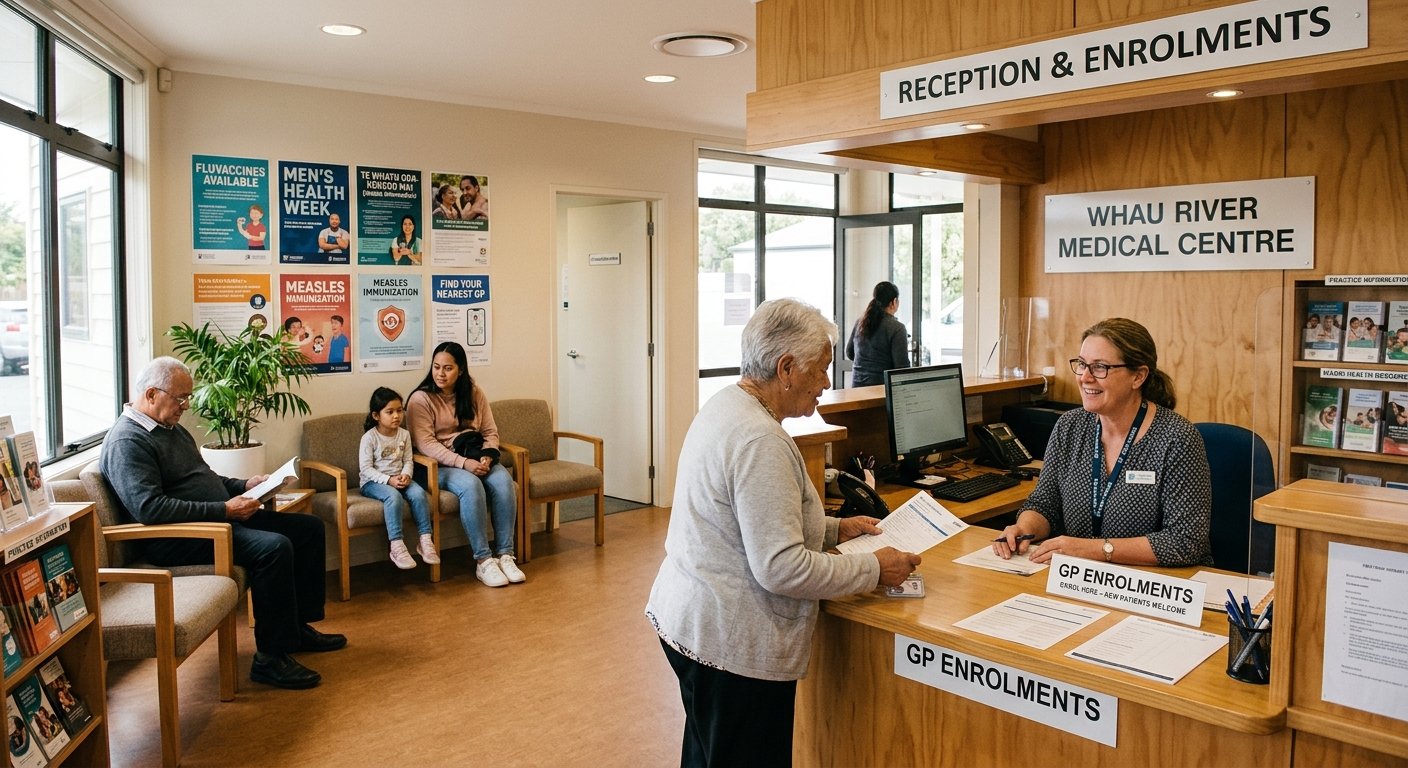
General practitioners in New Zealand are called GPs and work in practices often called medical centres. Enrolment with a GP practice is free. Once enrolled, the government pays your practice a capitation subsidy — a per-person annual payment, not a fee per visit — which substantially reduces what you pay per consultation.
Enrolled adult GP consultations typically cost NZD $19 to $60, depending on the practice and its location. At a casual (unenrolled) rate — which is what you pay if you are not eligible, or before you have enrolled — the cost is typically NZD $75 to $120 or more. Auckland practices I have seen listed on Healthpoint charge $90 to $120 for casual visits; check the fee for a specific practice there before assuming these figures apply to it.
Children under 14 who are eligible for publicly funded care get zero-fee GP visits, prescriptions and after-hours care at their enrolled practice. For adults, after-hours clinics (Accident and Medical centres, separate from hospital emergency departments) typically cost NZD $75 to $100 for an enrolled patient, per the fee schedules practices publish on Healthpoint.
You can only enrol if you are eligible for publicly funded health care. Enrolment does not create eligibility — it is the other way around. GP fees are not nationally fixed, each practice sets its own rates. The practical thing to do is check Healthpoint.co.nz for fees at practices near where you will live before you arrive and call several, because practices frequently have no capacity for new patients. This is especially true outside the main cities.
A practical note on what “medical centre” actually means in New Zealand: the term is used loosely and covers everything from large walk-in multi-doctor clinics to single-doctor family practices. Walk-in centres — where you see whoever is available — tend to charge at the higher end of the enrolled fee range and consultation quality can vary substantially from one visit to the next. There are also reports, which I have not been able to formally verify, that medical centres are only required to have one registered doctor on site at any given time and that doctor may be relatively junior. Where you have a choice, a practice that assigns you a regular, named GP — someone who knows your file and sees you for the majority of your visits — is preferable. The clinical continuity matters more than it sounds.
There is an under-advertised category of practice: those holding Very Low Cost Access (VLCA) status. VLCA practices serve higher-needs populations, typically communities with significant Māori, Pacific, or lower-income residents and receive additional government funding in return for capping their consultation fees. Enrolment is not restricted to low-income patients; any eligible patient can enrol. As of 1 July 2025, adult enrolled consultation fees at VLCA practices are capped at $30.50 for a standard patient and $20.00 for Community Services Card holders, compared with $40–$60 or more at many standard practices as per Health New Zealand’s VLCA fee schedule. In my experience, these clinics attract committed GPs, a family doctor I know told me that spending time in public-service medicine is for some senior practitioners enjoyable and a way they can give back. The quality of care I have received at VLCA clinics has been equal to anything at a standard practice. You can identify them on Healthpoint by checking the fee schedule, or simply call ahead and ask.
A word on the medical workforce, international medical graduates made up 42.1% of New Zealand’s practising doctors in the Medical Council’s 2025 workforce survey, with India and the Philippines among the most common training countries, alongside South Africa, China, the United Kingdom and elsewhere. In my experience the clinical knowledge is sound and frequently impressive, some of the most capable consultations I have had were with overseas-trained doctors. The occasional friction is communicative rather than clinical, a doctor who understands the physiology perfectly can sometimes miss the subtext of how a New Zealand patient is framing their concern or what they are actually worried about beneath what they are saying. If you find a GP who communicates well and knows your history, I would recommend staying with them. Shopping around until you find the right fit is entirely normal here.
ACC: the accident scheme that covers everyone — and what it does not cover
The Accident Compensation Corporation (ACC), is one of the most distinctive things about New Zealand. It is a no fault personal injury scheme that covers everyone physically present in the country regardless of visa status, provided the accident happens here. Residents, work visa holders, tourists and visitors are all covered the moment they set foot in New Zealand. See ACC’s own explanation of cover for visitors injured in New Zealand.
What ACC covers – partial treatment costs for injuries (you pay the remainder), up to 80% of pre-injury earnings as weekly compensation if an injury stops you working, transport and childcare costs during recovery, aids and equipment and permanent impairment payments in serious cases. Your doctor or health provider initiates the ACC claim on your behalf — you do not need to lodge it yourself, though ACC must accept the claim before it starts contributing to costs.
There is a significant trade-off (in NZ we might say it’s an advantage though) built into the scheme. Because ACC provides no fault compensation for injuries, the Accident Compensation Act 2001 bars ordinary personal injury lawsuits — you cannot sue someone for negligence if you are injured (a narrow exception exists for exemplary damages). See Community Law’s overview of the ACC scheme for how that trade-off works in practice. Most people find this fair and you should know it before you arrive.
The critical limitation: ACC covers accidents, not illness. A cancer diagnosis, a heart attack, a stroke, an infection, any chronic condition — none of these fall under ACC. If you are a visitor or short-term visa holder who becomes seriously ill rather than injured, ACC offers nothing. The New Zealand government’s own SafeTravel advice recommends that all visitors hold comprehensive travel insurance, precisely because minor treatment can be expensive and the government will not cover it.
Also excluded from ACC: injuries sustained while in transit to or from New Zealand (including on the aircraft) and ongoing treatment costs after you have left the country. The ACC website at acc.co.nz sets out the full scope clearly.
Prescriptions: Pharmac subsidies and what you actually pay
New Zealand’s pharmaceutical purchasing agency is Pharmac (Te Pātaka Whaioranga). It negotiates on behalf of the government and maintains a subsidised medicine list. For most adults with funded health care entitlement, the standard co-payment is NZD $5 per prescription item, reinstated from 1 July 2024 — see Health New Zealand’s pharmaceutical co-payments page.
There is an annual threshold: once you have paid for 20 funded prescription items in a year (the cycle runs 1 February to 31 January), all further subsidised prescriptions are free until the cycle resets, per the same Health New Zealand co-payments guidance. Community Services Card holders and children under 14 are exempt from co-payments entirely.
One practical note for 2026, from 1 February 2026 prescribers can issue prescriptions for up to 12 months for people with stable, well-controlled long-term conditions. The maximum supply at any one time is still 3 months (6 months for oral contraceptives), but the $5 co-payment is now charged only once, at the first dispensing, with repeat dispensings free of charge. See the Ministry of Health’s page on increasing prescribing lengths.
Private prescriptions — from a private specialist rather than a GP in the public system — cost NZD $15 per item (NZD $10 for ages 14–17). Not every medication is on Pharmac’s subsidised list. If your regular medication is not funded here, you pay the full retail price, which can be substantial for some drugs. Check the Pharmac website before assuming your prescription will be covered.
Specialist care and public waiting lists
Getting a referral from a GP to a public specialist is a two-step process. First, your GP refers you. Then you are assessed for priority and if you meet the threshold, you are placed on a waiting list for a First Specialist Assessment (FSA). The official target (one of Health New Zealand’s national health targets), is for 95% of patients to be seen within four months of referral.
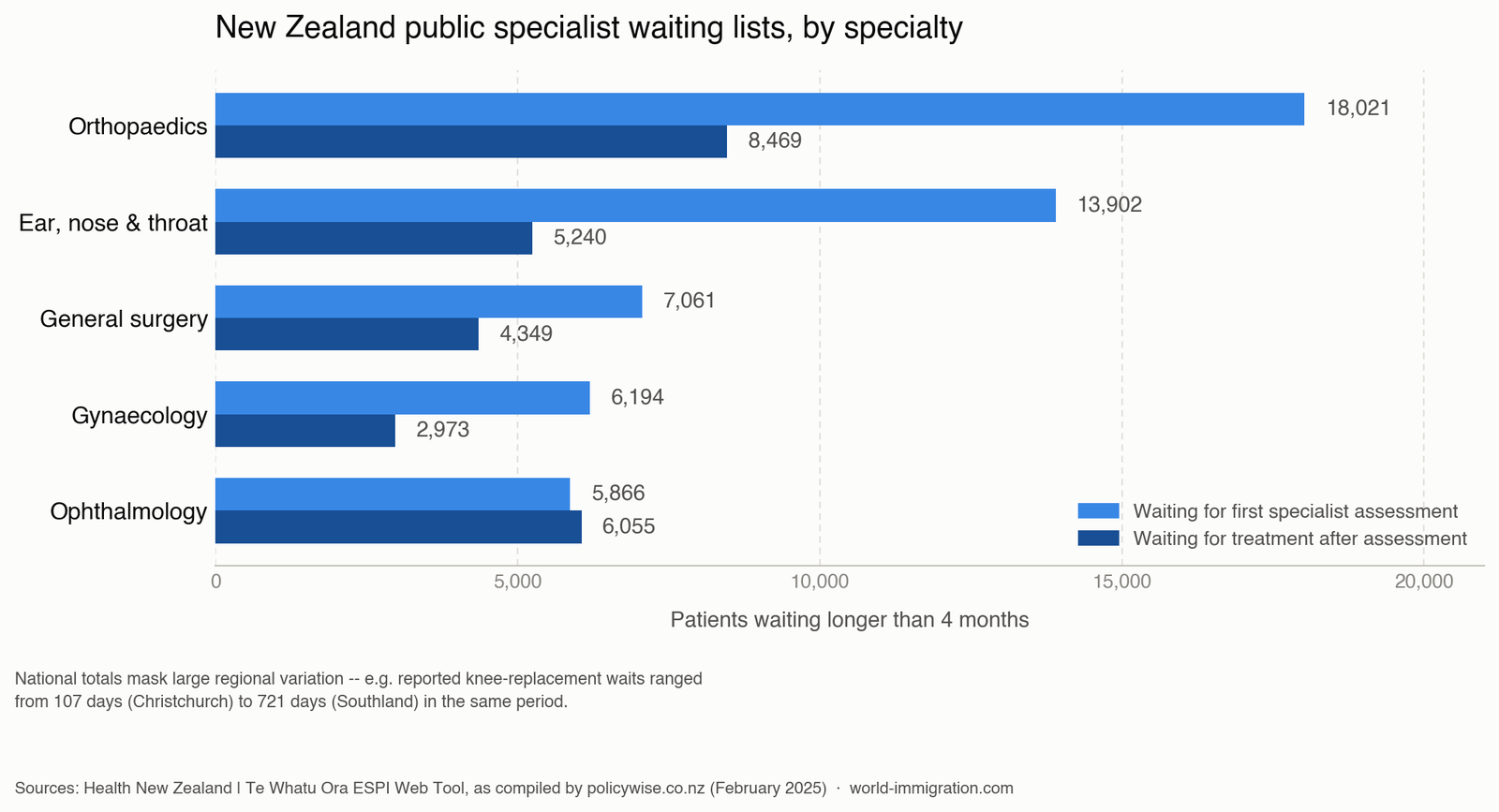
In practice, waits are long. As of February 2025, more than 74,000 patients had been waiting longer than four months for their FSA and over 36,000 were waiting more than four months for treatment after being assessed as per Policywise’s ’causes and impacts’ on patient wait times report. The specialties carrying the biggest share of that backlog were orthopaedics (18,021 waiting for an FSA, 8,469 for treatment), ear nose and throat (13,902 and 5,240), general surgery (7,061 and 4,349), gynaecology (6,194 and 2,973) and ophthalmology (5,866 and 6,055). Those are national totals and they mask real regional variation: RNZ reported knee-replacement waits, as at end January 2025, ranging from 107 days at Christchurch Hospital, the only hospital meeting the four-month target for that procedure to 721 days at Southland Hospital.
There is a further problem, RNZ reported in May 2026 based on Association of Salaried Medical Specialists data from seven districts (Health NZ does not collate a national figure), that roughly one in five GP referrals to specialists is declined because the patient does not meet the prioritisation threshold and that declined referrals rose from 101,962 in 2023 to an estimated 112,348 in 2025 across those districts. The underlying causes cited include chronic underfunding relative to population demand, workforce attrition and an ageing population, layered on persistent workforce shortages. Health New Zealand’s own 2024 Health Workforce Plan put the current gaps at around 1,700 doctors, 4,800 nurses and 1,050 midwives.
The picture is that the public system functions well for GP-level care, for emergencies and for clearly urgent cases. For elective and semi-urgent specialist care, the wait is long and the decline risk is significant. This is the single strongest argument for private health insurance for people who are eligible and can afford it. Accessing a private specialist entirely bypasses the public queue.
Private health insurance: who needs it and what it costs
New Zealand has three main private health insurers: Southern Cross Health Society (around 60% of the market by membership, structured as a not-for-profit friendly society rather than a for-profit company and covering over 951,000 members as of June 2025), nib (roughly 12–15%) and AIA (integrated with life insurance products, around 10%). Southern Cross is the one most people encounter first.
New Zealand’s private health insurance system is designed to supplement the public system, not replace it. Southern Cross’s own guidance confirms its plans are only available to people entitled to publicly funded healthcare and the other main insurers apply the same precondition. If you are on a sub-two-year work visa, a student visa, or a visitor visa, you generally cannot buy local private health insurance. You need international health insurance either from a provider in your home country or from a specialist expat insurer for the duration of your stay.
For those who are eligible, private insurance has risen sharply in cost — our cost of living in New Zealand guide covers where this sits in a full monthly budget. RNZ reported premium rises of around 25% in a year for some members and NZI reports medical inflation running at around 14.5% in 2025 alongside a 16% year-on-year rise in claims volume (increases actually vary widely by member, some reports put the range at 10–30% depending on age and plan). Ballpark costs also vary substantially by age, plan and excess chosen. According to insurance- omparison reporting, a 40-year-old on a mid-range Southern Cross Easy Claim plan might expect to pay around NZD $130 per month, entry-level plans start around NZD $50 per month, comprehensive cover for someone in their 40s costs NZD $120–$250 per month. People in their 50s typically pay two to three times more than those in their 20s for equivalent cover. Many companies in New Zealand offer Southern Cross Healthcare as an included benefit, some with a no-previous-conditions clause which means existing issues that would normally be excluded are not, ask any potential employer for the details of their scheme.
Premium escalation is a known frustration for long-term residents. The community discussion on this topic is extensive, many people raise their excess (the amount they pay before cover kicks in) to manage costs, or shift from comprehensive to surgery only cover. The decision I would make and what I have seen work for people here, is to treat private cover primarily as specialist access insurance rather than general health cover, carry a meaningful excess (NZD $1,000–$3,000) and rely on the public system for GP and emergency care. That usually brings premiums to a manageable level while protecting against the scenarios that actually matter financially.
Dental care: the gap most expats don’t expect
Adult dental care — for anyone aged 18 and over — is entirely outside the publicly funded health system in New Zealand. There is no universal adult dental scheme. Children are covered from birth through two linked programmes: the school dental therapy service to the end of Year 8 (roughly age 12–13), then the Teen Dental programme through to the 18th birthday, per the government’s own guide to government help with dental costs. From the day you turn 18, every dental visit is full private-pay.
This is a genuine outlier by the standards of comparable developed countries. The UK’s NHS, for example, still subsidises adult dental treatment through fixed patient charge bands rather than full private pricing and several other OECD countries run some form of public adult dental subsidy. New Zealand has none. My own observation, not a formally documented finding, is that the fee structure that has filled that space shows little sign of meaningful price competition between practices, I paid NZ$220 for a standard dental hygenist cleaning session just last week and these are not done by fully qualified dentists.
Based on the New Zealand Dental Association’s 2025 Fees however and the Dental Workforce Survey (also compiled at Policywise) there is a further 3.6% increase projected for 2026. Typical costs are below, but as you can see I’ve already paid well outside this range just last week so your mileage may vary:
- Examination: NZD $89–$125
- Scale and clean: NZD $96–$180
- Panoramic X-ray: NZD $111
- Composite filling (single surface): NZD $231–$378
- Simple extraction: NZD $291
- Root canal (molar): NZD $1,200–$1,800
- Porcelain or zirconia crown: NZD $1,624–$2,450
- Full single-tooth implant (implant, abutment and crown): NZD $5,000–$8,000 and higher when bone grafting is required
A routine visit covering an examination, X-ray, clean and a single filling comes to around NZD $559 at 2026 prices, up from $526 in 2023 and $428 in 2020 according to Consumer NZ’s reporting of the NZDA survey data, actual invoices commonly run higher once a practice’s individual item fees are added up. Separately, Consumer NZ reports dental costs have risen 23% since 2019. On unmet need, the Ministry of Health’s most recent published breakdown (the 2020/21 New Zealand Health Survey) found 39.8% of adults avoided a dental visit in the previous year due to cost — 43.3% of women and 36.3% of men — and more recent secondary reporting suggests the rate has climbed further since, though an updated official figure was not available at the time of writing.
The reasons for this pricing structure are not entirely opaque. The New Zealand Dental Association publishes annual fee surveys that function in practice as soft benchmarks across the profession. It has been reported persistently enough among practitioners that the claim deserves mention that dentists who price substantially below those benchmarks risk censure from the association. I have not been able to locate a documented ruling to that effect, but if it were verified it would represent a remarkable constraint on price competition in a private market with no public floor. What is not in dispute as per Consumer NZ’s tracking of NZDA survey data, is that dental fees have risen 23% since 2020, considerably outpacing general inflation, with further annual increases projected.
When the subject of a patient receiving overseas dental work comes up with a New Zealand dentist, the response is typically concern about quality and the risk of complications. However, Auckland in particular is recognised in Stats NZ’s 2023 Census data as one of the most ethnically diverse cities in the world and a notable share of foreign dentists practising in New Zealand received their training overseas — in India, China, South Korea, Colombia, the Philippines and Eastern Europe among other places. When such a dentist questions the standard of work done at a clinic in one of those countries, they are, often implicitly, questioning the standards of their own home country’s dental training. In my observation, pointing this out tends to resolve the conversation fairly quickly. A dentist who opens a consultation by asking where the patient’s previous work was done, rather than by assessing the current clinical condition of the tooth, is applying social pressure, not clinical judgement.
For major procedures, implants, crowns, full-mouth restorations the arithmetic of overseas dental treatment can be compelling. Dental tourism providers themselves report savings in roughly the 55–80% range against Australian/New Zealand prices for clinics in Thailand, Vietnam, Bali and parts of Latin America. Even allowing for variances, a return flight from New Zealand to Bangkok, ten days of accommodation and a single implant at a reputable clinic can plausibly cost half the price than the same implant in Auckland and comes with a free holiday.
The clinics that cater to international patients are well aware of western expectations and in the experience of people I know who have used them (including myself) the standard of care and equipment is usually better. The appropriate questions before going, clinic accreditation, reviews from comparable country patients, the protocol for follow up complications are exactly the questions you should be asking any New Zealand dentist. Sadly this is one area of New Zealand that remains unaffordable for many people and more and more are switching to overseas treatment as the dental industry strangely prices itself out of the market.
In addition private dental insurance for most people in New Zealand doesn’t financially stack up. Annual premiums run NZD $400–$700, while annual claim limits are typically NZD $500–$1,000 — Southern Cross caps its dental add-on at $750/year (75% of costs), nib’s Premium dental plan pays 80% up to $1,000/year. After paying the annual premium, the net benefit on most plans does not cover the cost of a single crown. Dental insurance in New Zealand is structured to partially offset routine maintenance costs, not to protect against the major procedures where the financial exposure is real. For most adults, setting aside the equivalent of the monthly premium in a savings account is the more rational approach.
Adults facing financial hardship can apply through Work and Income New Zealand (WINZ) for a non-repayable grant of up to NZD $1,000 in any 52-week period for immediate and essential treatment, extractions, fillings, root canals (excluding molars) and treating infections subject to an income and asset test. This is emergency provision, not a routine maintenance subsidy, but it’s there if you need it.
Mental health services
New Zealand has historically carried an uncomfortable relationship with mental health. The cultural expectation, particularly for men and bound up with the archetype of the practical, stoic New Zealander was that difficulty was private and that seeking help was a mark of weakness. That expectation has shifted considerably over the past decade or so, conversations about mental health are far more open, public campaigns are well-resourced and in most social settings a person who says they are seeing a therapist or have been through a difficult period will be met with support rather than judgement. Some contexts still carry the old attitudes, you will encounter them. But the direction has changed and the stigma, while not gone, is far less of a barrier than it once was.
Mental health and addiction services are publicly funded but stretched. For non-emergency mental health care, the path starts with a GP referral. Without that referral, access to specialist services is limited. The free 24/7 crisis and support line is 1737 — call or text, available to everyone.
Government mental health and addiction targets, announced in July 2024, aim for 80% of people accessing specialist mental health services to be seen within three weeks and 80% of those accessing primary mental health through the Access and Choice programme within one week, alongside a workforce target of training 500 new mental health and addiction professionals per year. Health New Zealand reported both access targets as met in early 2026 (82.2% and 83.7% respectively for the quarter), but a national target being met on average does not mean every region or age group is. Te Hiringa Mahara, the Mental Health and Wellbeing Commission, reported that the proportion of 19–24 year-olds using specialist services fell from 6.1% in 2020/21 to 4.9% in 2024/25, even as reported psychological distress in that age group rose sharply and that addiction-service wait times have lengthened over the same period.
For expats who have arrived with existing mental health conditions, the key practical point is to register with a GP as quickly as possible and tell them about your mental health history early. The GP referral is the gateway to most funded mental health care and establishing that relationship before a crisis is much better than trying to access the system from scratch during one.
Emergency care: what happens if you need a hospital
New Zealand’s public hospital network spans every region, from major tertiary hospitals in the main centres to smaller rural hospitals — Health New Zealand’s own hospital finder lists the full set if you want to check what’s near a specific address. Emergency departments cannot turn anyone away for inability to pay, emergency care is provided to everyone who needs it, regardless of visa status or eligibility. However, if you are not eligible for publicly funded care, you will receive a bill after the event. Emergency care is not free for ineligible patients, it is simply not refused at the door.
If your emergency involves an injury, ACC will cover a portion of the costs regardless of visa status. If it involves illness, you are liable for the full cost unless you hold travel or international health insurance.
What this article cannot tell you
This article covers the general structure of healthcare in New Zealand as it stands in mid-2026. There are things it cannot tell you with any precision.
It cannot tell you which GP practice near your specific address is currently accepting new patients, or what their enrolled fee is. That changes regularly and you need to check Healthpoint directly. It cannot tell you what a private health insurance policy will actually cost you, because premiums depend on your age, health history, the insurer, the plan and the excess you choose and New Zealand insurers do not publish age-banded rate cards publicly. Get at least three quotes.
It cannot tell you whether your specific visa arrangement (particularly if it has been extended, changed, or if you hold a combination visa) makes you eligible for funded care. Immigration New Zealand’s eligibility rules interact with visa conditions in ways that individual circumstances can complicate. Try confirming your status directly with Health New Zealand or your GP practice before assuming you are covered.
It cannot speak to healthcare costs as they may stand beyond 2026. Medical inflation in New Zealand was reported at around 14.5% in 2025, as covered in the insurance section above. Both GP fees and insurance premiums are likely to be higher in future years than the figures cited here.
Frequently asked questions
Q: Does ACC mean I don’t need health insurance in New Zealand?
No. As ACC’s own coverage rules set out, it covers personal injuries sustained in New Zealand, regardless of your visa status and it is comprehensive for that purpose. It does not cover illness of any kind, not cancer, not heart disease, not infections, not chronic conditions. A visitor or short-term visa holder who becomes seriously ill receives no ACC support at all. Even for people fully eligible for the public system, ACC does not eliminate the need to consider private health insurance for specialist access, dental care, or mental health treatment. The two things serve different purposes.
Q: Can I buy private health insurance in New Zealand if I’m on a short work visa?
In most cases, no. New Zealand’s main private health insurers — Southern Cross, nib and AIA are structured to supplement the public system and as per Southern Cross’s own guidance, it’s generally required that you be eligible for publicly funded healthcare before they will insure you. If you are on a work visa shorter than two years, a student visa or a visitor visa, you are typically not eligible for public care and therefore not eligible for local private insurance either. Your practical options are international health insurance from a provider in your home country or a specialist expat health insurer. Check this before you cancel your existing cover or rely on the local market.
Q: Is dental care free in New Zealand?
Free dental care runs to your 18th birthday, through the school dental therapy service and the Teen Dental programme. From the day you turn 18, dental care is entirely private pay with no public subsidy. There is no universal adult dental scheme in New Zealand. A routine visit covering an examination, X-ray, clean and a single filling costs around NZD $559 at 2026 prices per NZDA survey data (see the dental section above), though a full invoice with more items commonly runs higher — and major procedures such as crowns or implants run considerably higher still. Private dental insurance plans exist but are generally not financially worthwhile as annual premiums typically match or exceed the capped benefit available. See the dental section above for detail on overseas treatment options and the Work and Income emergency dental grant.
Sources and further reading
- Healthcare if you’re in New Zealand on a work visa — New Zealand Government
- Who can get public health care in New Zealand — Immigration New Zealand
- Accident Compensation Corporation (ACC) — what the scheme covers and how to claim
- ACC weekly compensation — how the 80% pre-injury earnings calculation works
- Overview of the ACC scheme — Community Law, on the bar on personal injury lawsuits
- Travel insurance advice — SafeTravel, New Zealand Ministry of Foreign Affairs and Trade
- Eligibility for publicly funded health and disability services — Health New Zealand
- Reciprocal health agreements — Health New Zealand, on the Australia and UK agreements
- Zero fees for tamariki under 14 — Health New Zealand
- Primary care funding and subsidies (capitation) — Health New Zealand
- Find a hospital — Health New Zealand’s public hospital directory
- The New Zealand Medical Workforce in 2025 — Medical Council of New Zealand workforce survey
- Health Workforce Plan 2024 — Health New Zealand, on doctor/nurse/midwife shortages
- Pharmac — Te Pātaka Whaioranga — the funded medicines list and prescription subsidies
- Prescription charges — New Zealand Government
- Pharmaceutical co-payments — Health New Zealand, for health providers
- Increasing prescribing lengths — Ministry of Health, on the 2026 12-month prescription change
- Health targets: shorter wait times for first specialist assessment — Health New Zealand, on the four-month FSA target
- Government help with dental costs — New Zealand Government
- Very Low Cost Access (VLCA) practices — Health New Zealand
- Healthpoint — find GP practices, their enrolled fees and whether they are accepting new patients
- Dentist fees: what you can expect to pay — Consumer NZ, citing the NZDA 2025 fees survey
- 2025 Fees and Dental Workforce Survey — New Zealand Dental Association
- Dental prices in New Zealand — Policywise, compiling NZDA fee-survey data
- Dental treatment grant — Work and Income New Zealand
- Ethnic group summaries reveal New Zealand’s multicultural make-up — Stats NZ, 2023 Census
- Long waiting lists and wait times in NZ’s public health system — Policywise, compiling Health New Zealand | Te Whatu Ora ESPI data
- The postcode lottery for hip and knee replacements is still strongly in force — RNZ
- One in five specialist referrals declined last year in seven districts — RNZ, May 2026
- Southern Cross Health Society — membership and market position
- Moving to New Zealand — Southern Cross, on the public-eligibility precondition for cover
- Wellbeing plan policy document — Southern Cross, Vision and Dental Module benefit limits
- Dental insurance — nib
- ‘Healthy, young’ but medical insurance premiums rise 25 percent in a year — RNZ
- New Zealand healthcare costs projected to climb sharply in 2026 — Insurance Business magazine
- 1737, Need to Talk? — free 24/7 mental health and addiction support line
- Mental health and addiction targets — Health New Zealand
- Young people are missing out on access to mental health services — Te Hiringa Mahara, Mental Health and Wellbeing Commission

