
When a New Zealander marries someone from overseas, or a migrant settles here and does well, the natural next thought might be about bringing an ageing parent closer. People assume there must be a simple family visa for it, the way there is for a partner. There isn’t. A New Zealand parent visa is not one thing, it is two quite different products with very little in common.
The two products are the Parent Boost Visitor Visa, a long-stay temporary visa that lets a parent live here for years at a time but never become a resident and the Parent Resident Visa, a permanent residence pathway that runs through a random ballot with a hard annual cap. One is a visitor visa with a long lease. The other is residence, if your number comes up. Confusing them is the single most common mistake in this space, so separating them clearly comes before any detail on either one. The figures throughout come from Immigration New Zealand (INZ), whose own pages are thorough but rarely lay the two side by side.
Two Visas, Not One: The Distinction That Matters Most
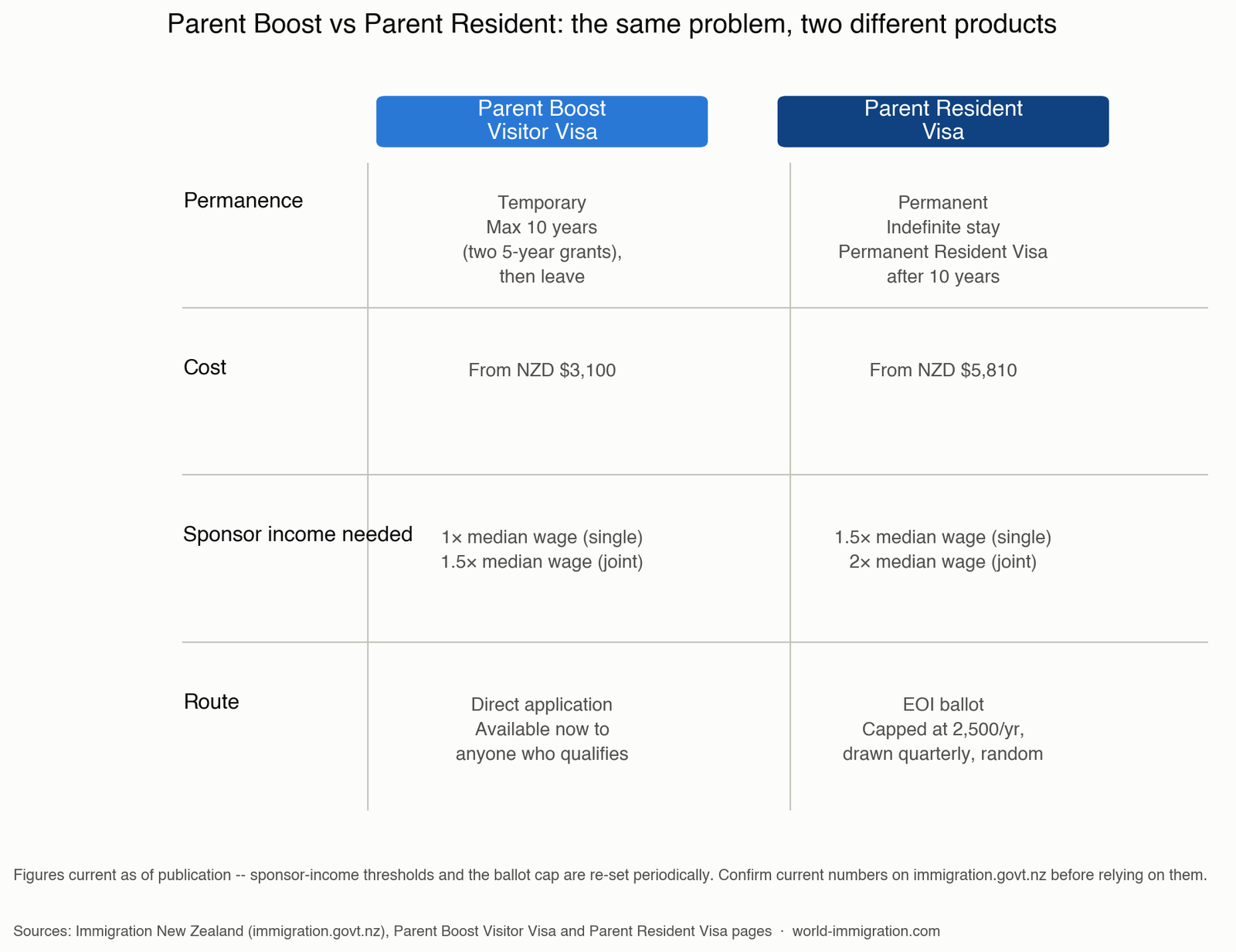
The Parent Boost Visitor Visa opened for applications on 29 September 2025, having been announced the previous June. It is designed for exactly the situation above: a parent who wants to spend long stretches in New Zealand near an adult child, without either side pretending it is a move to residence. A grant lasts up to five years and a parent can hold a maximum of two grants, so ten years is the ceiling. It is multi-entry with no cap on the length of any single visit and it costs from NZD $3,100. What it does not do is lead anywhere. INZ states outright that it “does not give you a pathway to a resident visa.” At the end of ten years the parent leaves, unless they separately qualify for something else.
The Parent Resident Visa is the residence route. It reopened on 12 October 2022 after being suspended in 2016, with a new set of sponsor-income rules and a fixed cap of 2,500 approvals a year. It grants indefinite stay with work and study rights and after ten continuous years a parent can move to a Permanent Resident Visa. It costs from NZD $5,810. The catch sits in how you get selected, which is not an application you simply lodge and wait on. You submit an expression of interest (EOI), it goes into a pool and INZ draws from that pool at random roughly four times a year. Until your EOI is drawn, you cannot apply at all.
Parent Boost is available to anyone who meets the requirements, right now, as a visitor. The Parent Resident Visa is residence, but access to it is rationed by a ballot most people will not win quickly. A family choosing between them is really choosing between “here often, but never a resident” and “possibly a resident, after an uncertain wait.”
What Your Adult Child Has to Earn: Sponsor Income Thresholds
Both visas lean heavily on the sponsoring child’s income and this is where a lot of applications fall over before they start. The requirement is not a token check. It scales with the visa, the number of parents being sponsored and whether one or two adult children sponsor jointly. The thresholds are pinned to the New Zealand median wage, which INZ set at NZD $35.00 an hour from 9 March 2026. On INZ’s own calculation (NZD $35 an hour times 40 hours a week times 52 weeks) that works out to NZD $72,800 a year and that is the figure used on the sponsor-income pages for both visas. The current thresholds took effect on 30 April 2026.
The Parent Resident Visa’s published sponsor-income rules ask the most, because it leads to residence. A single sponsor needs 1.5 times the median wage. Two adult children sponsoring together need twice the median. Each additional parent added to the application and each additional joint sponsor, moves the bar by another half of the median wage. The Parent Boost bar is lower, reflecting that it is temporary: one times the median for a single sponsor, 1.5 times for joint sponsors. A rough guide for the common cases:
| Situation | Multiple of median wage | Approx. annual income required |
|---|---|---|
| Parent Boost — single sponsor, one parent | 1× | NZD $72,800 |
| Parent Boost — joint sponsors, one parent | 1.5× | NZD $109,200 |
| Parent Resident — single sponsor, one parent | 1.5× | NZD $109,200 |
| Parent Resident — joint sponsors, one parent | 2× | NZD $145,600 |
| Each extra parent, or each extra joint sponsor | +0.5× | +NZD $36,400 |
Source: Immigration New Zealand sponsor-income requirements for the Parent Resident Visa and Parent Boost Visitor Visa, effective 30 April 2026, based on a median wage of NZD $35.00/hour. These figures move whenever the median wage is updated, so confirm the current numbers on immigration.govt.nz before relying on them.
There is a way around the sponsor-income test on Parent Boost specifically. A parent who cannot meet it through a child can instead self-fund, showing personal income of roughly NZD $33,663 a year, or about NZD $170,000 in maintenance funds, without a qualifying sponsor at all. That option does not exist for the Parent Resident Visa, which always requires a sponsoring child who clears the income bar.
One requirement differs between the two visas and families often assume any adult child qualifies when they don’t. For the Parent Resident Visa, the sponsor must have been a New Zealand citizen or resident for at least three years before applying and must actually live here throughout, defined as spending 184 or more days a year in the country in each of those years. Parent Boost is looser on this specific point: it only requires the sponsor to currently be a New Zealand citizen or resident who normally lives here and spends 184 or more days a year in the country during the sponsorship, with no minimum-years history behind them. Either way, a child who has residence but lives mostly overseas is not a workable sponsor.
The Ballot: A Lottery, Not a Queue
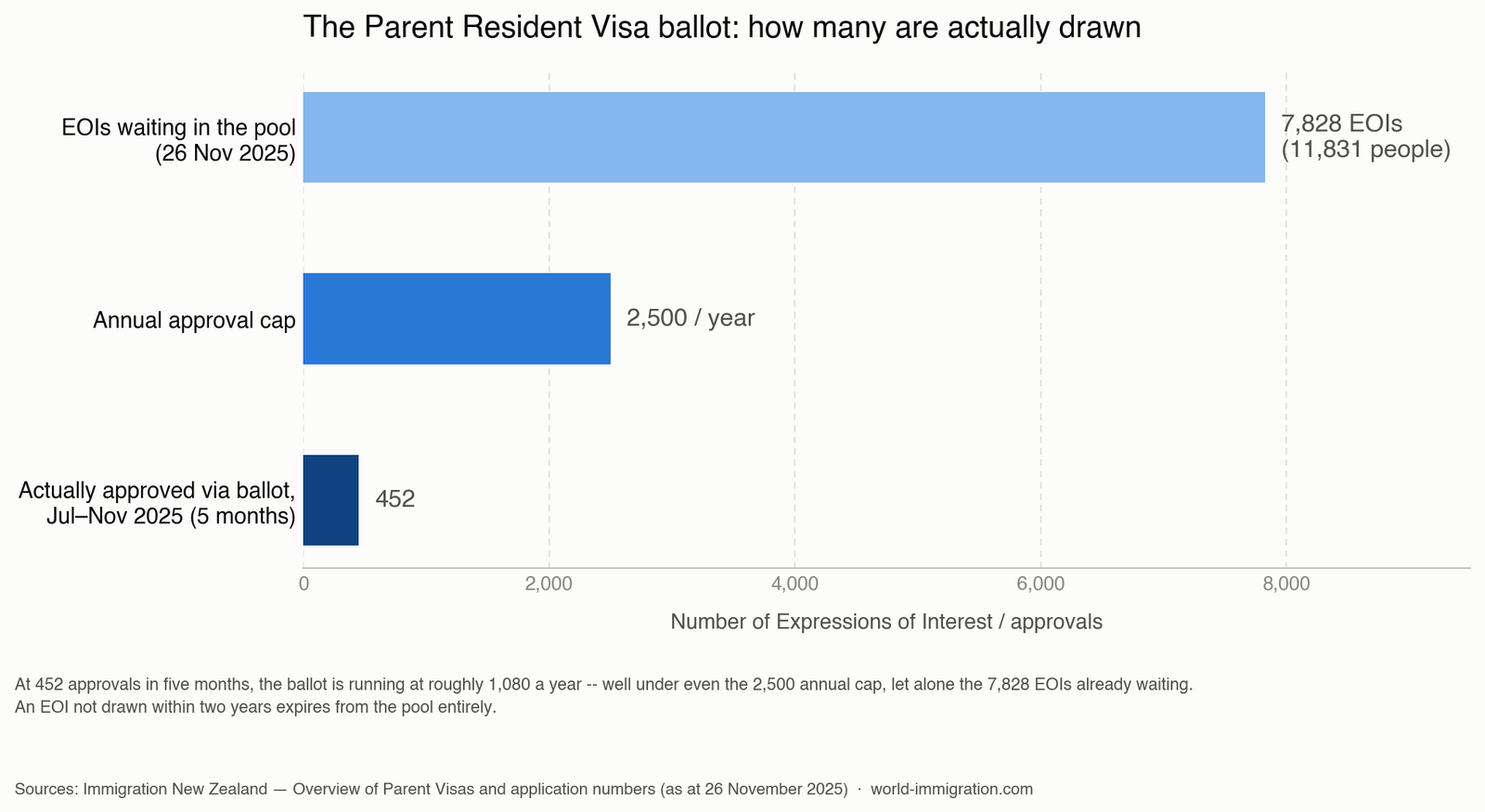
The part of the Parent Resident Visa that surprises people most is that selection is random. You submit an EOI and every quarter, on roughly the second Tuesday of February, May, August and November, INZ draws a batch from the pool. It is not first come, first served. An EOI lodged three years ago holds no priority over one lodged last week. If yours is drawn you receive an Invitation to Apply and the visa application itself begins. If it is not, it sits in the pool and waits for the next draw and it expires entirely after two years if it is never selected.
As of 26 November 2025 there were 7,828 EOIs in the pool, covering 11,831 people, against an annual cap of 2,500 approvals. In the first five months of the 2025–26 financial year, INZ’s own figures show 452 of those approvals came through the ballot draw itself, plus a further 818 through a residual transitional queue left over from the pre-ballot system, for 1,270 total. Set against a pool of 7,828 EOIs waiting for the ballot specifically, the ballot draw alone is still clearing only a small fraction of the people waiting each round, so a great many of those EOIs will simply time out at two years without ever being drawn. This is where the multi-year uncertainty lives and it is easy to miss because the official wait-time figures point somewhere else entirely.
INZ’s own resident-visa wait-times page puts the Parent Resident Visa at an average of 8 months, with most applications completed within 11 months. Those numbers only measure the stretch from Invitation to Apply to a decision. They say nothing about how long an EOI waits in the pool beforehand, which is the open-ended part. Read casually, “8 months” sounds like the whole journey. It is only the last leg of it and only for the minority who get drawn.
Whether the Ballot Survives Is an Open Question
The randomness has become a live political grievance. The objection is straightforward: families who have waited patiently see newer applicants drawn ahead of them purely by chance and the system gives no one any certainty about when, or whether, their turn comes. That frustration has been sharpest in migrant communities with large numbers of applicants and it fed a petition that gathered more than 10,000 signatures.
The government has responded by opening a review. In December 2025, Immigration Minister Erica Stanford’s office confirmed that officials were examining alternatives to the ballot, including reverting to a chronological queue where applications are processed in the order they arrive. Advice was expected “early 2026.” As I write this in mid-2026, no final decision and no implementation date have been announced publicly. So the ballot is the system today, but its future is unsettled. If you are planning around the Parent Resident Visa, treat the selection method as something that could change and do not assume either that the ballot is permanent or that a queue is coming. Neither is confirmed.
A formal 2,000-place queue that ran alongside the ballot was wound back in a 1 July 2025 update, because the older backlog it was clearing had nearly cleared. In the 2024–25 year the minister made a one-off increase to the cap, lifting the cap to 2,831 to help finish that clearance. Those are transitional details, not permanent features and they explain why the published approval figures do not sit neatly against a flat 2,500 cap.
Parent Boost’s Year-Three Catch: The Health and Insurance Check
Parent Boost is easy to picture as a relaxed five-year stay and that picture is wrong in one important respect. The visa carries ongoing obligations and the one families least expect lands in the third year. The holder has to pass a health and insurance recheck and to do it they must physically leave New Zealand. It is not a paperwork formality done from the sofa. It involves an offshore medical, it carries its own processing fee of NZD $325 (or $240 at the concession rate) and INZ warns it can take up to three months to clear. A family needs to plan an actual trip out of the country, at a fixed point, several years into the arrangement.
The insurance requirement behind it is specific and not cheap. For the full duration of the visa, the parent must hold health and travel cover of at least NZD $250,000 for emergency medical treatment, NZD $100,000 for cancer cover, NZD $250,000 for repatriation and NZD $50,000 for return of remains, from an insurer carrying a credit rating of at least “A (strong).” There is also a chest X-ray and general medical exam at application. For an older parent, maintaining insurance at that level for up to ten years is a substantial standing cost and it is the sort of figure that changes whether the visa is affordable at all.
The early application data hints at how much the insurance condition matters in practice. By 2 February 2026, INZ had received 708 Parent Boost applications and approved 230, but a further 108 sat “approved in principle,” held up pending acceptable insurance evidence. That is a sizeable share of applicants clearing every other hurdle and then stalling on the cover. Only six had been declined outright and 44 withdrawn.
Parent Boost carries no right to work in New Zealand, with one narrow exception: remote work for an employer or client based overseas is allowed. A parent cannot take a local job to help cover the insurance and living costs. And no dependent children can be included on the application, so it does not suit a younger parent still raising a family of their own.
A Third, Separate Route: The Parent Retirement Resident Visa
One more product sits alongside these two and gets folded into the confusion, so it deserves a clear name of its own. The Parent Retirement Resident Visa is a separate, investment-based route to residence for a parent who can commit substantial capital to New Zealand, on acceptable-investment terms similar to the country’s investor visas. It bypasses the ballot entirely, because it is bought rather than balloted. It is a niche, high-net-worth option, not a mainstream alternative for most families and it should not be confused with the Parent Resident Visa ballot. If a parent has serious investment capital, it is a route to explore with proper advice. For everyone else, the two main products above are the field.
What This Cannot Tell You
This article sets out how the two parent visas work as of mid-2026 and this is a category that has moved repeatedly. It cannot tell you when, or whether, a given EOI will be drawn from the ballot pool, because that is random and depends on how many others are waiting. It cannot tell you whether the ballot will still be the selection method by the time you read this, given the review underway. And it cannot tell you the exact fees and income thresholds that will apply on any future date, because both are re-set periodically against the median wage and the fee schedule.
It also cannot judge your own family’s numbers for you. Whether the sponsoring child clears the income threshold, whether a parent can carry the required insurance for a decade, whether self-funding is realistic, these turn on personal circumstances no general guide can assess. For a decision this large, check the current settings on immigration.govt.nz directly and for anything complex consider a Licensed Immigration Adviser, who is regulated in New Zealand and searchable on the Immigration Advisers Authority register.
For the wider picture on settling here, our moving to New Zealand hub pulls the country’s visa routes, costs and practicalities together. If the family member you are trying to bring over is of working age rather than retirement age, the New Zealand work visa routes are a different and often faster conversation than the parent categories. And if the parent is weighing New Zealand as a retirement base in their own right, rather than as a family visit, our retiring in New Zealand guide covers the routes and costs from that angle.
Frequently Asked Questions
Q: What is the difference between the Parent Boost and Parent Resident Visa?
Parent Boost is a long-stay visitor visa. It lets a parent live in New Zealand for up to five years at a time, to a maximum of ten years total, but it never leads to residence and carries no work rights beyond remote work for an overseas employer. The Parent Resident Visa is a permanent residence pathway with work and study rights and, after ten continuous years, access to a Permanent Resident Visa. The trade-off is access: Parent Boost is available to anyone who meets the requirements now, while the Parent Resident Visa is rationed through a random ballot capped at 2,500 approvals a year.
Q: How much does my child need to earn to sponsor a parent to New Zealand?
It depends on the visa and the numbers involved. For a single adult child sponsoring one parent, the Parent Resident Visa needs 1.5 times the median wage, about NZD $109,200 a year and Parent Boost needs one times the median, about NZD $72,800. Two children sponsoring together, or an extra parent added to the application, each raise the bar by half the median wage, roughly NZD $36,400. On Parent Boost only, a parent who cannot meet the sponsor-income test can self-fund instead, showing around NZD $33,663 of personal income a year or about NZD $170,000 in maintenance funds.
Q: How long does the New Zealand parent visa ballot take?
There is no fixed answer and anyone quoting you a firm timeline is guessing. INZ draws EOIs from the pool at random about four times a year and an EOI expires after two years if it is never selected. As of late November 2025 there were 7,828 EOIs waiting, covering 11,831 people, against a cap of 2,500 approvals a year, so many will time out undrawn. The official processing time, an average of 8 months and most completed within 11, applies only after an EOI is drawn and an Invitation to Apply is issued. It does not include the open-ended wait in the pool, which is the part with no guarantee.
Q: Can a parent on a Parent Boost visa eventually become a resident?
Not through Parent Boost itself. INZ is explicit that it does not provide a pathway to residence and the maximum is two grants of five years, so ten years total, after which the parent must leave. Becoming a resident means qualifying separately, either through the Parent Resident Visa ballot, the investment-based Parent Retirement Resident Visa, or another category entirely. Holding Parent Boost gives no advantage in the residence ballot.
Sources
- Immigration New Zealand — Parent Boost Visitor Visa
- Immigration New Zealand — Parent Resident Visa
- Immigration New Zealand — Parent Boost Visitor Visa FAQs
- Immigration New Zealand — Getting help to come to New Zealand on a Parent Resident Visa (sponsor income requirements)
- Immigration New Zealand — Parent Resident Visa expression of interest (EOI) selection process
- Immigration New Zealand — Resident visa wait times
- Immigration New Zealand — Overview of Parent Visas and application numbers
- Immigration New Zealand — Parent Resident Visa overview and application numbers
- Immigration New Zealand — Update to the Parent Resident Visa Category
- Immigration New Zealand — Parent Retirement Resident Visa
- Immigration New Zealand — New occupations recognised under the National Occupation List and annual median wage increase
- Immigration New Zealand — Income thresholds to increase for Pacific and parent visa categories
- RNZ — Parent Resident Visa review advanced after shortcomings recognised
- RNZ — Chronological queue under consideration for parent resident visa applications
- Immigration Advisers Authority — Register of licensed immigration advisers

