
Somewhere in the planning of a later-life move, a lot of people go looking for New Zealand’s retirement visa. Portugal has one. Panama has one. The Philippines has one. The assumption is a fair one: you have savings or a pension, you are past working age, you want to see out your years somewhere calm and green, so surely there is a category built for exactly that. There isn’t. New Zealand has no dedicated retirement visa in the sense those other countries mean it and discovering that after you have half-decided to come is where the planning gets hard.
So retiring in New Zealand is possible, but not through a purpose-built route that grants long-term residence on the strength of being retired and self-funding. What exists instead is a handful of separate visas, none of them designed for retirees as such, that a retiree can use with varying degrees of difficulty and cost. Some are temporary and cap how much of the year you can be here. Others lead to residence but ask for a seven-figure investment or an adult child already settled in the country. This article lays them out in order of how accessible they actually are and it is straight about the two things that hurt most: healthcare access before you qualify for the public system and how long the pension takes to reach. The figures come from Immigration New Zealand (INZ), Work and Income and the insurers named below.
Why There Is No Dedicated Visa for Retiring in New Zealand
The reason is structural rather than accidental. New Zealand’s residence system is built around two things: what you can contribute through work and family connection. There is a skilled-work stream, a family stream for partners and parents of people already here and an investor stream for large capital. Being retired fits none of those on its own. A retiree brings no labour to the market and unless they have a child who is a citizen or resident, no family anchor either. That leaves capital as the only lever, which is why every route that grants a retiree actual residence runs through a substantial investment.
This is not a criticism of the system, just an accurate representation of it. Countries with a dedicated retiree visa have made a deliberate choice to attract self-funded older migrants for the spending they bring. New Zealand has not made that choice. The result is that a comfortably-off retiree from the UK or North America who would sail into a Portuguese or Panamanian retirement visa finds the New Zealand options either capped, temporary, or very expensive. Knowing that at the outset saves a lot of wasted hope.
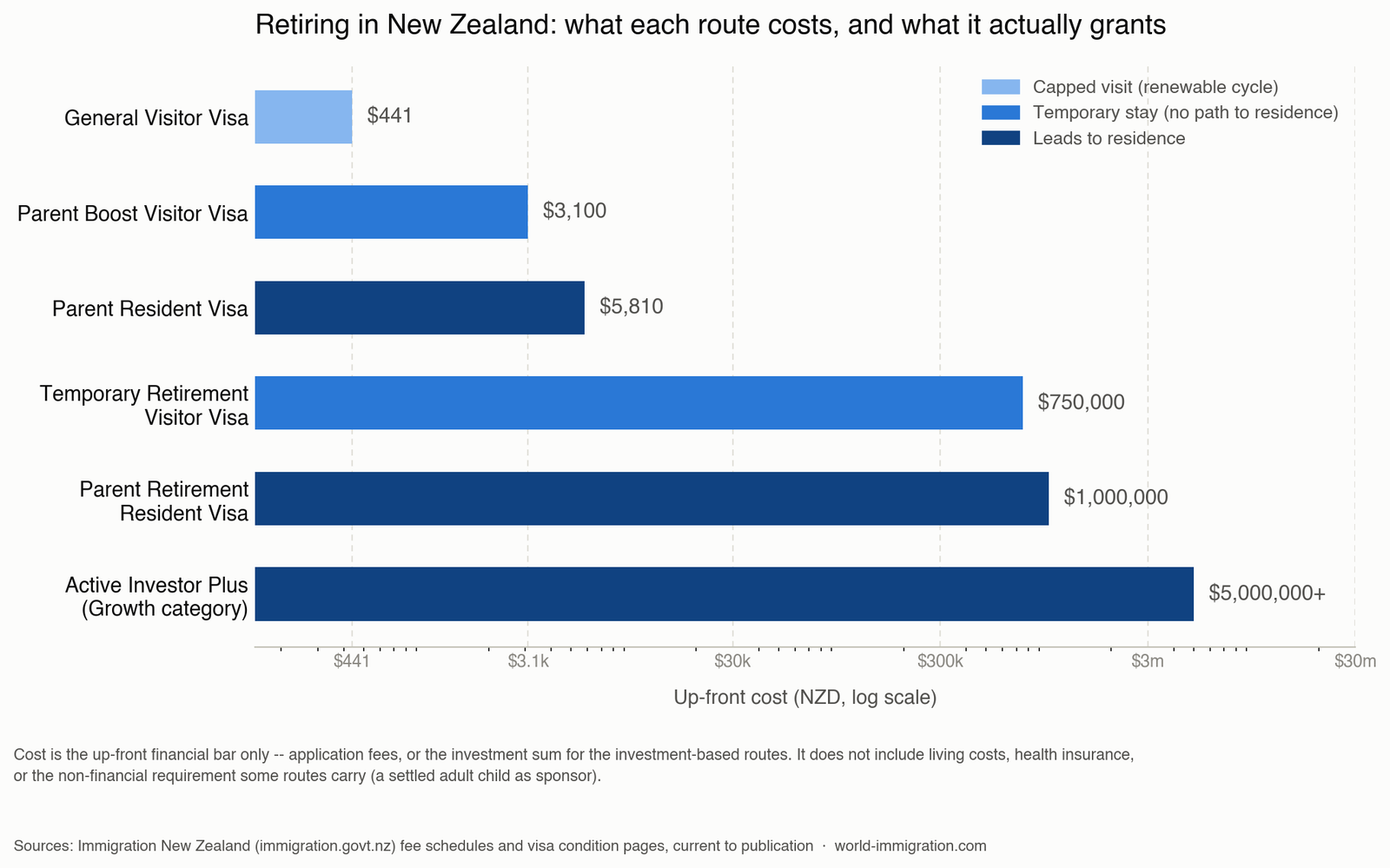
Route One: The Long-Stay Visitor Visa (The Cheapest Option, With a Hard Ceiling)
The most accessible way for a retiree to spend meaningful time in New Zealand is also the simplest: a General Visitor Visa, applied for and renewed on a cycle. It asks for no investment and no family connection, only that you can support yourself and intend to leave. It costs from NZD $441. For a retiree who wants to split the year between New Zealand and a home country, catching the southern-hemisphere summer here and returning north for the other half, it does the job without any of the complexity of the residence categories.
There is a firm limit built into it and it is the single most misread part of the whole subject. A standard single-entry Visitor Visa caps your physical presence at 9 months within any rolling 18-month period (multiple-entry visas are typically 6 months in any 12). The 18 months is a look-back window counted from your intended departure date, not a counter that resets each time you leave. So it is not “nine months, pop across the Tasman for a weekend, then nine months more.” Across every 18-month stretch, roughly a third of it has to be spent outside the country. You can apply to extend or renew from within New Zealand before your current visa runs out, but each grant lands you back inside the same ceiling. Renewing does not lift it.
It is a workable rhythm if that suits you. What it is not is a way to live in New Zealand year-round. It also comes with no work rights beyond remote work for an overseas employer and, the part that matters most for an older person, no access to publicly funded healthcare and no path toward the pension. More on both of those below.
Route Two: The Temporary Retirement Visitor Visa (The One Actually Named for Retirees)
This is the closest thing New Zealand has to a retirement visa and its name misleads people into expecting more than it delivers. The Temporary Retirement Visitor Visa is open to anyone aged 66 or over, with no requirement for a New Zealand family connection. In exchange for meeting a financial bar, it grants a stay of up to two years and you can reapply if you have kept the investment and insurance in place throughout. The financial bar has three parts: NZD $750,000 placed in an acceptable investment (bonds or managed funds, not cash deposits or property) and held for at least two years, a further NZD $500,000 in settlement funds to live on and an annual income of NZD $60,000 or more. The application fee runs from NZD $7,891 and INZ decides about 80% of these within four weeks, quick by the standards of its residence categories.
It does not lead to residence, despite the name. It is a two-year visitor visa that you renew, not a route to staying permanently. You must hold travel or health insurance for the whole stay, no dependent children can come with you and a partner can only be included if they independently satisfy the same requirements. So a retiree can commit three-quarters of a million dollars to an approved New Zealand investment, live here on this visa for a decade of two-year renewals and still never become a resident, never qualify for public healthcare through it and never move toward the pension. It buys time in the country. It does not buy a future in it.
For a retiree with capital but no adult child settled here, this is nonetheless the only investment-based option actually open to them, because the residence-granting investor routes below are either aimed at parents specifically or set the bar far higher. If your goal is simply to spend your retirement years in New Zealand and you can meet the numbers, it works. If your goal is to become a New Zealander, it does not get you there.
Route Three: The Parent Visas (Only If You Have a Child Settled Here)
If you are retiring to be near an adult child who is already a New Zealand citizen or resident, the family stream opens up and the situation changes considerably. Two visas sit here and they are entirely different from each other: the Parent Boost Visitor Visa, a long-stay temporary visa that lets a parent live here for up to ten years but never become a resident and the Parent Resident Visa, a residence route selected through a random ballot with a fixed annual cap. Both hinge on the sponsoring child clearing an income threshold pinned to the median wage and the ballot in particular can leave an application sitting undrawn for years.
Because the detail on these two runs deep, I have set it out in full separately rather than repeat it here. If a resident child is your anchor into New Zealand, the New Zealand parent visa guide covers the sponsor-income thresholds, the ballot mechanics, the insurance conditions and the ten-year ceiling on Parent Boost. The one point to carry across to this article is the gate: both parent routes require an adult child who is a citizen or resident living in New Zealand. A retiree with no family connection here cannot use either, which is precisely why the visitor-visa cycle and the Temporary Retirement Visitor Visa exist as the fallback options for everyone else.
Route Four: The Parent Retirement Resident Visa (Investment Plus a Settled Child)
This one is easy to mix up with the Temporary Retirement Visitor Visa above, because both carry “retirement” in the name and the two are nothing alike. The Parent Retirement Resident Visa is an investment-based route to actual residence, but only for parents of a New Zealand citizen or resident. It asks for a larger commitment across the board: NZD $1 million invested and held for four years (in acceptable investments such as government or investment-grade corporate bonds, NZX-listed shares, registered-bank deposits, or approved managed schemes), plus NZD $500,000 in settlement funds and an annual income of NZD $60,000 or more. After the four-year investment period, you become eligible to apply for a Permanent Resident Visa. The fee runs from NZD $12,850.
The difference from the temporary visa is the whole point of it. One is $750,000 held two years, temporary, open to any retiree, leading nowhere. The other is $1 million held four years, leading to residence, but locked behind having an adult child settled here. A retiree without a New Zealand-resident child cannot access this route at all, no matter how much capital they have. For them the choice collapses back to the temporary visa or the visitor cycle. This table is the clearest way to see the two “retirement” visas side by side.
| Temporary Retirement Visitor Visa | Parent Retirement Resident Visa | |
|---|---|---|
| Who can apply | Anyone aged 66+ (no NZ family needed) | Parents of a NZ citizen/resident child only |
| Investment | NZD $750,000, held 2 years | NZD $1,000,000, held 4 years |
| Settlement funds | NZD $500,000 | NZD $500,000 |
| Annual income | NZD $60,000+ | NZD $60,000+ |
| Leads to residence? | No, temporary only | Yes, Permanent Resident Visa after the term |
| Fee from | NZD $7,891 | NZD $12,850 |
Source: Immigration New Zealand, Temporary Retirement Visitor Visa and Parent Retirement Resident Visa requirements, 2026. Investment thresholds and fees are re-set periodically, so confirm the current figures on immigration.govt.nz before relying on them.
Route Five: Active Investor Plus (The “Golden Visa” for the Very Wealthy)
At the top end sits the Active Investor Plus Visa, often called New Zealand’s golden visa. It carries no age or retirement condition at all, so it is not a retiree category as such, but it is frequently used by wealthy retirees as a way around the family-sponsorship requirement. The Growth category asks for NZD $5 million invested in higher-risk New Zealand businesses, held for 36 months, with a minimum of 21 days physically present over the period. The Balanced category asks for NZD $10 million across a broader range of instruments, held for 60 months, with 105 days of presence (reducible with additional investment). It leads to residence after the investment term.
For most people this is academic. The thresholds put it out of reach of anyone but the seriously wealthy and it is covered in more depth in our New Zealand golden visa guide. The reason it belongs in a retirement article at all is that it is the one residence route with no family gate, so for a retiree with very substantial capital and no settled child, it is the alternative to giving up on residence entirely. As with every route here, gaining residence does not by itself deliver the pension. That runs on its own separate clock, which is the next thing to understand.
Healthcare: The Gap Before You Qualify for the Public System
Healthcare is where the temporary routes bite hardest for an older person and it is easy to miss until you need it. New Zealand’s public health system is eligibility-gated by visa type. Residents and people on work visas valid for two years or more from first arrival are covered. Visitors and holders of the Temporary Retirement Visitor Visa, Parent Boost, or a rolling Visitor Visa, are not. If you are here on any of the temporary retiree routes, you have no access to publicly funded hospital or specialist care and you pay full cost for anything you use.
The natural response is to buy private health insurance instead, but Immigration New Zealand’s own guidance warns that insurers may require proof of eligibility for the public system before they will sell a domestic policy. A retiree on a temporary visa generally cannot buy ordinary New Zealand health insurance and must hold international or travel health cover for the whole stay. Even for those who do become eligible, private premiums carry steep age-loading. Southern Cross, the largest insurer, phased in a rise in its “common rating age” (the age at which premiums stop climbing with age and pool instead) from 65 to 75 between 2016 and 2026, which means an older applicant is individually age-rated for longer than they used to be, reflecting the higher average cost insurers expect from older members. Insurers structure age-related pricing differently, but none of it helps until you are eligible to buy a domestic policy in the first place.
The full mechanics of who is covered, what the ACC accident scheme does and does not reach and what private cover actually costs are set out in the healthcare for expats in New Zealand guide. For retirement planning specifically, the take-away is blunt: on a temporary retiree visa, budget for full international health insurance at older-age rates for the entire time you are here, because the public system is closed to you and the domestic private market largely is too.
NZ Super: The Pension You Probably Will Not Get for Years
New Zealand Superannuation, universally called NZ Super, is the state pension, paid from age 65 to those who qualify. A common assumption among people planning a move is that gaining residence brings the pension with it. It does not. NZ Super has two separate tests and a migrant retiring here later in life can fail both for a long time.
The first test is status: you must be a citizen, permanent resident, or hold a residence-class visa. Every temporary visa fails this outright, including both retirement-named visitor visas and Parent Boost, no matter how many years you spend in the country on them. The second test is a residency-years requirement and this is the one that undoes late-life plans. It is currently phasing upward under the Fair Residency Amendment Act 2021, on a sliding scale keyed to your date of birth. Anyone born on or before 30 June 1959 needs 10 years of New Zealand residence since age 20. The requirement then climbs year by year, reaching 20 years for anyone born on or after 1 July 1977. At least five of those years must fall after age 50 and they need not be consecutive.
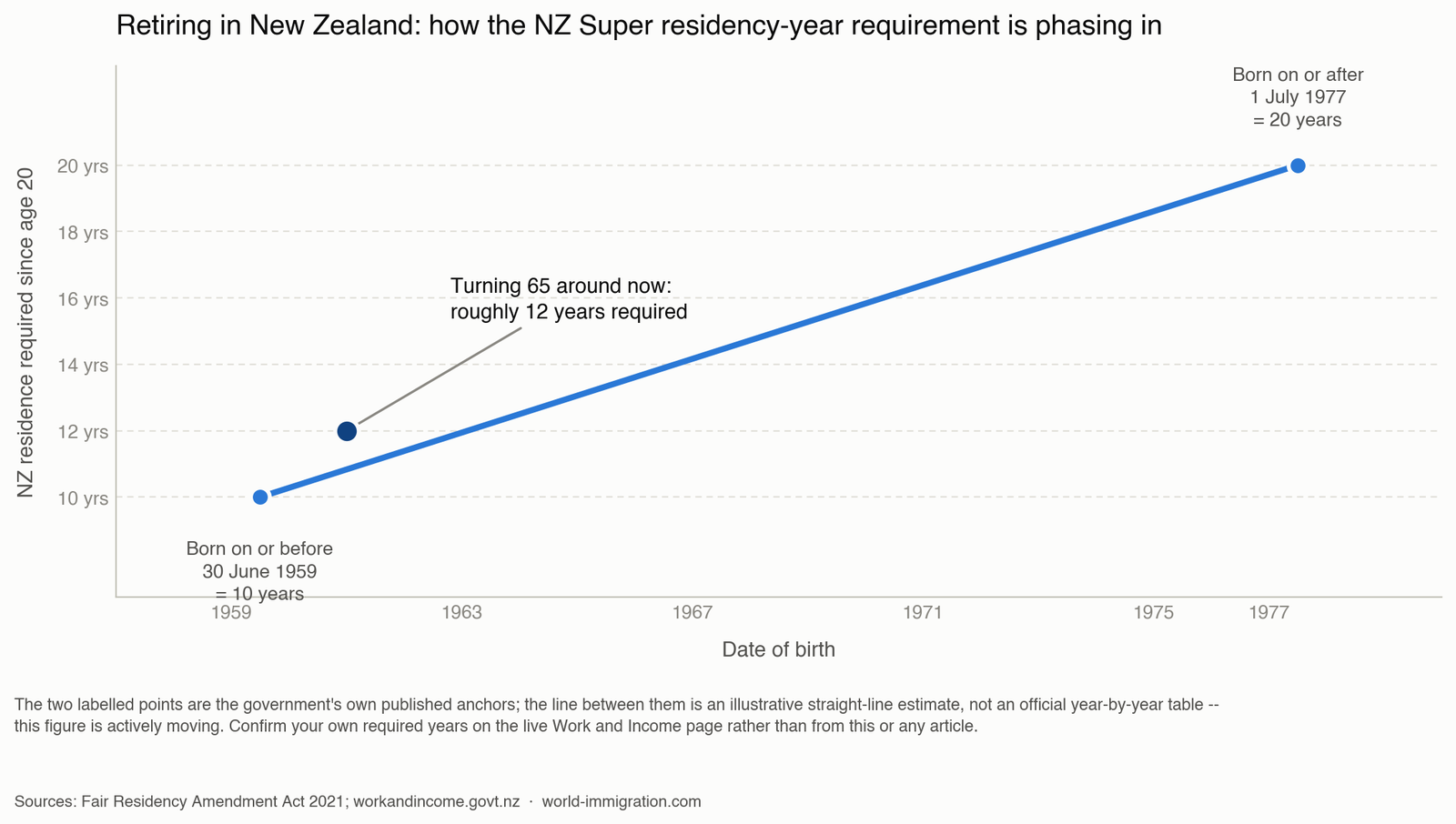
For someone turning 65 around now, the requirement sits at roughly 12 years of residence, per the Work and Income phase-in schedule. This is a moving figure. Check it against the live Work and Income page at the moment you are reading, rather than taking it from any article as settled. This is an actively-tracked and sometimes-contested policy area and the exact number for a given person turns on their precise birth date. As a lifelong New Zealander I can say it is a live domestic conversation, not just a migrant’s concern: it affects NZ-born people too if they have spent long stretches overseas.
Someone who arrives at 65 on a residence-class visa does not start collecting NZ Super on their birthday. They face something in the order of a decade of residence, potentially more, before the pension begins and if they arrive late enough, they may never reach the threshold. Time spent in Australia, Canada and several other social-security-agreement countries, or in the Realm countries of the Cook Islands, Niue and Tokelau, can count toward the total in some circumstances (under different rules to the SSA countries — Realm-country time can only cover part of the total, with a minimum of 10 years still needing to be actual New Zealand residence), which softens it for some. But the baseline planning assumption has to be that you fund your own living costs entirely from savings, pension or investment income for as long as the residency-years gap lasts. That is exactly why the NZD $60,000 annual-income requirement built into the investment visas is not a bureaucratic formality. It is the floor you actually live on.
What This Cannot Tell You
This article maps the routes a retiree can use to spend time in, or move to, New Zealand as they stand in mid-2026 and several of the settings inside it move. It cannot tell you the exact investment thresholds, income requirements, or fees that will apply on any future date, because INZ re-sets them periodically. It cannot tell you the precise NZ Super residency-years figure that will apply to you, because that depends on your date of birth and on a phase-in schedule that is still climbing and still politically live. Check the current numbers on the Work and Income page directly before you plan around them.
It also cannot judge your own arithmetic for you. Whether $750,000 tied up for two years makes sense against your other options, whether you can carry older-age international health insurance for the length of your stay, whether the years until the pension leave your savings intact, these turn on personal circumstances no general guide can weigh. For a decision this size, confirm the current settings on immigration.govt.nz and the Work and Income pension pages and for anything complex consider a Licensed Immigration Adviser, who is regulated in New Zealand and searchable on the Immigration Advisers Authority register. For the broader view of settling here, the moving to New Zealand hub pulls the visa routes, costs and practicalities together and the cost of living in New Zealand guide sets out what your income actually has to cover once you arrive.
Frequently Asked Questions
Q: Does New Zealand have a retirement visa?
Not in the way countries like Portugal, Panama or the Philippines do. There is no category that grants long-term residence purely on the basis of being retired and self-funding. The closest option is the Temporary Retirement Visitor Visa, open to anyone aged 66 or over who invests NZD $750,000 and meets income and settlement-fund requirements, but it is temporary and does not lead to residence. Actual residence for a retiree runs either through the parent visas (which need an adult child settled in New Zealand) or through large investor routes such as the Parent Retirement Resident Visa or Active Investor Plus.
Q: Can I just keep renewing a visitor visa and live in New Zealand?
Only up to a point. A standard single-entry Visitor Visa caps your physical presence at 9 months within any rolling 18-month period and renewing does not lift that ceiling. The 18-month window is a look-back counted from your departure date, so roughly a third of every 18 months must be spent outside the country. It is a workable pattern for a retiree splitting the year between New Zealand and a home base, but not a way to live here full-time. Visitor-visa holders also get no publicly funded healthcare and no progress toward NZ Super.
Q: If I get residence, do I get NZ Super straight away?
No. NZ Super has a residency-years test on top of the requirement to hold a residence-class visa. Under the Fair Residency Amendment Act 2021, the required years are phasing up from 10 to 20 depending on your date of birth, with at least five of them after age 50. Someone turning 65 around now needs in the order of 12 years of New Zealand residence, per the Work and Income phase-in schedule, so a person who arrives at 65 on a resident visa does not qualify immediately and may wait a decade or more. Check the exact current figure on the Work and Income website, as this is a moving and sometimes-contested policy area.
Q: Can a retiree on a temporary visa get New Zealand health insurance?
Usually not a domestic policy. Immigration New Zealand notes that insurers may require proof you are eligible for the public health system before they will sell you cover and temporary retiree visas do not confer that eligibility. In practice a retiree on the Temporary Retirement Visitor Visa, Parent Boost, or a rolling Visitor Visa needs international or travel health insurance for the whole stay, at older-age rates. Even once eligible, private premiums carry steep age-loading for older applicants, so this is a substantial standing cost to build into any retirement budget.
Sources
- Immigration New Zealand — Visitor Visa
- Immigration New Zealand — Working remotely in New Zealand on a visitor visa
- Immigration New Zealand — Temporary Retirement Visitor Visa
- Immigration New Zealand — Parent Boost Visitor Visa
- Immigration New Zealand — Parent Resident Visa
- Immigration New Zealand — Parent Resident Visa EOI selection process
- Immigration New Zealand — Parent Retirement Resident Visa
- Immigration New Zealand — Active Investor Plus Visa
- Health New Zealand (Te Whatu Ora) — Eligibility for publicly funded health and disability services
- Immigration New Zealand — Who can get public health care
- Southern Cross Health Society — Premium structure change FAQs (common rating age)
- New Zealand Legislation — New Zealand Superannuation and Retirement Income (Fair Residency) Amendment Act 2021
- Work and Income — Who can get NZ Super
- Work and Income — Change to residence criteria for NZ Super and Veteran’s Pension
- Work and Income — Using Social Security Agreement countries to meet residence criteria for NZ Super
- Work and Income — Using NZ Realm countries to meet residence criteria for NZ Super
- Immigration Advisers Authority — Register of licensed immigration advisers
- Portugal — Vistos (Ministry of Foreign Affairs), National Visa types (D7)
- Migración Panamá — Permisos migratorios (Pensionado)
- Philippine Retirement Authority — Special Resident Retiree’s Visa (SRRV)

