
Most people weighing up a New Zealand study visa (officially called a Student Visa) are probably not really asking about paperwork. They are probably asking wha the whole exercise adds up to, the tuition, the years away from home, the cost of actually living here, set against what it leaves them with at the end. A qualification, yes, but ideally perhaps also a foothold. The right to work while studying, a way to stay on and earn afterwards and maybe a path toward residence that makes the investment worthwhile. The visa itself is the easy part to describe. What matters is how it connects to everything that comes after it and the official guidance from Immigration New Zealand (INZ) lays out each piece clearly without ever quite joining them up for you. This article tries to join them up.
One point to set straight at the start, the rules here shifted through 2025 and are shifting again into 2026 and a lot of the data still circulating online predates those changes. The work-hours cap is not what most older pages say it is. The Post-Study Work Visa is being widened. From 24 August 2026, studying in New Zealand rather than overseas will earn you an extra residence point. If you are reading a forum thread or a blog post from 2024, treat it as background context, not current fact. Every figure below is current as of mid-2026 and sourced from immigration.govt.nz.
New Zealand Study Visa Eligibility and the Approved-Provider Requirement
A New Zealand student visa rests on an offer of place from an approved education provider. An approved provider is not simply any school, polytechnic, or university operating in New Zealand. It is one that is registered with the New Zealand Qualifications Authority (NZQA) or the Ministry of Education and that has signed the Education (Pastoral Care of Tertiary and International Learners) Code of Practice 2021.
International students cannot legally enrol at a provider that has not signed that Code. The Code is a specific, checkable status rather than a vague quality marker and NZQA keeps a public register of signatories. Before you pay a deposit or commit to anything, confirm the institution is on it. A provider can be entirely legitimate, well known, even long established and still not hold the right status for hosting international students on a visa. Checking first saves a great deal of grief later.
Beyond the offer of place, you need to meet health and character standards (covered below) and satisfy INZ that you hold genuine intentions to study, meaning the course is a plausible reason for coming here rather than a cover for something else. For most applicants with a legitimate offer from an approved provider, that last test is probably not the hurdle. The financial evidence is.
Financial Evidence
You have to show INZ that you can support yourself while you are here, on top of paying your tuition. The living-cost thresholds are fixed figures and they depend on what you are studying.
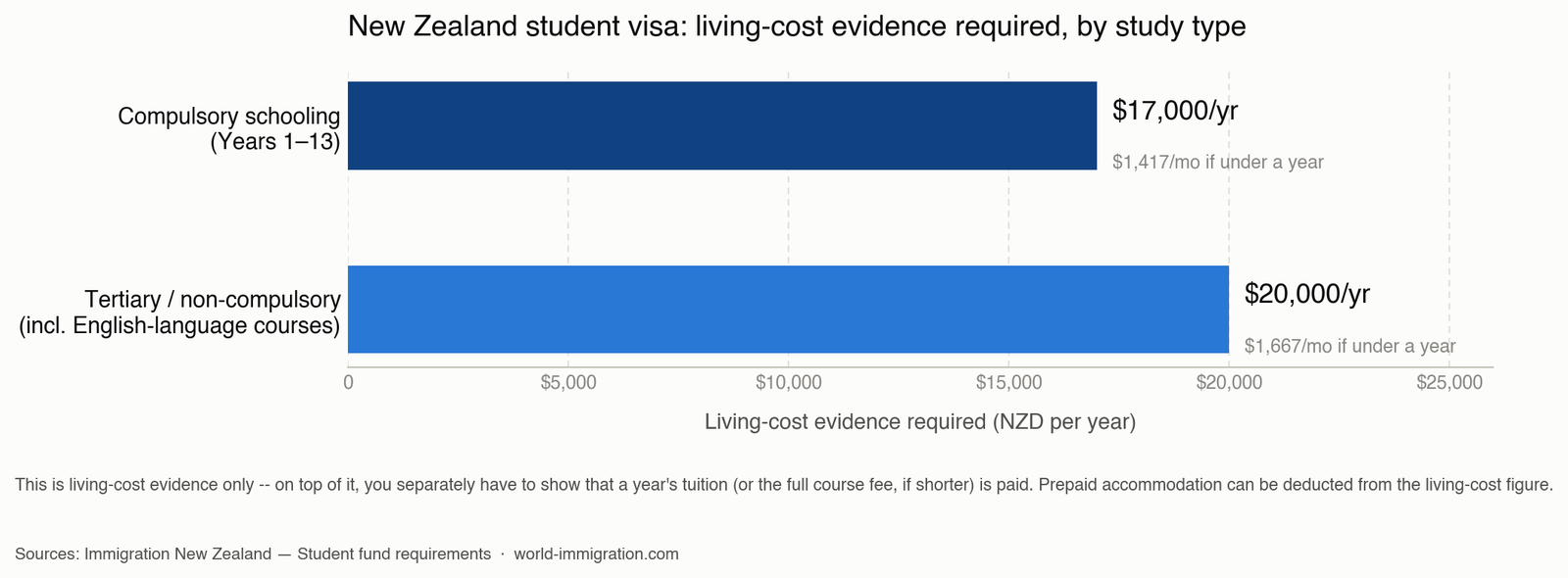
For tertiary study, English-language courses and other non-compulsory education, you need to show NZD $20,000 per year. If your course runs for less than a year, that works out at $1,667 per month. For compulsory schooling (Years 1 to 13), the figure is NZD $17,000 per year, or $1,417 per month for a course under a year. On top of the living costs, you have to separately show that the tuition fee for one year of study is paid (or the whole course, if it is shorter than a year). If you have prepaid your accommodation, that amount can be deducted from the living-cost figure you need to demonstrate.
INZ is specific about what it will and will not accept as evidence of those funds. It accepts bank statements covering the last three months with the account holder named, fixed-term deposits held for three months or more, scholarship letters and education-loan documentation from recognised banks. What it explicitly does not accept is a screenshot of your banking app, or a receipt from an education agent showing money paid to them. If your money sits in an account and you photograph the balance on your phone, that is not evidence INZ will use. You need the actual statement, in the account holder’s name, covering the required period.
There is one extra provision if it applies to your situation, you may need to show a further NZD $9,000 in evidence to cover maternity health and medical costs. Most applicants will not encounter this, but it is there in the rules.
The $20,000 figure deserves a reality-check, because it is a minimum for the visa, not a realistic annual budget for living here. In the larger cities, rent alone can consume a large share of it and the number has not always kept pace with what accommodation, transport and food actually cost. Treat it as the minimum INZ requires you to clear, not the sum you will comfortably live on. For a fuller picture of what it costs to live and rent in different New Zealand cities, the moving to New Zealand hub article pulls those figures together.
Health and Character Requirements
The health requirements scale with how long you intend to stay. A chest X-ray is generally required for stays over six months and also if in the five years before applying, you have spent a combined three months or more in a country with a high incidence of tuberculosis. A full medical certificate is generally not required for stays under 12 months, though INZ can ask for one case by case. Whatever medical evidence you provide has to be less than three months old at the point of application, so timing matters. Get it done too early and it expires before you file.
If you are 17 or older and the total time you will spend in New Zealand under the application is 24 months or more, you need police certificates. These must come from your country of citizenship and from any country you have lived in for five years or more since turning 17. A police certificate is valid for six months from its date of issue for the purposes of your application, so again, sequence the paperwork sensibly rather than gathering it all a year ahead.
Work Rights While Studying: The 25-Hour Rule
For years the standard figure was 20 hours per week. That is out of date. From 3 November 2025, eligible tertiary and secondary students can work up to 25 hours per week during the semester or term. The increase came out of the government’s International Education Going for Growth Plan, a concerted push to make New Zealand more competitive for international students. Anyone quoting you 20 hours is working from a superseded number.
The same change extended eligibility to all tertiary students on approved exchange or Study Abroad programmes, including single-semester courses that were previously shut out. During scheduled breaks (the mid-year break, the Christmas and New Year period and over summer) most eligible students can work full-time with no hourly restriction at all. That part has not changed and it shapes how you plan the year: the summer break in particular is a long stretch of unrestricted earning.
PhD and Research Master’s students sit in a more generous category that is easy to miss. They have no weekly hour cap at all, even during term, as long as they stay enrolled full-time. This is a distinct condition, not a variation of the 25-hour rule, if you are a doctoral or research-master’s candidate, you are not limited to 25 hours during the semester the way a coursework student is.
A few boundaries around all of this. Secondary students in Years 12 and 13 still need written permission from both a parent and the school before they can work, even under the new 25-hour cap. Students under 16 cannot work on a student visa at all. And work rights are not universal across every student visa, some very short courses or foundation only study carry no work rights whatsoever. Always read the actual condition printed on your visa rather than assuming the general rule applies to you.
Only student visas granted on or after 3 November 2025 carry the 25-hour condition from the outset, with nothing to apply for. Anyone whose visa was granted before that date still has the old 20-hour condition on it, whether it was issued through the old system (before 18 August 2025) or through the newer enhanced Immigration Online system (18 August to 2 November 2025) and has to apply for a variation of conditions to unlock the extra five hours, for a NZD $325 fee either way. All the 18 August 2025 date changes is which channel you apply through: an online variation-of-conditions form for the old system, or a variation through enhanced Immigration Online for the newer one. So two students at the same institution, doing the same course, can be on different caps purely because of when their visas were granted and a visa granted any time before 3 November 2025 needs an active application, not just a later issue date. If you are on an older visa and you want the full 25 hours, budget for the variation and file it rather than assuming a newer-looking issue date already covers you.
On the ground, the 25-hour cap mostly plays out in hospitality, retail and campus jobs, where a part-time roster of three or four shifts a week fits neatly under the limit. International students are a familiar and welcome part of those workforces here and the extra five hours makes a meaningful difference to a weekly budget without pushing anyone into the full-time bracket the visa is trying to hold them back from.
The Post-Study Work Visa
After finishing your qualification there is a next stage visa you can move on to, the Post-Study Work Visa. This is the main route for staying on and working after you graduate and it is designed as a bridge rather than a destination. To qualify you need an approved New Zealand qualification, studied full-time in New Zealand and you have to apply within the timeframe set for your qualification (3, 6, or 12 months after finishing study, depending on the level). You also need to show NZD $5,000 in living-expense evidence and meet the same health and character standards as before.
“Duration is not one figure for everyone.” Master’s and doctoral graduates who studied for at least 30 weeks in New Zealand get a fixed period of up to three years. Bachelor’s degrees (Level 7) and lower or non-degree qualifications work differently, instead of a fixed term, the visa length is matched to the actual time you spent studying, as confirmed by your education provider. For a longer undergraduate degree that can still be a solid stretch, for a shorter qualification it can be considerably less than the three years postgraduates receive. So the common belief that the Post-Study Work Visa is “one to three years, the same for everyone” is wrong in a way that matters for planning, a postgraduate gets a fixed generous period, an undergraduate gets a period pegged to how long they were enrolled.
The fee is from NZD $1,670 and processing runs at 80% of applications decided within five weeks. INZ’s own visa classification describes the Post-Study Work Visa as one that “can lead to a resident visa”, which is the official way of saying it is a stepping stone. It does not carry an independent long-term future of its own. Most graduates use the time it buys them in one of two ways: to find an employer who will sponsor them onto an Accredited Employer Work Visa, or to bank New Zealand work experience that counts toward residence points.
Changes Coming in November 2026
Two further changes are announced for 16 November 2026. They are part of the same International Education Going for Growth Plan that lifted the work-hours cap. As with anything dated in the future, confirm these are still on track before you rely on them, because announced settings can change.
The first is a new Short-term Graduate Work Visa. Six months of open work rights for graduates of NZQCF Level 5 to 7 qualifications who studied full-time for at least 24 weeks in New Zealand, excluding English-language, foundation or bridging qualifications. It needs NZD $5,000 in funds, the usual health and character checks and an application within three months of the student visa expiring.
To qualify you must never have previously held a Post-Study Work Visa, and the Short-term Graduate Work Visa itself can only be granted once. It explicitly cannot be used to run your own business, extended, or used to sponsor a partner or dependent children onto their own work or student visas. It is a job-search bridge, a window to line up an employer, not a route to start a company.
The second widens Post-Study Work Visa eligibility to graduates holding a Level 7 graduate diploma who also hold a bachelor’s degree (from New Zealand or overseas), provided the whole diploma was studied full-time in New Zealand with no cross-crediting. Here the visa length matches the study length, capped at one year and again it can be granted only once per person. Both changes point the same way, making it easier for graduates to convert study into a work window and a work window into something more permanent.
How Studying Here Feeds Into Residence
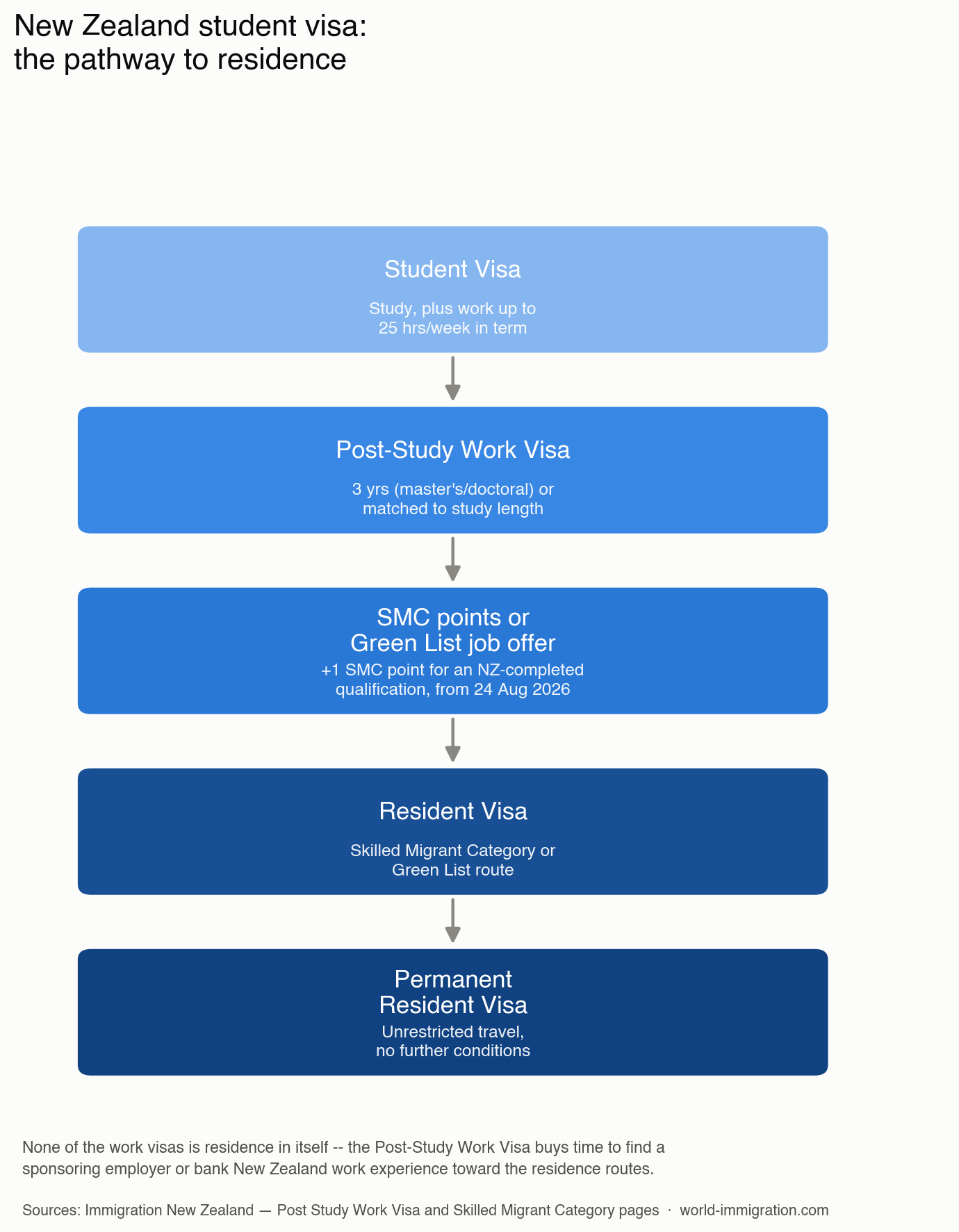
None of these work visas is residence in itself. The Post-Study Work Visa buys you time in New Zealand. Converting that time into a resident visa runs through the same machinery every skilled migrant uses, principally the Skilled Migrant Category (SMC) points system and the Green List job-offer routes. I have set out how those work in detail in the New Zealand work visa guide, so I will not re-run the points tables here. The connection to draw is why finishing your study in New Zealand, rather than getting the credential and leaving, is an advantage the coming rules build in on purpose.
From 24 August 2026, the Skilled Migrant Category awards one extra point for a qualification completed in New Zealand versus the same qualification completed overseas. (Doctoral degrees are the exception and in some cases master’s, where the differential does not apply.) That single point is a policy lever. Combined with the existing structure, where a qualification is worth points and each year of New Zealand skilled work adds one more up to a cap, a New Zealand-educated graduate with a decent job offer can reach the six-point threshold faster than an equivalent applicant who studied the same subject abroad. If the post-study job happens to be on the Green List, the path shortens again, some Tier 1 roles can go straight to residence and the 24 months of qualifying work that Tier 2 trades roles need is exactly the kind of experience a Post-Study Work Visa period can supply.
The student visa, the work rights while you study, the Post-Study Work Visa and the residence point for local qualifications are not four separate things. They are rungs on one ladder and the 2025 to 2026 changes have deliberately set them closer together. Whether they add up to a route that works for you depends on your qualification level, your field and whether your eventual occupation is one New Zealand is short of.
Fees and Processing at a Glance
| Item | Figure | Notes |
|---|---|---|
| Student visa application fee | From NZD $850 | Reviewed periodically; confirm current figure before applying |
| Student visa processing | Most completed within 3–10 weeks | Varies by provider type (schools ~3 wks, universities ~8 wks, PTEs ~9 wks, polytechnics ~10 wks); 80th-percentile estimates |
| Student visa duration | Up to 4 years | Generally matched to course length |
| Living-cost evidence (tertiary) | NZD $20,000/year | $1,667/month if course under a year; tuition shown separately |
| Living-cost evidence (schooling) | NZD $17,000/year | $1,417/month if course under a year |
| Variation of conditions (20→25 hrs) | NZD $325 | Required for any visa granted before 3 Nov 2025 with the 20-hour condition (both the old and enhanced Immigration Online systems) |
| Post-Study Work Visa fee | From NZD $1,670 | Processing: 80% within 5 weeks |
| Post-Study Work Visa funds | NZD $5,000 | Plus health and character standards |
Source: Immigration New Zealand (immigration.govt.nz, 2026). Fees are reviewed periodically and processing times are 80th percentile estimates that vary by provider type — see the student visa wait times page for the current breakdown. Confirm the current figures on the INZ site before you apply.
What This Cannot Tell You
This article maps the student visa and the routes that lead off it as they stand in mid-2026. It cannot tell you whether a particular institution holds approved-provider status and has signed the Pastoral Care Code, because that changes and only the NZQA register is authoritative. Check the specific provider before you commit money. It cannot tell you whether your own financial documents will satisfy INZ, since that turns on the exact form your evidence takes and the difference between an acceptable bank statement and an unacceptable screenshot is precisely the kind of detail a general guide cannot adjudicate for your case.
It cannot tell you how your qualification will be assessed for residence points down the line, which depends on your field, your provider and rules that INZ has changed repeatedly over the past three years and will likely change again. The November 2026 settings described above are announced, not yet in force and could be adjusted before they land. And it cannot substitute for licensed advice on a complicated situation. Licensed Immigration Advisers are regulated in New Zealand and searchable on the Immigration Advisers Authority register. For anything involving an unusual case, a borderline provider, or a residence plan you are betting years on, check immigration.govt.nz directly and consider paying for advice.
Frequently Asked Questions
Q: How many hours can I work on a New Zealand student visa?
From 3 November 2025, eligible tertiary and secondary students can work up to 25 hours per week during the semester or term, up from the old 20-hour cap. During scheduled breaks, most eligible students can work full-time with no hourly limit. PhD and Research Master’s students have no weekly cap at all, even during term, provided they stay enrolled full-time. Only visas granted on or after 3 November 2025 include the 25-hour condition automatically. If your visa was granted before that date, whether issued through the old system (before 18 August 2025) or the enhanced Immigration Online system (18 August to 2 November 2025), you still have the 20-hour condition and must apply for a variation of conditions (NZD $325) to get the extra five hours; the 18 August date only changes which system you apply through, not whether you need to apply. Always check the condition printed on your own visa, because some short or foundation-only courses carry no work rights.
Q: How much money do I need to show for a New Zealand student visa?
For tertiary and other non-compulsory study, NZD $20,000 per year in living costs (or $1,667 per month for a course under a year), plus separate evidence that a year’s tuition is paid. For compulsory schooling it is NZD $17,000 per year. The evidence has to be acceptable to INZ: bank statements from the last three months with the account holder named, fixed-term deposits held three months or more, scholarship letters, or education-loan documents from recognised banks. Screenshots of a banking app and receipts from an education agent are not accepted. Prepaid accommodation can be deducted from the living-cost figure you need to show.
Q: Can a New Zealand student visa lead to residence?
Not directly, but it is the first rung of a recognised path. After finishing an approved qualification you can apply for a Post-Study Work Visa (up to three years for master’s and doctoral graduates, matched to study length for bachelor’s and lower). That visa buys you time to find a sponsoring employer or to build New Zealand work experience toward Skilled Migrant Category points or a Green List job offer, which are the actual residence routes. From 24 August 2026, a qualification completed in New Zealand is worth one extra SMC point over the same qualification earned overseas, a deliberate incentive to finish your study here. The New Zealand work visa guide sets out the residence routes in full.
Q: What is an approved education provider and why does it matter?
An approved education provider is one registered with NZQA or the Ministry of Education that has also signed the Education (Pastoral Care of Tertiary and International Learners) Code of Practice 2021. International students can only study on a visa at a Code signatory. This is a specific, checkable status, not just any school operating in New Zealand and NZQA maintains a public register of signatories. Confirm the institution’s status before paying a deposit, because an offer of place from a provider that is not on the register will not support a student visa.
Sources
- Immigration New Zealand — Rules for approved education providers
- NZQA — The Tertiary and International Learners Code of Practice
- NZQA — Find Education Organisations (Code signatory register)
- Immigration New Zealand — Student fund requirements
- Immigration New Zealand — Who needs an X-ray or medical examination
- Immigration New Zealand — Police certificates
- Immigration New Zealand — Upcoming changes to student visa work rights
- Immigration New Zealand — Working on a student visa
- Immigration New Zealand — Check or change your student visa conditions
- Immigration New Zealand — Post Study Work Visa
- Immigration New Zealand — Work visa wait times (Post-Study Work Visa processing)
- Immigration New Zealand — Qualifications needed for a Post Study Work Visa
- Immigration New Zealand — Fees, decision times and where to apply
- Immigration New Zealand — Student visa wait times
- Immigration New Zealand — New and updated post-study work visa options
- Immigration New Zealand — Further changes to the Skilled Migrant Category (from 24 August 2026)
- Immigration Advisers Authority — Register of licensed immigration advisers

