
You are under 30, New Zealand appeals to you and the two things everyone seems to assume you already have, a job offer arranged before you land or enough savings to not need one, you don’t have. That gap is exactly what the New Zealand Working Holiday Visa was designed to close. It lets you arrive first, look around, take temporary work to fund the trip and decide once you are here whether you want to stay longer. No employer has to sponsor you, no occupation list has to include your trade and the fee is a fraction of what the residence routes cost. For a lot of people under 30, it is the most realistic first step onto New Zealand soil and for a smaller number it becomes the opening move toward something permanent.
This article is the detailed version of the short summary in our New Zealand work visa guide — the full country list rather than a handful of examples, how the application actually runs, what the visa does and does not let you do and the part most guides pass over: how a working holiday sometimes turns into a longer stay through the Accredited Employer Work Visa (AEWV). The figures below come from Immigration New Zealand (INZ), cross-checked against individual country pages. If you want the wider set of work and residence routes, the moving to New Zealand hub maps them all.
New Zealand Working Holiday Visa: Who Can Apply and the Default Terms
New Zealand runs Working Holiday Schemes with 45 partner countries. Australia is deliberately absent from that list and the reason is that Australians already have unrestricted work rights in New Zealand under the long-standing trans-Tasman arrangement, so they never needed a separate visa category.
Unless your country is named as an exception, the default terms are the same everywhere: you must be aged 18 to 30, the visa lasts up to 12 months, there is no annual cap and applications stay open all year. The fee is from NZD $770 for most schemes, as confirmed on individual country pages such as the USA working holiday visa page (a few countries pay a different amount under their own bilateral arrangement). You also have to show funds of NZD $4,200 to support yourself on arrival, plus either a return ticket or enough money to buy one. A few countries offer an alternative to the funds test — Peru, for instance, accepts either NZD $4,200 with an IELTS 5.0 result (in speaking plus one other skill), or NZD $7,000 without the English test.
Two conditions catch first-time applicants off guard, both confirmed on Immigration New Zealand’s own eligibility page. Each person only ever gets one Working Holiday Visa per country, for life, even if the visa is issued and never used. And once the visa is granted you must arrive within 12 months — miss that window and the eligibility is spent, with no reissue and no delay allowed.
The Countries With No Annual Cap
Thirteen of the 45 partner countries have no quota at all — the number left over once the 32 capped schemes are accounted for. Applications from these countries are open year-round and never fill, so there is no opening date to plan around and no risk of the scheme closing before you apply. If your passport is from one of these, timing is entirely your own choice:
- Belgium
- Canada
- Denmark
- Finland
- France
- Germany
- Ireland
- Italy
- Japan
- Netherlands
- Norway
- Sweden
- United States
This corrects a common assumption — that every scheme has a quota. It doesn’t. If you are German, Irish, Japanese, or American, you can apply whenever you are ready.
The Capped Countries: Opening Dates and Quotas
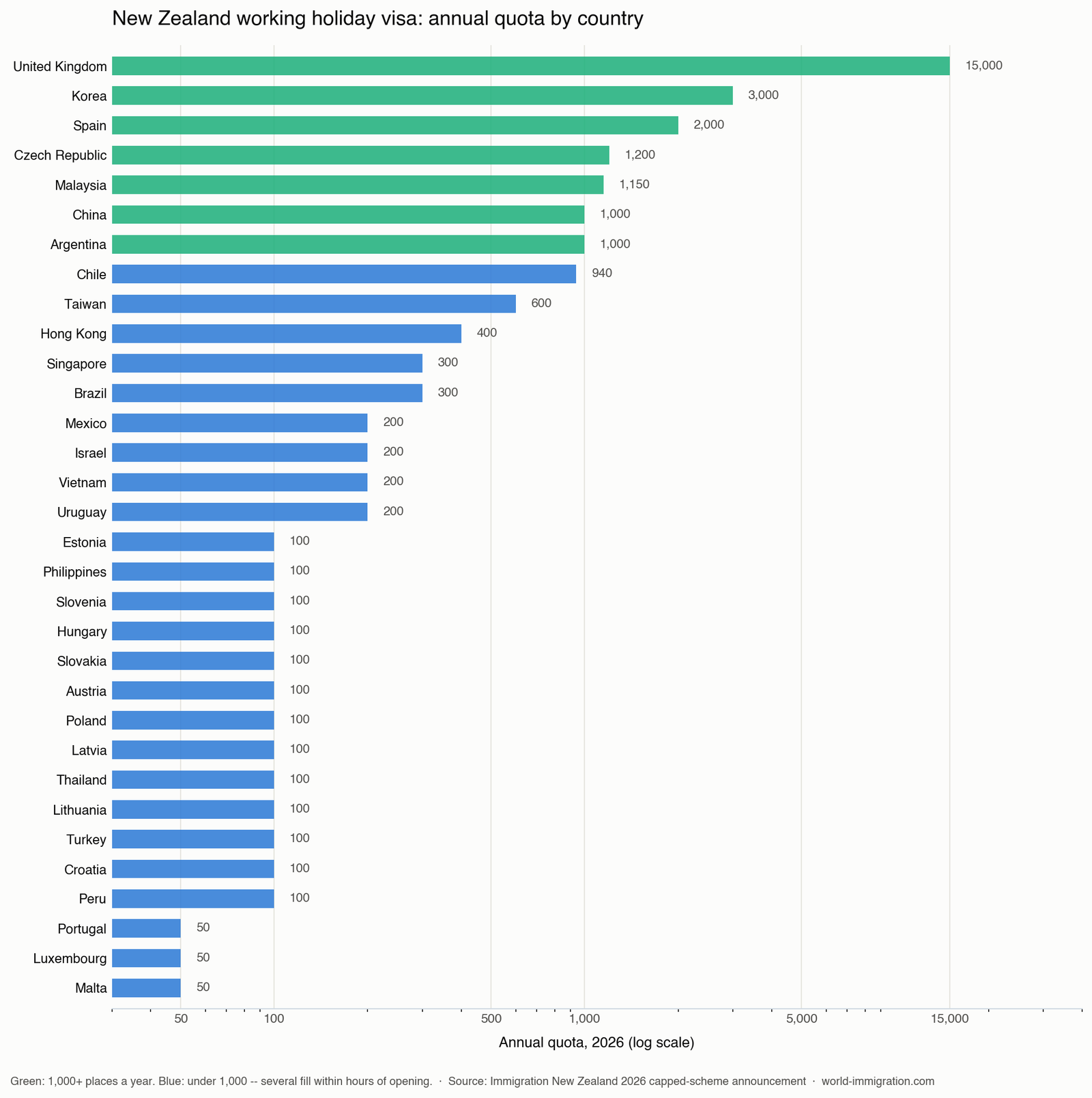
The other 32 countries are capped. Each opens on a fixed date and once the year’s places are taken the scheme closes until the next intake. Applying before the announced opening date does not put you in a queue — INZ states the application is automatically deleted, so the date matters. The table below lists the 2026 opening dates and annual quotas. These reset and can change each year, so confirm the current figures on your country’s own page at immigration.govt.nz before you plan around them.
| Country | 2026 opening date | Annual quota |
|---|---|---|
| Malaysia | 11 Feb | 1,150 |
| Portugal | 19 Feb | 50 |
| Mexico | 26 Feb | 200 |
| Estonia | 4 Mar | 100 |
| Philippines | 12 Mar | 100 |
| Hong Kong | 19 Mar | 400 |
| Slovenia | 1 Apr | 100 |
| Spain | 9 Apr | 2,000 |
| Hungary | 23 Apr | 100 |
| Slovakia | 5 May | 100 |
| Austria | 12 May | 100 |
| Korea | 14 May | 3,000 |
| Israel | 21 May | 200 |
| Taiwan | 28 May | 600 |
| Singapore | 3 Jun | 300 |
| Czech Republic | 18 Jun | 1,200 |
| United Kingdom | 25 Jun | 15,000 |
| China | 2 Jul | 1,000 |
| Luxembourg | 8 Jul | 50 |
| Poland | 15 Jul | 100 |
| Latvia | 22 Jul | 100 |
| Thailand | 5 Aug | 100 |
| Malta | 12 Aug | 50 |
| Lithuania | 19 Aug | 100 |
| Turkey | 27 Aug | 100 |
| Croatia | 10 Sep | 100 |
| Argentina | 24 Sep | 1,000 |
| Peru | 1 Oct | 100 |
| Brazil | 8 Oct | 300 |
| Chile | 15 Oct | 940 |
| Vietnam | 3 Nov | 200 |
| Uruguay | 17 Nov | 200 |
Source: Immigration New Zealand 2026 capped-scheme announcement, with Argentina and Chile confirmed against their own INZ visa pages. The size gap between schemes is enormous. The UK’s 15,000 places dwarf everything else and function close to unlimited in practice — the UK scheme has not been reported as filling. Korea at 3,000 and Malaysia at 1,150 are the next largest. At the other end, Portugal, Luxembourg and Malta share the smallest allocation at just 50 places each, which means they can fill within hours of opening. If you hold one of those passports, the opening date is not a soft target, it is the whole game.
The Age and Duration Exceptions
You will often read that “only the UK and Canada get the extended deal.” That mixes up two separate things and getting them straight changes who should apply.
The higher age ceiling of 35 is not rare. At least nine countries qualify their citizens up to age 35 rather than 30: Argentina, Canada, Chile, Czech Republic, Finland, Hungary, Slovakia, the United Kingdom and Uruguay. If you are 32 and thought you had aged out, check your own country’s page — you may not have. All nine are confirmed directly on their own INZ visa pages.
The longer stay is the truly scarce benefit and it really is limited to two countries. UK nationals can hold the visa for up to 36 months in total — they arrive on a 12, 23, or 36-month visa and anyone who arrives on a shorter one can apply in-country for a Subsequent Work Visa to top up to the 36-month maximum. Canadians can reach 23 months, arriving on 12 and extending in-country. Every other country, including the other seven that qualify people up to 35, is held to the standard 12 months. The higher age limit and the longer duration are not the same benefit and only the UK and Canada get both.
How the Application Runs
The whole thing is done online, in English. You create an Immigration Online account, complete the form, upload your documents and pay the fee. The only exception is the UK and Canada in-country extensions, which INZ requires on a paper form rather than online.
What you need to have ready is fairly light compared with the work and residence routes: a valid physical passport (valid at least three months beyond the visa’s expiry), evidence of the NZD $4,200 in funds or your country’s alternative, a return ticket or the money to buy one and, for most nationalities, full medical and travel insurance covering the length of your stay. A chest X-ray and general medical exam only come into play if your total time in New Zealand across all visa types will exceed 12 months and police certificates only if you are staying 24 months or more, which mainly concerns UK and Canadian extenders.
On processing time, I provide a range, because the sources disagree and the answer depends on where you apply from. INZ’s own wait-times page lists the Working Holiday Visa benchmark as “80% of applications processed within three weeks.” In practice, applications lodged offshore before you travel tend to clear faster than ones lodged after you have already arrived in New Zealand and some straightforward cases come back in a matter of days. Rather than bank on any one figure, check the live processing-time tool on immigration.govt.nz for your own country close to when you apply.
What You Can and Cannot Do on the Visa
The name is not decoration. INZ frames this as a holiday first and work second and the conditions enforce that order. You are allowed to work, but the work is meant to fund a trip, not to be the trip itself.
The hard limits are these. You must work for an employer under an employment contract or contract for services — you cannot set up and run your own business on this visa. That is less than the separate remote-work permission that applies to ordinary visitor visas; if remote work for an overseas employer is actually your goal rather than a local job, our New Zealand digital nomad visa guide covers that different route. You cannot take a permanent job. That is an absolute condition in INZ’s own wording, not a soft preference and it is the mechanism that keeps the visa temporary. If you want a permanent role, you need a different visa, which in most cases means the AEWV. You can study or train for up to six months in total, so an English course or a short programme is fine, but study has to stay secondary to the holiday purpose. And you can leave and re-enter New Zealand as many times as you like while the visa is valid.
The Seasonal-Work Extension, in Detail
There is exactly one way to add time to a standard Working Holiday Visa: the Working Holiday Extension Work Visa, which gives you up to three further months in New Zealand. It exists to reward the seasonal work the country most needs hands for and the conditions are specific.
The qualifying work is horticulture or viticulture only and only certain tasks within them: planting, maintaining, harvesting, or packing crops. Plant-nursery work and food-processing work do not count, even though they sit right next to the qualifying industries. You need at least three months of this seasonal work to become eligible, but it does not have to be continuous and it does not have to be with a single employer — you can string it together across the season and across orchards. The extension is one-time only, the fee is from NZD $800 (separate from your initial visa fee) and since you generally only get one Working Holiday Visa per country in a lifetime, the “one extension ever” rule is academic for most people.
One distinction matters here, because the two schemes get confused constantly. This extension is not the Recognised Seasonal Employer (RSE) scheme. RSE is a separate, employer-specific visa mainly for Pacific nationals (Fiji, Samoa, Tonga, Vanuatu and others), tied to one named employer, typically up to seven months in an 11-month period. A working holiday holder picking fruit is working under their own general visa rights and simply becomes eligible for this three-month top-up if they put in the hours. They are not on RSE, even though the two groups often work the same rows of the same orchard. Since December 2025 INZ has also added two further seasonal routes linked to the AEWV. The Global Workforce Seasonal Visa runs three years, needs no labour market test, requires three seasons’ experience in six years and requires three months a year outside New Zealand. The Peak Seasonal Visa runs up to seven months, requires a labour market test and requires health insurance for roles over three months. Those sit alongside RSE and the working holiday route as separate options, not replacements for either.
Insurance: Not Optional for Most Nationalities
Full medical and travel insurance for the length of your stay is an explicit visa condition for most countries — it is stated outright on the Argentina and Finland visa pages, among others. It is easy to assume that casual backpacking does not need cover and for most nationalities that assumption is wrong and could cost you the visa.
Exceptions are few. INZ exempts four schemes from the mandatory insurance condition: Ireland, Japan, Malaysia and the United Kingdom, which is why those four visa pages do not list it as a requirement the way the Argentina and Finland pages do. New Zealand’s reciprocal health agreements, which cover immediately-necessary treatment, only extend to Australia and the United Kingdom, so that agreement cannot be the reason Ireland, Japan and Malaysia are exempt too; INZ simply does not mandate insurance for those four schemes specifically. None of the exemptions are comprehensive cover, though and INZ and the New Zealand government still recommend full travel and health insurance regardless of nationality. If you hold one of these four passports, you are not exempt from needing insurance — you are exempt only from it being a formal visa condition and the underlying reason to carry it is unchanged.
From Working Holiday to a Longer Stay: the AEWV Route
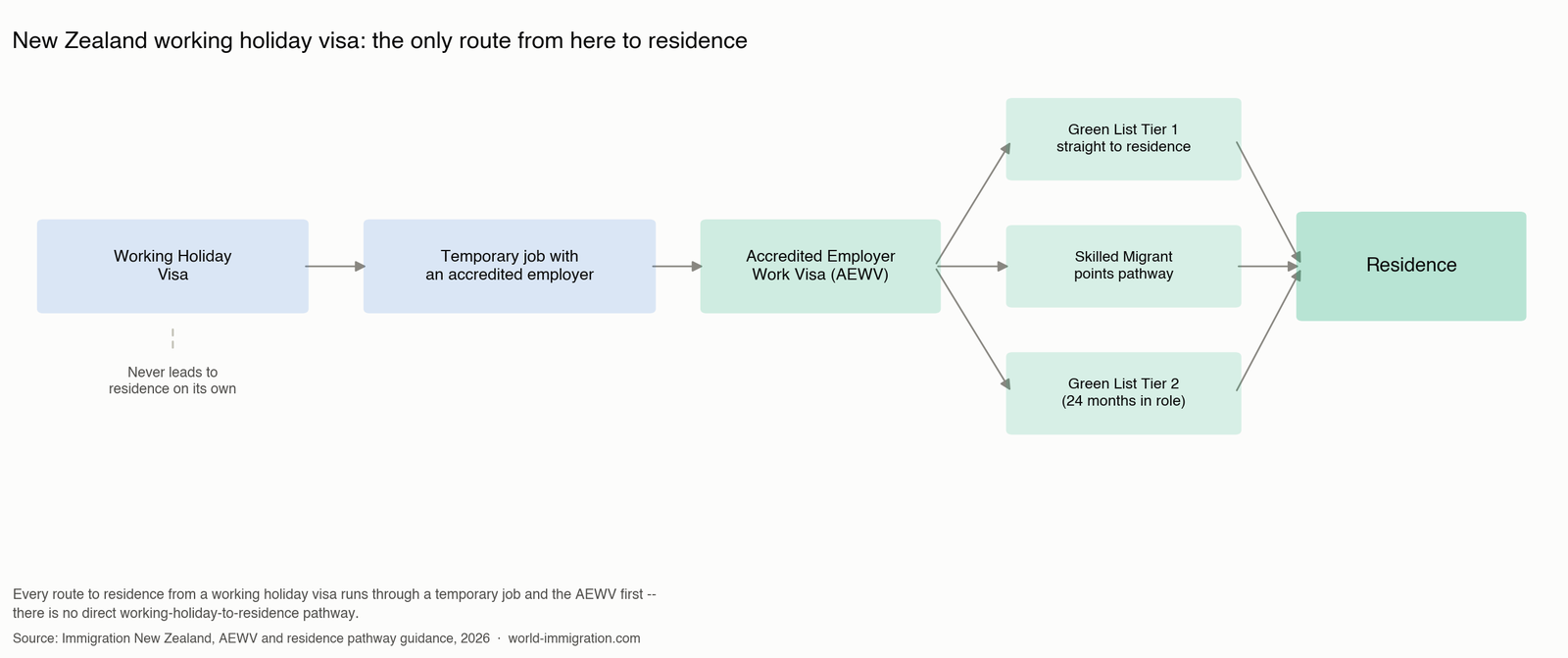
This is the section that matters most if the working holiday is a way in rather than an end in itself and it is also the section where I want to be careful not to oversell. The visa itself never leads to residence — the permanent-job ban makes sure of that. But it is common for people to arrive on a working holiday, land a job and then move onto an AEWV with that same employer, at which point they are on a route that can lead to residence over time.
Having lived in New Zealand my whole life, I can tell you this transition is a familiar pattern here, not an obscure loophole. It is the kind of thing you hear about second-hand fairly often — someone who came out for a year, stuck around a café or a vineyard or a ski-town job, got on well with the owner and eventually ended up staying. What no official statistic will tell you is how often that actually converts and I will be straight about that below.
Mechanically, the transition depends almost entirely on the employer, not on you. For the move to work, the employer has to hold (or obtain) INZ accreditation, then complete a job check for the specific role and only then generate the invite link you need to apply for the AEWV. You cannot start that process yourself. What changed in your favour is the wage floor: as of March 2025 the AEWV dropped from requiring the median wage to requiring the minimum wage plus market rate for the role. That widened the range of employers and roles the transition realistically fits, particularly in hospitality, retail and other lower-wage sectors where working holiday makers already cluster. Once you are on an AEWV, that time can count toward the Green List Tier 2 (Work to Residence) 24-month threshold, toward Skilled Migrant Category points, or, if your role sits on Green List Tier 1, toward a Straight to Residence application. Our New Zealand work visa guide covers those residence routes in full.
Now the caveat. INZ publishes plenty of AEWV headline numbers — more than 188,000 applications approved since the scheme opened, more than 29,000 accredited employers, more than 79,000 people holding an AEWV as at 31 March 2026. What it does not publish, at least not anywhere I could find, is the proportion of those AEWV holders who came off a working holiday first. So treat this as a well-worn and frequently described route, not a quantified conversion rate. Anyone quoting you a specific percentage for “working holiday to AEWV” is guessing, because the figure is not in the public statistics.
The practical test, then, is whether you can find an employer who is willing to hire you casually, likes the work you do and is then prepared to go through the separate, employer-borne accreditation and job-check process to keep you. Not every business that takes on backpackers holds AEWV accreditation and plenty of smaller hospitality and retail operators have not gone through it and may not want to. That combination, the right employer willing to do the paperwork, is the whole thing and it is not something you control from your side.
Where the Work Actually Is
The following comes from general knowledge of how the country works rather than from INZ policy, so treat it as orientation, not rules. Backpackers on working holidays are a visible, ordinary part of the workforce here, especially behind the counter. Spend a season in Queenstown or Wānaka and a fair share of the hospitality staff will not be local — the seasonal churn as people finish their 12 months and move on is just part of how those towns run. Cafés, bars, retail and tourism operators in Auckland, Wellington, Christchurch and the ski towns are where most working holiday makers find their first job.
Seasonal horticulture and viticulture work, the kind that unlocks the three-month extension, clusters in a few regions. Hawke’s Bay and Marlborough are the big wine areas, with harvest around February and March. Central Otago also does wine, the Bay of Plenty is kiwifruit country and Nelson and Tasman are apples. Ski-season hospitality and tourism work runs roughly June to October in Queenstown, Wānaka and the central North Island. Orchard and picking work is often bundled with cheap on-site staff accommodation, which is part of what makes it viable on a tight budget.
Before you can start any of it, two admin steps are mandatory, not optional: you need a New Zealand bank account and an IRD (tax) number, both flagged directly by INZ. For finding the work, the government-run resources are the sensible starting point — Tahatū Career Navigator, the Work and Income seasonal work calendar, Horticulture New Zealand’s recruitment resources and ServiceIQ for hospitality roles.
What This Cannot Tell You
This maps the Working Holiday Scheme as it stands in mid-2026. It cannot tell you whether your own country’s quota for the current year has already filled, because the capped schemes open and close through the year — check your country’s own page at the point you are ready to apply. INZ can also change an age cutoff or quota without much notice, so treat every figure above as current as of this research date, not permanent.
It cannot tell you how long your specific application will take, because that depends on your country, whether you apply onshore or offshore and INZ’s workload at the time. And it cannot tell you whether the AEWV transition will work out for you, because that rests on an employer’s decision, not on any rule you can satisfy in advance. INZ has adjusted these settings repeatedly in recent years and will again, so confirm anything load-bearing at immigration.govt.nz before you book flights or hand over money. For a complicated case, licensed immigration advice is regulated in New Zealand and searchable on the Immigration Advisers Authority register.
Frequently Asked Questions
Q: Do I need a job offer for a New Zealand working holiday visa?
No. That is the whole point of it. You apply on your own, arrive and then look for work once you are here. You do need to show funds of NZD $4,200 (or your country’s alternative) and, for most nationalities, full travel and medical insurance for your stay. What you must not do is take a permanent job, since the visa is temporary by design and bars permanent employment outright.
Q: How old can I be to apply?
For most countries the range is 18 to 30. For at least nine (Argentina, Canada, Chile, Czech Republic, Finland, Hungary, Slovakia, the UK and Uruguay) it extends to 35. The age limit is a hard cutoff with no discretion above it, so check your own country’s page rather than assuming. Being eligible up to 35 does not also get you a longer stay: only the UK (up to 36 months) and Canada (up to 23 months) get extended durations; everyone else is held to 12 months.
Q: Can a working holiday visa lead to permanent residence?
Not on its own — it never grants residence and cannot be renewed into it. What happens in practice is that some people use it to get into New Zealand, find an employer who then sponsors them onto an Accredited Employer Work Visa and build toward residence from there through the Green List or the Skilled Migrant Category. That transition depends entirely on finding an employer willing to obtain accreditation for you and there is no published statistic on how often it succeeds, so plan for it as a possibility rather than a guarantee.
Q: How do I extend my stay beyond 12 months?
For most nationalities the only extension is the Working Holiday Extension Work Visa, which adds up to three months if you have done at least three months of qualifying seasonal work in horticulture or viticulture (planting, maintaining, harvesting or packing crops — nursery and food-processing work do not count). It is one-time only and costs from NZD $800. UK and Canadian citizens are the exception, with in-country extensions taking them to 36 and 23 months respectively. Beyond that, a longer stay means moving onto a different visa, usually the AEWV.
Sources
- Immigration New Zealand — Who can apply for a working holiday visa
- Immigration New Zealand — Peru working holiday visa
- Immigration New Zealand — 2026 opening dates for capped working holiday schemes confirmed
- Immigration New Zealand — Argentina working holiday visa
- Immigration New Zealand — Chile working holiday visa
- Immigration New Zealand — Finland working holiday visa
- Immigration New Zealand — United Kingdom working holiday visa
- Immigration New Zealand — Canada working holiday visa
- Immigration New Zealand — Working Holiday Extension Work Visa
- Immigration New Zealand — Recognised Seasonal Employer Limited Visa
- Immigration New Zealand — Global Workforce Seasonal Visa
- Immigration New Zealand — Peak Seasonal Visa
- Immigration New Zealand — Changes to the Accredited Employer Work Visa (AEWV) and median wage
- Immigration New Zealand — Czech working holiday visa
- Immigration New Zealand — Hungary working holiday visa
- Immigration New Zealand — Slovakia working holiday visa
- Immigration New Zealand — Uruguay working holiday visa
- Immigration New Zealand — Ireland working holiday visa
- Immigration New Zealand — Japan working holiday visa
- Immigration New Zealand — Malaysia working holiday visa
- Immigration New Zealand — USA working holiday visa
- Immigration New Zealand — Australian Resident Visa (trans-Tasman work rights)
- Immigration New Zealand — English language requirements for some working holiday visas
- Immigration New Zealand — Work visa wait times
- Immigration New Zealand — Working holiday visa medical requirements
- Immigration New Zealand — Green List pathway to residence
- Immigration New Zealand — AEWV key information and statistics
- Immigration New Zealand — Managing your money, banking and taxes in New Zealand
- Ministry of Health New Zealand — Reciprocal health agreements

