
Moving to Portugal has become one of the more popular relocations in Europe and the reasons are easy enough to see from a distance. The weather is mild, the country is safe, the cost of living undercuts most of Western Europe and the visa routes are more welcoming to non-Europeans than almost anywhere else on the continent.
What is harder to see from a distance is the overview. The pace of the bureaucracy, the way housing costs have climbed in Lisbon and Porto, the difference between the postcard and the Tuesday afternoon at a government office. This article is the map of that fuller picture and it points you to the dedicated guides that go deeper on each part.
Portugal at a glance
The basics first, as orientation rather than the last word. Figures that move year to year, such as the minimum wage and visa thresholds, are the ones to check against a live source before you rely on them.
| Population | About 11.4 million (INE, 31 December 2025), of whom roughly 1.6 million are foreign residents |
| Capital | Lisbon (Porto is the large northern city and the second hub) |
| Official language | Portuguese (English is common in the cities and among younger people, thinner in rural areas) |
| Currency | Euro (EUR) |
| Minimum wage | €920 a month gross from 1 January 2026 (Decreto-Lei n.º 139/2025), paid across fourteen instalments a year, per DGERT, with the government schedule pointing higher in the following years |
| Climate | Atlantic in the north (green, wetter, cooler), Mediterranean in the south. The Algarve and the interior are hot and dry in summer; Lisbon sits comfortably in between. |
| Immigration agency | AIMA (Agência para a Integração, Migrações e Asilo), which replaced the former SEF in October 2023 |
What Portugal is actually like to move to
The first thing people who have made the move tend to mention is the pace. Lunch is unhurried, plenty of shops close on Sundays and the rhythm of a day runs slower than newcomers from busier countries are used to. Some arrive expecting to find this charming and discover it takes a few months to stop fighting it. The café culture is part of the same fabric. A morning coffee and a pastel de nata standing at the counter is not a tourist ritual so much as ordinary life.
Safety is the other feature that comes up early and consistently. Portugal placed seventh in the 2026 Global Peace Index, among the highest-ranked countries in the world and newcomers routinely describe feeling secure walking cities at night in a way they did not back home. That sense of ease is a large part of what keeps people once the initial novelty wears off.
Set against that is the bureaucracy, which is where most of the early frustration lives. A frequently repeated line from those who have settled is that a process which looks like a two-week task routinely takes six to eight weeks and that public services test your patience before they reward it.
This is not a reason to stay away. It is a reason to arrive expecting friction, to build slack into your timelines and to treat the first “no” or the first lost form as part of the process rather than a crisis. The people who adjust well are the ones who stop expecting the tidiness of a northern-European system and plan around the delay instead.
Language sits underneath all of it. You can start a life in Lisbon or Porto with English alone and many do. But government offices operate in Portuguese, English thins out quickly once you leave the cities and the coast and the path to citizenship expects at least a basic command of the language. My read is that arriving with a little Portuguese and a plan to keep learning, is the difference between a hard first year and a manageable one.
The visa landscape
Portugal’s residency visas are sorted by letter. Which one fits your situation matters more than how any single one works in detail. Get the category right and the paperwork follows from there. Here’s an overview, with one line each and a pointer to the article that treats each route properly.
- The D7 visa is the passive-income and retirement route, for people who can show a stable income from a pension, rental property or investments and it remains the most popular path for retirees and the financially independent.
- The D8 digital nomad visa is aimed at remote workers and freelancers earning from outside Portugal and it asks for a monthly income of roughly four times the Portuguese minimum wage.
- The D2 visa is the entrepreneur and independent-business route, for people setting up a company or self-employed activity in Portugal on the strength of a viable business plan.
- The D6 family reunification visa lets the spouse, partner, minor or dependent children and dependent parents of a legal resident join them in Portugal.
- The Golden Visa is the investment-residency route, restructured in October 2023 so that buying property no longer qualifies; the surviving paths run mainly through qualifying investment funds rather than real estate.
Two pieces of context matter across all of these. The first is AIMA, the immigration agency that replaced the old SEF in late 2023. It inherited a very large backlog of pending cases; the government reported in June 2026 that AIMA had issued decisions on more than 525,000 files and completed over 763,000 appointments, but appointment scheduling and permit processing can still run for months and a nationwide AIMA staff strike that same month added further delay (The Portugal News; Fragomen). Build that reality into any timeline.
The second is that Portugal’s parliament passed Lei Orgânica n.º 1/2026, published in the Diário da República on 18 May 2026 and in force from the next day, raising the legal-residence period required before you can apply for citizenship from five years to seven years for nationals of Portuguese-speaking (CPLP) countries and to ten years for everyone else and now counting that period from the date AIMA issues your first residence permit rather than from the date you applied. Anyone weighing a route partly as a path to a Portuguese passport should read the current rule rather than the older five-year figure that still circulates online.
One tax note belongs here too, because it changed recently and a lot of older advice has not caught up. The Non-Habitual Resident regime, the long-running tax incentive that drew many retirees and remote workers, closed to new applicants at the end of 2023. Its replacement, regulated by Portaria n.º 352/2024/1 and informally called NHR 2.0 or IFICI, is limited to qualifying research, scientific and innovation professionals and does not extend to the general newcomer. If a source is still selling you on NHR, it is out of date.
What it costs
Portugal is cheaper than most of Western Europe on a headline basis and that affordability is a meaningful part of the draw. The qualifier that matters is housing. Rents in Lisbon and Porto have risen sharply over the last few years and a one-bedroom flat in central Lisbon now sits in a range that would have surprised people who moved a decade ago.
Move to Porto, a smaller city, or the interior and the figure drops noticeably, though it too has climbed. Groceries, eating out, transport and healthcare remain gentle by Western-European standards, which is what lets a moderate income stretch further than it would in London or Amsterdam.
These figures shift often, so I’ll point you to the pages that stay current instead: the full breakdown lives in Cost of Living in Portugal, with a closer look at the capital in Cost of Living in Lisbon. If you are weighing local work rather than an overseas salary, the other half of the equation is what people actually earn, covered in Average Salary in Portugal. For most newcomers on the popular visa routes, the arithmetic that appeals is an income earned abroad set against Portuguese prices.
Where to live
Which part of the country to settle in is the question newcomers ask most, often before they have arrived and it is a decision with meaningful trade-offs rather than a formality. A short orientation, then the article that weighs it properly.
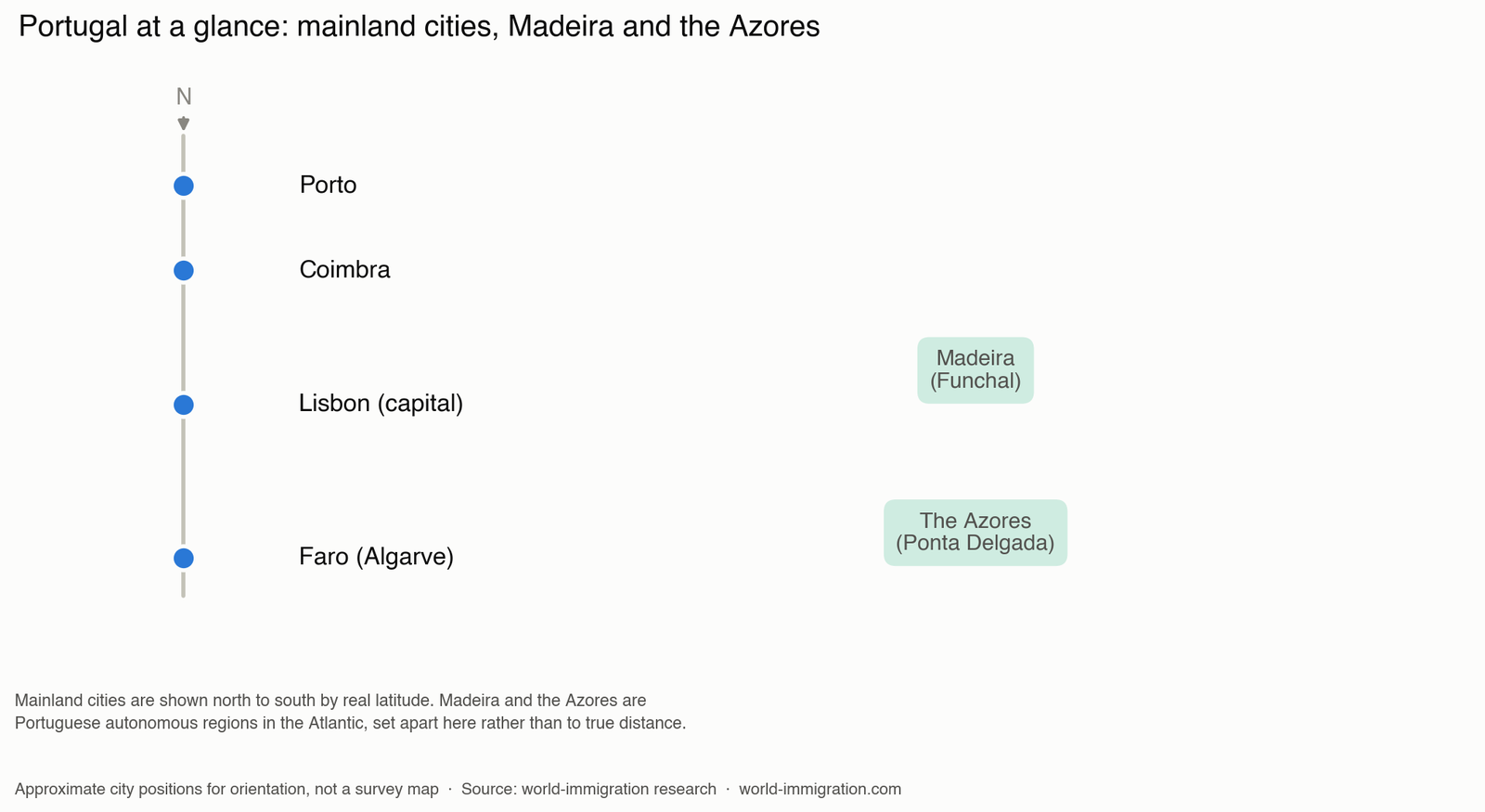
- Lisbon is the capital, the job market and the centre of the expat scene, with the highest costs to match. It suits people who want city life, an international crowd and the shortest learning curve for arriving without Portuguese.
- Porto is the northern hub, cheaper than Lisbon, often praised for its English and for a slightly slower, less touristed feel, with cooler and wetter Atlantic weather.
- The Algarve is the southern coast, the classic retirement and lifestyle choice, warm and geared toward foreigners, with a seasonal rhythm that swells in summer and quietens in winter.
Beyond the three headline options, the Silver Coast, Coimbra, Braga and the more rural interior draw people looking for lower costs and a quieter life. I am not going to adjudicate the choice in an overview, because it depends heavily on what you want from daily life. Best Place to Live in Portugal is the dedicated comparison and Living in Portugal goes further into what everyday life is actually like than a hub piece can.
Healthcare
Portugal runs a public health service, the SNS, that legal residents can access, alongside a private sector that many newcomers use for shorter waits and English-speaking care. Private insurance is affordable by the standards most arrivals are used to, which is why a good number carry it even while entitled to the public system. How the two fit together, what a visa expects of you and how cover works for a foreigner are the details that trip people up and they are the subject of Healthcare in Portugal.
The paperwork that comes first
A few practical steps surface almost immediately, ahead of the bigger settling-in questions and they are the ones to understand before you arrive.
- The NIF. The Número de Identificação Fiscal, the Portuguese tax number, is the near-universal first hurdle. You need it to rent, to open a bank account, to sign a phone or utility contract. The NIF itself carries no government fee, but if you are applying from outside Portugal, as most readers of this site are, you generally need a fiscal representative to get one before you arrive, which relocation and tax-representation services commonly price at €150 to €300 a year (Global Citizen Solutions) — so budget for that even though the NIF “fee” is technically zero.
- Banking. Opening a Portuguese account usually means a NIF plus proof of address and while some banks now allow app-based opening, many still want an in-person visit. People commonly keep an overseas account running for a while rather than cut ties before the local one is settled.
- Renting. Finding a place is the step most shaped by the market squeeze, particularly in Lisbon and Porto, where demand is high and good listings move fast. Renting in Portugal covers how the market works and what landlords expect of a foreign tenant.
- AIMA appointments. The residency steps that run through the immigration agency are where the timelines stretch. Book early, keep copies of everything and expect the schedule to slip rather than hold.
If your move is built around work rather than a passive income or investment, Working in Portugal covers finding a job, the registration steps and how the employment market treats newcomers. If it is built around buying rather than renting, Buying Property in Portugal walks through the purchase process and its costs and if you are moving to study, the Portugal Student Visa is the route to read.
The limits of an overview
An article like this can orient you, but it cannot make the decision and it would be doing you a disservice to pretend otherwise.
Where a figure moves year to year, such as the minimum wage, the visa income thresholds and the AIMA processing times, I have kept the specifics light and pointed you to the dedicated guides, because those are the numbers most likely to be out of date by the time you read this and the places I would want to be most current.
What I will say directly is that Portugal rewards patience in much the same way its bureaucracy demands it. The safety, the climate, the affordability against the rest of Western Europe and the openness of the visa routes are the draws and the country delivers on them.
The friction is the paperwork, the AIMA delays and a housing market that has tightened in the cities most newcomers want to live in. Arrive expecting some of that and it stops being a shock. The dedicated articles below go deeper than this overview can and they are where I would send you next once you have decided that moving to Portugal is worth a closer look.
Practical guides for moving to Portugal
The rest of this cluster covers each part of the move in the depth a hub article cannot. The money and daily-life guides:
- Cost of Living in Portugal
- Cost of Living in Lisbon
- Average Salary in Portugal
- Living in Portugal
- Best Place to Live in Portugal
- Renting in Portugal
- Working in Portugal
- Healthcare in Portugal
- Buying Property in Portugal
The visa and residency routes:
- Portugal D7 Visa (passive income and retirement)
- Portugal Digital Nomad Visa (the D8, for remote workers)
- Portugal D2 Visa (entrepreneurs and the self-employed)
- Portugal Family Reunification Visa (the D6)
- Portugal Golden Visa (investment residency)
- Portugal Student Visa
Frequently asked questions
Is it easy to move to Portugal?
Easier than most of Western Europe for non-Europeans, because the visa routes are comparatively open and the cost of living lowers the barrier further. The friction is rarely the visa itself. It is the bureaucracy around it, the AIMA processing delays and finding housing in the cities where rents have climbed. Straightforward to plan, patience required to complete.
How much money do you need to move to Portugal?
It depends on the route. The D7 asks for a stable passive income at roughly the level of the Portuguese minimum wage, while the D8 digital nomad visa expects around four times that. Beyond the visa threshold, you want a housing deposit, several months of living costs in reserve and cover for healthcare. The Cost of Living guides in this cluster carry current figures for Lisbon and the country as a whole.
Can you move to Portugal without speaking Portuguese?
You can start a life in Lisbon or Porto on English alone and many arrivals do. Government offices work in Portuguese, English thins out in rural areas and citizenship expects a basic command of the language. Arriving with some Portuguese and continuing to learn it, makes the first year markedly smoother than getting by without.
What is AIMA and what happened to SEF?
AIMA, the Agency for Integration, Migration and Asylum, took over Portugal’s immigration and residency functions in October 2023 when the former SEF was dissolved. It inherited a large backlog; the government reported in June 2026 that it had issued decisions on more than 525,000 files, but appointment and permit timelines can still stretch to months and a nationwide staff strike that same month added further delay (The Portugal News), so any reference to SEF in older guidance is out of date.
Sources
- INE (Instituto Nacional de Estatística) — resident population estimates, 2025: ine.pt
- AIMA (Agência para a Integração, Migrações e Asilo) — the immigration and residency authority that replaced SEF: aima.gov.pt
- Portuguese government migrant portal — NIF, social security and living/working guidance: gov.pt
- DGERT (Direção-Geral do Emprego e das Relações de Trabalho) — the 2026 national minimum wage, Decreto-Lei n.º 139/2025: dgert.gov.pt
- Institute for Economics and Peace — Global Peace Index 2026: economicsandpeace.org
- Eurostat — comparative European cost-of-living and wage statistics: ec.europa.eu/eurostat
- Diário da República — Lei Orgânica n.º 1/2026, de 18 de maio (the nationality-law reform extending the residency period before citizenship): diariodarepublica.pt
- Diário da República — Portaria n.º 352/2024/1, de 23 de dezembro (the IFICI/”NHR 2.0″ tax-incentive regulation): diariodarepublica.pt
- Vistos (Portuguese Ministry of Foreign Affairs national-visa portal) — the D7 and D8 income requirements: vistos.mne.gov.pt
- The Portugal News — the government’s June 2026 update on AIMA backlog clearance and the AIMA staff strike: theportugalnews.com
- Fragomen — the June 2026 AIMA staff strike and its effect on immigration processing: fragomen.com
- Global Citizen Solutions — typical fiscal-representative costs for a non-resident NIF applicant: globalcitizensolutions.com

