
For years, a certain story circulated among people thinking about retiring abroad: move to Portugal, live near the sea and pay almost nothing in tax on your pension. That story was true for a while and it drew a lot of people. It is no longer accurate and the gap between the old version and the current reality is where retirees now get caught out.
The visa itself, the D7, is still very much open and still the main route a retiree takes into Portugal. What has shifted is the tax deal that used to sit alongside it and a citizenship rule that changed on 19 May 2026.
This guide covers what the Portugal D7 visa actually is and who it suits, the minimum passive income you need in 2026 and how that figure is worked out, which income types qualify, the documents, how the application runs from a consulate abroad to an appointment with AIMA in Portugal, how long that realistically takes, the tax picture now that the old scheme has closed and the path from a first residence permit toward permanent residency and citizenship.
What the Portugal D7 visa actually is and who it suits
The D7 is often described as Portugal’s retirement visa and for practical purposes that is how most people use it. Strictly, though, the official visa category covers retirees, religious workers and people living on their own income — a passive-income residence visa. It is not restricted to retirees. Anyone who can show a stable, recurring income that does not depend on working in Portugal can apply. A retiree drawing a pension is the classic case, but someone living off rental income, dividends, or investment returns qualifies on the same basis.
That distinction matters when you read older guides. The D7 predates Portugal’s newer routes and it has become the default for two overlapping groups: retirees on a pension and financially independent people not yet at retirement age who live on passive income. The clean test is whether your income keeps arriving regardless of whether you lift a finger in Portugal. If it does, the D7 fits. If you need to keep working to earn it, such as through remote work or freelancing, the D8 digital nomad visa is the route built for that case instead.
There is a third option worth knowing about, for people who would rather commit capital than demonstrate ongoing income: the Portugal Golden Visa, a residency-by-investment route with its own thresholds and timeline, separate from the D7’s income test.
The D7 sits within a broader move and it helps to see it in that context. Our moving to Portugal guide covers the wider picture of relocating there; this article is the deep dive on the one route most retirees take.
The income requirement and the figure that changes every year
The D7 income threshold is tied to the Portuguese national minimum wage, which Eurofound’s overview of Portugal’s minimum wage confirms is indexed and rises most years. That single fact is the reason so many figures online are wrong. A guide written in 2023 quotes a lower number in good faith, then never gets updated and readers arrive expecting a threshold that no longer applies.
For 2026, the Portuguese minimum wage is €920 per month. The D7 requires a main applicant to show passive income of at least 100% of that figure, calculated over twelve months, per AIMA’s own means-of-subsistence criteria and confirmed by Global Citizen Solutions’ 2026 D7 guide, which puts the minimum at €11,040 a year for a single applicant.
Here is a trap that trips up careful readers. Portuguese labour law pays employees across fourteen instalments a year, not twelve, because a thirteenth and fourteenth payment (the subsídio de Natal and subsídio de férias) fall at Christmas and in summer. That produces an annual minimum salary figure of €12,880, which some sites quote as the D7 requirement. It is not.
The €12,880 number is the labour-law annual salary; the visa “means of subsistence” test uses the twelve-month calculation, so €11,040 is the figure that applies to a D7 application. If you have budgeted to the higher number you have a comfortable margin, which is no bad thing, but the actual requirement is the lower one.
Family members add to the requirement, per the same AIMA means-of-subsistence criteria: a spouse or second adult dependent adds 50% and each child under 18 adds 30%. In 2026 terms that works out as follows.
| Applicant | Share of minimum wage | Minimum passive income (2026) |
|---|---|---|
| Main applicant | 100% | €11,040 per year (€920/month) |
| Spouse / second adult | +50% | +€5,520 per year (€460/month) |
| Each child under 18 | +30% | +€3,312 per year (€276/month) |
| Example: couple, one child | 180% | €19,872 per year |
That table covers dependants applying together with you on the same D7. If a family member is joining you later, once you are already established in Portugal, that runs through Portugal Family Reunification Visa (D6) instead.
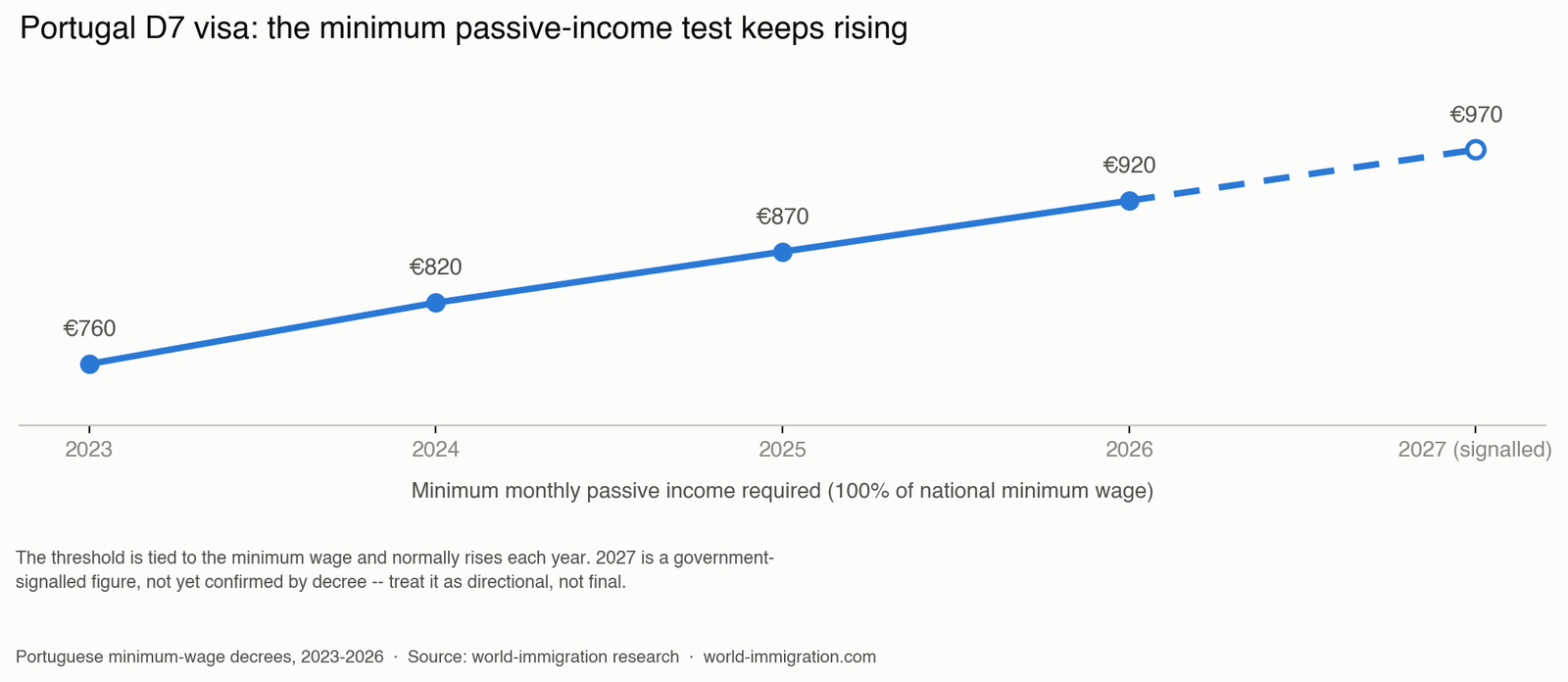
Because the base figure is pegged to the minimum wage, it climbs each year. Garrigues’ 2026 wage update confirms the rise has been steady: €760 a month in 2023, €820 in 2024, €870 in 2025 and €920 in 2026, with the government having signalled €970 for 2027. The chart below shows that trajectory, which is the reason a threshold you read about eighteen months ago is almost certainly out of date now.
Separate from the income test, most applicants are also asked to show savings held in a Portuguese bank account. There is no fixed figure for this in the regulations, but consulates and immigration consultancies, including Portugalist’s D7 guide, commonly report around twelve months of the same threshold, so roughly €11,040 for a single applicant, being expected in practice. Consulates vary in how strictly they apply this, but treating it as a firm requirement rather than a suggestion is the safer approach.
Which income counts as passive
The point of the D7 is that you can support yourself without needing a Portuguese job. The income the Portuguese authorities accept reflects that. The qualifying categories are consistent across sources:
- Pensions, whether state, occupational, or private
- Rental income from property, in Portugal or abroad
- Dividends and returns from shares or investment portfolios
- Interest from savings or bonds
- Royalties from intellectual property
What does not count, at least not on its own, is income you actively earn by working and particularly income from employment inside Portugal. The stronger your evidence that the income is recurring and stable rather than a one-off, the smoother the assessment tends to be. Pension statements and several months of bank records showing regular deposits are the kind of proof that lands well.
The documents you will need
The document set is one of the more consistent parts of the D7 process. The Portuguese consular authorities’ own checklist lines up with what Portugalist’s D7 requirements guide and consulates actually ask for. Expect to prepare:
- A passport valid for at least six months beyond your intended stay, plus passport photos and the completed consular application form
- Proof of passive income meeting the threshold above, such as pension or investment statements
- Proof of savings, usually evidenced with about three months of bank statements and your most recent tax return
- A Portuguese tax number (NIF), which you need before you can open a bank account or file the application
- Proof of accommodation in Portugal, normally a rental contract of twelve months or more, or a property deed
- A criminal record certificate from your country of nationality and from anywhere you have lived for a year or more, apostilled or legalised and sometimes translated into Portuguese
- Insurance: Schengen-compliant travel insurance at the consular stage and full private health insurance for the appointment in Portugal
- A cover letter setting out your plans and how you will support yourself
The NIF and the Portuguese bank account are the two pieces of groundwork that hold people up, partly because you generally want them arranged before you apply and partly because arranging them from abroad often means using a fiscal representative or a foreigner-friendly bank. People who have been through it tend to describe this early administrative stage, rather than the visa paperwork, as the part that takes longest.
How the application works: consulate first, then AIMA
The D7 runs in two stages, in two places. The first stage happens in your home country. You apply at the Portuguese consulate with jurisdiction over where you live (often through a VFS Global centre), submit the documents above and pay a consular fee, currently €110. If approved, the consulate issues a national D7 entry visa. That visa is valid for four months and allows two entries. Its job is to get you into Portugal so you can complete the second stage.
The second stage happens in Portugal, with AIMA (the Agência para a Integração, Migrações e Asilo), which took over immigration functions from the former SEF under Decree-Law 41/2023, in force since 29 October 2023. Within the four-month window of your entry visa, you attend an AIMA appointment, give biometrics and formally apply for your residence permit. AIMA then has up to 90 days by law to decide and issue the card, which arrives by post. In practice most people report it taking between one and four months after the appointment.
The residence permit itself follows a two-then-three pattern set out in gov.pt’s official renewal guidance: the initial permit runs two years, the first renewal extends it for three and subsequent renewals also run three years. Throughout, you cannot be out of the country for more than six consecutive months or eight non-consecutive months, since the point of residency is that you actually reside.
How long it takes: the AIMA question
This is the part of the process I would treat with the most caution. In 2026 it depends and it is still moving. AIMA inherited a very large backlog from SEF and from Portugal’s surge in residency applications. In mid-May 2026 the government reported that a dedicated task force had completed around 763,000 appointments and decided more than 525,000 cases. That is meaningful progress. But the immigration lawyers quoted alongside those figures were careful to note that clearing old cases does not automatically translate into quick processing for new applicants.
Reported waits for a first AIMA appointment vary so much that no single number is trustworthy. Some 2026 guides put the Lisbon and Porto wait at around 120 days and much shorter, a couple of weeks, in less populated districts. Others describe first-time appointments in the Lisbon area running to twelve or eighteen months. Those estimates differ by an order of magnitude and the likeliest explanation is that it varies by which AIMA office you are dealing with and when.
My read is to plan for a total D7 timeline of six to twelve months from consulate application to card in hand, to book any AIMA slot the moment one appears rather than holding out for a more convenient date and to accept that the appointment stage is the one you have least control over. If AIMA misses its statutory deadlines, the Supreme Administrative Court has confirmed there is a legal route through the administrative courts, though needing it is not where anyone wants to be.
The tax picture has changed and retirees feel it most
This is the section that most contradicts what a lot of older content still says. From 2009 to 2024, Portugal ran the Non-Habitual Resident scheme, known as NHR. Each qualifying resident held the status for ten years from registration, but the scheme itself stayed open to new applicants for about fifteen years, not ten.
Under it, qualifying new residents could have foreign pension income taxed at a flat 10% from the 2020 State Budget onward (and, before that change, at 0%). For many retirees, that tax treatment was the single biggest reason they chose Portugal over Spain, France, or Italy.
NHR closed to new applicants from 1 January 2024, under the 2024 State Budget law, as KPMG’s summary of the transition sets out. There was a transitional window for people who already had strong ties to Portugal by set 2023 cut-off dates and that window itself closed on 31 March 2025. As of now, a new arrival cannot register for the old NHR scheme at all. Anyone already inside it keeps it until their ten-year term ends, but that is a closed group.
The replacement, formally the IFICI regime and informally called “NHR 2.0”, is far more restrictive. It is aimed at qualified professionals in scientific research, higher education, technology and innovation roles, generally requiring a relevant degree or doctorate and it does not extend to pension income. The International Bar Association’s summary is explicit that under IFICI, foreign pension income remains taxable at Portugal’s ordinary progressive rates. So for a retiree moving to Portugal today with no qualifying professional activity, the old headline no longer holds.
What a new retiree faces instead is ordinary Portuguese income tax on their foreign pension, charged under the standard progressive IRS scale PwC Portugal sets out for 2026 (which runs to a top marginal rate of 48% on higher incomes, plus surcharges). Most retirees will sit well below the top band, but the direction is clear: a foreign pension in Portugal now attracts normal European taxation, not the standout deal it once was.
I would take any current claim of a special 10% pension rate for new arrivals with considerable scepticism, because it does not match the primary tax-authority position and looks like a holdover from the old NHR rules. If a firm tells you otherwise, ask them to point to the provision in writing before you rely on it.
For a 2026 retiree the sensible planning assumption is that the old break no longer exists, because for you it does not. Portugal is still an appealing place to live; the tax case for choosing it over its neighbours is simply weaker than the one you may have read about.
Healthcare on a D7
Health cover shows up twice in the D7 process. At the consular stage you need Schengen-compliant travel insurance; at the AIMA appointment in Portugal you need full private health insurance. Once you hold your residence permit, you can register with the public health service, the SNS (Serviço Nacional de Saúde), through your local health centre and obtain a patient “utente” number.
Registration is not always instant on arrival and many retirees keep a private policy running alongside the SNS, either to cover the gap before registration or as an ongoing supplement for faster access. The fuller picture of how public and private cover work together sits in our guide to healthcare in Portugal, so I will not duplicate it here.
From D7 to permanent residency and citizenship
Here is the other change that most existing guides have not caught up with. The familiar line was that five years of legal residence opened the door to both permanent residence and citizenship. The five-year figure for citizenship is no longer correct.
Portugal’s new Nationality Law, formally Lei Orgânica n.º 1/2026, came into force on 19 May 2026. It raises the residence requirement for citizenship by naturalisation from five years to ten years for most nationalities, with a shorter seven-year requirement for citizens of EU states and of Portuguese-speaking (CPLP) countries such as Brazil, Angola and Cape Verde.
It also adds integration requirements: A2-level Portuguese, a civic and historical knowledge assessment whose exact format is still being defined and a declaration of commitment to democratic principles. For a typical retiree from an English-speaking country who is not an EU or CPLP national, that means citizenship eligibility now sits at around ten years of residence rather than five.
Two important caveats. First, applications already filed with the registry before 19 May 2026 are assessed under the old five-year rule. What is unsettled and where the sources disagree, is the position of people who are partway through their residence but had not yet filed a citizenship application when the law changed.
Some read the transitional protection as covering only those who had already applied; others say residents still counting toward the old five years get no protection and must serve the full new term. I would not treat this as resolved — Portugalist’s own coverage of the reform flags the same ambiguity — and anyone whose plan depends on it should take current legal advice rather than a website’s summary, this one included.
Second, the reform targets naturalisation (citizenship) specifically, not permanent-residence status. Permanent residence stays on the standard five-year timeline; the nationality-law reform left that threshold untouched. What changed is citizenship, which is now a longer road than the “five years to a Portuguese passport” story most people arrive with.
Where retirees actually settle
The Algarve remains the classic retirement destination, for understandable reasons: the climate, the coastline, established English-speaking communities and infrastructure built around exactly this kind of resident. Within it, the eastern Algarve around Tavira draws people wanting somewhere quieter and cheaper than the built-up western resorts.
Beyond the Algarve, the Lisbon metropolitan area (including Cascais and Sintra) dominates by sheer numbers, Porto runs noticeably cheaper than Lisbon with more of a working-city character and Silver Coast and interior towns such as Óbidos, Coimbra and Braga come up repeatedly as the affordable alternative as coastal prices climb.
Where you settle drives your budget more than almost any other choice and rents in Lisbon, Porto and the prime Algarve have risen sharply. Our guide to the best places to live in Portugal weighs these regions side by side and the cost of living in Portugal guide puts numbers to what a month actually costs in each. For a D7 retiree, those two decisions, where and how much, matter as much as the visa mechanics.
What this guide cannot tell you
A reference article can give you the structure. It cannot give you the specifics that depend on your circumstances and on a system that is still in motion.
It cannot tell you how long your particular AIMA office will take, because that varies enormously and is changing month to month as the backlog is worked through. It cannot tell you exactly how your foreign pension will be taxed once every double-taxation treaty and personal allowance is applied, which is a question for a Portuguese tax adviser who can see your full position.
And it cannot tell you how the transitional rules of the new Nationality Law will be applied to someone who is mid-residence but has not yet filed for citizenship, because that point is unresolved as things stand. On each of those, the sensible move is to confirm against a current official source or a qualified adviser at the time you act, rather than relying on any single figure quoted here or anywhere else. Naming what is uncertain is more useful to you than pretending it is settled.
Frequently asked questions
Is the D7 only for retirees?
No. The D7 is a passive-income residence visa. Retirees on a pension are the most common applicants, but it is open to anyone with stable recurring income that does not depend on working in Portugal, including people living on rental income, dividends, or investment returns. If your income comes from remote work or freelancing, the D8 digital nomad visa is the better fit, because the D7 is built around income you receive rather than income you actively earn.
How much income do I need for the D7 in 2026?
A single applicant needs passive income of at least €11,040 a year, which is 100% of Portugal’s 2026 monthly minimum wage of €920 over twelve months. A spouse or second adult adds 50% (€5,520 a year) and each child under 18 adds 30% (€3,312 a year). Some sites quote €12,880, which is the fourteen-payment labour-law annual salary rather than the visa threshold. Because the figure is pegged to the minimum wage, it rises most years, so always check the current year’s number.
Can I still get the NHR tax break on my pension?
Not as a new arrival. The Non-Habitual Resident scheme, which taxed foreign pensions at a flat 10%, closed to new applicants from January 2024 and its transitional window shut on 31 March 2025.
The replacement regime, IFICI, is aimed at qualified professionals in research, technology and innovation and does not cover pension income. A retiree moving to Portugal today is taxed on their foreign pension at ordinary progressive rates, so the tax case for Portugal is materially weaker than it was before 2024. Any current offer of a special low pension rate should be checked against the tax authority’s own rules before you rely on it.
How long until I can apply for Portuguese citizenship?
Under the Nationality Law in force since 19 May 2026, the residence requirement for citizenship by naturalisation is ten years for most nationalities and seven years for EU and Portuguese-speaking (CPLP) country nationals, alongside new language and civic-knowledge requirements. This replaced the previous five-year rule. Applications filed before 19 May 2026 are still assessed under the old five years, but the position of people who are partway through their residence without having applied yet is currently unsettled, so take specific advice if your plans depend on it.
Sources
- Garrigues — Portugal minimum monthly wage 2026
- Eurofound — Minimum wage in Portugal
- Global Citizen Solutions — Portugal D7 Visa Guide
- Portugalist — D7 Visa Requirements
- International Bar Association — Overview of Portugal’s new IFICI regime
- KPMG — Portugal’s NHR regime ended and IFICI introduced
- PwC Portugal — Personal income tax, 2026 State Budget
- Portuguese Government — task-force regularisation figures (14 May 2026)
- The Portugal News — AIMA backlog update, June 2026
- gov.pt — Renewing a residence permit (official)
- Sovereign Group — Portugal’s new Nationality Law
- Portugalist — Portuguese citizenship now takes ten years
- Portuguese MNE (vistos.mne.gov.pt) — D7 residence visa documentation requirements
- Portuguese MNE (vistos.mne.gov.pt) — National visa fees
- Portuguese MNE (vistos.mne.gov.pt) — Visa types and validity
- AIMA — Meios de subsistência (means-of-subsistence criteria)
- AIMA — Autorização de Residência Permanente, Art. 80.º
- Diário da República — Subsídio de Natal (Código do Trabalho, Art. 263.º)
- Lei n.º 23/2007, Art. 82.º — Decisão e notificação (90-day residence-decision deadline)
- Lei n.º 23/2007, Art. 85.º — Caducidade da autorização de residência (absence limits)
- Diário da República — Decreto-Lei n.º 41/2023 (creation of AIMA)
- Diário da República — Acórdão do Supremo Tribunal Administrativo n.º 11/2024 (remedy for AIMA delays)
- RTP — OE2020: 10% IRS rate approved for foreign retirees under NHR
- Diário da República — Lei Orgânica n.º 1/2026, de 18 de maio (Nationality Law reform)
- Ministério da Justiça — Lei da Nacionalidade: novas regras entram em vigor a 19 de maio
- gov.pt — Migrantes: cuidados de saúde em Portugal (SNS registration)

