
One of the first worries behind any move to Portugal is what happens if you get sick. The short answer is that Portugal runs a universal public health service, the SNS and legal residents can use it.
The part that trips people up is the gap between “entitled to” and “able to see a doctor next week” and the fact that most visa routes ask for private insurance before you ever set foot in a public health centre. This is a look at how healthcare in Portugal actually works for someone arriving from abroad, what it covers, what it costs and where private cover fits in.
If you are still weighing up the move itself, the wider picture sits in our guide to moving to Portugal and the day-to-day budget side is covered in cost of living in Portugal. This article stays on the health question.
Healthcare in Portugal: two tracks and most expats use both
Healthcare in Portugal runs on two parallel tracks. The first is the public system, the Serviço Nacional de Saúde (SNS), funded through taxation and open to legal residents. The second is private health insurance, sold by domestic insurers and a handful of international brands. My read, from how consistently expats describe it, is that these are not an either-or choice.
A large share of people who move to Portugal register with the SNS for the safety net and the low cost, then hold a private policy on top to skip the public waiting lists for routine appointments. The visa rules, as you will see, tend to push you toward private cover before you have any say in the matter.
The SNS: Portugal’s public health service
The SNS is Portugal’s equivalent of the NHS and it is close to free at the point of use. Once you are a legal resident, you are entitled to register and receive care on the same terms as a Portuguese citizen. Entitlement follows residency rather than nationality, so it applies whether you arrive on a work visa, a retirement route, or the digital nomad visa, as long as your status is in order.
An applicant who has submitted their residence-permit application to AIMA (the immigration agency) and holds the submission receipt can generally register from that point, rather than waiting for the plastic card to arrive.
How you register and the número de utente
The key that unlocks the system is the número de utente, your SNS user number. It is issued free of charge and you get it by registering in person at the Centro de Saúde (health centre) that covers your home address. Since mid-2024, if the health centre registration stalls, you can also handle it through a local Espaço Cidadão citizen-services desk.
The number itself needs only basic identity details. Getting the SNS to cover the cost of your care, rather than just assigning a number, is where the full document set comes in. In practice, the paperwork people are asked for is:
- A valid residence permit, or the AIMA submission receipt if the permit is still in process.
- Your passport or, once you have one, the Cartão de Cidadão.
- Your Portuguese NIF (the tax number every resident needs).
- Proof of a Portuguese address, such as a rental contract, a utility bill, or an atestado de residência from the local junta de freguesia.
- A Portuguese mobile number and originals plus photocopies of the lot.
Once registered, the system tries to assign you a médico de família, a family doctor who is your first point of contact for everything non-urgent. That assignment is the step that can take a while and it matters more than the number itself, which I will come back to.
What it covers and what it costs
The SNS covers the full sweep of a public system: GP consultations, referrals to hospital specialists, diagnostic tests, surgery, hospital stays, maternity care and emergency treatment. On cost, Portugal made a notable change. The taxas moderadoras, the small user fees once charged for appointments and tests, were abolished across almost all SNS services from 1 June 2022. Health-centre consultations, scheduled hospital appointments, prescribed tests, surgery and hospitalisation now carry no fee at the point of use.
One exception survives. Turning up at a hospital emergency department without a prior referral still attracts a modest charge: €14 for a basic emergency unit, €16 for a médico-cirúrgica unit and €18 for a polivalente unit. That fee is waived if you were referred by a health centre, a duty doctor or the SNS24 helpline first, or if the visit ends in you being admitted. The design intent is to steer non-urgent cases away from emergency departments and toward primary care, which is exactly where the system is under the most strain.
Where the SNS strains: waiting lists and the family-doctor gap
The SNS is a strong system under considerable pressure: a shortage of family doctors is the biggest strain. According to ECO, reporting official Conselho das Finanças Públicas figures, 1.56 million people in Portugal had no assigned médico de família at the end of December 2025, around 41,000 more than a year earlier — a figure that has been climbing rather than falling.
The shortage is heavily concentrated in the Lisboa e Vale do Tejo region specifically, which accounts for around 70% of the national shortfall (more than 1.1 million people) on its own. The Norte region around Porto carries only a small fraction of that shortfall by comparison, so don’t assume the two big cities share the same wait.
Specialist and hospital waits tell a similar story. By mid-2025, 974,770 patients were queuing for a first hospital consultation and more than half of those had waited beyond the response times the system sets itself.
The practical workaround for many people is the SNS24 telephone line, which triages symptoms and arranges primary-care appointments, though calls were taking an average of eight minutes to be answered in late 2025, about five times slower than the year before. None of this means you cannot get care. It means that for anything routine, the wait can be long enough that a private policy starts to look less like a luxury and more like a way to keep small problems small.
For context on how the system rates overall, the OECD and WHO’s 2025 country health profile for Portugal is the current reference. It puts Portuguese life expectancy at 82.7 years (2024), a year above the EU average and rates the country ahead of average on most health-status measures. Its weak points echo what expats report on the ground: patient-reported experience scores sit below the EU average and access, rather than clinical quality, is the pinch point.
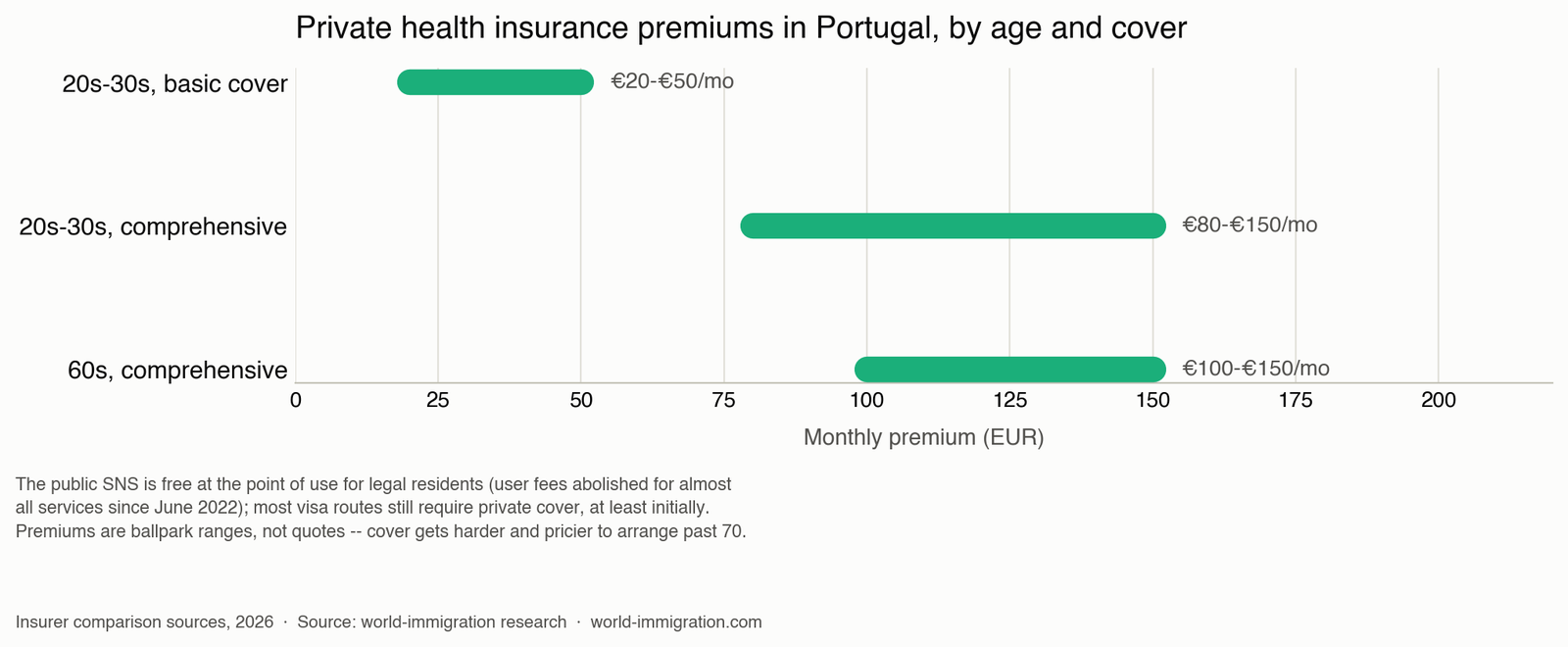
That gap between a near-free public system and paid private cover is the trade-off most new arrivals end up pricing, which is where the private side comes in.
Private health insurance: the common supplement
Private cover in Portugal buys speed and choice rather than a fundamentally different standard of medicine. It gets you into private hospitals and clinics, shorter waits for consultations and scans and often English-speaking doctors, which many expats value in the early years before their Portuguese is fluent. The main domestic insurers are names like Médis, Multicare, AdvanceCare and Fidelidade, alongside international expat-focused providers.
On price, the figures below are illustrative ranges drawn from insurer and comparison sources rather than a fixed schedule, because premiums depend heavily on age, the level of cover and any deductible you accept. Treat them as a sense of the ballpark, not a quote:
- Younger applicants (20s to 30s), basic cover: roughly €20 to €50 a month.
- A mid-range plan across most ages: commonly €30 to €60 a month for basic cover, rising to around €80 to €150 for a comprehensive plan.
- Older applicants (60s), comprehensive cover: often €100 to €150 a month and higher again for the most complete plans.
- Age 70 and over: this is where cover gets hard. Fewer insurers accept new applicants past 70 and some offer only limited senior-specific products rather than a standard plan.
The way I would approach it is to pull live quotes from two or three insurers or a comparison site such as ComparaJá before committing, since the same age and cover level can vary noticeably between providers and headline “from €X” prices usually reflect the thinnest possible plan. Buying private cover does not remove your SNS entitlement and plenty of people keep both: the SNS as the underlying safety net, private cover for anything they would rather not wait for.
How your visa route shapes healthcare access
Here is the part that surprises people. You generally cannot register with the SNS until you are legally resident, which means for the popular residence visas you need private insurance in place first. This applies to both the D7 passive-income and retirement visa and the D8 digital nomad visa and the requirement lands in two separate stages rather than as one continuous policy.
- At the consulate, for the visa application: travel or Schengen medical insurance with a minimum of €30,000 in cover for emergencies, urgent treatment and hospitalisation, valid for the visa’s travel window (often four to six months). A common misconception is that you need full long-term health insurance at this stage. You do not.
- At the AIMA appointment, for the residence permit: once you have arrived and are applying for residency, you need proper private health insurance from an accepted insurer, covering emergency and in-hospital care. Advisers commonly carry the same €30,000 figure over from the consular stage as a rule of thumb, but it is not a formal AIMA-mandated minimum the way it is at the consulate — what actually matters here is that the policy is from an insurer AIMA accepts, not the exact cover amount.
The sequence matters for budgeting, because it means paying for private cover before you can access the free public system at all. Once residency comes through and you have your número de utente, the SNS opens up, but the private policy from the visa stage does not vanish and many expats simply carry it forward for the speed it buys.
Pharmacies and prescriptions
Portuguese pharmacies, farmácias, are private businesses marked by the familiar green cross and they are woven into the public system for dispensing. The country runs on paperless electronic prescriptions, the Receita Sem Papel, which has been standard nationally for years. When a doctor prescribes something, you receive a set of codes by SMS, email or the SNS24 app rather than a paper slip.
To collect your medication, you can walk into any pharmacy in the country and give your codes along with your Citizen Card or phone number. There is no need to return to the same pharmacy or clinic. Pharmacies also handle a wide range of over-the-counter advice and minor ailments and many pharmacists speak some English, which softens the early language barrier. Your prescription history is visible through the SNS citizen portal and the associated app, which is handy when a repeat is due.
What this cannot fix
A few limits matter here. SNS registration gives you entitlement, not a guaranteed family doctor on any set timeline and in the busiest cities that wait is the single biggest frustration new residents report.
Private insurance shortens waits but is not a full substitute for the public system: policies carry exclusions, waiting periods for pre-existing conditions and annual caps and cover gets harder and dearer to arrange the older you are, sharply so past 70. The premium figures here are ballpark ranges, not quotes and the only way to know your number is to ask an insurer for one against your age and health.
The rules around user fees, visa insurance thresholds and waiting lists also shift with policy, so treat the specifics as a starting point and confirm the current position with the SNS and your insurer before you rely on them. However what still remains true about healthcare in Portugal is: a universal public system you are entitled to as a resident, a private layer most expats add for speed and a visa process that asks you to sort the private layer first.
Sources
- gov.pt (official) — Obtain a National Health Service (SNS) user number: www2.gov.pt/en/servicos/pedir-o-numero-de-utente-do-sns
- gov.pt (official) — Migrants: Healthcare in Portugal (SNS eligibility tied to legal residence): www2.gov.pt/en/migrantes-viver-e-trabalhar-em-portugal/migrantes-cuidados-de-saude-em-portugal
- SNS (official) — End of taxas moderadoras across the SNS (June 2022): sns.gov.pt
- Governo de Portugal (official) — User fees end across the SNS except unreferred hospital emergencies: portugal.gov.pt
- Doutor Finanças — Guia de taxas moderadoras: custos e isenções (exact emergency-fee schedule by unit type): doutorfinancas.pt
- OECD / WHO European Observatory — Portugal: Country Health Profile 2025: eurohealthobservatory.who.int
- SPMS / SNS (official) — Receita Sem Papel (paperless prescriptions): spms.min-saude.pt
- The Portugal Post — Reporting on SNS waiting lists and family-doctor shortages (2025): theportugalpost.com
- ECO — Utentes sem médico de família voltam a aumentar para 1,56 milhões em 2025, citing Conselho das Finanças Públicas data (June 2026): eco.sapo.pt
- Global Citizen Solutions — Health Insurance in Portugal: guide for expats (2026): globalcitizensolutions.com
- C1 Brokers — How much does private health insurance cost in Portugal? A guide for expats: c1brokers.pt
- Feather Insurance — Portugal health insurance and visa requirements (2026): feather-insurance.com
- Portugal Residency Advisors — Portugal travel insurance for visa and residency: a legal guide (AIMA-stage requirements, 2026): portugalresidencyadvisors.com
- Portugalist — How to get a número de utente in Portugal: portugalist.com

