
Portugal spent the last decade with a reputation as the affordable corner of Western Europe: sunshine, safety and a cost of living that let a modest foreign income stretch a long way. Parts of that are still true. Other parts have stopped being true and the gap between the two is where a cost of living in Portugal budget goes wrong.
Rents in Lisbon and Porto have climbed hard since 2020, while the interior has barely moved. Ask what it costs to live in Portugal in 2026 and the useful answer always comes with a city and a lifestyle attached, because a single figure hides the thing that actually decides your budget.
This guide sets out what the numbers look like now, for a single person and for a couple, across a few realistic tiers of comfort. It leans on official data from INE (Portugal’s national statistics agency) and the European Central Bank for the wider picture and on current crowdsourced price snapshots for the day-to-day items. The aim is the national shape, plus the ranges that let you sanity-check a budget before you commit to one. For a street-level view of the most expensive city, see our deep dive article: Cost of Living in Lisbon.
The cost of living in Portugal: why there is no single figure
Three things pull any Portuguese budget in different directions. The first is geography and it does more work here than in most countries. Lisbon sits at the pricey end, with Porto not far behind. The Algarve and the coastal commuter towns around the capital price close to them. Step inland to Braga, Coimbra, Guarda or Castelo Branco and the same money buys a great deal more.
INE‘s own lease data puts median new-lease rent in Greater Lisbon at around €14.38 per square metre against roughly €10.13 in the Porto metro area and far less again in the interior (INE, Q1 2026, published 26 June 2026). Two Portugals, on one small map.
The second factor is the split between what a comfortable life costs a local and what a newcomer typically ends up spending. Portugal’s national minimum wage in 2026 is €920 a month gross, up from €870 in 2025, paid across fourteen instalments (Government of Portugal, Decree-Law 139/2025). The average gross salary sits near €1,550 to €1,700 depending on the source, which nets out to somewhere in the region of €1,150 to €1,300 a month after deductions (Fedfinance; wage.is, 2026).
Those figures describe a Portuguese household’s world. A foreigner arriving on a remote-work income usually lands well above them and not through extravagance. Newcomers tend to search in a narrower, pricier band of housing, often furnished and short-term, in the districts other foreigners already cluster in and they frequently carry private health insurance on top of public access. A realistic expat budget starts a fair way above the comfortable-local one.
The third factor is the currency and it only matters if you earn outside the euro. As of early July 2026 the euro traded near US$1.14 and around £0.86 (ECB reference rates, 3 July 2026). For anyone paid in dollars or pounds, a move of a few cents in that rate changes the felt cost of living more than local inflation does.
Portuguese consumer prices rose about 3.3% in the year to May 2026, their fastest since 2023, pushed largely by a 13% jump in energy costs (INE, May 2026). Any non-euro figure in this guide is a snapshot and worth re-checking against the live rate before you lean on it.
A monthly budget: single person and couple
The table below is an editorial estimate for Portugal as a whole, built from current 2026 price data rather than the pre-2020 numbers that still circulate in older guides. Treat the tiers as overlapping ranges, not fixed price tags. Rent does most of the work in moving a budget from one tier to the next, which is why the interior can sit in the modest column and central Lisbon can push a single person into the comfortable-plus one. (A couple sharing one apartment is why the couple column is not simply double the single one).
| All-in monthly cost (€) | Modest (interior / outside centre) | Comfortable (mid-size city) | Comfortable-plus (central Lisbon/Porto) |
|---|---|---|---|
| Single person | €1,100 – 1,400 | €1,600 – 2,000 | €2,400 – 3,200+ |
| Couple | €1,500 – 1,900 | €2,200 – 2,800 | €3,300 – 4,500+ |
Editorial estimate for 2026, in euros. At roughly €1 = US$1.14 = £0.86, the single-person comfortable range works out near US$1,800–2,300 or £1,375–1,720 a month. Ranges synthesise current rent, utility, transport and grocery figures; individual households vary widely.
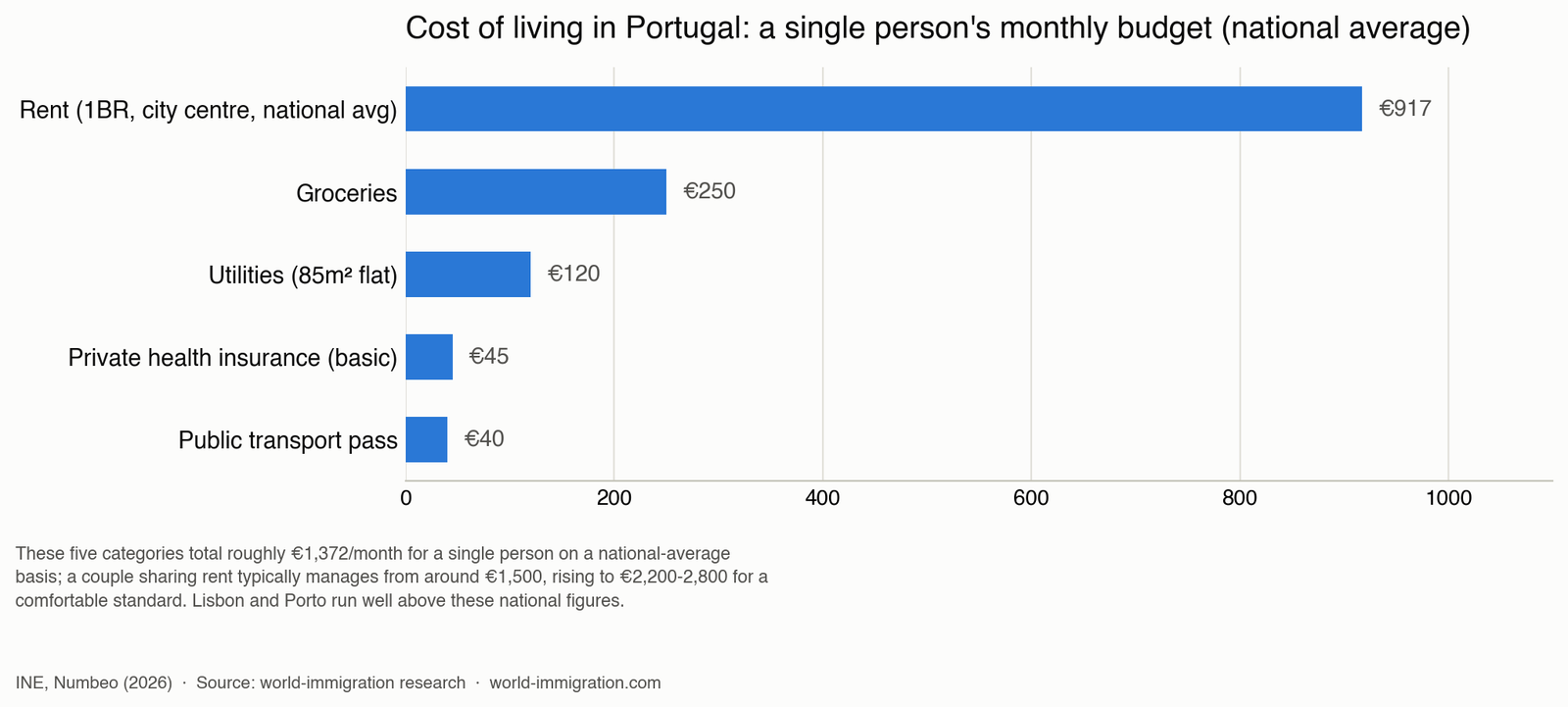
To see where those totals come from, here are the individual line items, each cited to its source and date. The figures below draw partly on Numbeo, a crowdsourced cost-of-living database, which is useful for a national shape but built from voluntary contributions rather than a formal survey, so it is best read as a starting point rather than a quote.
- Rent is the swing item. Numbeo‘s national averages put a one-bedroom apartment at about €917 a month in a city centre and €725 outside it (Numbeo, July 2026). Those blend the whole country, so they sit well below the coastal cities and above the interior. City-level Numbeo data (July 2026) puts central Lisbon one-beds at roughly €1,100 to €1,800, Porto a little lower at €850 to €1,200 and an interior city such as Braga or Coimbra lower again at €550 to €900 for something comparable. Renting in Portugal covers the leases, deposits and contract types in detail.
- Utilities for an 85-square-metre flat average around €120 a month across electricity, heating, cooling, water and rubbish (Numbeo, July 2026). That figure hides a large seasonal swing, covered below, because winter heating is where Portuguese bills catch people off guard.
- Groceries are one of the cheaper parts of the budget. A single person shopping mostly local produce can keep it to roughly €250 to €300 a month (Numbeo-based estimates, June 2026); staples like bread, eggs, chicken and rice are inexpensive and local markets undercut the international supermarkets.
- Transport is a bargain in the cities. A monthly public-transport pass runs about €40 (Numbeo, July 2026) and Lisbon and Porto both cap city travel at that level, so many residents skip owning a car entirely.
- Eating out stays affordable by Western European standards. A meal at an inexpensive restaurant is around €12 and a coffee well under €2 (Numbeo, July 2026), which keeps a modest social life from wrecking a budget.
- Health insurance is the line most local budgets do not carry. Private cover runs roughly €30 to €60 a month for a basic plan and €80 to €150 for a comprehensive one, depending on age and provider (Expatica, 2026). Whether you need it at all turns on your residency status, which the next section unpacks.
Lisbon and Porto versus the smaller cities and the interior
The broad ranking is consistent. Lisbon is the most expensive place to live, with the widest spread between its cheapest and priciest neighbourhoods. Porto sits a step below, though it has climbed fast as remote workers who found Lisbon too dear moved north. The Algarve and the towns ringing Lisbon price close to the capital, particularly in the tourist season. The interior is the other Portugal: cities like Guarda, Castelo Branco, Bragança and Beja can run 30 to 50% below Lisbon on housing (Numbeo city-level data, July 2026) and they still track local wage levels rather than foreign incomes.
One caveat on the direction of travel and it is easy to misread. Official INE lease data for Q1 2026 shows every NUTS III sub-region of the country, the Porto metro area included, still rising year on year — the city of Lisbon itself by 8.2%, a touch below the 9.1% national rate (INE, Q1 2026, published 26 June 2026). What actually fell was the quarter-on-quarter change: the Porto metro area’s median rent dropped 5.1% and Greater Lisbon’s dropped 1.4% against the previous quarter, a short-term cooling signal sitting alongside the annual rise, not replacing it.
Asking-price data from Idealista, a Portuguese property portal, broadly agrees with this split: national asking prices are down slightly, Lisbon only a little, Porto more noticeably. The practical read is that Lisbon remains high and still climbing, Porto has genuinely started to ease and the interior remains the lever if affordability is the priority. Because a single national figure flattens all of this, the city-specific detail is where a budget actually gets decided.
How Portugal compares to the US, UK and the rest of the EU
At a high level, Portugal remains meaningfully cheaper than the English-speaking countries most newcomers arrive from. Crowdsourced comparisons put the overall cost of living, rent included, roughly 30% below the United States, with groceries and restaurants each around a third cheaper (Numbeo, June 2026). Against the United Kingdom the gap is narrower, with rent something like a fifth lower on average. Within the European Union, Eurostat’s comparative price-level data consistently places Portugal among the cheaper Western European economies, below the EU average on most consumer prices, though the gap to Western Europe has shrunk as the coastal cities have caught up (Eurostat, Comparative price levels of consumer goods and services, 2025).
The comparison that matters, though, is not country to country but city to city. Central Lisbon now prices closer to a mid-tier North American or Western European city than to the rest of Portugal. The affordability advantage is real, but it lives increasingly in the smaller cities and the interior, not in the two metros that draw the most foreign attention. Anyone benchmarking Portugal against home on the strength of a national average is comparing the wrong numbers.
The cost traps to plan for
A few recurring surprises push budgets past what the headline figures suggest. None of them are hidden, but they are easy to miss until the first bill or the first cold snap arrives.
- Winter heating in older housing. Portuguese homes are built for summer heat, not winter cold and central heating is uncommon. Many flats rely on reversible air-conditioning units or portable heaters, which struggle to warm a poorly insulated building and send electricity bills up sharply from December to February. With energy costs up more than 13% in the year to mid-2026 (INE, 2026), a utilities line that reads €120 in October can climb well beyond that in the depths of winter. The €120 average is a yearly blend, not a monthly constant.
- Rent outpacing local wages. The gap between what Portuguese salaries can support and what coastal rents now ask is one of the defining stories of the market. It has fuelled visible public frustration over housing costs and it means the cheapest advertised rents in Lisbon and Porto are often long-standing contracts unavailable to a newcomer. Budget from current listings, not from the low figures that older guides quote.
- Private health insurance before public access. Portugal’s public health service, the SNS, is open to legal residents, but a new arrival is not covered until residency is in place and several visa routes require private insurance as a condition of the application (see Healthcare in Portugal for the route-by-route detail). That premium is a recurring cost most local budgets never carry and it is easy to leave out of an early estimate.
- Tourist-area pricing. Restaurants, groceries and short-term rentals in the tourist cores of Lisbon, Porto and the Algarve can cost a good deal more than a few streets or a few towns away. The affordable Portugal and the expensive one often sit within walking distance of each other.
Two other choices move this budget more than any single line item. Whether you rent long-term or buy is one — the costs and process of purchasing are covered separately in Buying Property in Portugal. If you are retiring rather than working, the income mix and the visa route both look different again, covered in Retiring in Portugal: The D7 Visa Explained. And for the fuller comparison of where in the country your money stretches furthest, see Best Place to Live in Portugal.
Healthcare and what it adds to a budget
Healthcare deserves its own line because it behaves differently from the rest of the budget. According to Expatica, once you hold a residence permit you can register with the SNS and use the public system and since 2022 most user fees have been abolished, with the few that remain running a handful of euros per visit. That makes the ongoing public cost low.
The complication is timing and choice. Before residency is finalised and often as a visa requirement, newcomers carry private cover and many keep a private plan afterwards for faster specialist access, which is where the €30 to €150 a month above comes in. Healthcare in Portugal goes through eligibility, enrolment and the public-versus-private trade-off in full.
The limits of any Portugal budget
These numbers are ranges, not a precise index. The rent, utility and grocery figures draw partly on crowdsourced data with uneven sample sizes, so they read best as a well-informed starting point rather than a quote for your specific flat. The rent picture in particular is genuinely contested right now, with official lease data and portal asking prices pointing in slightly different directions, so treat any single rent figure as provisional.
For non-euro earners, the currency caveat bites: a budget set at one exchange rate can feel different a few months later and I would build in headroom rather than assume today’s rate stays.
The practical takeaway is to treat this as a guide, then get current figures for your specific city and lifestyle before you commit. Pull live listings in the actual neighbourhoods you are considering rather than a national average, price a winter’s heating rather than an autumn utility bill and pad the first few months for the setup costs that always run higher than the steady state.
Do that and Portugal still holds up as one of the more liveable and affordable moves a person from a higher-income country can make, provided the budget is built on this year’s numbers and the right Portugal. For the wider picture beyond the money, see Moving to Portugal and for the earnings side, Average Salary in Portugal.
Frequently asked questions
How much money do I need to live in Portugal?
For a single person in 2026, a modest but workable budget in the interior or outside the city centre starts around €1,100 to €1,400 a month all in, with a comfortable standard in a mid-size city closer to €1,600 to €2,000. Central Lisbon or Porto can push that past €2,400. A couple sharing an apartment can manage from roughly €1,500 and spends around €2,200 to €2,800 for a comfortable standard. Rent, city and heating choices move the figure more than anything else.
Is Portugal still cheap to live in?
It depends heavily on where. Portugal overall is still noticeably cheaper than the US or UK, with groceries, transport and eating out all a good deal lower. But central Lisbon and Porto have risen sharply since 2020 and no longer feel cheap by any measure, while the interior remains inexpensive. The country’s affordability advantage has shifted from the whole map to the smaller cities and inland towns.
Why are utility bills in Portugal higher than expected in winter?
Portuguese housing is built for summer heat rather than winter cold and central heating is uncommon. Homes often rely on reversible air-conditioning or portable heaters that work a poorly insulated building hard, so electricity bills spike from December to February. With energy costs having risen more than 13% over the past year (INE, May 2026), a utility line that looks moderate in autumn can climb well beyond it in winter. The commonly quoted €120 monthly average is a yearly blend, not a constant.
Do I need private health insurance in Portugal?
Once you hold a residence permit you can register with the public SNS, where most user fees have been abolished, so ongoing public healthcare costs little. Before residency is in place, though and as a condition of several visa routes, you generally need private cover, which runs roughly €30 to €150 a month depending on the plan (Expatica, 2026). Many residents keep a private policy afterwards for quicker specialist access rather than out of necessity.
Sources
- INE (Instituto Nacional de Estatística) — Consumer Price Index and median new-lease rent releases, 2025–2026. ine.pt
- European Central Bank — euro foreign-exchange reference rates (EUR/USD, EUR/GBP), 3 July 2026. ecb.europa.eu
- Numbeo — Cost of Living in Portugal (crowdsourced database), accessed July 2026. numbeo.com
- Idealista — Portuguese rental market reporting, June 2026. idealista.pt
- Fedfinance / wage.is — Portugal minimum wage and average salary, 2026. wage.is
- Expatica / Global Citizen Solutions — SNS access and private health insurance for foreigners, 2026. expatica.com
- Government of Portugal — minimum wage increase to €920 for 2026 (Decree-Law 139/2025). portugal.gov.pt
- Eurostat — Comparative price levels of consumer goods and services, 2025. ec.europa.eu/eurostat

