
If you are weighing up a move to Portugal, the average salary figure is one of the first things you will look for and one of the easiest to misread. Headlines, drawing on INE data, put the average salary in Portugal at around €1,700 a month before tax.
That number is accurate as far as it goes, but on its own it tells you very little about what a typical worker takes home, what a specific job in Lisbon or Porto is likely to pay, or whether the money stretches to cover the rent. The gap between the headline and the lived reality is where most planning goes wrong.
This article works through what the official data actually shows. It covers the national average and the median, the 2026 minimum wage, how pay varies by sector and by region, how salaries line up against the cost of living and roughly what lands in your account after Portuguese income tax and social security. The figures come from Instituto Nacional de Estatística (INE), Pordata, Eurostat and the Portuguese government.
The national average and why it flatters the typical worker
According to INE, the average (mean) gross monthly remuneration per worker in Portugal rose to about €1,694 in 2025, up from €1,602 in 2024. On an annual basis, Eurostat put Portugal’s average full-time gross wage near €24,800 for 2024, which INE data puts among the lower averages in the European Union. So the €1,700-a-month figure is sound, provided you understand what “average” is doing here.
The mean is pulled upward by a relatively small group of high earners in technology, finance and senior management. The median, meaning the middle earner with half the workforce above and half below, sits noticeably lower. INE reported a median net monthly salary of €980 in 2024, the highest it had been since 2011 (the gross median sits a little higher, closer to €1,000 to €1,050).
Note that the €980 figure is net (after-deductions), so it is not directly comparable to the €1,694 gross mean. The point that survives the mismatch is the shape of the distribution: a large share of Portuguese workers earn well below the average and the average is not the figure a typical new arrival should anchor to.
One structural quirk matters before any of these numbers make sense. Under the Código do Trabalho‘s rules on the holiday and Christmas subsidies (Articles 263 and 264), Portugal traditionally pays fourteen salaries a year, not twelve. You receive your normal monthly pay across the year, plus a holiday subsidy (usually in summer) and a Christmas subsidy, each roughly equal to a month’s pay. Some employers spread these two extra payments across the twelve months instead. When you see an annual gross figure quoted for a Portuguese job, check whether it divides by twelve or by fourteen, because it changes what each monthly payslip looks like.
The 2026 minimum wage
Portugal’s national minimum wage (the salário mínimo nacional) rose to €920 a month gross from 1 January 2026, set by government decree (Decreto-Lei n.º 139/2025). Paid across fourteen payments, that comes to €12,880 a year before deductions. The increase continues a steady climb: €705 in 2022, €760 in 2023, €820 in 2024, €870 in 2025 and now €920. A tripartite agreement between the government, unions and employers projects further rises toward €1,020 by 2028, though those later figures are targets rather than law.
The autonomous regions set their own slightly higher floors. For 2026 the minimum is €966 a month in the Azores and €980 in Madeira (Decreto Legislativo Regional n.º 1/2026/M), against €920 on the mainland. A meaningful share of the Portuguese workforce earns at or close to the minimum wage, which is part of why the median sits so far below the mean.
What different sectors pay
Sector is the single biggest driver of where you land relative to the average. The ranges below are gross monthly figures for 2025 and 2026. The technology figures in particular come from job-board aggregators rather than INE, so treat them as indicative of the market rather than official statistics.
| Sector | Typical gross monthly range |
|---|---|
| Technology and IT | ~€1,300 (junior) to €2,000+ mid-level; senior software and specialist roles €3,000–€5,000+ |
| Education (public school teachers) | ~€1,771 at the entry step of the official scale, rising with seniority above €2,300 |
| Healthcare (public-sector nursing) | €1,657 at entry (Enfermeiro, position 1, 2026 pay table); Enfermeiro Especialista from €1,920 |
| Tourism and hospitality | ~€950 to €1,200; table and kitchen staff cluster near the lower end |
Technology is where Portugal’s pay reaches competitive European levels, which is a large part of why Lisbon and Porto have drawn so many international tech employers and remote workers. Hospitality sits at the other end. Tourism is one of the country’s biggest employers, yet its average pay runs below the national figure and the sector’s collective agreement for 2026 (AHRESP–SITESE) lifts base rates by only around five percent. Teaching and public-sector nursing follow published pay scales — the teachers’ remuneration table and the nursing career remuneration table — which makes their figures more reliable than the market averages that float around online for private-sector roles.
Salary by region: Lisbon and Porto versus the interior
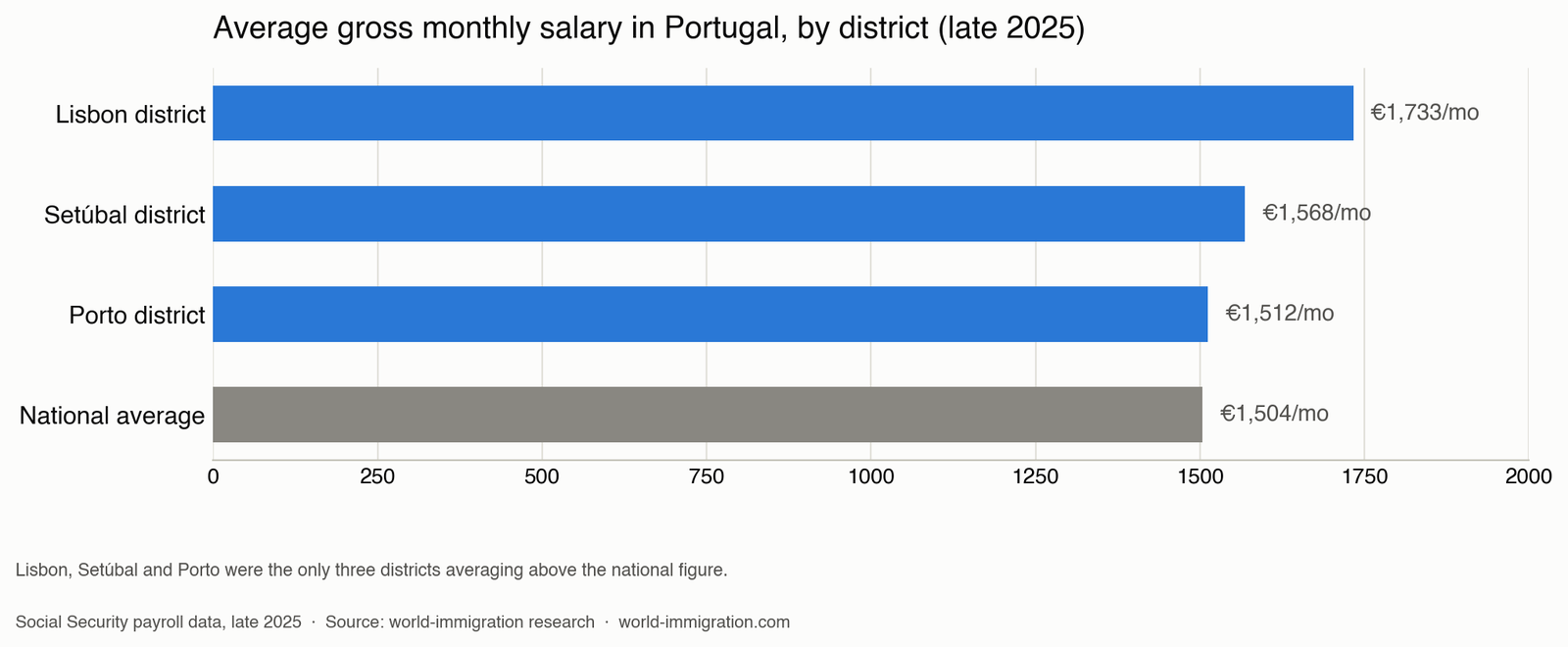
Where you work in Portugal changes the number as much as what you do. Based on an analysis of October 2025 Social Security payroll data from the Ministério do Trabalho, Solidariedade e Segurança Social (GEP/MTSSS), the national average sat around €1,504 a month, with Lisbon clearly out in front. Lisbon district averaged roughly €1,733 a month, about fifteen percent above the national figure. Setúbal, just to the south, came next at around €1,568 and Porto followed at about €1,512. Those three districts were the only ones above the national average.
The interior tells the opposite story. Districts such as Beja and Portalegre in the Alentejo and Vila Real and Guarda in the north and centre, ran more than fifteen percent below the national average. That north-and-interior versus coast-and-capital divide is one of the defining features of Portuguese earnings and it maps closely onto the cost gap too. The single-euro district figures here come from that same private analysis of government payroll data rather than directly from Pordata, so I would read them as showing the direction and rough scale of the gap rather than as exact to the euro.
Set against the national average, the chart below gives a sense of how far Lisbon pulls ahead and how far the interior trails.
What the average salary buys against the cost of living
A salary figure means nothing without the cost picture beside it and in Portugal the two have pulled apart in the cities. According to Numbeo, monthly costs for a single person excluding rent in Lisbon run around €756. Add housing and the arithmetic gets tight fast: a one-bedroom flat in the city centre averages roughly €1,432 a month, with the figure closer to €1,077 outside the centre. Total monthly outgoings for a single person in Lisbon, rent included, come to around €2,190 in the centre and about €1,830 outside it.
Put that against take-home pay. Someone on the national average of about €1,694 gross keeps somewhere in the region of €1,250 to €1,300 a month after deductions, which I will come to below. In central Lisbon, that leaves very little once rent is paid and it is why so many people working in Portugal report that a single average salary does not comfortably cover living alone in the capital.
Couples sharing costs and workers in Porto or smaller cities where rents are lower, have a materially easier time of it. This is the central tension of moving to Portugal on a local salary: the lifestyle and climate are a strong draw, but the wage-to-rent maths in Lisbon is unforgiving and it is worth modelling carefully against the cost of living in Portugal and specifically the cost of living in Lisbon, before committing.
Take-home pay after tax and social security
Two deductions come off Portuguese gross pay. First is the employee social security contribution, a flat eleven percent of gross earnings. Second is IRS, the personal income tax, which is progressive. According to the 2026 Portal das Finanças tables, it runs across nine income bands, from roughly twelve to thirteen percent on the lowest band up to a top marginal rate of forty-eight percent on annual income above about €81,000. Income at or below the minimum wage is exempt from monthly withholding, though social security still applies.
I want to be careful here, because the exact IRS band thresholds for 2026 are complex, they shifted in the latest state budget and reputable Portuguese payroll sources do not fully agree on the precise figures. So treat the take-home numbers below as approximate. They assume a single person with no dependants on the standard withholding tables and they are for orientation only, not for financial planning.
| Gross monthly salary | Approx. net after IRS + 11% social security |
|---|---|
| €920 (minimum wage) | ~€820 |
| €1,200 | ~€1,010 |
| €1,700 (near national average) | ~€1,250–€1,300 |
| €2,500 | ~€1,700–€1,750 |
| €3,500 | ~€2,250 |
The pattern to take from this is that the effective bite climbs steadily as gross pay rises and that even at the national average the combined deduction is meaningful. For an exact figure on any specific salary, the Portuguese tax authority publishes the current withholding tables through the Portal das Finanças and that is what I would use before signing a contract rather than any online estimate, including this one.
What these figures cannot tell you
Salary data has limits and it is fair to be plain about them. Official statistics and published pay scales are reliable for the overall numbers. They are less reliable for what any single job actually pays.
A few specifics the numbers do not capture. The IRS band thresholds for 2026 were unsettled across sources at the time of writing, so the take-home figures are approximate and should be confirmed against the Portal das Finanças. The regional district averages come from payroll analysis rather than directly from INE or Pordata, so read them as scale, not gospel.
The technology and hospitality sector figures come from job-board aggregators, which tend to overstate the top end. And tax brackets, the minimum wage and social security rules all change year to year, so some specifics here will date within twelve months. Verify current rates directly with INE, Pordata and the Portuguese government before making decisions.
The larger thing the tables cannot tell you is how quickly you will find work in your field and at what level, as a new arrival. A salary benchmark describes what a role pays once you hold it. It says nothing about the months it may take to get there. If you are still mapping the move, the practical routes and permits are covered in the guides on working in Portugal and moving to Portugal.
Frequently asked questions
What is a good salary in Portugal?
As a working benchmark, a gross salary of €2,000 to €2,500 a month puts a single person comfortably above the national average and covers living costs with room to save in most cities, though central Lisbon stretches it. Anything from €3,000 upward is a strong income by Portuguese standards. At the national average of around €1,700 gross, life is manageable outside the capital but tight in central Lisbon once rent is paid. A couple earning between them has far more breathing room than the single-salary figures suggest.
Why is the average salary in Portugal higher than what most people earn?
Because a relatively small number of high earners in technology, finance and senior management pull the mean upward. Portugal’s income distribution is skewed, so the median (the middle earner) sits well below the average. INE’s median net figure of €980 a month is a far better guide to a typical income than the €1,700 gross average.
What is the minimum wage in Portugal in 2026?
The national minimum wage is €920 a month gross from 1 January 2026, paid across fourteen payments a year for a total of €12,880 gross. The Azores set theirs at €966 and Madeira at €980. Income at the minimum wage is exempt from monthly income-tax withholding, though the eleven percent social security contribution still applies.
Can you live on the average salary in Portugal?
Outside the big cities, yes, reasonably comfortably as a single person. In central Lisbon it is difficult on one average salary once rent is accounted for, since a one-bedroom flat in the centre can absorb the larger part of average take-home pay. Porto and smaller cities offer a much better balance and sharing costs as a couple changes the picture entirely.
Sources
- Instituto Nacional de Estatística (INE) — average and median monthly earnings, ine.pt
- Pordata — Portuguese statistics database, earnings by region and sector, pordata.pt
- Eurostat — EU comparative annual wage data, ec.europa.eu/eurostat
- Governo de Portugal — 2026 national minimum wage decree (Decreto-Lei n.º 139/2025), portugal.gov.pt
- Autoridade Tributária e Aduaneira — 2026 IRS bands and withholding tables, Portal das Finanças, portaldasfinancas.gov.pt
- Numbeo — Lisbon cost-of-living and rent benchmarks, numbeo.com
- Código do Trabalho (Lei n.º 7/2009) — holiday and Christmas subsidy rules, Articles 263–264, pgdlisboa.pt
- Governo dos Açores — 2026 regional minimum wage, portal.azores.gov.pt; Região Autónoma da Madeira — Decreto Legislativo Regional n.º 1/2026/M, diariodarepublica.pt
- Ministério do Trabalho, Solidariedade e Segurança Social (GEP/MTSSS) — Social Security payroll data by district, October 2025, as compiled by brighterfuture.pt
- SPN (Sindicato dos Professores) — teachers’ pay scale, spn.pt; ASPE (Associação Sindical Portuguesa dos Enfermeiros) — nursing career pay scale, aspe.pt
- AHRESP — 2026 tourism and hospitality collective agreement, ahresp.com
- gov.pt — employee social security contribution rate, gov.pt

