
An acceptance letter from a Portuguese university is the good news. The part that stalls people comes next, which is working out which visa actually lets you turn up, enrol and stay for the length of a degree. For a student from outside the EU, that visa is the D4 and it behaves differently enough from a tourist entry or a short-course permit that it pays to understand it before you book flights or pay a deposit.
This guide is for someone outside the EU, the EEA and Switzerland who has been accepted, or is about to enrol, at a recognised Portuguese higher-education institution. If you hold an EU passport, none of this applies to you, since you can study in Portugal on the same footing as a local. And if your course runs under 90 days, Portugal’s own visa-type rules treat that as a temporary-stay matter, so a short-stay Schengen visa usually covers it and a D4 is more than you need.
Portugal itself and what it is like to move there, sits in the wider moving to Portugal guide; this article is only about the study route.
What the Portugal student visa (D4) actually is
The D4 is Portugal’s national long-stay visa for study and research. It covers a spread of purposes under one heading: enrolment in higher education (a bachelor’s, a master’s or a doctorate), student exchanges, academic research, secondary-school exchange, unpaid internships and voluntary work. Each purpose carries its own document checklist, but for a foreigner enrolling in a degree, the higher-education branch is the one that matters and it is the correct category for that situation, per the official D4 one-pager. It is distinct from the D5 route, which immigration-consultancy guides such as WithPortugal’s D4/D5 explainer describe as covering mobility/exchange students already enrolled at an institution elsewhere in Europe; Portugal’s own visa portal does not use the D4/D5 shorthand itself, so treat that distinction as consultancy convention rather than official terminology.
The detail that surprises people most is that the D4 is a residence visa, not the residence permit itself. Think of it as the entry ticket. It gets you into Portugal legally so you can complete the second, in-country step that turns you into a resident, exactly as Portugal’s own visa-type guidance sets out: the residency visa is valid for a fixed window, during which its holder must apply for the residence permit itself. That two-part structure runs through everything below and losing sight of it is where the confusion starts.
Portugal student visa requirements: the documents
The paperwork is not exotic, but a couple of items run on timetables you do not control, so starting them early is the difference between a calm application and a last-minute scramble. The core list, drawn from Portugal’s own official visa documentation, looks like this.
- A completed national-visa application form and two passport photographs.
- A valid passport, with validity running at least 90 days beyond your intended stay.
- An acceptance or enrolment letter from a recognised Portuguese higher-education institution. This is the document the whole application hangs on.
- A criminal record certificate from your country of residence, carrying a Hague Apostille or the relevant legalisation, if you are over 16.
- Travel or health insurance covering medical costs for the period of the visa.
- Proof of accommodation in Portugal and proof of sufficient means to support yourself (covered in its own section below).
Two points to know before you over-prepare. First, Portugal’s official visa documentation says students admitted to a recognised higher-education institution can be exempt from separately presenting some of these proofs, because the admission letter stands in for them; nationals of Portuguese-speaking (CPLP) countries have the means-of-subsistence requirement waived outright.
Second, that exemption is written into the rules but not always applied evenly. Several relocation practitioners report consulates still asking for the full financial file regardless and any post can request extra documents at its discretion. My read is to prepare the complete set and be pleasantly surprised if asked for less.
The item to begin first is the criminal record certificate, because the apostille or legalisation step and any required translation, each runs on its own clock. Leave it to the final fortnight and it becomes the thing holding up the whole submission.
Proof of funds: the 2026 threshold
The financial requirement is the number people most want pinned down and it moves every year, so older guides quoting it are often out of date. Portugal ties the means-of-subsistence figure to its national minimum wage. For 2026 that minimum wage rose to €920 a month (up from €870 in 2025), set by Decreto-Lei n.º 139/2025.
For a study visa, the applicant is generally expected to show means for 12 months, or for the number of months the stay will last, per Portugal’s official means-of-subsistence rules. On the €920 baseline that works out to roughly €11,040 for a full year. That same official page does not publish a sliding-scale discount for students specifically; the reduced-percentage provisions it sets out apply to other categories, such as research or amateur-sports visas. What it does confirm for students is a full waiver of the requirement for holders of a recognised scholarship, such as one from Camões – Instituto da Cooperação e da Língua, on top of the CPLP waiver already mentioned above. Treat a scholarship or CPLP nationality as the confirmed ways the €11,040 figure changes, not a partial discount some guides describe. The amount is assessed net of social-security contributions, so the practical monthly figure sits a little below the headline €920.
One caution on the underlying number. Portugal’s official means-of-subsistence guidance references the minimum wage and that is the figure I would work from. Some secondary sources instead quote the IAS (the social-support index, €537.13 for 2026), which is a lower and different benchmark. The two get muddled online.
The safe move is to budget against the €920 minimum-wage figure and confirm the exact expectation with the consulate handling your file, because it is their call, not a blog’s. For a sense of what that money actually has to stretch to cover once you arrive, the cost of living in Portugal guide is the companion piece to this one.
Tuition at Portuguese public universities
Portugal runs a two-tier fee system and which tier you fall into depends entirely on your nationality rather than your course. EU, EEA and Swiss students pay a regulated fee, the propina, capped at around €697 a year for 2025/26 bachelor’s and integrated master’s programmes at public universities, per the Direção-Geral do Ensino Superior’s own propinas schedule. That cap is the reason Portugal has a reputation as cheap for European students.
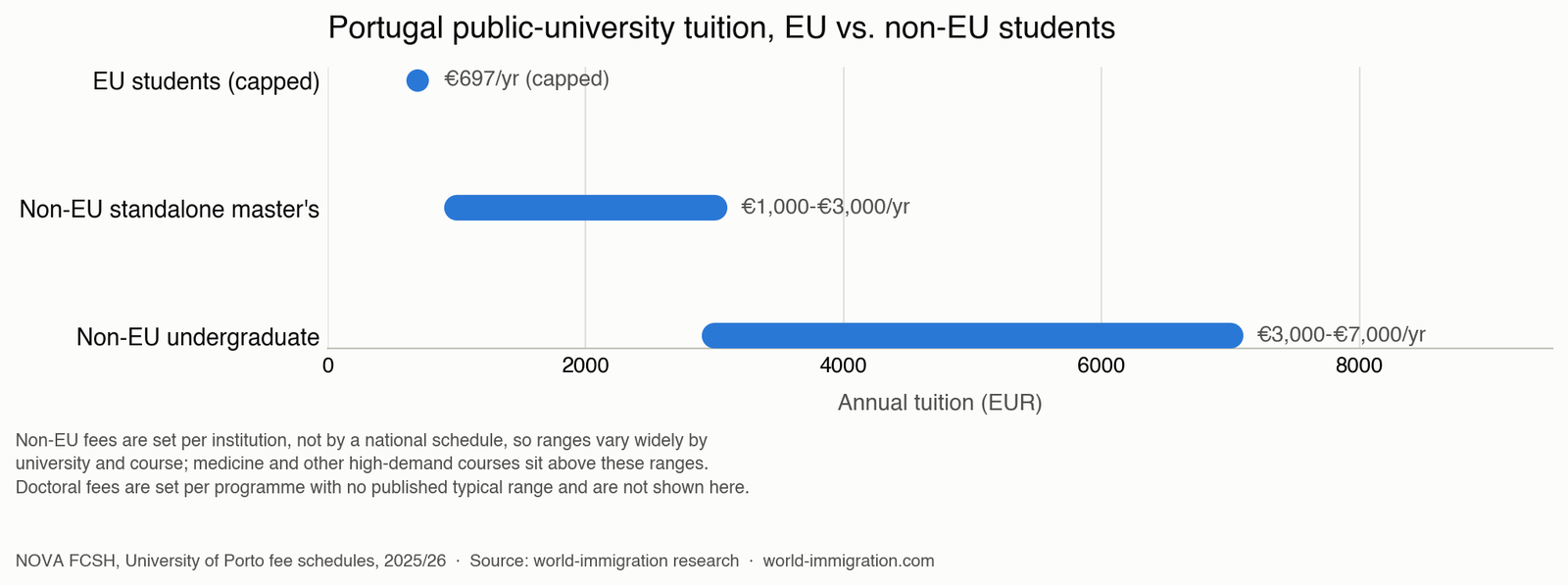
Non-EU students are charged under the estatuto de estudante internacional (international student statute) and here each institution sets its own fees rather than following a national cap. The result is markedly higher and it varies a lot by university and by course. According to Mastersportal, as a broad guide, an undergraduate licenciatura for an international student runs somewhere in the region of €3,000 to €7,000 a year.
To put concrete numbers on it, NOVA FCSH in Lisbon charges around €3,500 a year for international undergraduates, while the University of Porto‘s range across bachelor’s and integrated master’s programmes spans roughly €3,500 to €16,500, with medicine and other high-demand courses sitting at the top. According to the same Mastersportal survey, standalone master’s programmes tend to fall in a €1,000 to €3,000 band, though specialised ones climb well past that.
Because no central schedule governs the non-EU fee, treat the ranges above as orientation only. The figure that binds you is the one on your chosen university’s own fee page for your specific programme.
How the application works, step by step
The sequence is where the visa-then-permit structure becomes concrete. It runs roughly like this:
- Secure your admission from a recognised institution and obtain a Portuguese tax number (NIF), which you will need for almost everything that follows.
- Apply for the D4 at the Portuguese consulate or embassy in your country of residence, or through its outsourced visa partner (often VFS Global).
- Receive the national visa, which Portugal’s own visa-type rules describe as a temporary document valid for 120 days and allowing two entries into Portugal.
- Travel to Portugal, then attend an appointment with AIMA to convert that visa into a residence permit (título de residência), usually first issued for one year and renewable.
AIMA is the Agency for Integration, Migration and Asylum, which took over Portugal’s immigration functions from the former SEF on 29 October 2023. If you read older guides referring to SEF appointments, that is the same job, now under a new body. The residence permit AIMA issues is the document that makes you a legal resident student; the consular visa only gets you far enough to obtain it.
How long it takes
The consular stage has a statutory decision period of 60 days for a residency visa, though I would build in two to three months before your course start date to absorb the variability between posts, since the quiet season and the pre-September rush are not the same experience.
The AIMA stage is harder to promise a number for. The agency inherited a very large backlog during the SEF handover and has been working through it across 2025 and 2026, with reported improvement but continuing variability. Practitioner reports in 2026 describe biometric appointments landing a few months after submission and the physical card arriving some weeks to a few months after approval. Those are observed ranges from immigration consultancies rather than an official published service standard, so treat them as a planning guide with a short shelf life and check the current position close to the time.
Can you work part-time on a D4?
Yes, within limits and this is one clear advantage the D4 has over a short-course entry. Once you hold the residence permit (not merely the visa), you can take part-time work. Immigration consultancies and university international offices, such as ForForeignersPortugal’s own guidance, consistently describe the widely applied guideline as up to 20 hours a week during term, with full-time work permitted during holidays and semester breaks, provided the work does not get in the way of your studies, though as the next paragraph explains, this is standard practice rather than a numbered statute. Students on a short course under 90 days, holding only a Schengen visa and no residence permit, cannot work at all.
One caveat: the 20-hour figure is the standard operating norm rather than a single hard statutory cap written into Portuguese law the way some countries codify it. I would treat it as a working assumption and confirm the specifics with your institution’s international office, which deals with this constantly. If earning a living rather than topping up pocket money is central to your plan, the broader working in Portugal guide is the better starting point, because a student permit is built around study first and work second.
After you graduate: staying on to work
Portugal is comparatively generous here, which is part of what makes the study route attractive as a longer-term play. Under Article 122 of the immigration law, graduates who completed higher education in Portugal and who held a lawful student residence permit throughout, can apply from within the country, directly to AIMA, for a residence permit to work. That means you do not have to leave and start again with a fresh consular visa once you have a job offer or a viable self-employed activity lined up.
Separately, be careful with anything you read about a general job-seeker visa for people applying from abroad — a different thing from the in-country Article 122 permit above. That route was abolished from 23 October 2025 under Lei n.º 61/2025 and its intended replacement, a narrower “Skilled Job Seeker Visa” open only to professionals with recognised qualifications or several years of experience, was still not accepting applications as of mid-2026, pending the regulation that would bring it into force.
Where the route did exist, or does once it launches, Portugal’s own job-seeker visa documentation describes the duration as around 120 days plus a possible 60-day extension, not the twelve months some older guides still describe. If a source describes this as a live, open-to-any-graduate 12-month permit, that is a sign it has not caught up with the October 2025 change.
Two things deserve a clear flag if your longer plan reaches toward long-term residence or citizenship. First, Portugal reformed its nationality law in late 2025 and, after a partial constitutional-court rejection of the first version, the redrafted law was signed and published as Lei Orgânica n.º 1/2026 on 18 May 2026, raising the ordinary naturalisation residence requirement to 10 years for most nationalities (7 years for EU and CPLP citizens), up from the 5-year rule that older content still quotes.
Second, time spent on a student residence permit counts at only half-rate toward the five-year threshold for the separate EU long-term resident status (estatuto de residente de longa duração) — not the same thing as Portugal’s own permanent residence authorisation, which has no such halving rule — so two years of study counts as roughly one qualifying year toward that specific status. This traces to Article 126(3) of Portugal’s immigration law, which transposes the EU’s Long-Term Residents Directive (2003/109/EC).
Citizenship is a different matter: naturalisation runs under a separate statute, the Nationality Law and every source I could find on it counts all periods of legal residence toward the naturalisation clock without a student-specific discount. Treat the half-rate as established for EU long-term resident status and unconfirmed for citizenship, rather than assuming it applies to both.
What a Portugal student visa cannot do for you
Naming the edges is the fair way to close, because most disappointment with this visa comes from expecting it to do jobs it was not built for.
- It is not a full work permit. Part-time work during term is allowed, but building a working life around it is the wrong way to think of it, a work-based route is the tool for that.
- It does not fast-track citizenship. The 2026 reform lengthened the underlying residence clock regardless; the half-rate discount for study years is established for the separate five-year EU long-term-resident-status milestone, not confirmed for citizenship itself.
- It cannot be relied on for a fixed timeline. The consular stage is reasonably predictable; the AIMA stage, in 2026, still is not.
- It does not remove the cost question. For non-EU students, institution-set tuition plus a year of proven funds is a substantial sum and the fee exemptions that help European students do not apply.
Held to what it is for, the D4 does its job well. It gives a non-EU student a legitimate, workable basis to study in Portugal for the length of a programme, with part-time work rights and a clear in-country path to stay on and work afterwards. That combination is better than most study visas offer. The trouble only starts when it is asked to be something else.
Frequently asked questions
How much money do I need for a Portugal student visa in 2026?
The requirement is tied to Portugal’s minimum wage, which is €920 a month for 2026. A student is generally expected to show means for 12 months, so roughly €11,040 for a year, assessed net of social-security contributions. Portugal’s official rules do not publish a sliding-scale discount for students specifically; what they do confirm is a full waiver for recognised scholarship holders (such as a Camões Institute scholarship) and for CPLP nationals. Confirm the exact figure with the consulate handling your application.
Can I work while studying in Portugal on a D4?
Once you hold the residence permit, yes. Practitioner and university guidance commonly describes up to 20 hours a week during term, with full-time work allowed during holidays, as long as it does not interfere with your studies, though this is standard practice rather than a numbered statute (see the note in the main guide above). Students on a short course of under 90 days, holding only a Schengen visa, cannot work.
How long does a Portugal student visa take to process?
The consular decision period is set at up to 60 days under Portugal’s official visa deadlines, though allowing two to three months before your course starts is safer. The later AIMA residence-permit stage is less predictable in 2026 because of an inherited backlog; reported waits run from a few months for a biometric appointment to some weeks or months for the card to arrive. Check the current position close to your application date.
How much is tuition at a Portuguese public university for international students?
EU students pay a regulated fee, per the DGES propinas schedule, capped around €697 a year. Non-EU international students pay institution-set fees, which are much higher: broadly €3,000 to €7,000 a year for an undergraduate degree and often €1,000 to €3,000 for a standalone master’s, with high-demand courses such as medicine running well above that. Check the specific university’s own fee schedule for your programme.
Can I stay in Portugal to work after I finish my degree?
Yes. Under Article 122 of the immigration law, graduates who studied in Portugal on a lawful student residence permit can apply from within the country to AIMA for a residence permit to work, without leaving for a new consular visa.
A general job-seeker visa for those applying from abroad existed until it was abolished in October 2025; its planned replacement, restricted to skilled professionals, was not yet operational as of mid-2026, so confirm the current position before counting on it. Note that study time counts at a reduced rate toward the five-year EU long-term-resident-status threshold specifically (not confirmed for citizenship) and the residence period for citizenship lengthened under the 2026 nationality reform regardless.
Sources
- Portuguese Ministry of Foreign Affairs — National Visas: Necessary Documentation (Residency), Means of Subsistence, Type of Visa, Deadlines, Job-Seeker Visa and Change in the Regime Regarding Work-Seeking Visa Applications (official).
- VFS Global — D4 Residence Visa for Research, Study, Higher Education, Exchange, Internships and Voluntary Work (official one-pager).
- AIMA / Portuguese immigration portal — Residence Permit for Higher Education Students and Article 122 — residence permit for graduates seeking work (official); Portuguese Government — AIMA starts work (official, confirms the 29 October 2023 SEF handover date).
- DGERT (Portuguese labour directorate) — Guaranteed minimum monthly wage for 2026 (official).
- University of Lisbon — Tuition Fees; NOVA FCSH — International Student Statute; University of Porto — Applications for International Students (official institutional fee pages); DGES — Propinas (official, EU/EEA/Swiss fee cap).
- Mastersportal — Cost of Studying in Portugal in 2026.
- Diário da República — Lei Orgânica n.º 1/2026, de 18 de maio (official, nationality-law reform); Lei n.º 23/2007 (Foreigners’ Law) — Article 126 — conditions for EU long-term resident status (statute text via a Portuguese immigration-law reference site, not an official government domain).
- Secondary/practitioner sources, flagged as such where used above: WithPortugal — D4/D5 visa explainer; ForForeignersPortugal — working while studying guidance.
Fees, thresholds, processing times and residency rules change and Portugal’s immigration and nationality rules have shifted notably through 2025 and 2026. Treat this as an informed starting point and confirm the specifics for your own programme and nationality with the consulate and your chosen institution before you commit.

