
Buying a home in a country you did not grow up in is one of the larger commitments a move abroad can involve and Portugal has spent the last decade as one of Europe’s most popular places for foreigners to do it. The process is open to non-residents and, according to Sovereign Group, Portuguese law draws no distinction based on nationality and places no blanket restriction on foreign ownership.
What trips people up is not permission, it is sequence and cost. The order of the steps is fixed, the paperwork gates everything and the taxes on a purchase changed in a way that matters a great deal for foreign buyers in 2026. This guide walks through how a purchase actually runs, what it costs all-in and where the process goes wrong.
Buying a house in Portugal does not, by itself, give you any right to live there — the most common misconception on the topic. The old idea that a €500,000 apartment buys a Golden Visa is out of date and I will come back to exactly why later on. Ownership and immigration are two separate questions here and conflating them is the single costliest assumption a foreign buyer can carry into this.
Buying a house in Portugal: the process, step by step
A Portuguese purchase runs through a defined sequence and each stage has a name you will hear repeatedly. Knowing them in advance is the difference between following the transaction and being led through it.
It usually starts with a reservation. Once you have agreed a price, the agent commonly asks for a small reservation fee to take the property off the market while checks are done. That is an informal step, not a legal one and the sums are modest. The binding stage is the next one.
The promissory contract, the Contrato de Promessa de Compra e Venda or CPCV, is where the deal becomes concrete. Both sides sign a written agreement committing to complete the sale on agreed terms and the buyer pays a deposit, the sinal, governed by Article 442 of the Civil Code. Ten per cent of the price is the usual figure, though it can range up to twenty depending on what is negotiated.
This contract carries a rule that surprises newcomers. If the buyer walks away without cause, they forfeit the deposit outright. If the seller walks away, Article 442 of the Civil Code entitles the buyer to repayment of double the deposit. That symmetry is what gives the CPCV its weight and it is why the due diligence, the title checks and survey I cover below, belongs before you sign it, not after.
Completion happens at the escritura pública de compra e venda, the public deed of purchase and sale, signed in front of a notary. The notary is a public official whose job is to verify the identities, confirm the money has been paid, check the taxes are settled and formally record the transfer of ownership. The balance of the price changes hands at this point.
Once the deed is signed, the final step is registration at the Conservatória do Registo Predial, the Land Registry, which records you as the legal owner. In practice your lawyer normally handles that registration promptly after completion and until it is done your ownership is not yet protected against competing claims.
The paperwork you cannot skip
The document that gates the whole purchase is the NIF, the Número de Identificação Fiscal, Portugal’s tax number. You cannot buy property without one and you will need it well before completion, from the promissory contract stage onward. My read is that sorting the NIF should be the very first thing on a buyer’s list, ahead of serious viewings, because the transaction stalls the moment it is missing.
There is a catch for buyers from outside the EU. A non-EU or non-EEA resident generally has to appoint a fiscal representative in Portugal, a resident individual or firm that receives tax correspondence on your behalf, in order to obtain a NIF. A lawyer or accountant typically provides this for a yearly fee, commonly in the range of €150 to €400. EU and EEA residents have been exempt from this requirement outright since a 2022 change (Decree-Law 44/2022), no opt-in needed.
Non-EU residents can also avoid appointing one, but only conditionally, by registering for Portugal’s electronic tax-notification system — and that route closes again if you take on a Portuguese VAT-liable activity, which owning and renting out a property commonly does. In practice, for most non-EU buyers who go on to let the place out, the fiscal representative ends up being a standing cost of ownership rather than a one-off.
A Portuguese bank account is the other thing buyers repeatedly find they need. It is not written into property law as a condition of purchase, but the deposit, the taxes and the ongoing utility and tax payments all run more smoothly through a local account and some steps effectively assume you have one. Treat it as a practical requirement reported by people who have made the move and open it early, because non-residents sometimes face in-person verification that takes time to arrange.
An independent lawyer, a solicitador or advogado acting for you rather than the seller or agency, is the other piece I would treat as non-negotiable. The lawyer runs the title checks, reviews the contracts and confirms the property is free of debts and legally fit to sell. On a purchase in an unfamiliar legal system, in a language most buyers do not read fluently, that independent check is the cheapest insurance in the whole transaction.
What it actually costs
The headline price is never the whole bill. Portuguese purchase costs stack several taxes and fees on top and for a foreign buyer in 2026 the largest of them changed. Budget for the full package before you commit, because the extras routinely add several per cent to what you hand over.
The big one is IMT, the Imposto Municipal sobre Transmissões, the property transfer tax. For Portuguese tax residents buying a home to live in, IMT is a progressive tax on a sliding scale. According to PwC Portugal, it starts at zero on the cheapest properties, up to around €106,000, then climbs through a series of brackets to a marginal 8% in the higher ranges, before flattening to 6% and then 7.5% at the top for the most expensive homes.
A holiday or secondary home follows a similar curve but without the zero-rated band at the bottom. Rural land is taxed at a flat 5% and building plots or commercial property at a flat 6.5%.
Since May 2026, under Decree-Law 97/2026, a buyer who is not a Portuguese tax resident pays a flat 7.5% IMT on urban residential property, in place of the progressive brackets, the reductions and the first-home relief that residents receive. It applies by tax residency, not nationality, so a non-resident EU citizen is caught by it just as a non-resident buyer from the UK, the US or anywhere else would be.
Since most foreign buyers are not yet Portuguese tax residents at the moment they purchase, the flat 7.5% is the realistic default to plan around, not the resident sliding scale that older guides describe.
There is relief built in. According to DECO PROteste, you can reclaim the difference between the flat rate and the standard progressive rate if you become a Portuguese tax resident within two years of buying, or if you let the property long-term at a capped moderate rent. This is recent law, so I would confirm your own position with a Portuguese tax adviser before committing figures.
On top of IMT sit the smaller costs. Stamp duty, the Imposto do Selo, is 0.8% of the purchase price or the property’s official tax value, whichever is higher. Notary and Land Registry fees are regulated and largely fixed rather than proportional and according to relocation cost guides, for a standard residential deal the combined total, including the searches and certificates that go with it, usually lands somewhere around €1,000 to €1,500.
Legal fees for your independent lawyer commonly run at roughly 1% to 2% of the price, plus VAT, a range Idealista also quotes. Where an estate agent is involved, their commission is normally paid by the seller rather than the buyer, so it does not usually add to your side of the ledger.
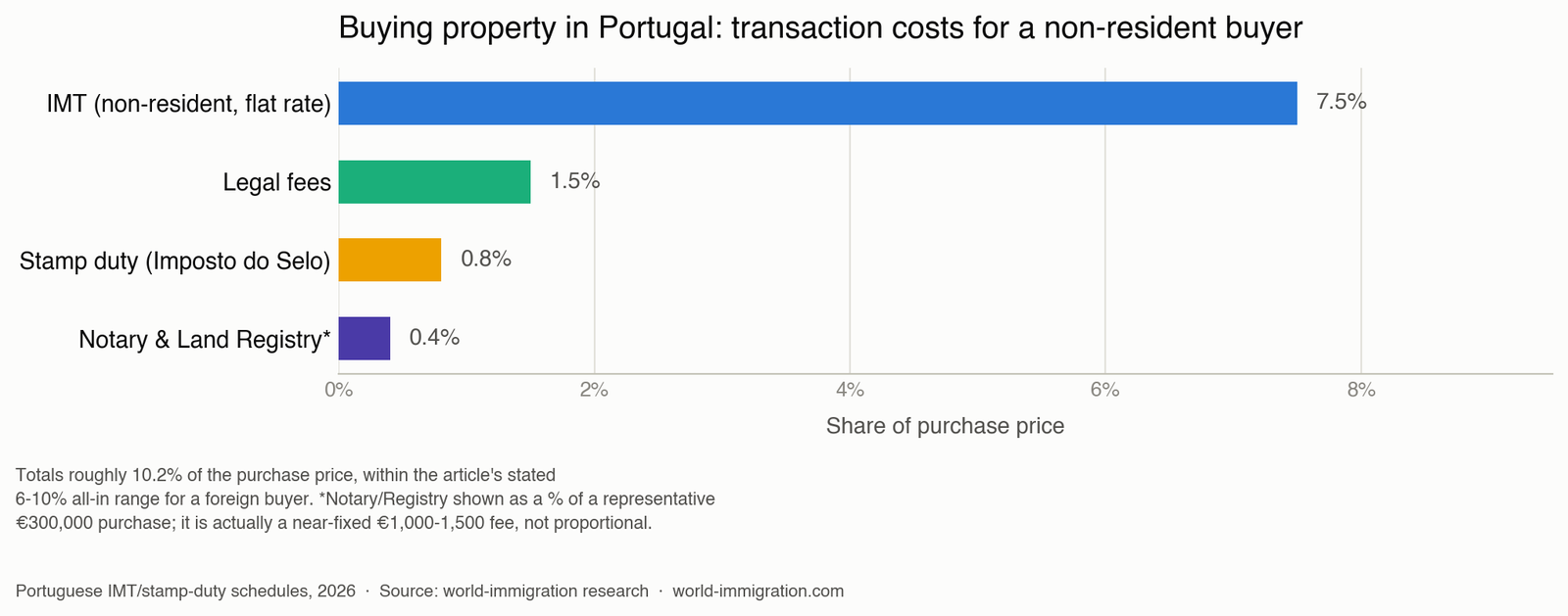
Adding it up and according to Idealista, a resident buyer has historically budgeted around 6% to 10% of the purchase price in taxes and fees on top of the price itself, the exact figure depending mostly on where the property falls on the IMT scale.
For a non-resident buyer since May 2026, the flat 7.5% IMT removes the low-band relief that used to keep costs down on cheaper homes, so the all-in figure now tends to sit at the higher end of that range and can pass 10% on lower-priced properties where a resident would once have paid little or no transfer tax. If you are weighing whether to buy at all, our guide to the cost of living in Portugal puts these one-off purchase costs against the ongoing monthly picture.
Does buying get you residency? No and this is where people go wrong
Buying a property in Portugal grants you no right of residence on its own. For years the assumption was that a €500,000 property purchase, or a €350,000 renovation project, bought you a Golden Visa and a path to residency. That route is gone.
The “Mais Habitação” housing reform, enacted in October 2023, stripped every real-estate option out of the Golden Visa programme and it has not been reinstated as of 2026. The government’s stated aim was to stop channelling foreign money into housing it blamed for pricing locals out of Lisbon, Porto and the Algarve.
According to Global Citizen Solutions, the Golden Visa itself still exists, but it now runs through investment funds, job creation, company investment and cultural or scientific donations, not through property. If your plan was to buy a home and have that home be your visa, that plan no longer works and no amount of searching will surface a current property route, because there is not one. Our Portugal Golden Visa guide covers the routes that do still qualify in detail and it is the place to correct any assumption you have picked up elsewhere.
Owning property does carry one indirect immigration use. Several of Portugal’s residence visas, the D7 passive-income visa among them, require you to show proof of accommodation and a property deed in your name satisfies that requirement in place of a rental contract. So a home can support a visa application you qualify for on other grounds, income, savings, remote work, but it never substitutes for those grounds. The property is evidence of where you will live, not the reason you are allowed to live there.
The pitfalls that trip foreign buyers
Most Portuguese purchases complete without drama. The ones that go wrong tend to fail in a handful of recognisable ways and a foreign buyer is more exposed to each of them because verifying anything on the ground is harder from a distance.
Buying off-plan
Buying a property that is not yet built, off-plan or under construction, carries a different risk profile from buying an existing home. You are paying, in stages, for something that does not exist yet, which puts the developer’s solvency and track record at the centre of the deal.
The warning signs are pressure for large upfront payments without a bank guarantee or escrow protecting them, vague contracts on specification and completion date and a developer you cannot verify has delivered before. The protections that answer those risks are a bank guarantee or escrow arrangement over your staged payments, a clear penalty clause for late delivery and independent legal review of the plans and permits before you sign anything. If a developer resists all three, that resistance is itself the answer.
Verifying clear title
The most important check on any existing property is that the seller owns it free and clear and that there are no debts, mortgages or charges attached that would pass to you. Two documents establish this. The Certidão do Registo Predial, the Land Registry certificate, confirms who owns the property and lists any registered mortgages or liens against it.
The Caderneta Predial is the tax authority’s record of the property and its official value. Your lawyer should obtain both, check they describe the same property consistently and confirm there are no encumbrances. A mismatch between the two, or a charge nobody mentioned, is exactly the kind of problem that is far cheaper to find before the promissory contract than after.
Two further documents belong on the same checklist. The licença de utilização, the habitation or usage licence, confirms the property is legally authorised for residential use and its absence is a recurring problem with older and rural houses. The certificado energético, the energy certificate, is a legal requirement for any property sold in Portugal and grades the building’s energy efficiency. Neither should be treated as a box-ticking formality, because a property that cannot produce them may have a legal problem underneath.
The ongoing tax nobody budgets for
IMT is a one-off tax you pay on purchase. IMI, the Imposto Municipal sobre Imóveis, is the annual municipal property tax you pay every year afterwards and it is easy to overlook when you are focused on the purchase itself. It is calculated on the property’s official tax value, which is generally set below market value, at a rate each municipality fixes within a legal band.
For urban properties that band runs from 0.3% to 0.45%, so two similar homes in different councils can carry noticeably different annual bills. Rural properties are taxed at a flat 0.8%. The same rates apply to residents and non-residents alike. It is a modest sum against the purchase price, but it is a permanent cost of ownership and it belongs in your budget alongside condominium fees and insurance rather than as an afterthought.
What this guide cannot tell you
I have not bought property in Portugal myself, so this guide is built from Portuguese tax and legal sources, government and institutional material and the reported experience of people who have made the purchase, rather than from having sat at the notary’s table personally. That method has limits. Tax law here is moving quickly and the flat 7.5% IMT for non-residents is recent enough that a Portuguese tax adviser should confirm how it applies to your specific situation before you commit numbers to a contract.
IMT bands, the official tax values that IMI is calculated on and municipal IMI rates all change, so treat the figures here as the current shape rather than a quote for your particular property. And the fine detail of title, licensing and off-plan protection is exactly where local legal advice earns its fee, because those checks turn on documents and circumstances no general guide can see.
What holds regardless is the broad process. Get your NIF early, engage an independent lawyer before you sign anything binding, understand that the promissory contract deposit is at risk if you walk away and budget for taxes and fees well above the sticker price. If you are still weighing the wider decision, our guides to moving to Portugal and renting in Portugal cover the alternatives to buying and the steps that come before it.
Frequently asked questions
Can foreigners buy property in Portugal?
Yes. There is no general restriction on foreigners buying property in Portugal and non-residents can purchase on the same terms as residents. What every foreign buyer needs first is a NIF, the Portuguese tax number and non-EU residents generally have to appoint a fiscal representative in order to obtain one. A local bank account and an independent Portuguese lawyer are strongly advisable rather than legally mandatory. Ownership itself gives no right to live in Portugal, which is a separate question decided by the visa and residence rules.
Does buying property in Portugal give you residency or a Golden Visa?
No. Buying property grants no residence right on its own. The real-estate route to the Golden Visa, both the €500,000 standard version and the €350,000 renovation version, was removed by the “Mais Habitação” reform in October 2023 and has not been reinstated as of 2026. The Golden Visa still exists but now runs through investment funds, job creation, company investment and cultural or scientific donations. A property deed can serve as proof of accommodation for a residence visa such as the D7, but the visa itself must be qualified for on separate grounds like income.
How much are the costs of buying property in Portugal?
Budget for taxes and fees on top of the purchase price. The main cost is IMT, the transfer tax. For residents buying a home it is a progressive tax up to a marginal 8%, but since May 2026 a non-resident buyer pays a flat 7.5% on urban residential property.
Stamp duty adds 0.8%, notary and Land Registry fees usually total around €1,000 to €1,500 and an independent lawyer runs roughly 1% to 2% plus VAT, in line with Idealista’s figures. All in, a foreign buyer should expect costs at the higher end of a 6% to 10% range and sometimes above it on lower-priced properties.
What is the difference between IMT and IMI in Portugal?
IMT, the Imposto Municipal sobre Transmissões, is the one-off property transfer tax you pay when you buy. IMI, the Imposto Municipal sobre Imóveis, is the annual municipal property tax you pay every year you own the property. IMI is charged on the official tax value, which is usually below market value, at a rate each municipality sets between 0.3% and 0.45% for urban properties, or a flat 0.8% for rural ones. Both residents and non-residents pay IMI at the same rate.
Sources
- Diário da República — Decreto-Lei n.º 97/2026, de 20 de maio (the reform introducing the flat 7.5% IMT rate for non-residents): diariodarepublica.pt
- PwC Portugal — tax flash on the 2026 housing measures, including the non-resident IMT rate: pwc.pt
- DECO PROteste — who pays the new 7.5% IMT rate for non-residents and the relief conditions: deco.proteste.pt
- AICEP Portugal Global — official overview of the Municipal Property Tax (IMI): portugalglobal.pt
- Idealista — the real cost of buying property in Portugal in 2026, a guide for foreign buyers: idealista.pt
- Defesa Legal — Law 56/2023 and the end of the real-estate route to the Golden Visa (October 2023): defesalegal.com
- Global Citizen Solutions — current Portugal Golden Visa routes after the removal of real estate: globalcitizensolutions.com
- gov.pt — how foreign citizens request a NIF, including the fiscal-representative rule: www2.gov.pt
- Sovereign Group — Portugal property ownership: no legal distinction by nationality, no restrictions on foreign buyers: sovereigngroup.com
- Diário da República — Código Civil, Article 442 (the sinal/deposit and double-forfeiture rule on a promissory contract): diariodarepublica.pt
- Ordem dos Notários — the notary’s role in formalising a property sale: ordem.notarios.pt
- gov.pt — Compra e venda de imóveis em Portugal (purchase process, Land Registry registration and the title documents a buyer needs): gov.pt
- Portal das Finanças (Autoridade Tributária) — NIF for foreign non-resident citizens: info.portaldasfinancas.gov.pt (PDF)
- Portal das Finanças — FAQ on fiscal representation, including the 2022 EU/EEA exemption and the electronic-notification route for non-EU residents: info.portaldasfinancas.gov.pt
- Portal das Finanças — Tabela Geral do Imposto do Selo (stamp duty rate on property acquisitions): info.portaldasfinancas.gov.pt
- Portal das Finanças — Código do IMI, Article 112 (the municipal IMI rate bands): info.portaldasfinancas.gov.pt
- Santander Portugal — IMT rates for rural land and building plots/commercial property: santander.pt
- immoabroad.com — notary and Land Registry fee estimates for a residential purchase: immoabroad.com
- Wise — finding a real estate agent in Portugal, including who pays the commission: wise.com

