
Portugal has a way of looking settled from the outside. Tiled facades, tram bells, a coffee that costs less than a euro and a coastline that runs almost the length of the country. Most people arrive with some version of that picture in their head. Living in Portugal, day to day, means more paperwork and a slower pace than the photographs suggest. For most arrivals that is a fair trade, not a letdown.
This is the what-it’s-actually-like piece. If you want the numbers, the cost of living in Portugal guide handles those and where to actually settle compares the regions side by side. The question here is simpler, once the move is done and the boxes are unpacked, what does ordinary life feel like?
Pace of life: the first thing people notice
The tempo is the first thing almost everyone comments on. Lunch is not a sandwich at a desk. It runs from midday to mid-afternoon, cafés stay busy all day and the Sunday family lunch can stretch from one o’clock to early evening without anyone checking the time. In the InterNations Expat Insider 2025 survey, which polled more than ten thousand people living abroad, the arrivals in Portugal singled out the laid-back lifestyle, the friendliness of locals and how readily they could settle into a community.
The same unhurried pace has a second face. The systems move at that tempo too. That is where new arrivals get stuck. An appointment that would be a five-minute online form elsewhere can mean a physical visit, a printed document and a wait. People who have made the move tend to describe the same learning curve. The parts of life that feel slow are not a sign that something has gone wrong, they are the setting the whole country runs at. The ones who settle in best are usually the ones who stop fighting it.
The paperwork and the AIMA question
If there is one recurring frustration in accounts from recent arrivals, it is the residency bureaucracy. In late 2023 Portugal dissolved SEF, its old immigration and borders service and handed the residency function to a new agency, AIMA (the Agency for Integration, Migration and Asylum), under Decree-Law 41/2023, effective 29 October 2023. The handover coincided with a large backlog of pending cases and clearing it has dominated the immigration story ever since.
By mid-2026 the official picture is one of progress. Government figures reported through the Portuguese press describe more than half a million immigration files decided and a large majority of them approved.
The lived picture is more uneven. Immigration lawyers quoted alongside those same figures caution that a shrinking backlog does not translate into fast processing for a new application and relocation guides tracking 2026 cases put the spread at three to six months for a standard residence permit up to twelve to eighteen months for a Golden Visa renewal.
A strike by AIMA’s own migration-technician staff (not, as some accounts have it, subcontracted workers), organised by the Sindicato dos Técnicos de Migração, ran for several days in early June 2026 and, per immigration-law reporting at the time, was expected to disrupt appointments nationally. My read is that the backlog is smaller than it was and still capable of stalling your year, so plan around the slow case rather than the fast one.
Beneath the residency paperwork sits a different number that governs almost everything else: the NIF, or Número de Identificação Fiscal, the Portuguese taxpayer number. It is close to a master key for daily life. You need it to sign a lease, open a bank account, set up utilities or a phone contract and buy property. The government’s own guidance lists it as a requirement for purchasing goods and services and entering into contracts.
It is free and a foreigner obtains it either in person at a tax office (Finanças) or remotely through a fiscal representative before arrival, per the same government guidance. Sorting the NIF early is the single step that unblocks the most other steps and leaving it late is where a lot of first months get stuck.
Banking follows the same pattern. Most banks want the NIF and proof of address before they will open an account, which creates a familiar chicken-and-egg loop for new arrivals: the account wants an address, the lease wants the account. It is solvable and specialist services and some fiscal representatives exist precisely to unpick it, but expect the loop rather than being surprised by it.
Language: Portuguese first, English closer than you’d think
Portuguese is the only official language and it is not the easy cousin of Spanish that some arrivals assume. The written form looks familiar; the spoken form, with its swallowed vowels, does not. That said, Portugal is unusually comfortable in English for a southern European country. On the EF English Proficiency Index it sits sixth in the world, inside the “very high” band, with proficiency concentrated among younger people and anyone working in tourism.
Where you land changes this a lot. In Lisbon, Porto and the tourist belt of the Algarve you can run most of your early life in English without much friction. Move into the interior, the smaller towns and the older population and the English thins out quickly. The same EF data also shows speaking as the weakest of the sub-skills, so a shopkeeper may understand your English better than they can reply in it.
None of this removes the case for learning Portuguese. The arrivals who report feeling at home, rather than merely resident, are almost always the ones who put the effort in and even a beginner’s grasp changes how you are treated at the counter. If work is part of your plan, the working in Portugal guide covers the employment side, where the language question sharpens further.
Climate: a different country from north to south
“Portugal has good weather” is true and also too broad to plan around. The country runs a strong gradient from a green, Atlantic north to a dry, Mediterranean south. According to Climates to Travel, Braga and Porto sit under something like 1,250 to 1,450 millimetres of rain a year, with mild but properly wet winters.
The Algarve gets roughly a third of that, closer to 500 millimetres, with long dry summers and the same climate data puts temperatures on the same line, from a January average near 10°C in Porto to a Lisbon high approaching 28°C in August, warmer still as you go south.
The practical point is that the region you choose is a weather decision as much as a lifestyle one. The postcard-dry, sun-every-day version of Portugal is mostly the south. The north is greener because it rains and a lot of new arrivals who pictured perpetual sunshine are caught out by a damp, cool Porto winter in a house built to shed heat rather than hold it. Where to weigh that up against everything else is what the best places to live in Portugal comparison is for.
Food, cafés and the social rhythm
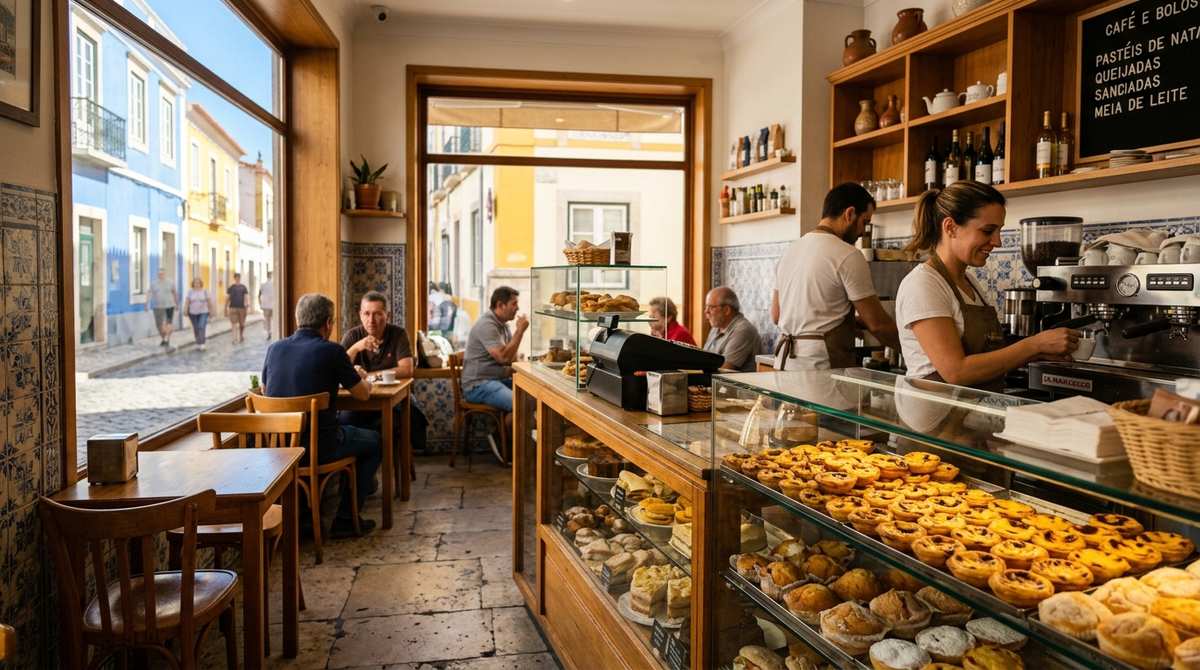
The café is the social infrastructure. A neighbourhood pastelaria is where the morning bica (the short, strong espresso) gets drunk standing at the counter, where the local news gets exchanged and where a lot of the day’s small business happens. It is cheap, it is constant and it is a large part of why the pace feels sociable rather than merely slow.
Meals sit later and last longer than many arrivals are used to. Lunch spreads across the early afternoon and dinner rarely starts before half past seven. Family is the organising unit of social life and the weekend meal is close to sacred.
The etiquette rewards small courtesies. Greeting everyone in a group on arrival and departure is expected rather than optional and there are hours of the day when a phone call is frowned upon. None of it is hard to learn and picking it up is one of the faster routes into being treated as a neighbour rather than a visitor.
What newcomers notice most about living in Portugal
Pull the accounts together and a few surprises come up more than the rest.
- The safety. Portugal ranked seventh on the 2026 Global Peace Index and low everyday crime is one of the things new arrivals mention first. Walkable cities and a general sense of ease feature heavily in what keeps people there.
- How welcoming it is. The friendliness of locals and the ease of finding a community are consistent themes in the InterNations survey above and they are a big part of why arrivals keep citing it as a reason to stay despite the paperwork.
- How much slower officialdom is. The gap between the relaxed lifestyle people came for and the patience the bureaucracy demands is the most common source of frustration. The two are the same national tempo seen from opposite sides.
- How quickly English runs out inland. Arrivals who based their expectations on Lisbon are often surprised by how much less English they meet an hour into the interior.
- That the public healthcare actually works. Legal residents can register with the public system (the SNS) and the standard of care runs well above what people who planned around private cover alone typically expect. The healthcare in Portugal guide sets out how access works.
Opinion splits on one question: whether the bureaucracy is a manageable early hurdle or a persistent grind. For many it is the former, a rough first few months that fade once the residency and NIF are settled. For others, especially those hit by an AIMA delay at renewal time, it stays a live source of stress well into their stay. Both accounts are true. Which one becomes yours depends heavily on your nationality, your visa route and a measure of luck with timing.
What this piece can’t tell you
A short article about a whole country only takes you so far.
Three limits in particular. First, the AIMA situation changes month to month, so treat any processing-time claim, including the ones here, as a snapshot and check the current status before you count on it.
Second, the experience is not one experience. An EU citizen and a non-EU citizen face very different paperwork and a coastal city and a rural village feel like almost different countries day to day. Third, no reading substitutes for a scouting trip in the season you would actually live through, ideally a wet northern February rather than a bright July week. For the wider practicalities of the move itself, the moving to Portugal guide is the place to start.
Sources
- Government of Portugal (gov.pt) — Applying for a taxpayer identification number (NIF)
- The Portugal News — Portugal says AIMA immigration backlog is moving forward (June 2026)
- EF Education First — EF English Proficiency Index: Portugal
- Statistics Portugal (INE), reported via Idealista — 11.4 million residents in Portugal, 1.6 million of them foreign (June 2026)
- InterNations — Expat Insider 2025 survey (reported via CNBC)
- Vision of Humanity / Institute for Economics and Peace — 2026 Global Peace Index (reported via Forbes)
- Climates to Travel — Portugal climate: temperature and rainfall by region
- Diário da República — Decree-Law 41/2023 (dissolution of SEF, creation of AIMA)
- The Portugal News — AIMA workers are on strike (June 2026)
- Fragomen — Portugal: Immigration Agency Strike Affects Immigration Processing (June 2026)
- Jobbatical — AIMA Portugal Residence Permit Guide for HR 2026

