
If you have spent an afternoon researching the Portugal Golden Visa, you have almost certainly read that the way in is to buy a €500,000 apartment in Lisbon or the Algarve. Set that aside. That route no longer exists. Portugal removed every real-estate option from the Golden Visa in October 2023 and it has not brought them back.
A large share of the guides for this topic were written before that change, or copied from ones that were, so the single most common thing people believe about this visa is now wrong. The programme is still open and it still works, but it works through a different set of investments than most of the internet is describing.
The Golden Visa, formally the Autorização de Residência para Atividade de Investimento (ARI), is Portugal’s residence-by-investment programme. In plain terms, you make a qualifying investment and in return you get a residence permit that asks almost nothing of your physical presence in the country. That last part is the reason it exists as a separate route from Portugal’s other residence options.
It is built for someone who wants a foothold in the EU and a long-term path to a Portuguese passport, but who is not ready to actually relocate. If you intend to move to Portugal and live there, the D7 passive-income visa or the D8 digital-nomad visa will usually cost you far less. The Golden Visa is a capital play, not a cheaper visa.
What the 2023 reform actually removed
The change came through the “Mais Habitação” (More Housing) law, which took effect in October 2023. Its purpose was to stop channelling foreign investment into Portuguese property, which the government blamed for pushing housing out of reach in Lisbon, Porto and the Algarve. To do that, it stripped three routes out of the Golden Visa entirely:
- The real-estate purchase route, both the €500,000 standard version and the €350,000 rehabilitation and low-density-area version.
- The €1.5 million capital-transfer route, where a straight deposit of funds into Portugal qualified.
- The bank-deposit route.
As of 2026, none of the three has been reinstated and no credible source I found suggests that is on the table. This matters beyond the Golden Visa itself, because it feeds a second misconception in the other direction.
Buying property in Portugal is still perfectly possible for a foreigner and plenty of people do it. It simply no longer earns you residency. If your interest is in owning a home there rather than in the visa, that is a separate exercise and the mechanics are covered in buying property in Portugal. Purchase and residency used to be the same transaction under this programme. They are now two unrelated things.
The qualifying investment routes in 2026
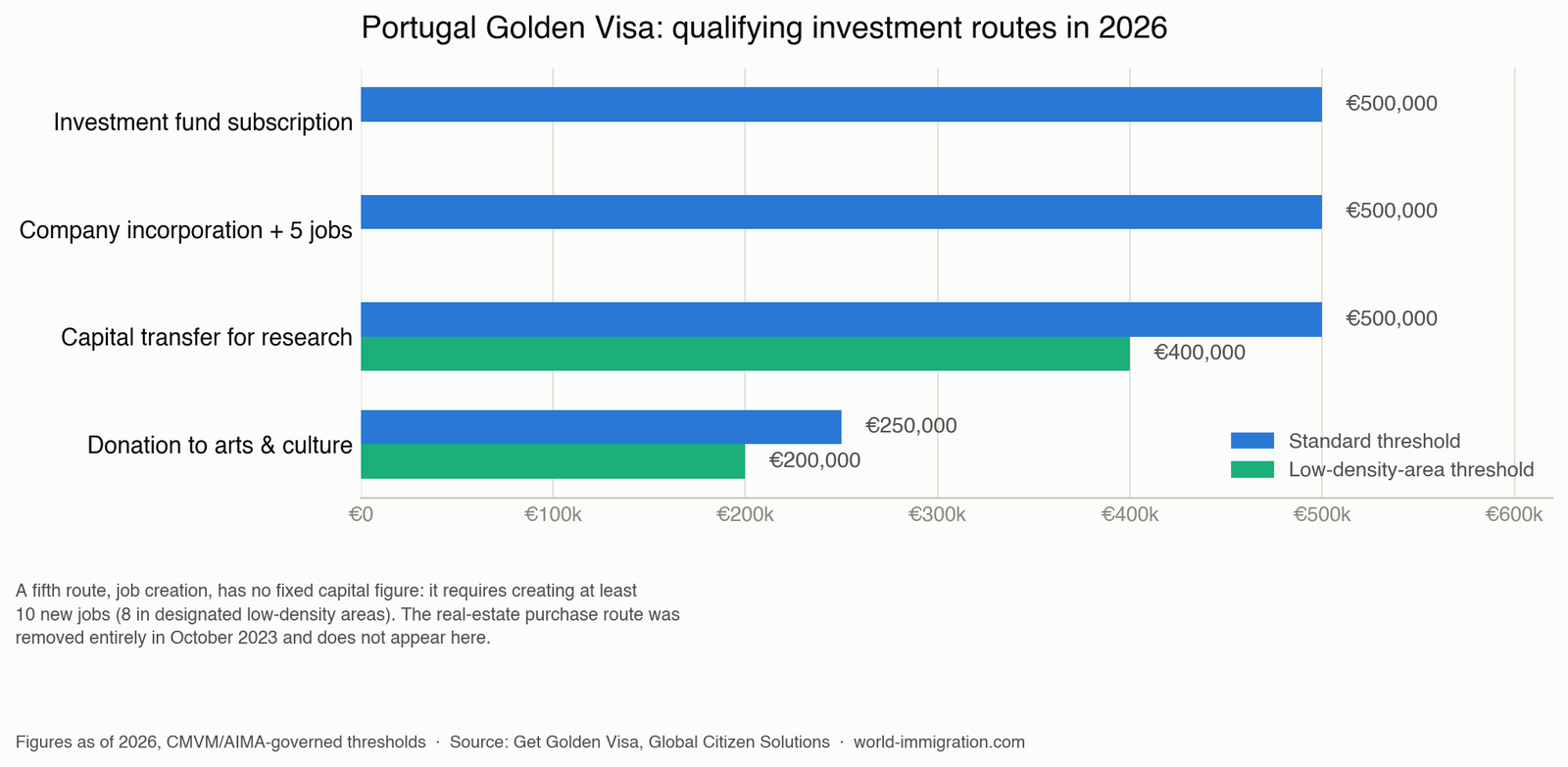
What survives is a set of routes aimed at productive parts of the economy rather than housing. There are five practical ways in and the thresholds below are the current figures as of 2026. Read them as firm-for-now rather than fixed, since this is an area of Portuguese law that has moved more than once in recent years.
Investment fund subscription — €500,000
This has become the route most applicants take since 2023 and it is the one to understand first. You subscribe at least €500,000 into a qualifying Portuguese investment or venture-capital fund. According to Global Citizen Solutions’s 2026 investment guide, the fund has to be regulated by the CMVM, Portugal’s securities market authority, have a maturity of at least five years at the point you invest and hold at least 60% of its capital in commercial companies headquartered in Portugal.
Critically, it cannot have real-estate exposure, direct or indirect. That last condition is the reform’s fingerprint. Regulators closed off the obvious workaround of a property fund dressed up as a venture fund. The trade-off to keep in mind is that this is a market investment with market risk. Your capital is not sitting in an apartment you can see and sell at will; it is in a fund whose value can fall.
Job creation — 10 jobs, no fixed capital figure
You create at least 10 new full-time jobs in a Portuguese business you own. In designated low-density areas the requirement drops to 8, a 20% reduction. There is no set investment sum attached to this route, since the qualifying act is the employment itself, but in practice funding a business to the point of 10 permanent salaried roles is a substantial commitment and not a shortcut. This is the route for someone actually running or building a company in Portugal, which puts it closer in spirit to the active D2 entrepreneur visa than to the passive fund route.
Company incorporation with job creation — €500,000
A middle path between the two above. You invest €500,000 into a new or existing Portuguese company and create or maintain five permanent jobs for at least three years. It suits an applicant who wants to put capital into a business rather than a fund, but does not want the full weight of the ten-job route.
Capital transfer for research — €500,000
A transfer of at least €500,000 into research projects run by public or private institutions within Portugal’s national science and technology system. In low-density areas the figure falls to €400,000. This one sees far less traffic than the fund route, but it is a clean option for someone comfortable directing capital into research rather than a return-seeking fund.
Donation to arts and cultural heritage — €250,000
The lowest headline number on the list and a donation rather than an investment. You give at least €250,000 to a project supporting the arts or the preservation of national cultural heritage, reduced to €200,000 in low-density areas. It is the cheapest way to qualify by capital outlay, but the money is gone. There is no fund to redeem and no business to sell at the end, so the effective cost is the full amount. That framing is why fewer people take it than the sticker price might suggest.
The low-density reduction applies to the job-creation, research and cultural-donation routes when the activity or capital is directed at qualifying interior or less-populated municipalities. It does not extend to the €500,000 investment-fund route, which carries no location-based discount. Where it does apply, it is a lever some applicants use deliberately to lower the threshold, though it narrows where your money can go.
The stay requirement is the whole point
If there is one feature that explains why people pay a premium for this route over the cheaper residence visas, it is the physical-presence rule. The Golden Visa asks you to spend an average of about seven days a year in Portugal. The precise legal formulation, which traces back to Regulatory Decree 84/2007, is seven days in the first year of residence, then 14 days in each subsequent two-year period, consecutive or not. There is no requirement to actually live in Portugal, learn to live off Portuguese income, or uproot your family.
Set that against the passive-income and nomad routes, where Portugal expects you to make the country your genuine home and be present for most of the year. The D7 is designed around relocation. The Golden Visa is designed around the opposite, a residence permit for someone whose life stays elsewhere. That gap in presence is the product. It is what someone is buying when they choose the more expensive route and it is the underlying reason the two sit at such different price points.
Permanent residency, citizenship and a 2026 change to watch
The long game with a Golden Visa is usually the passport and this is where 2026 has shifted the ground. Two separate milestones matter and they are often conflated.
Permanent residency comes after five years of legal residence, at which point the investment-maintenance conditions generally fall away. That five-year figure is unchanged.
Citizenship is the part that changed and it changed recently enough that a lot of marketing has not caught up. For years the headline was that you could apply for a Portuguese passport after just five years, one of the shortest timelines in Europe. That is no longer the case. Portugal’s revised Nationality Law, Organic Law No. 1/2026, came into force on 19 May 2026.
It raised the residence period required for naturalisation from five years to seven years for EU and CPLP (Portuguese-speaking country) nationals and to ten years for everyone else, which covers most Golden Visa investors.
It also redefined when the clock starts. Time now counts from the date your residence permit is actually issued, not the date you applied. Given how slow issuance has been, that is a meaningful difference. The new law also introduced an A2-level Portuguese language requirement, a cultural-knowledge assessment and criminal-record checks as conditions of naturalisation.
There is a transitional protection and it exists because of a court fight rather than legislative generosity. The original bill would have applied the tougher new rules retroactively, even to people already partway through the residence clock.
Portugal’s Constitutional Court struck that down in December 2025 on legal-certainty grounds, the President vetoed the original decree and the revised version that eventually passed, in force from 19 May 2026, is the one that already carries the grandfathering clause as a direct result of that ruling. In practice: nationality applications already filed before 19 May 2026 continue to be assessed under the old five-year rule and anyone starting the process now should plan around the new seven or ten-year horizon.
That is not the end of it. Separately from the retroactivity fight, a group of more than 500 Golden Visa holders, mostly American, is pursuing a collective lawsuit, reported filed in June 2026, arguing that the substance of the seven and ten-year extension itself, not just its retroactive reach, breaches the legitimate expectations of people who invested under the old five-year promise.
That challenge has not succeeded as of writing and the new timeline stands, but it is unresolved rather than settled law. Anyone whose whole plan hinges on the exact citizenship timeline should confirm the current position with a Portuguese immigration lawyer before committing capital, rather than relying on any guide, this one included.
Processing times and the AIMA backlog
The programme’s weakest point is not the rules, it is the wait. In October 2023 the immigration authority SEF was dissolved and its functions passed to a new agency, AIMA and the handover coincided with a large and growing backlog. Industry estimates put pending Golden Visa cases, covering new applications, renewals and dependants, in the region of 50,000 to 55,000 as of 2025, against a statutory target of 90 days that has been exceeded many times over.
In practice, reported average waits run to around 34 months and some applicants who filed as far back as 2021 were still waiting on an appointment in early 2026.
There are signs of movement. The government reported clearing hundreds of thousands of immigration files across all categories through late 2025 and into 2026 and pledged in October 2025 to clear the outstanding Golden Visa applications during 2026. AIMA also launched an online renewal portal in February 2026, which digitised submissions and fee payment.
My read is to treat these as encouraging but unproven for now. The published progress figures are for the immigration system as a whole and are not broken out for the Golden Visa and lawyers quoted in the Portuguese press have cautioned that a shrinking backlog does not translate into fast processing for a new application filed today. If a predictable, quick timeline is essential to your plans, this route does not currently offer one.
What it actually costs beyond the investment
The investment figure is only part of the outlay and the rest is not small. There are two layers on top: government fees paid to AIMA and professional fees paid to the lawyers and advisers who run the file.
Government fees are charged per applicant and each dependant counts as an applicant. The best-supported current figures, which cite the governing regulation (Portaria n.º 307/2023) and AIMA’s rate table as updated on 1 March 2026, put the initial cost at roughly €632 for the application and analysis plus about €6,314 for the permit issuance, a little under €7,000 per person to start.
These figures are not settled across sources. One reputable adviser quotes the issuance fee closer to €8,400, which looks to be AIMA’s in-person rate rather than the online one and others give lower, apparently older numbers.
Renewal fees are even less settled: figures I found range from roughly €3,160 to about €4,210 per applicant, so treat any single renewal number, including one you are quoted, as indicative rather than fixed. The mechanism is CPI-linked and updated annually each March, so the exact euro amounts drift. Confirm them against AIMA’s live fee table before you budget hard numbers.
Legal and advisory fees are a market rate, not a government charge and they are where the total climbs. According to rate guides published by Portuguese immigration-law firms, a full-service engagement typically runs somewhere between €4,000 and €20,000 depending on complexity, family size and the citizenship of the applicant. A single, straightforward applicant might sit at the lower end; a family, or a US citizen whose tax situation needs structuring, at the higher. Add roughly €1,000 to €3,000 per dependant, plus smaller ancillary costs for a Portuguese tax number, a fiscal representative and certified translations.
Putting it together, the non-investment cost of the process for a single applicant across the first renewal cycle commonly lands somewhere in the €15,000 to €35,000 range, on top of the €250,000 to €500,000 investment itself. Treat that as an order-of-magnitude figure rather than a quote. The point is that the true cost of a Golden Visa is well above the investment headline and anyone comparing it against the cheaper residence routes should be looking at the all-in number.
What this route cannot do for you
It cannot give you property-based residency any more. If your plan was to buy a home and have that home be the visa, that plan died in October 2023 and no amount of searching will surface a current property route because there is not one. It cannot promise a fast timeline, given the AIMA backlog. It cannot deliver a five-year path to citizenship any longer for most nationalities, following the 2026 Nationality Law.
And it cannot be recommended in the abstract as cheaper or easier than Portugal’s other residence routes. For most people who actually intend to live in Portugal, the D7 or D8 is the better and far less expensive fit. The Golden Visa earns its cost in one specific situation, when you have substantial capital to deploy, you want EU residence and an eventual passport and you are not willing or able to be physically present in Portugal for most of the year.
One note on standing. I have not personally run a Golden Visa file through AIMA, so the figures and rules above lean on Portugal’s current immigration law and specialist practitioner sources rather than my own paperwork and I have flagged where a number is the kind that moves.
This is a fast-changing corner of European immigration and the sensible move is to treat any guide as your starting map, then confirm the current thresholds, fees and timelines with a qualified Portuguese immigration lawyer before you commit money. For the wider picture of settling in the country, the moving to Portugal guide is the place to start.
Frequently Asked Questions
Can you still get a Portugal Golden Visa by buying property?
No. The real-estate purchase route, both the €500,000 and the €350,000 rehabilitation versions, was removed by the October 2023 “Mais Habitação” reform and has not been reinstated as of 2026. Foreigners can still buy property in Portugal, but a property purchase no longer qualifies for the Golden Visa. The current routes are investment funds, job creation, company investment, research capital and cultural donations.
How much do you need to invest for a Portugal Golden Visa in 2026?
The lowest capital threshold is a €250,000 donation to arts or cultural heritage, though that money is not recoverable. The most-used route is a €500,000 subscription into a qualifying Portuguese investment fund. Other routes sit at €500,000 for research capital or company investment with job creation, or the creation of 10 jobs with no fixed sum. Low-density-area reductions of around 20% apply to several of these.
How many days a year do you have to spend in Portugal?
Very few. The requirement is seven days in the first year, then 14 days in each following two-year period, which averages out to roughly seven days a year. This minimal presence rule is the Golden Visa’s main advantage over the D7 and D8 visas, which expect you to make Portugal your main home.
How long until you can apply for Portuguese citizenship?
Under the Nationality Law that took effect on 19 May 2026, the residence period for naturalisation is seven years for EU and Portuguese-speaking-country nationals and ten years for other nationalities, with the clock starting when the residence permit is issued. This replaced the previous five-year rule. Applications filed before 19 May 2026 are still assessed under the old five-year rule. Permanent residency, a separate and lower bar, remains available after five years.
How long does a Portugal Golden Visa take to process?
Longer than the 90-day statutory target and the straight answer in 2026 is that it is unpredictable. AIMA, the agency that replaced SEF in 2023, has carried a large backlog, with applicants reporting waits of a year or more. The government has pledged to clear the Golden Visa backlog during 2026, but processing for new applications remains slow and should not be assumed to be quick.
Sources
- Vistos (Portuguese Ministry of Foreign Affairs), ARI — Autorização de Residência para Atividade de Investimento, official programme page: vistos.mne.gov.pt/pt/ari-autorizacao-de-residencia-para-actividade-de-investimento
- AIMA, Autorização de Residência para Investimento — Art. 90.º-A (official route page, stay requirement and Regulatory Decree 84/2007 reference): aima.gov.pt/pt/viver/autorizacao-de-residencia-para-investimento-art-90-o-a
- AIMA, Autorização de Residência Permanente — Art. 80.º (permanent residence, five-year requirement): aima.gov.pt/pt/viver/autorizacao-de-residencia-permanente-art-80-o
- Get Golden Visa, Portugal Golden Visa 2026 guide (investment routes and thresholds): getgoldenvisa.com/portugal-golden-visa-program
- Get Golden Visa, Portugal Cultural Golden Visa 2026 (donation route thresholds): getgoldenvisa.com/portugal-cultural-production-golden-visa
- Global Citizen Solutions, Portugal Golden Visa 2026 updates and investment guide: globalcitizensolutions.com/golden-visa-portugal
- Global Citizen Solutions, Is the Portugal Golden Visa ending? (2023 reform and removed routes): globalcitizensolutions.com/portugal-golden-visa-ending
- Global Citizen Solutions, Portuguese Nationality Law updates (2026 residence periods, language and clock-start rules): globalcitizensolutions.com/portuguese-nationality-law-updates
- Clark Hill, Portugal Nationality Law changes 2026: clarkhill.com/portugal-nationality-law-changes-2026
- Sovereign Group, Portugal brings new Nationality Law into force: sovereigngroup.com/news/portugal-nationality-law-update
- Sovereign Group, Portuguese Constitutional Court blocks changes to Nationality Law: sovereigngroup.com/news/portuguese-constitutional-court-blocks-changes-to-nationality-law
- The Portugal News, Golden visa holders to file lawsuit against Portugal over the new Nationality Law (May 2026): theportugalnews.com
- The Portugal News, AIMA immigration backlog progress (June 2026): theportugalnews.com
- IMI Daily, Portugal revamps AIMA procedures to tackle more than 55,000 Golden Visa related applications: imidaily.com
- Global Citizen Solutions, Portugal Golden Visa Delays 2026 (processing-time figures): globalcitizensolutions.com/portugal-golden-visa-delays
- movingto.com, Portugal Golden Visa cost 2026 (fee breakdown, citing Portaria 307/2023): movingto.com/pt/portugal-golden-visa-cost
- AIMA, fee-table update (Portaria 307/2023, annual CPI adjustment): aima.gov.pt/pt/noticias/atualizacao-da-tabela-de-taxas
- Global Citizen Solutions, Working with a Portugal Golden Visa Lawyer (legal/advisory fee ranges): globalcitizensolutions.com/portugal-golden-visa-lawyer

