
Sorting somewhere to live is the step that turns a plan to move abroad into a physical reality and it is the one most newcomers underestimate. Renting in Portugal follows its own sequence and the order matters more than people expect. You generally need a Portuguese tax number before you can sign anything, the deposit and contract norms differ from what most arrivals are used to and the big-city market has been shaped by years of tourism pressure. Getting the groundwork right before you start viewing flats saves money and a good deal of stress.
The good news for tenants: Portuguese law gives renters a defined set of protections, contracts have to be in writing and registered with the tax authority under the Novo Regime do Arrendamento Urbano and there is a cap on the deposit a landlord can ask for, set at two months’ rent by Article 1076 of the Civil Code.
The less comfortable news: the upfront bureaucracy is front-loaded, competition in Lisbon, Porto and the Algarve is stiff and rental scams aimed at foreigners paying from abroad are common enough that a national newspaper and the largest property portal have both run warnings about them. This guide covers the process of renting rather than the full cost-of-living picture, which is covered separately.
Renting in Portugal: Where to find a rental
Most searches start on Idealista, which carries the largest inventory and has an English-language interface, so it is the default first stop for international renters. Imovirtual, part of the OLX group, is the second-largest portal by traffic and is strong on rentals, often surfacing listings that Idealista does not.
Casa Sapo has been running since 2001 and still lists properties found nowhere else, while OLX’s own classifieds section leans towards budget and peer-to-peer lets. City-specific and expat Facebook groups fill in the informal channel and are where a lot of shared flats and rooms first appear.
Treat those platforms as places to gather leads, not as a filter that has vetted anything for you. A listing on a reputable portal is not proof the person behind it owns the flat and that distinction is where the scams covered further down take hold.
You need a NIF before you can sign
The single piece of paperwork that gates everything else is the NIF, the Número de Identificação Fiscal, Portugal’s tax number. You cannot sign a lease without one, because every residential rental contract has to be registered with Finanças, the tax authority and that registration is tied to your NIF. My read is that sorting the NIF should be near the top of anyone’s arrival checklist, ahead of viewing properties, because trying to secure a flat you like while the number is still pending is how good opportunities will slip away.
You request a NIF in person at a Finanças office or online through the Portal das Finanças. Portuguese rules have historically required a non-resident to appoint a fiscal representative, a Portuguese resident or company that receives official tax correspondence on your behalf and submits the application for you.
More recently, non-EU or non-EEA residents with no Portuguese tax obligations can avoid keeping a fiscal representative by activating electronic notifications on the Portal das Finanças. The catch is that earning rental income, owning property or holding a Portuguese bank account is enough to trigger the representative obligation, so it does not disappear for most people who are actually settling in.
A Portuguese bank account is the other thing renters repeatedly report being expected to have. It is not written into rental law as a requirement, but landlords and agencies often prefer domestic bank transfers for rent and having a local account smooths the whole process. Treat it as a practical expectation reported by people who have made the move rather than a formal legal condition and open one early if you can.
Deposits and the money up front
The deposit is called the caução. One to two months’ rent is the usual figure and Portuguese law caps it at a maximum of two months, under Article 1076 of the Civil Code, as amended by the 2023 State Budget law. On top of the deposit you will normally pay the first month’s rent in advance, so the cash you need to hand over before you get the keys can amount to around three months’ rent in total.
On a Lisbon flat at €1,400 a month, that is over €4,000 committed before your first night in the place. Have that money ready and accessible, because a strong application that cannot pay immediately loses to a weaker one that can.
The deposit is meant to come back. The Civil Code does not set a fixed statutory deadline for returning it, but Portuguese case law and standard practice treat 30 days after you hand back the keys as the reasonable norm, less any deductions for damage beyond normal wear or for unpaid rent and a good contract will state this explicitly. When you transfer money, label each payment clearly as “renda” (rent) or “caução” (deposit) in the transfer reference and keep the records. A clean paper trail is your protection if there is a dispute later about what was paid and why.
The contract and your rights as a tenant
Residential renting is governed by the Novo Regime do Arrendamento Urbano, the NRAU, the framework introduced by Law 6/2006 and amended several times since. Your agreement is the contrato de arrendamento. It has to be in writing and registered with Finanças and the standard minimum duration for a long-term residential lease is one year, renewing automatically unless the contract says otherwise.
A registered contract is not just a formality: it is what gives you a defensible position if anything goes wrong and it is one reason to be wary of any landlord who wants to keep things off the books.
Notice periods are set by law and depend on how much time is left to run. Under Article 1098 of the Civil Code, a tenant giving notice must allow 120 days if more than a year remains on the contract, or 60 days if less than a year remains.
A landlord ending a fixed-term contract owes notice tied to the length of the term itself, not a flat two-year split, under Article 1097 of the Civil Code: 60 days for a term of six months to under a year, 120 days for one year up to six years and 240 days for a term of six years or longer (shorter terms use one-third of the contract length).
Rent increases on existing contracts are capped each year by a coefficient published by INE, the national statistics institute; the ceiling for 2026 is 2.24%, set by Aviso n.º 23174/2025/2, so a landlord cannot lawfully raise the rent on a running contract by more than that.
One recent change is worth knowing about. Since 1 August 2025, if a landlord fails to register the lease with Finanças, the tenant can register it themselves through the tax portal. That closes a gap that used to leave tenants exposed when a landlord kept the arrangement informal and it is a point in your favour if you ever need to prove the tenancy exists.
What rent actually costs, city by city
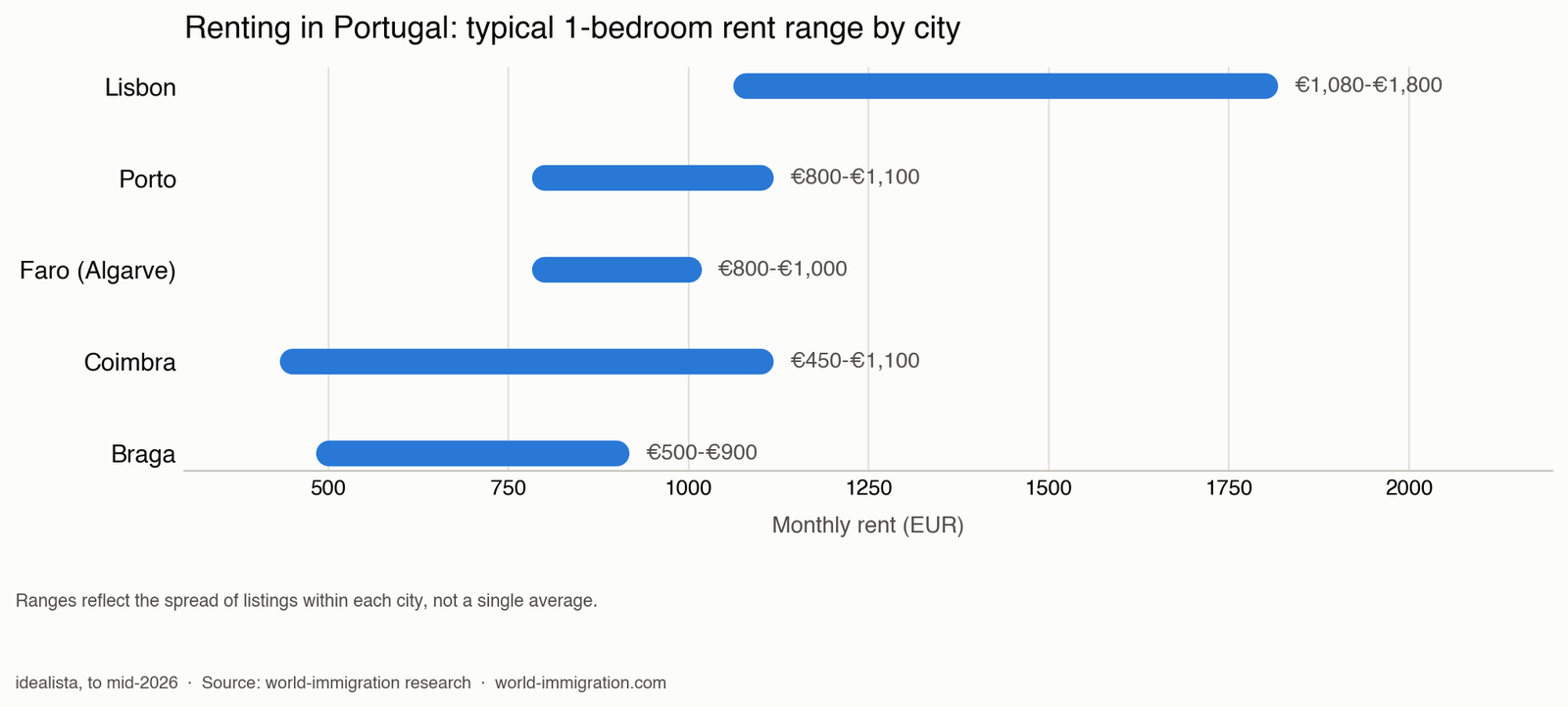
Rent varies enormously by city and by neighbourhood and the market has been moving quickly. The figures below are approximate asking prices, drawn from Idealista’s rental index as reported to mid-2026 and cost-of-living data. They are indicative, not signed-lease averages and they will date, so treat them as a starting point rather than a fixed quote. For the fuller picture of what daily life costs alongside rent, see our guides to the cost of living in Portugal and the cost of living in Lisbon.
| City | Typical 1-bedroom (monthly) | Recent trend (Idealista, to mid-2026) |
|---|---|---|
| Lisbon | €1,080–€1,800 | Slight fall year-on-year (around −2%) |
| Porto | €800–€1,100 | Falling (the steepest of the major cities) |
| Faro (Algarve) | €800–€1,000 | Rising sharply (around +11%) |
| Braga | €500–€900 | Roughly flat (down slightly, about −1%) |
| Coimbra | €450–€1,100 | Mixed; sources disagree on direction |
Two things stand out in the current data. First, rents were actually easing across most of the country through the first half of 2026, with Lisbon and Porto both down year-on-year on Idealista’s index after years of increases. Second, the Algarve is the clear exception. Faro was rising while the rest of the market softened, which lines up with the region’s tourism-driven demand rather than a nationwide trend. If you are comparing cities, the north and interior remain markedly cheaper than the coast and the capital.
Portal asking-price data is not the full picture, though and the gap matters for anyone budgeting. INE, Portugal’s national statistics institute, suspended its own official rent statistics between October 2025 and June 2026 for a methodology overhaul, then resumed publication with Q1 2026 figures built from actual signed lease contracts rather than advertised listings. Those show the median rent on a new contract nationally at €9.46/m², up 9.1% year-on-year, with Grande Lisboa at €14.38/m² and the Algarve at €10.71/m². That is a materially different story from the falling asking prices above: asking price and signed-contract price are two different measures and they can move in opposite directions at the same time. Budget from the higher, contract-based figure if you want a margin of safety.
The pitfalls people report
Two problems come up again and again in accounts from people renting in Portugal and both hit newcomers hardest because they are least able to spot the warning signs.
Rental scams aimed at foreigners
The pattern is consistent. A listing appears with attractive photos, often lifted from a legitimate advert elsewhere. The supposed landlord cannot show the property in person, invents a reason for the delay and pressures you to pay a deposit and a month or two of rent quickly “because other people are interested.” Once the transfer lands, the contact disappears.
In March 2024, Idealista’s own news desk reported a group caught scamming foreign students and workers in Porto with false leases, pressing victims for deposits of two to four months’ rent, between roughly €1,600 and €2,400. The Portugal News flagged the same pattern again in April 2025 as an ongoing problem.
The defence is straightforward and non-negotiable. Never wire money for a property you, or a verified agent acting for you, have not seen in person. Check that the name on the bank account you are asked to pay matches the owner named on the property documents.
Be sceptical of any pressure to pay fast, which is the scammer’s main tool. If something feels wrong, it can be reported to the PSP or GNR, Portugal’s police forces. The uncomfortable truth is that paying a deposit before viewing is exactly the mistake these operations are built to exploit and arriving from another country makes it harder to verify anything on the ground.
Short-term rentals and tourist-area pressure
Portugal’s short-term rental sector, known locally as Alojamento Local or AL, has reshaped the long-term market in the tourist cities and the rules around it have been on a rollercoaster. The 2023 “Mais Habitação” housing package suspended new AL licences in designated housing-pressure areas, including much of Lisbon and Porto, in an effort to return flats to long-term tenants.
That was largely reversed by Decree-Law 76/2024, which took effect on 1 November 2024 and reopened AL licensing nationwide, subject to municipal rules. Lisbon and Porto have since adopted their own local regulations, applicable in 2026, defining zones where new short-term licences are restricted or barred, particularly in historic centres.
How much of the rent pressure in these cities is down to short-term rentals specifically, as opposed to strong demand, slow construction and foreign buyers, is contested. I have not found a source that cleanly isolates the AL effect, so I would treat any precise “AL raises rents by X%” claim with caution.
What the data does show is that the Algarve, the most tourism-dependent region, is where rents are rising fastest while the rest of the country cools. That is the strongest signal that tourist demand and rental cost move together, even if the exact mechanism is hard to pin down.
If something goes wrong: who to contact
DECO PROteste is Portugal’s main consumer-protection association and it publishes practical tenant guidance, including material aimed specifically at foreign renters. It is not a government body, but it is an established, citable source of independent advice.
For lease registration and for self-registering a lease your landlord has not filed, the Portal das Finanças is the official channel. The Balcão Nacional do Arrendamento, the Ministry of Justice’s national arrendamento office, handles the special eviction procedure and is the formal route for certain landlord-tenant disputes. Knowing these exist before you need them is part of renting with your eyes open.
What this guide cannot tell you
The rent figures are a snapshot of a fast-moving market and will drift, so check the current Idealista index for the month you are searching.
Conditions vary sharply at the neighbourhood level and a city-wide range may not reflect the street you end up on. The direction of rents in a smaller market like Coimbra was unclear across the sources I checked. And the causal link between short-term rentals and long-term prices, while widely asserted, is not something I would state as a settled figure.
What is solid is the process: get your NIF early, expect a deposit of up to two months plus a month in advance, insist on a written contract registered with Finanças and never pay for a flat you have not seen. That sequence for renting in Portugal remains regardless of which city you land in. For the wider decision of where in the country to base yourself and whether renting or buying makes more sense over the longer term, see our guides to moving to Portugal and buying property in Portugal.
Frequently asked questions
Do you need a NIF to rent in Portugal?
Yes. A NIF, the Portuguese tax number, is required to sign a residential lease, because every rental contract must be registered with Finanças and that registration is tied to your NIF. You can apply in person at a Finanças office or online through the Portal das Finanças.
Non-EU citizens have generally needed to appoint a fiscal representative, though that requirement can be avoided by activating electronic notifications if you have no Portuguese tax obligations. Because owning property, earning rental income or holding a local bank account triggers the representative obligation, most people settling in will still need one. Sorting the NIF before you start viewing flats is the practical order.
How much is a rental deposit in Portugal?
The deposit, or caução, is typically one to two months’ rent and Portuguese law caps it at a maximum of two months. You will usually also pay the first month’s rent in advance, so the total up front is often around three months’ rent. There is no fixed statutory deadline for returning the deposit, but case law and standard practice treat 30 days after you move out as the reasonable norm, minus any deductions for damage beyond normal wear or unpaid rent. Label every transfer as “renda” or “caução” and keep the records, which is your protection if a deduction is later disputed.
How can I avoid rental scams in Portugal?
Never send money for a property you or a trusted representative have not viewed in person. The common scam involves an attractive listing, a landlord who will not show the place and pressure to wire a deposit quickly before someone else takes it.
Check that the bank account name matches the documented owner, be wary of any urgency to pay and remember that a listing on a well-known portal has not been verified as genuine. Idealista and The Portugal News have both reported organised scams targeting foreign renters, so this is a documented risk rather than a rare one. Suspected fraud can be reported to the PSP or GNR.
Is it better to rent or buy in Portugal?
For most newcomers, renting first is the lower-risk move. It lets you test a city and neighbourhood before committing and it avoids the transaction taxes and fees that come with a purchase. Buying makes more sense once you are settled, know where you want to be and are planning to stay long enough to absorb the upfront costs. The two decisions turn on different factors, so it is worth reading our guide to buying property in Portugal alongside this one before deciding.
Sources
- Idealista — Portuguese rental index and rental news, including the mid-2026 report that rents are easing overall: idealista.pt
- Idealista news — “Group found scamming foreigners in Porto with false leases” (March 2024): idealista.pt
- The Portugal News — “False rental scams warning” (April 2025): theportugalnews.com
- gov.pt — how foreign citizens request a NIF, including the fiscal-representative rule: www2.gov.pt
- DECO PROteste — tenant guidance for foreign renters and lease self-registration: deco.proteste.pt
- Balcão Nacional do Arrendamento (Ministry of Justice) — the national arrendamento office: bna.mj.pt
- visas.pt — “Two Years After Mais Habitação: How Portugal’s Housing Law Reshaped Alojamento Local”, background on Decree-Law 76/2024: visas.pt
- Diário da República — Novo Regime do Arrendamento Urbano (Lei n.º 6/2006), consolidated text: diariodarepublica.pt
- Código Civil, Article 1076 — deposit (caução) cap of two months’ rent: informador.pt
- Código Civil, Article 1097 — landlord notice periods for ending a fixed-term lease: informador.pt
- Código Civil, Article 1098 — tenant notice periods for ending a fixed-term lease: informador.pt
- Diário da República — Aviso n.º 23174/2025/2, setting the 2026 rent-update coefficient at 2.24%: diariodarepublica.pt
- Diário da República — Portaria n.º 106/2025/1, allowing tenants to self-register a lease from 1 August 2025: diariodarepublica.pt
- Diário da República — Lei n.º 56/2023 (“Mais Habitação”), 2023 suspension of new Alojamento Local licences: diariodarepublica.pt
- Diário da República — Decreto-Lei n.º 76/2024, reopening Alojamento Local licensing from 1 November 2024: diariodarepublica.pt
- INE — Estatísticas de Rendas da Habitação ao Nível Local, 1.º trimestre de 2026 (official rent statistics resumed after the October 2025–June 2026 methodology suspension): ine.pt (PDF)
- The Portugal News — “Rents fall for fifth consecutive month in Portugal” (2 July 2026), city-level asking-rent breakdown: theportugalnews.com
- Ricardo Gama (advogado) — “Devolução da Caução no Arrendamento”, on deposit-return timing where the Civil Code sets no fixed deadline: ricardogama.com

