
Ask around a bit and you might hear a comment that foreigners can’t buy property in New Zealand. It gets repeated confidently in expat forums and in the comments under articles about the housing market. The actual position is more specific. Since the 2018 amendment to the Overseas Investment Act, most people who are not citizens or residents cannot buy an existing home here without government consent and that consent is granted only in limited situations. But “most people” is not everyone and “an existing home” is not any property at all. Who you are, what visa you hold and what you are trying to buy each modify the answer.
The rules that govern buying property in New Zealand as a non-resident sit in the Overseas Investment Act and its 2018 amendment, administered by the Overseas Investment Office (OIO), a part of Toitū Te Whenua Land Information New Zealand (LINZ). There are really two things to hold in your head. First, a broad restriction that has applied to most foreign buyers of residential land since 2018. Second, a narrow carve-out that took effect in March 2026 for a small group of investor-visa holders buying at the very top of the market. Those two got tangled together in a lot of the reporting, which is where the “New Zealand has reopened to foreign buyers” headline came from. It hasn’t, not in any way that applies to an ordinary buyer. This article separates the two and walks through what each type of buyer actually faces.
Buying Property in New Zealand: Who Can Buy Freely and Who Needs Consent
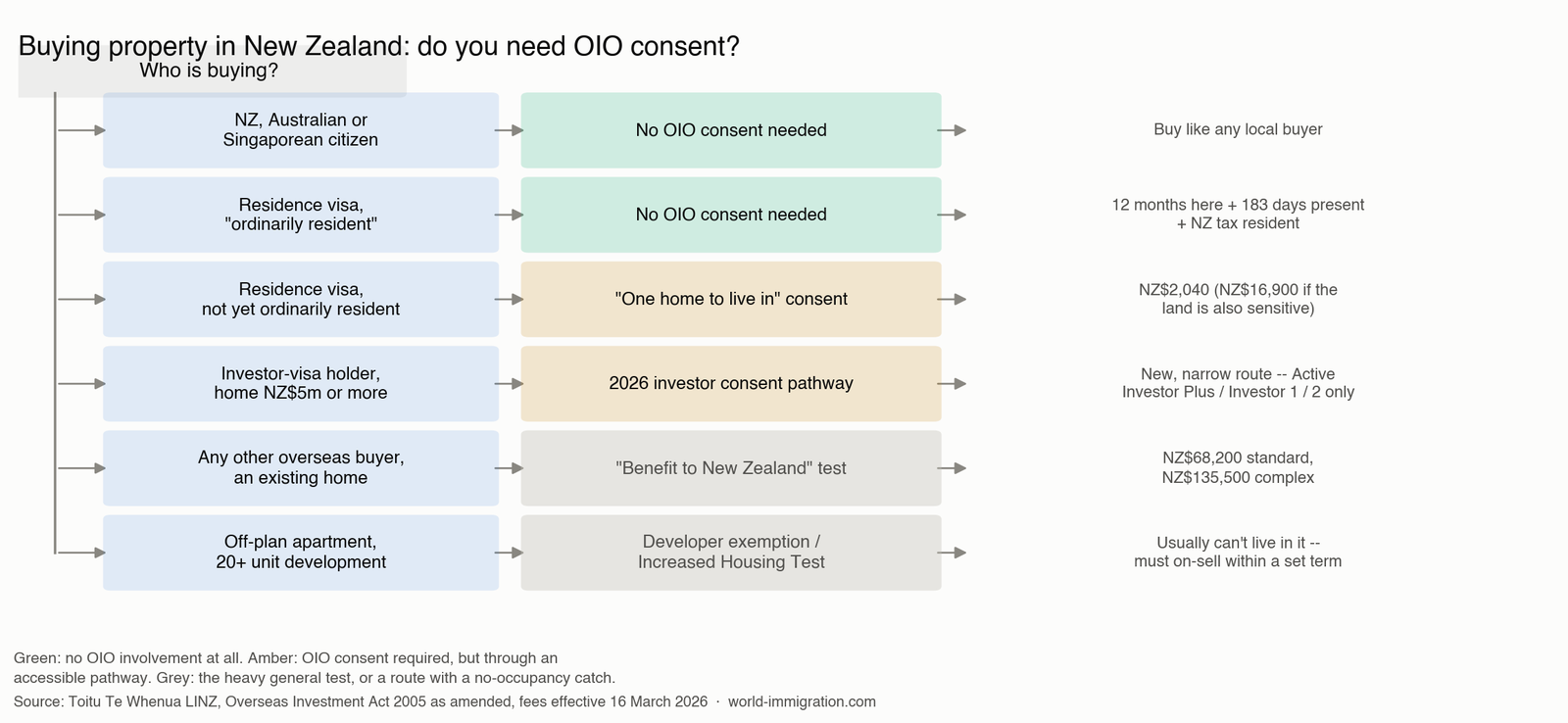
Three groups can buy residential property here with no OIO involvement at all. New Zealand citizens, wherever in the world they live. Australian citizens and Singaporean citizens, on the same footing as New Zealanders, because of trade and treaty arrangements. And holders of a New Zealand residence-class visa who meet a test called being “ordinarily resident”. If you fall into any of those three, the Overseas Investment Act is simply not your problem and you buy under the same rules as any local.
The third condition is the one that might be counter-intuitive, a common assumption is that holding a residence visa is enough on its own. It is not. “Ordinarily resident” is a defined test with four parts and you have to satisfy all of them: you hold a residence-class visa; you have lived in New Zealand for the 12 months immediately before the purchase; you were physically present here for at least 183 of those 12 months; and you are a New Zealand tax resident. Miss any one and you are treated as an overseas person for this purpose even with residence in hand.
Where this matters is the new arrival. Someone who has just been granted residence and wants to buy a home to move into has, by definition, not yet lived here for the preceding 12 months. So they do not meet the test on day one and technically they need consent to buy a home. There is a pathway built precisely for that situation and it is far more accessible than the general “sensitive land” route, but it is a step that may surprise you if you had assumed residence meant unrestricted buying. If you are moving here and expecting to buy immediately on arrival, this is the detail to check against your own timeline before you start making offers.
Most people moving here wouldn’t buy straight away anyway. Renting first, then buying once you know a city and have local history (financial and social), is the ordinary sequence and it also happens to clear the ordinarily-resident test as a side effect. If that is your situation, our guide to renting in New Zealand covers it and the broader moving to New Zealand hub sets out where buying fits in the wider picture.
If You Need OIO Consent: The Process and the Cost
If you are an overseas person and none of the exemptions apply, buying residential land means applying to the OIO for consent before the purchase can settle. There are two very different pathways here and the gap between them in cost and difficulty is large.
The first is the “one home to live in” pathway, designed for the situation above, a residence-class visa holder who intends to live in the property but has not yet met the ordinarily resident test. The application fee is NZ$2,040 for an individual (effective 16 March 2026) and the assessment is comparatively straightforward because you are committing to occupy the home and, generally, to sell it if you later stop being ordinarily resident in New Zealand. If the specific property is also sensitive for reasons beyond being residential, such as size, coastline, or proximity to conservation areas, the fee for that variant of the same pathway rises to NZ$16,900, but the assessment still sits inside this light-touch route rather than the substantive test below.
The second (via the same link above) is consent under the general “benefit to New Zealand” test, for residential land that does not qualify for the ‘live in’ pathway at all. This is the expensive route, NZ$68,200 for a standard application or NZ$135,500 for a complex one (both effective 16 March 2026) – with a substantive assessment of whether the investment benefits New Zealand. Most ordinary overseas buyers of an existing home to live in will never need it, because they either qualify for an exemption or fit the live in route, even where their specific property pushes that route’s fee up to the NZ$16,900 tier above. This general test matters mainly for buyers who cannot use the live in route at all, not simply for land that happens to be sensitive on top of being residential.
On timing, resist the temptation to plan around a fixed number of days. LINZ works to a directive to complete its assessment within half the standard regulatory timeframe in 80 percent of cases and those underlying timeframes are set in regulation and differ by the type of application. In practice that means weeks rather than days and the live-in-it pathway clears faster than a full sensitive-land assessment. Build the consent step into your offer as a condition, with enough time in the window, rather than assuming it will be waved through between signing and settlement.
The 2026 Investor Carve-Out: A Narrow Exception, Not a Reopening
This is the change that generated the “New Zealand welcomes rich foreigners back” headlines and it is much smaller than those headlines suggest. The Overseas Investment (National Interest Test and Other Matters) Amendment Act 2025 received Royal Assent on 19 December 2025 and came into force on 6 March 2026. What it does is create a single new consent pathway: holders of the Active Investor Plus, Investor 1, or Investor 2 visa categories, or people on the route to one of them, can buy or build a residential property valued at NZ$5 million or more.
NZ$5 million sits far above even the country’s most expensive main centre: REINZ data has put the national median house price around $770,000, with Auckland’s median just under $1 million. A $5 million threshold is concentrated in a handful of Auckland suburbs and around Queenstown, not a route to buying a normal family home in Hamilton or Christchurch. It is a mechanism that lets someone who is already committing millions to New Zealand under an investor visa also house themselves at the top end while they do it. The pathway itself is fast and comparatively cheap to apply for, LINZ’s application fee is NZ$2,040 for an existing home over the threshold, or NZ$3,500 to build one, with consent typically decided within about five working days. The broad 2018 restriction is untouched for everyone else. This sits on top of the existing rules as a narrow exception, not in place of them and describing it as the ban being lifted is simply creative marketing.
One practical note for anyone this actually applies to, the eligible visa list and the dollar threshold are policy settings and policy settings change. Both the NZ$5 million figure and the specific categories that qualify can be changed by future amendment or Order in Council, so confirm the current position against LINZ before you rely on it. As I write, the three named investor categories and the NZ$5 million floor are what the law provides.
The New-Build Pathway: It Exists, but Not as You Might Think
The other exception people cite is new-builds, usually phrased as “a foreigner can always buy a new apartment”. That is partially true, there is a pathway there, but it’s a specific case. Specifically, apartments in larger developments of 20 or more units, bought off the plan, can be sold to overseas buyers where the developer holds an exemption or the buyer obtains consent under what is called the Increased Housing Test. That much is true and it is a standing feature of the rules. Developer exemption certificates for these larger developments can let up to 60 percent of the units go to overseas buyers without each buyer needing individual consent.
The catch usually left out is under this pathway the overseas buyer typically cannot live in the unit once it is built and must on-sell it within a timeframe set by the OIO. It is structured as a way to help fund the construction of new housing, not as a way for foreigners to acquire a home to occupy. So if your plan is to buy a shiny new apartment and move into it, this route is unlikely to deliver that. What it does deliver is an investment with a resale obligation attached. Any developer’s claim that overseas buyers are welcome should be met with a direct question about occupancy and resale conditions and make sure you get your lawyer to read the specific exemption the development holds rather than accepting general reassurance. Eligibility attaches to particular developments that hold a current exemption, not to new apartments as a blanket category.
Due Diligence That Is Specific to New Zealand
Set the overseas-buyer rules aside for a moment, because once you are eligible to buy, the New Zealand purchase process has its own uniqueness which applies to locals and newcomers alike.
There is no cooling-off period
New Zealand has no automatic statutory cooling-off period for residential property. Once both parties have signed, the agreement is binding. It is subject only to whatever conditions were written into the contract, such as finance, a building report, a LIM, or OIO consent and once those conditions are satisfied and you go “unconditional”, you are committed. If you change your mind after that, you are looking at losing your deposit and potentially more.
Growing up here, “going unconditional” is understood as the point of no return, the moment the house is effectively yours and there is no backing out. Newcomers from jurisdictions with a statutory cooling-off window can carry an instinct that a signed contract still leaves a few days of grace. It does not in New Zealand. This is what the conditional period is, the only window for resolving doubts and don’t forget to never let a condition lapse or waive one to look like a stronger buyer until the due diligence behind it is actually done.
Leaky homes and monolithic cladding
This is the one piece of local knowledge I would not want an overseas buyer to miss, because a standard builder’s report does not reliably catch it. Between roughly the mid-1990s and the mid-2000s, New Zealand went through what became known as the “leaky homes” crisis. A style of construction, monolithic plaster or stucco cladding fixed directly to timber framing, often without a drainage cavity behind it, let water into the structure where it rotted the internal out of sight framing. I am currently living in an apartment that had this issue repaired once, it’s back again and this is unforunately very common. Estimates of the number of affected homes range from about 22,000 to 89,000, with a widely cited government-commissioned consensus estimate around 42,000. The repair bills run to six figures and the framing damage is frequently invisible from the street.
For anyone who grew up here, a certain look sets off the alarm before you have read a word of the listing: a flat or low-pitched roof, no eaves, a seamless plastered exterior, built in that late-90s-to-mid-2000s window. It is pattern recognition locals absorb almost without noticing and it is exactly the kind of thing an overseas buyer, reasonably trusting a tidy modern-looking house, would not think to question. A general builder’s report is a visual inspection. It is not the same as a dedicated weathertightness assessment with invasive moisture testing, which is what a home from this era and construction type actually calls for. If you’re looking at a house that fits this profile, the moisture test is not an optional extra, it is the whole point of the inspection and I would make the offer conditional on it.
Freehold, leasehold, cross-lease and unit title
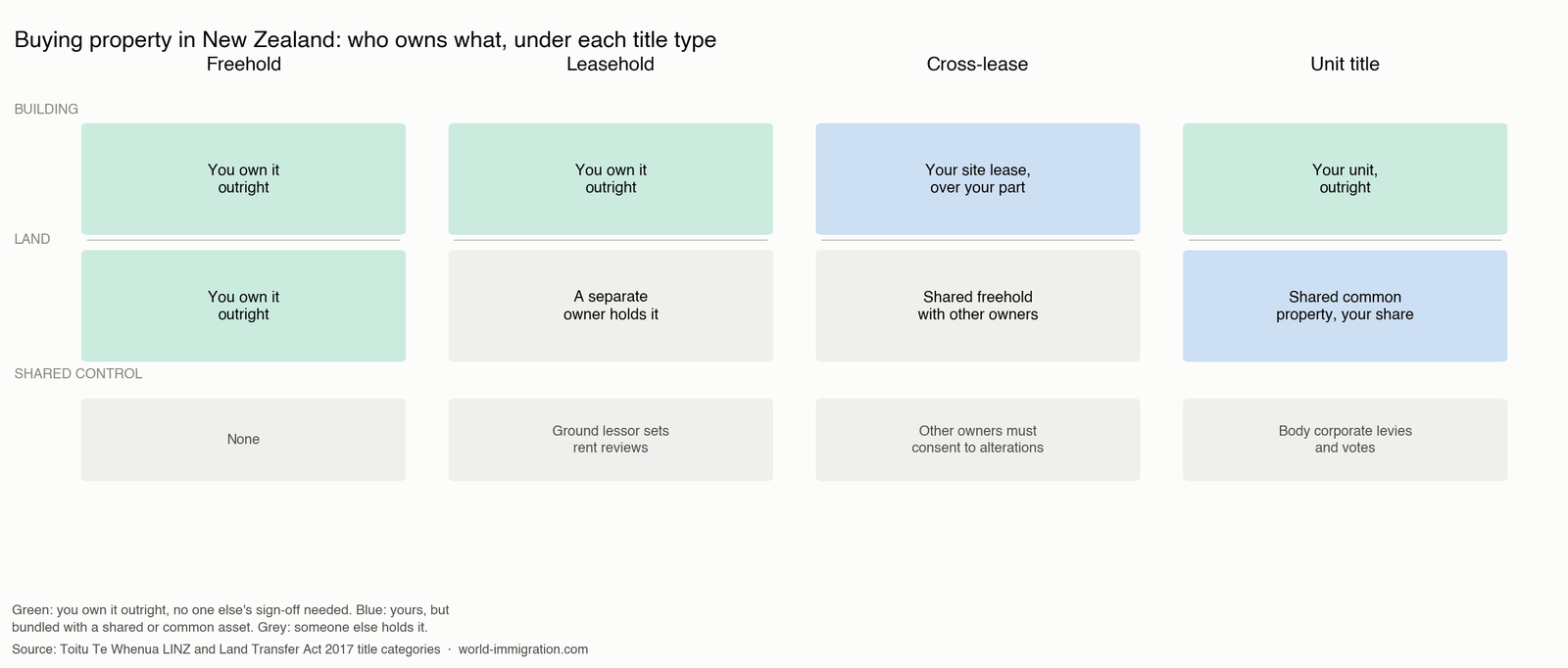
New Zealand has four common forms of property title and these dictate what you actually own, what you can do without asking permission and what the property is worth. This is another area where locals learn to check the title type early in a house hunt and where a newcomer can wrongly assume “a house is a house”.
| Title type | What you own | What to watch for |
|---|---|---|
| Freehold (fee simple) | The land and everything on it, outright | The simplest and most liquid form; usually the benchmark that other titles are priced against |
| Leasehold | The building only; a separate party owns the land beneath it | Ground rent can be reviewed sharply upward and a short remaining lease term makes the property hard to finance and to resell |
| Cross-lease | A freehold shared with the other owners, plus a lease over your own part of the site | Many alterations need the other cross-lease owners’ consent; tends to sell at a discount to equivalent freehold, commonly cited around 7.5 percent |
| Unit title | Your unit outright, plus a share of the common areas | A body corporate levies regular fees and votes on shared-property decisions; read its accounts and minutes before buying |
Cross-lease in particular is common in older Auckland and other urban suburbs and it is the one most house-hunters here learn to identify early, because the “shared freehold plus a lease over your bit” structure means you cannot always alter, extend or even re-roof your own home without the neighbours’ sign-off. I’ve owned one and it is however workable (and common) plus the discount can make it good value, but it is a compromise you want to enter into with your eyes open rather than discover at the lawyer’s office, ALWAYS inspect the title type.
The Practical Buying Process
Assuming you are eligible to buy, or you have your OIO consent lined up, the mechanics of a New Zealand purchase run through a fairly settled set of steps. A few of them might look different from what you’re used to.
A lawyer or licensed conveyancer is required in practice. Property transfers here go through a settlement process handled by lawyers and you engage yours early, before you sign anything, not after. They review the sale and purchase agreement, run the title search, handle the transfer of funds and confirm any OIO condition is satisfied. This is not a corner to cut to save a few hundred dollars.
A LIM, or Land Information Memorandum, is a report you buy from the local council. It pulls together what the council knows about the property, consents and permits, drainage and services, flood or erosion hazards, rates and any notices or requisitions on the land. Order one during your conditional period. It is one of the most useful documents in the whole process and it routinely surfaces things a viewing never would, such as unconsented building work by a previous owner.
A building report is separate from the LIM and separate again from the weathertightness assessment discussed above. The layering matters, the LIM tells you what the council has on file, the building report tells you the physical condition and for a monolithic-clad home from the risk era you add a dedicated moisture assessment on top. For an ordinary weatherboard or brick home, a good general building report may be enough. For anything in the leaky-homes profile, it is not.
Offshore buyers specifically run into two more items. You need a New Zealand IRD (tax) number to buy or sell property here and applying for one from overseas takes longer and requires more effort, since it generally hinges on having a fully verified New Zealand bank account first. Start that early, because it can become the slowest link in the chain. And your lawyer, your bank and the real estate agent are all bound by New Zealand’s anti-money-laundering rules, which means identity verification and source-of-funds checks on your deposit and purchase funds. For a buyer moving money in from another country, that documentation, showing where the money came from and that it is legitimately yours, is best assembled before you need it rather than scrambling under a settlement deadline.
What This Cannot Tell You
This article maps the ownership rules and the buying process as they stand in 2026. It cannot tell you whether a specific property counts as sensitive land under the Overseas Investment Act, because that relies on the exact property, its size, its location and what adjoins it, all of which need to be checked against LINZ guidance for that title. It cannot confirm whether a particular new development holds a current exemption for overseas buyers, or what occupancy and resale conditions attach to it. Those are questions for the OIO register and your lawyer, on the specific development.
It also cannot account for policy that changes after publication. The investor carve-out threshold and the eligible visa categories are exactly the kind of setting governments adjust and the OIO fee schedule is reviewed periodically. The figures here come from LINZ, the Overseas Investment Act as amended and IRD and they were current as of the March 2026 changes, but confirm the live position before you commit. For a purchase involving OIO consent, an offshore-based buyer, or a title type you have not dealt with before, licensed local advice, a lawyer for the transaction and where consent is in play, an adviser who handles OIO applications is money well spent against the size of what you are buying.
Frequently Asked Questions
Q: Can foreigners buy property in New Zealand?
It depends who you are. New Zealand citizens, Australian citizens and Singaporean citizens can all buy freely, as can residence-class visa holders who meet the “ordinarily resident” test (a residence visa, plus 12 months living here, at least 183 days physically present and New Zealand tax residency). Everyone else is generally an “overseas person” under the Overseas Investment Act and cannot buy an existing home without OIO consent, which is granted only in limited situations. It is a targeted restriction, not a total ban, so the flat statement that foreigners cannot buy here is inaccurate.
Q: Did New Zealand lift its foreign buyer ban in 2026?
Not in the way the headlines implied. A change that took effect on 6 March 2026 created a narrow new consent pathway allowing holders of the Active Investor Plus, Investor 1 or Investor 2 visa categories to buy or build residential property valued at NZ$5 million or more. That threshold covers only the very top of the market, mostly in Auckland and Queenstown. The broad 2018 restriction remains in force for everyone else. It is an exception layered on top of the existing rules, not a reopening of the market to ordinary foreign buyers.
Q: Is there a cooling-off period when buying a house in New Zealand?
No. New Zealand has no automatic statutory cooling-off period for residential property purchases. Once both parties sign, the agreement is binding, subject only to any conditions written into the contract, such as finance, a building report, a LIM, or OIO consent. When those conditions are met and you go “unconditional”, you are fully committed and pulling out can cost you your deposit. This differs from jurisdictions that give buyers a few days to reconsider and it surprises newcomers used to a few days of grace. Do your due diligence during the conditional period, not after.
Q: Do I need an IRD number to buy property in New Zealand?
Yes. You need a New Zealand IRD (tax) number to buy or sell property here and it is part of the settlement paperwork your lawyer handles. Applying for an IRD number from overseas takes longer than doing it onshore, because it generally requires a fully verified New Zealand bank account first. On top of that, anti-money-laundering rules mean your lawyer and bank must verify your identity and the source of your funds, which is more involved for money coming in from another country. Both are best started well ahead of any settlement deadline.
Sources
- New Zealand Legislation — Overseas Investment Act 2005
- LINZ — History of the overseas investment regime
- LINZ — Buying or building one home to live in
- LINZ — Overseas investment fees and penalties schedule
- LINZ — Assessment timeframes
- New Zealand Legislation — Overseas Investment (National Interest Test and Other Matters) Amendment Act 2025
- RNZ (reporting REINZ data) — Housing market “steady on the surface”, REINZ says
- LINZ — Investing in apartments
- Settled.govt.nz — Understanding the sale and purchase agreement when buying
- PricewaterhouseCoopers for the Department of Building and Housing (2009) — Weathertightness: Estimating the Cost
- Hayden Roulston — Cross Lease vs Freehold NZ
- New Zealand Legislation — Local Government Official Information and Meetings Act 1987, s 44A (Land Information Memorandum)
- Inland Revenue (IRD) — Information to provide when buying and selling property
- Inland Revenue (IRD) — Living overseas: IRD number application
- Department of Internal Affairs — AML/CFT information for lawyers and conveyancers
- Department of Internal Affairs — AML/CFT information for real estate agents

