
If you want to move to Portugal to run your own thing, whether that is a small business you are setting up or freelance work you already do for yourself, the visa you are looking for is the Portugal D2 visa. It is Portugal’s route for entrepreneurs and self-employed people and it sits alongside two others that sound similar and trip a lot of people up.
The D2 is for your own business. The D3 is for a highly qualified job with a Portuguese employer. The D8 digital nomad visa is for working remotely for clients or an employer outside Portugal. Pick the wrong one and you spend months preparing paperwork for a visa that was never yours.
This guide walks through the D2 in detail, then folds in a full section on the D3 for anyone weighing an employer-sponsored move and finishes with a comparison table so you can place all three side by side. If you are still deciding whether Portugal is the right destination at all, the moving to Portugal hub is the wider picture and working in Portugal covers the employment landscape you would be stepping into.
What the Portugal D2 visa actually is
The D2 is a residence visa for people who will earn their living in Portugal through their own economic activity rather than as somebody’s employee, one of the national visa categories set out on the Ministry of Foreign Affairs’ national visas portal. It covers two situations that read as one on the form but feel quite different in practice.
- The entrepreneur. You are setting up or have set up a company in Portugal, typically an Lda (the Portuguese limited company) and you will run it. This is the classic “starting a business in Portugal” case.
- The independent professional. You work for yourself as a freelancer, consultant or service provider, invoicing clients under your own name or a service contract. No company structure is strictly required, though many people register one anyway.
The common thread is that nobody in Portugal is employing you. You are the business. That single fact shapes the whole application, because instead of an employer vouching for you, the burden sits with you to show the venture is viable and that you can support yourself while it finds its feet.
The money side: what you have to show
Here is the first thing that surprises people. There is no fixed legal minimum investment for the D2, a point immigration-law advisers make consistently because no such figure appears in Portugal’s immigration law or AIMA’s own guidance. Unlike the golden visa, which is built around a set investment figure, the D2 asks whether your business makes sense and whether you have the means to live, not whether you have parked a specific sum. The bar is a matter of judgement by the officer reviewing your file, not a number you can tick off.
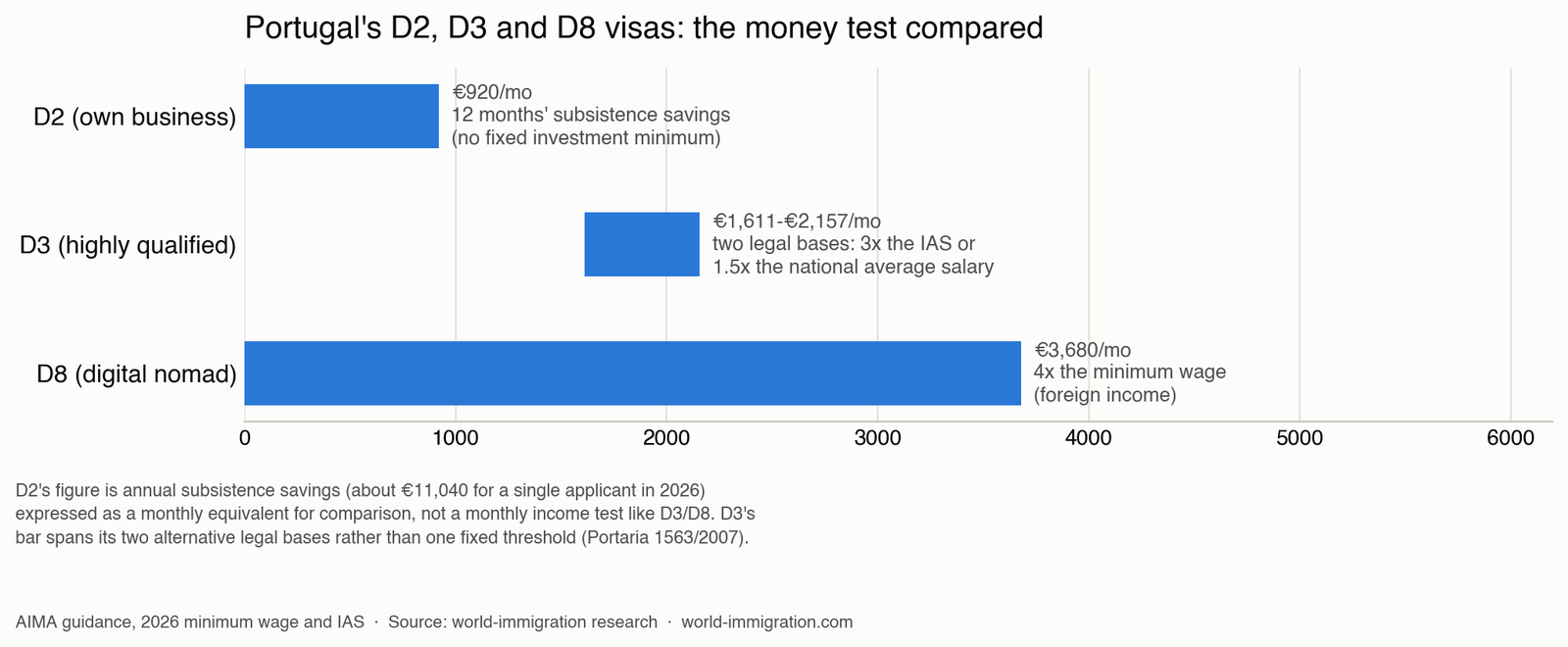
Two things carry most of the weight. The first is subsistence funds: savings that show you can keep yourself afloat while the business gets going. The standard yardstick is twelve months at the Portuguese minimum wage, a formula set out in Portaria n.º 1563/2007 and applied to the current minimum wage on AIMA’s own means-of-subsistence page. For 2026 the minimum wage is €920 a month, so a single applicant is looking at roughly €11,040 in demonstrable savings. Bringing family adds to that, commonly cited as an extra 50% for a spouse and 30% for each dependent child. Those uplifts vary slightly between sources, so treat them as the direction of the requirement rather than the last word.
The second is business capital: enough money behind the venture to make the plan credible. Because there is no statutory figure, advisers tend to point to a working benchmark of around €50,000 of demonstrated capital or investment for a business-owner application, a figure repeated across immigration-law firms’ own D2 guides such as Global Citizen Solutions’. I want to be clear that this is an industry rule of thumb, not a legal threshold and a modest freelance operation with low overheads may not need anything like it.
What the officer is really testing is proportion. Does the money you are showing match the business you have described? A consultancy run from a laptop and a plan claiming a chain of cafés will not line up and that mismatch is where thin applications come apart.
The business plan and where IAPMEI fits
The business plan is the heart of a D2 file. It needs to describe the activity, the financials, your own background and why you are equipped to run it and how the venture contributes to Portugal, whether through jobs, services or investment, the same criteria set out in the consulate’s own residence-visa documentation requirements. A vague one-pager will not do the job. The plan is the document that turns “I want to move to Portugal” into “here is a workable business that supports me” and it is where I would spend the most preparation time.
There is a persistent muddle about the role of IAPMEI, Portugal’s agency for competitiveness and innovation. A lot of guidance implies every D2 needs an IAPMEI viability assessment. That is not the case. For the standard D2, entrepreneur or independent professional, IAPMEI does not sit in the process at all; your plan goes to the consulate and then to AIMA without its involvement and IAPMEI’s own StartUp Visa page frames its role as belonging to that separate, opt-in track rather than the standard D2.
Where IAPMEI does matter is the StartUp Visa, an innovation-focused variant of the D2 for scalable, technology-led ventures routed through a certified incubator. On that track, IAPMEI issues a formal declaration after assessing the project’s innovation, scalability, market potential and job-creation prospects and it aims to decide within 30 working days. So if you have a high-growth startup and an incubator behind you, IAPMEI is part of your world. If you are opening a guesthouse or going freelance, it is not. Knowing which track you are on saves a good deal of wasted effort.
Documents you’ll need
The exact checklist comes from the consulate or visa centre handling your country and it does shift — VFS Global’s own D2 checklist is the place to confirm it for your specific country, so treat the list below as the working set rather than gospel. For a D2 you are generally assembling:
- A passport valid for at least six months, with blank pages, plus the application form and photos.
- Criminal record certificates from your home country and anywhere you have lived for a year or more, apostilled or legalised, plus consent for a Portuguese criminal check.
- The detailed business plan and evidence of the company registration (the Lda) or your independent-activity registration.
- A Portuguese tax number (NIF) and a Portuguese bank account, usually a business account, with statements showing your subsistence savings and business capital.
- Proof of accommodation in Portugal for the initial period, a motivation letter and Schengen-compliant travel insurance with cover of at least €30,000 for the consular stage, the minimum set by the EU’s Visa Code (Regulation (EC) No 810/2009), Article 15. Once you are in Portugal and converting to a residence permit at AIMA, travel insurance is no longer accepted; you need actual health insurance from an accepted Portuguese or international insurer and the cover level required at that stage is not necessarily the same €30,000 figure, a stage-change immigration advisers report consistently though it is not itself set out in a single published AIMA table.
- Apostilled family documents (marriage or birth certificates) if you are bringing dependants.
Most people engage a Portuguese accountant early, partly because you need one for the tax and company side anyway and partly because getting the NIF, the bank account and the registration in the right order is fiddly to do from abroad.
The two-stage process and the timing question
The D2 runs in two stages and it helps to hold them apart in your head.
Stage one, the visa. You apply at the Portuguese consulate or a VFS Global visa centre in your country of residence. What you receive is a residence visa, valid for four months and allowing two entries. Its job is to get you into Portugal legally so you can complete the move. Consulate processing for a D2 is commonly reported at around three to six months, so this is not a quick turnaround and it pays to start well ahead of any date you have in mind.
Stage two, the residence permit. Once in Portugal, you attend an appointment with AIMA (the Agency for Integration, Migration and Asylum, which replaced SEF on 29 October 2023) to convert that visa into a residence permit. The permit is the document that lets you actually live and work in Portugal for the medium term.
AIMA itself is the wildcard in the timing. The agency inherited a very large backlog when it took over from SEF, widely reported as running into the hundreds of thousands of pending cases across all categories and appointment waits have been volatile. Some applicants report a couple of months; others have waited the better part of a year for an AIMA slot.
I would not plan around a promised date. Build in slack, keep your visa’s four-month window in view and check AIMA’s own updates close to your move, because this is the part of the process most likely to slip and least within your control.
After you arrive: renewals and the longer road
The first residence permit is issued for two years, then renewable for a further three, the general rule for temporary residence authorisations under Portugal’s immigration law (Lei n.º 23/2007, Art. 75(1)). After five years of legal residence you can apply for permanent residence, which is unchanged and is a separate status from the EU long-term-resident status that also runs on a five-year clock. Citizenship used to follow the same five-year figure, which was unusually short by European standards and part of what drew people to the country in the first place, but that changed in 2026.
One caution on that last point. Portugal’s Nationality Law was reformed by Organic Law No. 1/2026, in force from 19 May 2026, which raised the naturalisation residence requirement to ten years for most nationalities and seven years for EU and CPLP (Portuguese-speaking country) citizens, with the clock now starting from the date the residence permit is issued rather than the application date. Applications already filed before 19 May 2026 are still assessed under the old five-year rule.
This is a recent, politically live change, so confirm the current position when citizenship becomes a live question for you rather than relying on the old five-year figure still quoted in a lot of older content.
It is also worth separating the D2 from Portugal’s golden visa, which people often mention in the same breath. The golden visa is passive. You qualify by making a qualifying investment and have very light physical-presence requirements. The D2 is active, so you are running a business and living in the country. They lead to similar residency destinations by very different roads and the D2 is the one that fits someone who wants to build something on the ground rather than park capital.
The D3 visa: highly qualified work with a Portuguese employer
The D3 is the visa to reach for when the situation is flipped. Instead of running your own business, you have been offered a highly qualified job by a Portuguese employer. Where the D2 is self-sponsored, the D3 is employer-sponsored and that difference drives everything about it.
To qualify you generally need three things. A signed contract or a binding job offer from a Portuguese employer. A salary that clears the highly-qualified threshold and this is worth being precise about because it is not one number: AIMA’s own Article 90 guidance sets it at 1.5 times the national average gross salary or 3 times the IAS (the Indexante dos Apoios Sociais, Portugal’s social-support index) and those two bases do not land in the same place.
The 1.5x-average-salary calculation works out at roughly €2,100 to €2,200 a month; 3 times the 2026 IAS of €537.13 comes to about €1,611 a month, some €500 lower. Advisers generally point people toward the higher figure, but which base actually applies to your file is a matter for AIMA or the consulate handling your case, not something a guide can settle for you.
Shortage-occupation roles get a reduced threshold (roughly 1.2 times average salary or 2 times the IAS). And the qualifications to match, usually a higher-education degree, or documented professional experience in a specialised field where a degree is not the norm. Depending on the profession, you may also need your qualification formally recognised in Portugal.
A couple of the D3’s finer figures move around between sources. The exact salary threshold is tied to national wage and social-support (IAS) values that are revised annually and the minimum contract length is reported variously as six months or a year.
My read is to treat the salary figure as “comfortably above the national average” and verify the precise number and the contract as needing to run for a defined minimum term, against AIMA’s current page before you rely on either. One helpful thing about the D3 is that it skips Portugal’s labour-market test, so the employer does not have to prove the role could not be filled locally.
D3 and the EU Blue Card
The D3 sits close to the EU Blue Card and the two overlap heavily. Both are for highly qualified, employer-sponsored workers and both skip the labour-market test. The Blue Card’s distinguishing feature is intra-EU mobility. Under the current EU rules, a holder can move to another EU country for highly qualified work after twelve months of legal residence in the country that issued the card, down from the eighteen months an older version of the Blue Card Directive used to require: Directive (EU) 2021/1883, transposed into Portuguese law in 2023, sets the twelve-month figure and older sources still quoting eighteen months are describing the previous regime.
Portugal allows a route from the D3 into the Blue Card after that same twelve-month mark, so if working across several EU states is on your horizon, the Blue Card is the version to ask your employer and lawyer about. If you intend to stay put in Portugal, the D3 does the job on its own.
On timing, the D3 (along with the D7 and D8) has been reported as sitting higher in AIMA’s priority order than the golden visa, though I would read that as practitioner observation rather than published policy and the same backlog caveats apply.
D2 vs D3 vs D8: which route is yours
Most of the confusion in this whole area comes down to one question: who is paying you and from where. That single answer usually points straight at the right visa. The table below lays the three routes side by side so you can find your situation quickly.
| D2 (own business) | D3 (highly qualified) | D8 (digital nomad) | |
|---|---|---|---|
| Who it’s for | Entrepreneurs and self-employed people running their own activity in Portugal | Skilled workers with a highly qualified job offer from a Portuguese employer | Remote workers and freelancers paid by clients or an employer outside Portugal |
| Who pays you | Your own business / your clients | A Portuguese employer | A foreign employer or foreign clients |
| Sponsor | None (self-sponsored) | The Portuguese employer | None (foreign income) |
| Money test | No fixed investment minimum; viable business plan plus ~12 months’ subsistence savings (about €11,040 single) | Salary of roughly 1.5× the national average (about €2,100–€2,200/mo) | Income of at least 4× the minimum wage (about €3,680/mo in 2026) |
| Business plan | Yes, central to the application | No | No |
| Permit structure | 2 years, then renewable for 3 | 2 years, then renewable for 3 | 2 years, then renewable for 3 |
| Path to residency | Yes | Yes | Yes |
The D8 figures above are the headline numbers; I have kept them brief because the Portugal digital nomad visa guide carries the detail. The short version: if your income comes from outside Portugal, that is your visa, not the D2.
Frequently asked questions
How much money do I need for a Portugal D2 visa?
There is no fixed legal minimum. You need to show subsistence savings, using a benchmark set by Portaria n.º 1563/2007 of twelve months at the minimum wage (around €11,040 for a single applicant in 2026), plus enough business capital to make your plan credible. Advisers often cite about €50,000 of capital for a business-owner application, but that is an industry rule of thumb rather than a legal threshold and a low-overhead freelance operation would need far less.
Do I need an IAPMEI assessment for the D2?
Not for the standard D2. IAPMEI’s viability opinion is part of the StartUp Visa, the innovation-focused variant for scalable ventures routed through a certified incubator. A regular entrepreneur or self-employed D2 goes to the consulate and AIMA without IAPMEI in the loop.
What is the difference between the D2 and D3 visas?
The D2 is for your own business or self-employment, with no employer sponsoring you and a business plan at the centre of the file. The D3 is for a highly qualified job with a Portuguese employer, sponsored by that employer, with a salary threshold to meet and no business plan required. Own business is D2; skilled employee is D3.
How long does a D2 visa take?
The consulate stage is commonly around three to six months. The residence-permit stage in Portugal depends on AIMA appointment availability, which has been unpredictable because of a large backlog, ranging from a couple of months to close to a year. Plan with a wide margin and check AIMA’s current position near your move.
Can I bring my family on a D2 visa?
Yes. Portugal’s family reunification provisions let you bring a spouse and dependants and you show additional subsistence funds for each of them (commonly an extra 50% for a spouse and 30% per child). Family documents need to be apostilled or legalised.
What this guide can’t settle for you
A few things sit outside what a reference page can pin down and it is better to name them than to paper over them.
- The exact figures on the day. The minimum wage, the IAS and the D3 salary threshold are revised annually and the consulate checklist changes. The numbers here are for orientation; the official pages are what bind.
- Whether your specific business plan clears the bar. With no fixed investment minimum, viability is a judgement call by the reviewing officer. A marginal or poorly-evidenced plan is where D2 applications most often stall and only your own file can answer that.
- AIMA timing. Appointment waits are volatile and largely outside your control. Any timeframe here is indicative, not a promise.
- The citizenship clock. Portugal’s 2026 Nationality Law reform lengthened naturalisation to ten years for most nationalities (seven for EU/CPLP citizens). Confirm the current position when it matters to you, since this changed recently and transitional details are still settling.
For anything that turns on your nationality, your profession or the particular business, the official pages below are the authority and on a visa that ties your right to live in Portugal to your own venture, a Portuguese immigration lawyer is money well spent.
Sources
- Portuguese Ministry of Foreign Affairs, national visas portal: vistos.mne.gov.pt/en/national-visas
- AIMA (Agency for Integration, Migration and Asylum), highly qualified activity residence permit (Art. 90): aima.gov.pt
- IAPMEI, StartUP Visa programme: iapmei.pt/Paginas/StartUP-Visa-en.aspx
- VFS Global (Portuguese visa application centre), D2 residence-visa checklist: vfsglobal.com/portugal
- Portaria 480-A/2025/1, IAS for 2026 set at €537.13 (official gazette): apcmc.pt
- Portaria n.º 1563/2007, de 11 de dezembro, means-of-subsistence formula (Diário da República): diariodarepublica.pt
- AIMA, means of subsistence (current minimum-wage reference value): aima.gov.pt
- AIMA, permanent residence authorisation (Art. 80): aima.gov.pt
- Diário da República, Organic Law No. 1/2026, de 18 de maio (Nationality Law reform): diariodarepublica.pt
- EUR-Lex, summary of Directive (EU) 2021/1883 (EU Blue Card, twelve-month intra-EU mobility rule): eur-lex.europa.eu
- EU Visa Code, Regulation (EC) No 810/2009, Article 15 (€30,000 minimum travel-insurance cover): eur-lex.europa.eu
- gov.pt, official notice of AIMA taking over from SEF, 29 October 2023: www2.gov.pt
- The Portugal News, reporting on the scale of AIMA’s processing backlog: theportugalnews.com
Figures on this page reflect the 2026 framework and current official guidance. Portuguese immigration rules and thresholds are updated periodically, so confirm against the official pages above before you apply.

