
Most people who look up the Portugal family reunification visa are already halfway into the move. One person has the residence permit, or is about to and the quiet worry sitting behind the search is the rest of the household. A partner still at home. Children who need to be enrolled in school. A dependent parent who cannot be left behind. Underneath it is whether the family can actually be together, legally and for the long term, on the same side of the border.
This guide sets out how the route works in 2026, who counts as family under it and one point that trips up more applications than any other, which is that a recent change to Portuguese law has reshaped the timing.
This is a careful read of the current rules, drawn from AIMA, the Portuguese Ministry of Foreign Affairs consular portal and the text of the law itself, written for someone weighing the move rather than a lawyer.
Portugal’s immigration rules are mid-reform as I write this, so treat it as a well-sourced starting point and confirm the current position with AIMA or a licensed advogado before you commit money or flights.
What the Portugal family reunification visa actually is
Plenty of guides frame this as a marriage visa and that framing is misleading. Portugal’s route is reagrupamento familiar, family reunification, defined in Lei n.º 23/2007 and it is open to the qualifying relatives of any legal resident, not only to a spouse. The visa a family member abroad applies for to travel on this basis is the D6, per the official visa checklist.
It is governed by the Foreigners Act, Lei n.º 23/2007, articles 98 to 100, which was substantially amended by Lei n.º 61/2025 during late 2025 and 2026. That amendment matters more than any other single fact here, so it gets its own section further down.
The mechanism is different from most visa routes: the application is anchored to a person who is already a legal resident of Portugal. That resident, the sponsor, is the one who starts the process from inside the country. The relatives abroad do not apply first and hope to qualify. The sponsor petitions for them and only once that petition is approved do the relatives collect a D6 entry visa. Everything else follows from that shape, as set out in AIMA’s own procedure page for Article 98(1) reunification.
Who counts as family under this route
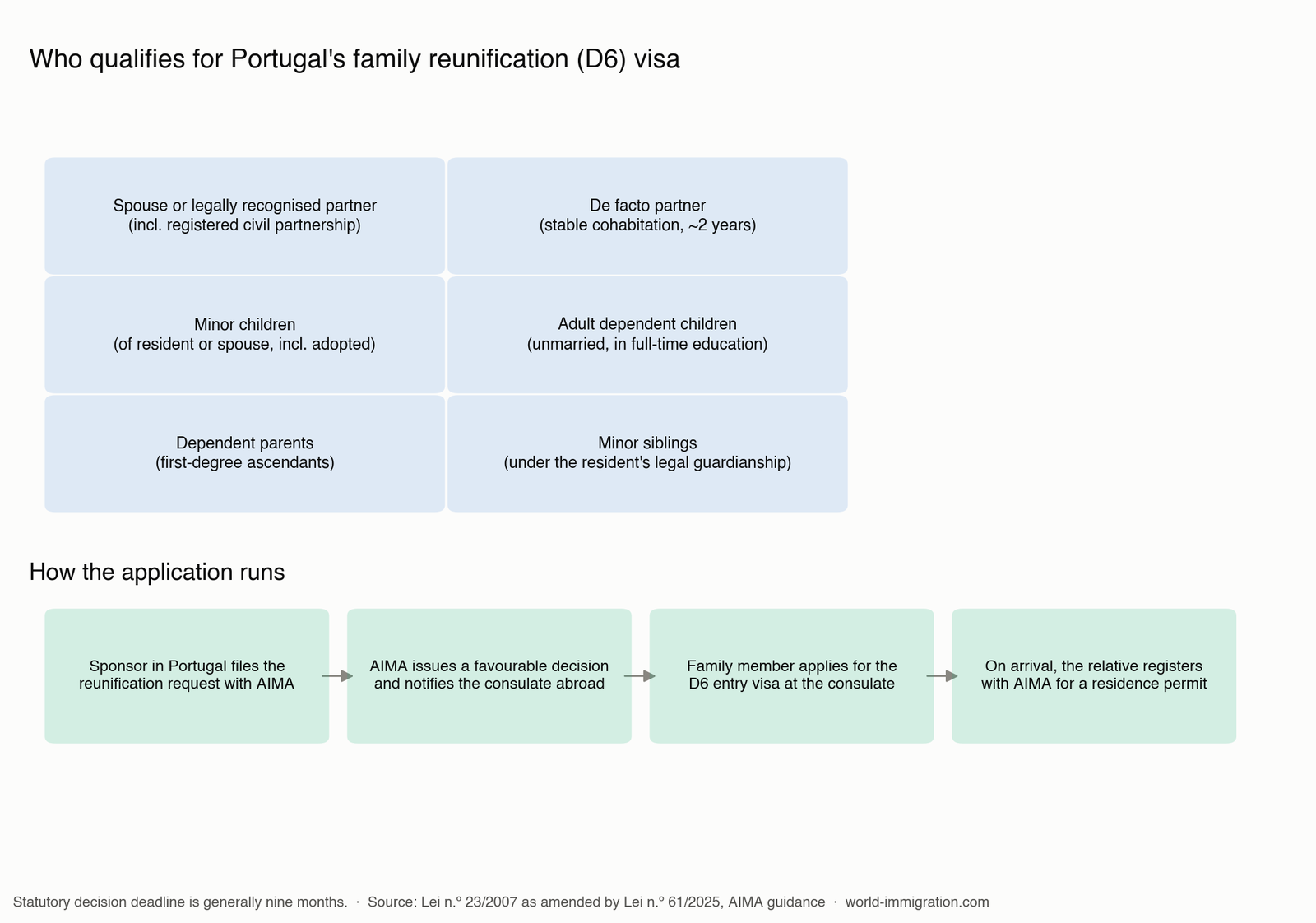
The category is broader than a spouse and children, which is part of why the marriage-visa framing sells it short. Based on Lei n.º 23/2007, article 99 and consular guidance, the relatives a resident can reunify with include:
- A spouse or a legally recognised partner, including a registered civil partnership.
- A de facto partner in a stable cohabiting relationship, a união de facto. Portugal treats this as a legitimate basis rather than a lesser one, though it asks for firmer evidence and the cohabitation period commonly cited is around two years.
- Minor children of the resident or the spouse, adopted children included.
- Adult children who are still dependent, unmarried and studying at an educational establishment in Portugal. The test here is dependency and study rather than a single hard age and different sources summarise the upper bound differently, so it is one to confirm for a specific case rather than assume.
- Dependent parents, the first-degree ascendants of the resident or the spouse, where they rely on the resident for support.
- Minor siblings under the resident’s legal guardianship, subject to that guardianship being recognised.
The two categories that carry the most conditions are the de facto partner and the dependent parent, because both hinge on proving something less tidy than a birth or marriage certificate. A cohabiting relationship has to be evidenced. Dependency has to be shown, not merely stated. My read is that these are the places a thin application stalls, so they are the places to over-document rather than under-document.
The rule people miss: the sponsor must already be resident
The sponsor has to hold a valid Portuguese residence permit before reunification can be filed, per Lei n.º 23/2007, article 98. The relative overseas cannot start the process on their own. That much has always been true.
What changed with Lei n.º 61/2025 is the timing. The reform rewrote article 98(1) of Lei n.º 23/2007 to require that a sponsor hold their residence authorisation for at least two years before they can reunify with relatives who are still abroad. Previously there was no fixed waiting period, so a new resident could petition fairly soon after settling. Under the amended rules, most routes now carry that two-year wait for after-the-fact reunification.
There are carve-outs and they matter a great deal depending on how you arrived. Article 98(3) of the amended law exempts minors or incapacitated people in the sponsor’s care, a spouse who is the parent of a minor already in that care and family members of a sponsor holding certain permits: the teaching, highly-qualified or cultural-activity residence category (article 90), investment-based residence of the Golden Visa type (article 90-A) and the EU Blue Card (article 121-A), per Lei n.º 61/2025.
Those sponsors can reunify without the delay. Holders of the passive-income D7 visa and the D8 digital nomad visa are not on the article 98(3) exempt list, so for them the general rule is the two-year wait (Lei n.º 61/2025).
There is one genuine shortcut worth knowing about: article 98(2) gives a spouse or de facto partner who can show at least 18 months of cohabitation with the sponsor immediately before the sponsor’s arrival in Portugal a reduced 15-month wait instead of the full two years, per Lei n.º 61/2025. It only helps a couple who were already living together before the move, not one that formed or moved in together afterwards, but if it applies to you, it is worth confirming rather than assuming the full two years is unavoidable.
If you are moving on a D7 or D8 and intend to bring family later, that distinction is the one to plan around from the outset.
What the sponsor has to prove
Because the sponsor carries the application, the sponsor is the one tested on means. Three things sit at the centre of it: suitable housing and sufficient income to support the larger household without leaning on the state, per article 101 of the amended law, plus a clean criminal record among the documents AIMA requires.
The income side is usually expressed as a base figure tied to the Portuguese minimum wage, plus a percentage on top for each additional family member joining. Commercial visa guides put the additions at roughly half the base for a spouse or adult dependent and around a third for each child, with a smaller amount for a dependent parent. The consular portal’s own means-of-subsistence guidance for national-visa applicants generally uses the same shape of calculation, currently a €920 monthly base plus 50 percent per additional adult and 30 percent per child under Regulatory Decree n.º 139/2025 — see vistos.mne.gov.pt.
I would treat those specific euro figures as indicative rather than settled. They move with the minimum wage, they vary between the sources quoting them and AIMA’s own subsistence table is the number that governs. Before building a budget around a threshold, check the current figure against AIMA directly.
The documents
The exact list flexes with the relationship and the country the relative is applying from, but the core set, per the official D6 visa checklist, is consistent:
- A valid passport, typically with at least three months of validity beyond the intended stay, plus passport photos.
- Proof of the family tie: a marriage or civil-partnership certificate, a birth or adoption certificate, or, for a de facto union, cohabitation evidence such as a declaration from the local parish council (Junta de Freguesia) or foreign equivalent, joint bills, shared financial records and, in some cases, witness statements.
- A criminal record certificate from the relative’s country of origin and from any country they have lived in for more than a year. These usually expire quickly, often within about 90 days of issue (gov.pt confirms a 3-month validity for Portuguese-issued certificates and consulates commonly apply the same window to foreign ones), so timing the request matters.
- Travel insurance valid for six months from the date of the visa request, covering necessary medical expenses including emergency treatment and repatriation, per the official D6 checklist. That checklist does not set a specific minimum euro figure for this cover; the €30,000 minimum quoted by many guides is the Schengen short-stay visa standard and is not confirmed as a requirement for this national D6 visa, so check the current figure with your consulate rather than assume it applies here.
- The sponsor’s evidence of housing and income, submitted on the Portuguese side.
- The AIMA reunification approval notification itself. The family member abroad lodges the D6 visa application only after AIMA has approved the sponsor’s petition, so this document is the hinge between the two halves of the process.
Documents that are not in Portuguese generally have to be apostilled or otherwise legalised and officially translated, per the official D6 checklist. That step is slow and easy to leave too late, so I would front-load it rather than treat it as a formality at the end.
How the application actually runs
The process has two distinct halves and confusing them is where people lose time. First, the sponsor in Portugal files the reunification request with AIMA, the Agência para a Integração, Migrações e Asilo, which took over immigration functions from the former SEF in October 2023. That filing carries the sponsor’s housing, income and criminal-record evidence, along with proof of the relationship.
Second, once AIMA issues a favourable decision, it notifies the relevant consulate and the family member abroad applies for the D6 entry visa there, in many countries through a VFS Global visa centre. After arriving in Portugal on that visa, the relative registers with AIMA to collect their residence permit.
On timing, the statutory answer and the practical one differ. Article 105 of the amended law sets AIMA a deadline of nine months to decide. That deadline is fixed, not extendable, for the ordinary reunification-from-abroad route this guide covers, the article 98(1) two-year-wait and article 98(2) 15-month cases; the law allows an extension of an equal period, in complex cases, only for reunification requests that fall outside those two categories.
The practical picture is shaped by AIMA’s backlog. When it absorbed SEF’s caseload in October 2023 it inherited a queue reported at roughly 327,000 pending requests and although a government task-force report shows most categories substantially cleared through 2025, reunification filed after a sponsor is already resident is one of the categories commentators still flag as slow, mostly because of appointment availability. I would plan on many months, treat any “60 days” claim as marketing rather than fact and build in slack rather than book flights against an optimistic date.
D6 reunification versus bringing family from the outset
Clearing up this confusion can save a family a year. Family reunification through the D6 is the route for when the sponsor is already resident and needs to bring relatives across afterwards. It is not the only way to move as a family and often it is not the best one.
The alternative is to include the family in the main applicant’s original visa application from the start, through the separate Accompanying Family Member visa the consular network uses for exactly this case, noted in the official D6 checklist as the route for anyone who wants to travel with a sponsor rather than apply via the D6. When someone applies for a D7, a D8, or a D2 entrepreneur visa, qualifying dependents can generally be attached to that application and travel together, without a separate reunification procedure and without the D6 as a distinct step. The family arrives as part of one move rather than in two waves.
Since the 2025 reform, this distinction carries more weight. If a D7 or D8 sponsor does not include their family at the outset, those relatives can now be caught by the two-year residence wait described above before reunification becomes possible, unless an exemption applies. That is the concrete cost of leaving family out of the first application and it is the reason to weigh the two routes before deciding rather than after.
The way I would think about it, reunification is the fallback for when circumstances change or someone was left behind, not the default plan for a family that already knows it is moving together. If everyone can be on the first application, that is usually the cleaner path.
The reform is recent and it is still settling
A large share of the confusion online traces back to the timing of Lei n.º 61/2025. It was published on 22 October 2025 and took effect the next day and it came with a single transitional provision: a 180-day window, running to roughly 22 April 2026, that let sponsors regularise family members who were already in Portugal under the old rules.
There is no separate later-running window beyond that — if a source describes one, treat it with scepticism until you can check it against the actual text of Lei n.º 61/2025. A lot of older guidance still describes the pre-reform rules as though they were current, which is how a reader ends up with two contradictory answers to the same question. If a source does not acknowledge the 2025 change, that is a fair sign it is out of date.
What this guide cannot settle for you
The structure of the route is stable and well documented. The fine detail is the part that moves and there are three specific numbers I would not build a plan on without checking against AIMA or a lawyer first.
The cohabitation period for a de facto union is cited slightly differently across sources. The age at which an adult child stops qualifying as a dependent is a test rather than a fixed number and summaries of it disagree. The income thresholds are tied to a minimum wage that rises and the exact euro figures vary between the guides quoting them. None of that makes the route uncertain in outline, but each is a place where a specific case can turn on a specific figure.
The larger limit is the reform itself. Because Lei n.º 61/2025 is still phasing in through 2026, anyone acting this year should confirm the current status with AIMA or a licensed advogado before committing to a timeline.
For how long a particular consulate actually takes, people who have recently made the move are the better source.
Frequently asked questions
Is the D6 a marriage visa?
No and the distinction matters. The D6 is the entry visa for family reunification, which covers a resident’s qualifying relatives more broadly than a spouse. That includes a spouse or de facto partner, minor and dependent children and dependent parents, among others. A marriage or partnership is one basis for it, not the whole of it.
Does the sponsor have to be resident first?
Yes. Family reunification is anchored to a sponsor who already holds a valid Portuguese residence permit and that person files the request from inside Portugal. Since the 2025 reform, most sponsors also have to have held their residence authorisation for at least two years before reunifying with relatives who are still abroad, with exemptions for minors in their care and for certain permit types such as the Golden Visa, highly-qualified and EU Blue Card categories.
How long does AIMA take to decide?
The law sets a deadline of nine months and that deadline cannot be extended for the standard reunification-from-abroad route this guide covers; the extension available in complex cases applies only to reunification requests that fall outside that route. In practice, AIMA’s backlog means reunification filed after a sponsor is already resident is often slower than that headline suggests, so plan on many months and be cautious of any source promising a decision in a matter of weeks.
Should I use reunification or bring my family on the first visa?
If the whole family is moving together, including dependents in the main applicant’s original D7, D8 or D2 application is usually the cleaner route and it avoids the separate reunification procedure and the new two-year wait that can catch D7 and D8 sponsors who bring family later. Reunification through the D6 is the route for when someone is already resident and needs relatives to join afterwards.
Can I bring a parent or an adult child?
Potentially, yes, but both are conditional. A first-degree parent can qualify where they depend on the resident for support and an adult child can qualify while unmarried, dependent and in full-time education. Both turn on evidence of that dependency rather than the family tie alone, so they need more documentation than a minor child or a spouse. For the broader picture of settling in the country, our guide to moving to Portugal covers the visa routes a family would most often be joining.
Sources
- Portuguese Ministry of Foreign Affairs, National Visas portal — Family reunification, general information: vistos.mne.gov.pt
- AIMA (Agência para a Integração, Migrações e Asilo) — Reagrupamento familiar, com familiar fora de território nacional (Art. 98.º): aima.gov.pt
- Diário da República — Lei n.º 61/2025, de 22 de outubro (the amending law): diariodarepublica.pt
- Lei n.º 23/2007, de 4 de julho (the Foreigners Act / Lei de Estrangeiros), articles 98–100: diariodarepublica.pt
- VFS Global — Residence Visa for Family Reunification (D6), applicant one-pager: vfsglobal.com
- Portuguese Ministry of Foreign Affairs, National Visas portal — Means of subsistence: vistos.mne.gov.pt
- gov.pt — Requesting a criminal record certificate (validity period): gov.pt
- Governo de Portugal — Estrutura de Missão para a Recuperação de Processos Pendentes na AIMA, balanço da produção: portugal.gov.pt
- Público — “AIMA resolverá todas as pendências até o final do ano, promete ministro,” 24 September 2025: publico.pt

