
If you earn your living online and you have been picturing a year or two in Lisbon, the Algarve, or a village in Madeira, the practical question underneath the daydream is a legal one. How do you stay in Portugal long enough to actually settle without stretching a tourist stamp past what it was meant for? Portugal’s answer is the D8, the visa most people mean when they say “the Portugal digital nomad visa”. This is a look at how it works in 2026, who it fits and which of the numbers are the ones that date fastest.
This leans on Portugal’s official visa portal, the government’s 2026 minimum-wage figures, a KPMG briefing on the tax change that trips up so much older writing and the accounts of people who have recently made this move.
What the Portugal digital nomad visa (D8) actually is
The D8 is Portugal’s residence route for people whose income comes from outside the country, created under Article 88(1) of the Foreigners Law, administered by AIMA. It covers two kinds of remote earner. The first is the employee working over the internet for a company based abroad. The second is the freelancer or contractor billing clients who sit outside Portugal. In both cases the point is the same: your money arrives from elsewhere and you are not stepping into the Portuguese job market to earn it.
That boundary matters more than the headline income figure. The D8 does not authorise you to take a job with a Portuguese employer or bill Portuguese clients for local work. If that is the plan, you would be looking at a work permit or the business-owner route instead. For remote workers, though, it is the cleanest legal footing Portugal offers and unlike a tourist stay it can lead somewhere.
There are two D8s and the difference is not cosmetic
The single most useful thing to understand early is that “the D8” is really two visas wearing one name and people apply for the wrong one all the time.
According to Portugal’s visa portal, the temporary-stay D8 is for stays of under a year. It grants multiple entries and it does not involve any residence-permit step once you land. It suits someone who wants a long, legal stretch in Portugal without committing to becoming a resident. The trade-off is that it leads nowhere. Time on it does not accumulate toward permanent residency or citizenship.
The residency D8 is the one most people actually want. According to Portugal’s visa portal, the visa itself is issued for about four months with two entries and it is really a travel document to get you into the country. Once you are in Portugal, you attend an appointment with AIMA, the immigration agency and convert it into a residence permit, typically valid for two years and then renewable.
After five years of legal residence, you become eligible to apply for permanent residence, which is unchanged. Citizenship is a separate and longer milestone: Lei Orgânica n.º 1/2026, de 18 de maio, in force since 19 May 2026, raised the naturalisation residence requirement to ten years for most nationalities (seven for EU and CPLP citizens), up from the five-year figure a lot of older content still quotes; nationality applications already filed before that date are still assessed under the old five-year rule. If a long-term future in Portugal is the goal, this is the track and the four-month visa is just the door.
The income requirement and why so much online is out of date
Here is the number that goes stale fastest, because it is pinned to the Portuguese minimum wage and that figure is reset every January. Portugal’s own visa-document rules set the D8 income threshold at four times the national minimum wage. For 2026 the mainland minimum wage rose to €920 a month (set by Decreto-Lei 139/2025 and paid across fourteen instalments a year), which puts the D8 requirement at €3,680 a month.
That is the figure to check against the calendar. Plenty of guides still quote the 2024 or 2025 threshold and because the multiple stays the same while the wage climbs, an old article looks plausible while being wrong. The rule (four times) is stable. The euro amount it produces is not. Madeira and the Azores set their own, higher regional minimum wages for 2026 — €980 in Madeira and €966 in the Azores — but immigration lawyers report that the D8 income test is still measured against the national €920 figure wherever in the country you intend to live, so €3,680 remains the number that matters for the application.
The first is a savings requirement, commonly stated by immigration-law guides as twelve times the minimum wage, which works out to about €11,040 for 2026, held in your account as evidence you can cover roughly a year.
The second is the uplift for dependants, set out in Portaria n.º 1563/2007 and the base amount is easy to get wrong. The uplift is 50% of the minimum wage for a spouse or partner and 30% of the minimum wage per child, not 50% and 30% of your own four-times threshold.
For 2026 that is roughly €460 for a spouse and €276 per child, regardless of whether your own income is one times the minimum wage or four. The rule traces to Portaria n.º 1563/2007 (Article 2), which sets these percentages against the minimum wage itself and is updated automatically each time the minimum wage rises, so budget from the minimum-wage figure rather than a multiple of your own threshold.
That covers dependants applying alongside you on the same D8 application. If a family member is joining later rather than at the same time, the route runs through Portugal Family Reunification Visa (D6) instead.
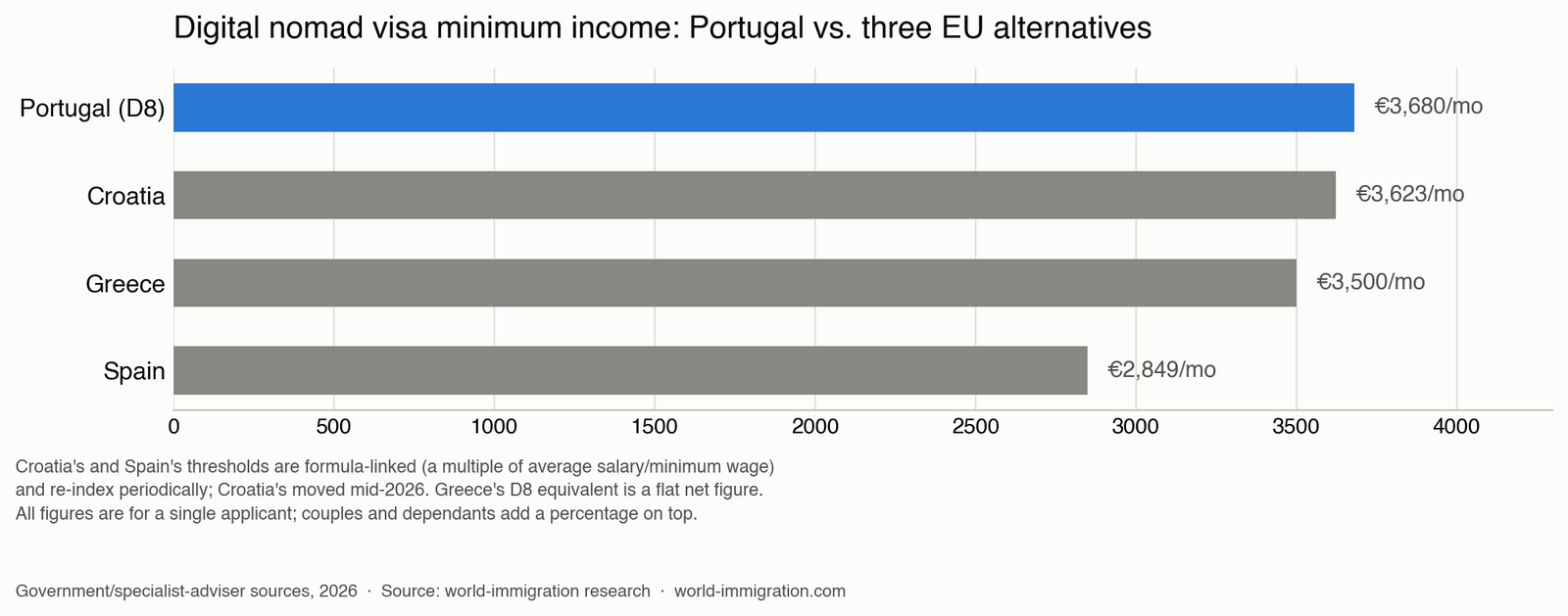
For context, €3,680 sits at the higher end among Europe’s nomad visas. Comparative guides put Spain’s threshold at roughly €2,850 a month (200% of its own minimum wage), Croatia’s at around €3,295 and Greece’s at around €3,500, so if the income test is the binding constraint for you, Portugal is not automatically the cheapest door into the EU. It tends to win on lifestyle, language accessibility and the size of its existing remote-work community rather than on the number you need to clear.
The documents you will need
The paperwork is fairly predictable and most of it is about proving three things: who you are, that the income holds up and comes from abroad and that you have somewhere to live and cover for illness. The list below follows Portugal’s official residence-visa documentation requirements, though individual consulates can ask for extras.
- A passport valid well beyond the visa period, plus the completed application form and photos.
- Proof of remote income: an employment contract and recent payslips if you are employed, or client contracts and invoices if you freelance, generally covering the last three months.
- Bank statements showing the income landing and the savings balance behind it.
- A NIF, the Portuguese tax number. You can obtain it remotely through a fiscal representative and consulates increasingly want to see it at the application stage.
- Proof of accommodation in Portugal, usually a signed lease. A four-month lease tends to satisfy the temporary-stay track; the residency track commonly expects twelve months.
- A criminal background check from your country of residence, translated and legalised.
- Private health insurance (more on that next) and often a short cover letter explaining the move.
A Portuguese bank account is not strictly required to lodge the application, but you will want one soon after arrival and opening it is smoother once you hold a NIF. Setting the NIF up early removes friction from almost everything that follows.
Health insurance is not optional
At the consulate application stage, what you need is Schengen-compliant travel insurance, commonly quoted at a minimum of €30,000 in cover, extending to any dependants travelling with you. It is only once you reach the AIMA residence-permit appointment in Portugal that travel insurance stops being accepted and you need residency-grade private health cover valid in Portugal instead, because you do not yet have access to the public SNS system.
Once you are a legal resident you can register with the SNS, but the private policy is what carries you through the gap. There is more detail on how the public and private systems fit together in the guide to healthcare in Portugal.
How you actually apply
The application starts outside Portugal, at a Portuguese consulate or embassy in your country of residence. In many countries, including the UK, the administrative side is handled by VFS Global, which acts as the front desk (booking appointments, collecting documents and biometrics) while the consulate makes the actual decision. VFS is a logistics layer, not the authority, so its involvement does not change the requirements.
If you are on the residency track, the consulate issues that four-month, two-entry visa on approval. You then travel to Portugal and attend an AIMA appointment to obtain the residence permit, which is the document that lets you stay long term and eventually build toward permanent residence. The temporary-stay track skips the AIMA step entirely, which is part of what makes it simpler and also what makes it a dead end for anyone with longer-term plans.
Processing times and the AIMA backlog you have heard about
This is where expectations need managing and where a lot of marketing copy quietly misleads by collapsing two very different timelines into one.
The consular decision on the visa itself is the faster step. According to Portugal’s own statutory deadlines, the residency-track decision is due within 60 days and the temporary-stay decision within 30, though appointment availability at busy consulates can add weeks or months before the clock even starts and the deadline can be extended if extra checks or documents are needed.
The AIMA stage in Portugal is the one that has earned Portugal its reputation for delay. AIMA replaced the old SEF agency in 2023 and inherited a large backlog and the appointment-and-permit process has been slow. According to The Portugal News, in June 2026 the government reported the backlog was clearing, with more than 525,000 files decided and hundreds of thousands of appointments completed and it framed the situation as moving forward.
Independent relocation and legal advisers tell a more mixed story on the ground. The Portugal News reported in January 2026 that AIMA was still working through card-delivery delays for already-approved cases and relocation lawyers separately describe appointment waits of several months and residence-card delivery anywhere from a few weeks to several months after approval. Both things can be true at once. The system is processing far more than it used to and individual applicants still report long, frustrating waits.
The way I would set expectations is to separate the two. The visa decision might take a couple of months. Getting the residence card in hand, end to end, has commonly run to six or nine months once the AIMA stage is included and it is the AIMA stage that is unpredictable. If a service quotes you a single tidy figure for “the whole thing”, that is the number to be sceptical of.
Tax: the NHR story most articles get wrong
If you have read about Portugal’s tax breaks for newcomers, you have almost certainly read about the Non-Habitual Resident regime, or NHR. For years it offered generous treatment of foreign income and became a big part of Portugal’s pitch to remote workers and retirees. A great deal of writing online still presents it as available. It is not and this is the correction to carry away from this article.
According to KPMG, the NHR regime closed to new applicants on 1 January 2024, under the 2024 State Budget law. There is transitional grandfathering for people who had already met specific conditions during 2023 (a signed employment contract, a property agreement, a child enrolled in a Portuguese school, or a residence visa in progress by the cut-off dates) and those who qualified keep the benefit for its full ten-year run. But for someone applying for a D8 in 2026, the old NHR is off the table.
Its replacement is a narrower scheme, formally the Incentivo Fiscal à Investigação Científica e Inovação, or IFICI, sometimes marketed as “NHR 2.0”. According to KPMG, the name it goes by matters less than what it is, which is a targeted incentive rather than a general expat break. It is aimed at qualified professionals in scientific research, higher education, recognised technology and innovation roles, certain R&D positions and staff at companies that export the bulk of their turnover or qualify as eligible startups.
For those who fit, KPMG notes it offers a flat 20% rate on qualifying income for ten years. The point for D8 readers is: a typical remote employee or freelancer working for a foreign company in an ordinary, non-research role will generally not qualify. Assume you will not, unless a Portuguese tax adviser confirms your specific role does.
What that leaves for most D8 holders is Portugal’s standard income tax. Once you spend more than 183 days a year in the country, or make it your main home, you become a Portuguese tax resident and are taxed on worldwide income under the progressive IRS schedule, which, according to PwC Tax Summaries, runs from around 13% at the bottom to 48% at the top, with additional surtaxes at higher incomes.
Where a tax treaty or foreign tax credit applies there may be relief, but the mechanics get specific quickly. This is the point at which I would stop reading guides and speak to a tax professional who works with expatriates in Portugal, because the difference between qualifying for IFICI and not is measured in tens of percent.
How the D8 compares to Portugal’s other routes
If the D8 does not quite fit, knowing the adjacent route stops you applying in the wrong lane. The D8 is for people employed or contracted by others abroad. If instead you plan to run your own business in Portugal, or to be self-employed with Portuguese activity, the business-owner route is the D2 visa, built around a company or a viable business plan rather than a salary from elsewhere. The distinction is about where the work and the enterprise sit, not just how much you earn.
For the wider picture of settling in the country (cities, costs, the practical order of setting up), moving to Portugal goes broader than there is room for here and if the earning side is what you are weighing up, working in Portugal covers the local employment context the D8 deliberately sits outside of.
What this guide cannot settle for you
Two things this article cannot do for you. It cannot promise the figures above are still exact by the time you read them. The income threshold is tied to a minimum wage that resets every January, the savings and dependant uplifts rest on consular practice rather than a published table and AIMA’s timelines shift with its backlog. And it cannot stand in for the consulate or a tax adviser. The structure of the D8 is stable and well documented; the precise euro amounts and waiting times are the parts that move.
So the sensible way to use this is as a map of how the visa works and whether it fits your situation, then to confirm the current thresholds and processing status directly with a Portuguese consulate and, for anything tax-related, with a professional who works with expatriates. That is not a disclaimer for its own sake. Given how much stale NHR advice is still circulating, checking the current position is the single most valuable thing you can do before committing money or a plane ticket.
Frequently asked questions
How much do I need to earn for Portugal’s digital nomad visa?
The D8 income requirement is four times the Portuguese national minimum wage. For 2026 that minimum wage is €920 a month, so the threshold is €3,680 a month, shown across recent income and bank statements. Because the figure resets each January while the multiple stays the same, always check the current year’s number rather than trusting an older article.
Is the old NHR tax break still available to digital nomads?
No. The Non-Habitual Resident regime closed to new applicants on 1 January 2024. Its replacement, IFICI (sometimes called “NHR 2.0”), is narrower and aimed at scientific research, higher education and technology or innovation roles. A typical remote worker on a D8 will usually not qualify and should expect standard Portuguese income tax once tax-resident.
What is the difference between the temporary-stay and residency D8?
The temporary-stay D8 is for stays under a year and involves no residence permit, but it leads nowhere long term. The residency D8 is a four-month entry visa that you convert into a residence permit with AIMA in Portugal; it can be renewed and, after five years of legal residence, opens a path to permanent residence. Citizenship now takes longer under the 2026 Nationality Law reform (ten years for most nationalities, seven for EU/CPLP citizens).
How long does the D8 take to process?
The consular decision on the visa is commonly around 60 days, though busy consulates add appointment delays. The residence-permit stage with AIMA is the slow part; end to end, getting the residence card has commonly run to six to nine months. Treat any single “whole process” figure with caution, since it usually hides the AIMA wait.
Sources
- Direção-Geral do Emprego e das Relações de Trabalho (DGERT), Portuguese government — 2026 national minimum wage (Decreto-Lei 139/2025): dgert.gov.pt
- Ministério dos Negócios Estrangeiros — Portuguese visa portal, national visa types and process: vistos.mne.gov.pt
- The Portugal News — AIMA immigration backlog status, June 2026: theportugalnews.com
- KPMG Global Mobility Services — end of the NHR regime and the new IFICI scientific-research and innovation incentive: kpmg.com
- PwC Tax Summaries — Portuguese individual income tax (IRS) rates: taxsummaries.pwc.com
- Ministério dos Negócios Estrangeiros — Portuguese visa portal, D8 income and documentation requirements: vistos.mne.gov.pt
- Ministério dos Negócios Estrangeiros — Portuguese visa portal, statutory consular decision deadlines: vistos.mne.gov.pt
- Agência para a Integração, Migrações e Asilo (AIMA) — legal basis for the D8 remote-work residence authorisation, Article 88(1): aima.gov.pt
- Diário da República — Lei Orgânica n.º 1/2026, de 18 de maio, the 2026 Nationality Law reform: diariodarepublica.pt
- Diário da República — Portaria n.º 1563/2007, dependant income-uplift percentages: diariodarepublica.pt
- Governo Regional da Madeira, Direção Regional da Administração Pública — 2026 regional minimum wage: madeira.gov.pt
- Governo dos Açores, Direção Regional da Qualificação Profissional e Emprego — 2026 regional minimum wage: portal.azores.gov.pt
- Consulate General of Portugal in London — VFS Global as the appointed visa-application intermediary: londres.consuladoportugal.mne.gov.pt
- The Portugal News — AIMA residence-card delivery delays, January 2026: theportugalnews.com
- Expat Insurance — the two-stage insurance requirement: Schengen travel cover at the consulate, private Portuguese health cover at AIMA: expatinsurance.com
- Global Law Experts — the commonly-cited D8 savings-requirement figure, a secondary source (flagged as such in the article): globallawexperts.com
- Jobbatical — comparative EU digital-nomad-visa income thresholds (Spain, Croatia, Greece): jobbatical.com

