
Ask five people where the best place to live in Portugal is and you will get five confident, contradictory answers. That is not a sign anyone is wrong. Portugal is small on the map but far more varied than its size suggests. A sun-baked retiree town on the Algarve, a damp green university city in the north and a subtropical island out in the Atlantic are all Portugal and the place that suits a remote worker in their thirties can be the wrong choice for a couple retiring on a fixed income.
So the starting point is a plain one. There is no single best place to live in Portugal, only a best place for a given set of priorities.
This piece is a comparison meant to narrow your shortlist, not a verdict handed down from on high. For the wider question of whether Portugal is worth the move at all, Moving to Portugal is the place to start. Here the question is more specific: which part of the country is right for you.
Start with the decision, not the map
Before comparing regions, it helps to be clear about what you are actually optimising for. In Portugal the choice tends to come down to a handful of levers and once you know which ones matter most to you, the shortlist writes itself.
- Climate. Portugal runs from hot, dry southern summers to cool, wet Atlantic winters in the north, with a mild subtropical island thrown in. The south gets over 300 days of sun a year, the north over 1,200mm of rain a year against London’s roughly 600mm (IPMA). Get this wrong and little else will fix it.
- Budget. Rents vary enormously, from the most expensive square-metre rates in Lisbon down to interior towns at a third of that. I have kept precise monthly figures light here because they date quickly and Cost of Living in Portugal keeps them current. What matters at this stage is the relative tier.
- Pace and seasonality. Some places are lively year-round. Others, particularly on the coast, swing between a crowded, noisy summer and a half-empty winter. That rhythm is easy to miss on a two-week holiday and hard to ignore once you live there.
- English and integration. In Lisbon, Porto and the tourist towns of the Algarve you can function in English for a long time. In the interior and the north you cannot and that cuts both ways, harder at first and better for integration later.
- Community versus opportunity. The largest ready-made expat communities are in the Algarve, Lisbon and, increasingly, Madeira. The widest formal job market is in Lisbon and Porto. If your income arrives from abroad, your map changes and you can weigh climate and cost above employment.
The five regions, compared
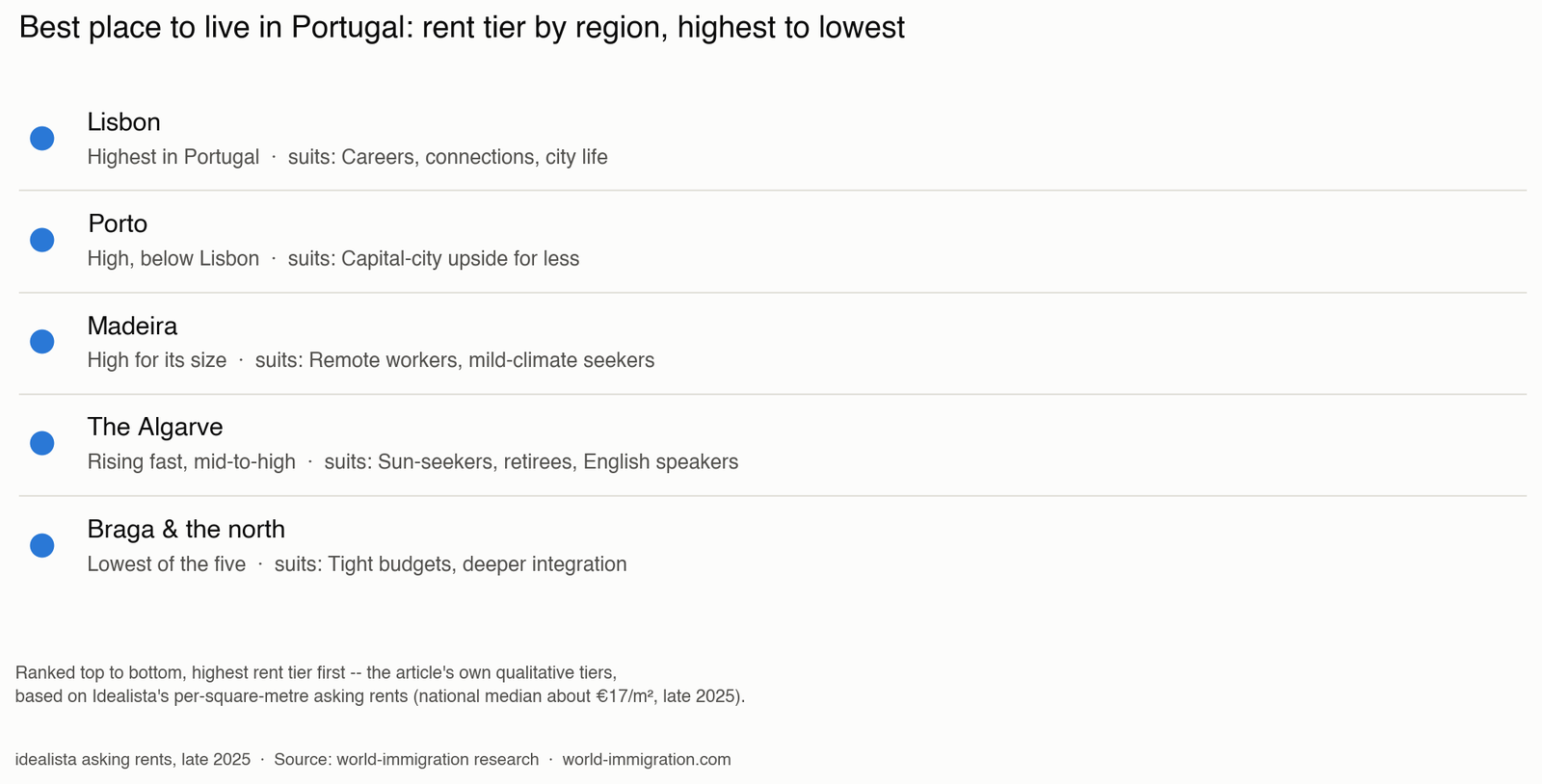
“Here is how the five regions compare at a glance, before the detail on each.” Rent tiers reflect Idealista‘s asking rents per square metre to mid-2026, where the national median sat around €16.3 and had been easing rather than rising; the climate figures are IPMA climate normals.
| Region | Climate | Rent tier | Best suited to |
|---|---|---|---|
| Lisbon | Mild Mediterranean, ~2,800 sun hrs/yr | Highest in Portugal | Careers, connections, city life |
| Porto | Cooler, wet Atlantic, ~1,200mm rain/yr | High, below Lisbon | Capital-city upside for less |
| The Algarve | Hot, dry, 300+ days of sun | Rising fast, mid-to-high | Sun-seekers, retirees, English speakers |
| Braga & the north | Green, cool, wet winters | Lowest of the five | Tight budgets, deeper integration |
| Madeira | Mild subtropical, even year-round | High for its size | Remote workers, mild-climate seekers |
The table sorts the field on climate and cost. The other axis that decides most moves is harder to reduce to a number, the size of the existing foreign community and the pace of daily life, which the chart below captures better than a row of figures.
Lisbon — the default and the most expensive
Lisbon is where most people picture themselves and for concrete reasons. The capital carries the deepest job market, the startup and international-company scene, the international schools and the airport links and it holds by some distance the largest concentration of foreign residents in the country. The climate helps the case, mild and one of the sunniest of any European capital, with roughly 2,800 hours of sun a year (IPMA) and a proper warm season rather than a brief one.
The catch is cost and it is not a small one. Lisbon carries the highest rents in Portugal by a clear margin, with asking rents around €21.8 per square metre against a national median of €16.3 as of mid-2026, even though Lisbon’s own rents have actually been easing slightly rather than climbing further over the past year (Idealista). People who have made the move flag a gap the brochures gloss over, that salaries in Portugal are low by Western-European standards while Lisbon’s housing has run away, so the affordability that draws people to the country is thinnest exactly where they are most likely to land first.
The other recurring complaints are overtourism, the crowding and noise in the central districts and older apartments that can be humid and hard to heat. My read is that Lisbon rewards people who need what only a capital offers and disappoints those who came chasing a cheaper, slower life and assumed the capital would supply it. If it is your pick, Cost of Living in Lisbon carries the neighbourhood-level numbers and Renting in Portugal covers the deposits and paperwork that trip newcomers up.
Porto — most of the upside, for less
Porto is the standard answer for people who want much of what Lisbon offers without the top-tier price. It is the country’s second city, with a proper job market, a growing international scene and a character many find warmer and more grounded than the capital’s. Rents sit meaningfully below Lisbon, around €16.4 per square metre as of mid-2026 and falling faster year-on-year than any other major city (Idealista) and the wider cost of living tracks a notch lower too.
The trade-off is written into the weather. Porto is cooler than Lisbon and considerably wetter, with annual rainfall above 1,200 millimetres against London’s roughly 600 millimetres a year (IPMA). The point long-term residents raise most is not the rain itself but the housing, much of the northern building stock lacks central heating and proper insulation, so the damp winter months from November to March are felt indoors as well as out.
It is an adjustment for anyone arriving from a colder country expecting Portugal to mean warmth. Porto drew the same investor and remote-worker pressure that pushed rents up across the country in earlier years, but its rents have since fallen faster than Lisbon’s, so the discount has actually widened rather than narrowed over the past year (Idealista). The way I would frame it, Porto suits someone who wants a proper Portuguese city on a smaller budget and can live with grey winters and a jumper indoors.
The Algarve — sun and community, on a seasonal clock
The Algarve is the south coast and it is where the sun lives. According to IPMA climate data, the region gets over 300 days of it a year, the driest and warmest climate of the five and it holds the country’s most established English-speaking community, built over decades largely from British and other northern-European retirees. In the tourist towns you can get by in English almost entirely, a substantial part of the draw for people who want a soft landing.
That community is still growing fast: according to INE data for end of 2025, both Lagos and Tavira now have foreign nationals making up more than 30% of the population, among the highest shares of any municipality in the country.
Two limits shape whether it suits you. The first is seasonality, which residents describe as a structural problem, not a mood. The coastal towns are loud and crowded from June to September, then empty out and go quiet through the winter, with reduced transport and services in the smaller places.
The second is work, since the economy leans on tourism and agriculture and year-round employment is scarce, which is why the Algarve suits retirees and remote workers far better than anyone needing a local salary. Rents in Algarve towns like Faro have kept climbing even as the rest of the country cools, up more than 11 percent in the year to mid-2026 while Lisbon and Porto’s rents were both falling (Idealista). Even within the pro-Algarve camp there is disagreement about which towns work, with quieter picks like Tavira, Faro and Carvoeiro favoured over the busier Albufeira and Portimão for staying livable out of season.
Braga and the north — the value end, if you will learn the language
Braga and the interior north are where the sums change. This is the affordable end of Portugal, with city rents around a third of Lisbon’s in places and interior municipalities cheaper still (Idealista). Braga itself is a working city of just over 200,000 people (203,519 at the end of 2024, per INE), mostly local rather than expat, where settlers describe a couple living comfortably on a fraction of what the coast demands. The climate is green and temperate, which is the polite way of saying it rains and the north shares Porto’s damp, under-heated winters.
The defining feature here is not cost but language. English is not widely spoken, particularly among older residents and everyday tasks like a doctor’s appointment or a utility problem become harder without Portuguese. Some guides go further and list the deep interior and parts of the Alentejo as places to avoid unless you are ready for full immersion.
I would put it differently. That same absence of an English-speaking cushion is what pushes people to learn the language and integrate and settlers in the north describe a harder first year that pays off in a life that feels rooted rather than lived inside a bubble. If your budget is tight and you will do that work, the north is the strongest value on this list. If you want to arrive into a ready-made English-speaking scene, it is not.
Madeira — mild year-round, with the island catch
Madeira is the outlier, a volcanic island out in the Atlantic with a climate few places can match, mild and remarkably even all year, sitting around 20°C with the narrowest seasonal swing of anywhere here (IPMA). Funchal, the capital, has drawn a growing remote-work crowd since the regional government and Startup Madeira set up a purpose-built digital-nomad village at Ponta do Sol in 2021 (Digital Nomads Madeira Islands) and for someone whose income arrives online it offers a compelling mix of warmth, scenery and a small community of others doing the same thing.
The island itself is the limit, in two ways. The first is isolation. Amenities and nightlife are modest, the social scene is small and some residents describe a cabin-fever effect over time.
The second is easy to miss until you are living it. Madeira’s airport is exposed to high winds and flights are cancelled, delayed or diverted often enough that reliable travel on and off the island cannot be assumed, with most routes needing a connection anyway.
Housing costs are high for the island’s size, pushed up by the logistics of supplying a remote place. My read is that Madeira rewards people who want a quiet, mild-climate base and treat the outside world as optional and frustrates anyone who needs to travel at short notice or wants a city’s range of things to do.
The bureaucracy applies wherever you land
One thing does not vary by region, so set expectations on it before you fall for a coastline. Portugal’s immigration system has been under heavy strain. The old service, SEF, was dissolved in late October 2023 and its work handed to a new agency, AIMA, which inherited a large backlog of pending cases; by June 2026 the government reported AIMA had issued decisions on more than 525,000 files, though scheduling and processing can still run for months (The Portugal News).
Residents and new arrivals through 2025 and 2026 have reported long waits for first biometric appointments and for physical residence cards, with the agency hard to reach in between. None of this is a reason not to move, but it is a reason to budget time and patience into the plan.
The tax picture has shifted too. The Non-Habitual Resident regime, the tax break that drew a lot of foreign residents for a decade, closed to new applicants from 1 January 2024 under that year’s state budget law (Lei n.º 82/2023, de 29 de dezembro), with a transitional window for people who already had ties to Portugal that itself shut on 31 March 2025.
Its replacement, IFICI, regulated by Portaria n.º 352/2024/1, is far narrower and aimed at specific high-skill research and innovation fields rather than a broad expat incentive, so treat older articles that lean on the old NHR benefits as out of date. Living in Portugal goes further into the day-to-day of settling in once the paperwork is behind you.
A short decision framework
If the profiles above have not already pointed you somewhere, this is the quick version. Start from the priority that matters most and follow it.
- If you want the widest job market, international schools and connections, and can absorb the country’s highest rents, Lisbon is the answer.
- If you want most of the capital’s upside for meaningfully less, and grey, wet winters do not put you off, look at Porto.
- If sun and an established English-speaking community matter most, and you can plan around the tourist season, the Algarve fits and I would lean toward the quieter towns like Tavira or Faro over the busiest resorts.
- If your budget is tight and you are ready to learn Portuguese, Braga and the interior north give you the most life for the money and the deepest integration.
- If a mild year-round climate and a remote-work base appeal more than nightlife or easy travel, Madeira is worth a look, with the island’s flight disruptions factored into the decision.
What this comparison cannot do
This is an orientation piece and it has limits: solid for narrowing a shortlist, poor for telling you how a particular street will feel on a wet Tuesday in February. No article substitutes for spending a couple of weeks in the two or three regions that appeal, ideally out of the tourist season, when the coastal towns show their quieter side and the northern damp is at its most obvious.
The figures move as well. Rents have shifted direction within the past year (up in the Algarve, down in Lisbon and Porto), national house prices rose 17.6% in 2025, the steepest annual rise INE has recorded since it began tracking the index in 2009 (INE) and immigration processing times shift month to month. Treat what is here as a current map rather than a permanent one and verify the specifics that will affect your budget and your visa before you sign a lease or ship your life across the world.
Frequently asked questions
What is the best place to live in Portugal for expats?
There is no single answer, because the best place depends on what you are optimising for. Lisbon wins on jobs, schools and connections if you can absorb the highest rents. Porto offers much of that for less, with wetter winters. The Algarve is the pick for sun and an established English-speaking community, provided you can live with a seasonal economy. Braga and the north are the value end for anyone willing to learn Portuguese and Madeira suits remote workers who want a mild, quiet island base. Start from your climate and budget priorities and the shortlist follows.
Where is the cheapest place to live in Portugal?
The interior and the north are consistently the most affordable. Braga and inland cities carry rents around a third of Lisbon’s in places (Idealista) and the cheapest municipalities of all sit in the interior, well below the coastal and capital markets. The trade for those lower costs is less English spoken, a smaller foreign community and, in the north, damp winters in housing that often lacks central heating. Lisbon and the Algarve sit at the expensive end, with the Algarve’s rents rising fastest of anywhere.
Is Lisbon or Porto better to live in?
They answer different needs. Lisbon has the larger job market, the deeper international scene, more sun and the country’s best air links, at the country’s highest cost. Porto delivers much of the same city life for meaningfully less, with a character many find more grounded, but it is cooler and considerably wetter and its older housing is harder to keep warm through the winter. If you need the widest professional opportunity, Lisbon. If you want a proper city on a gentler budget and can handle the weather, Porto.
Where do most expats live in Portugal?
The largest and longest-established foreign communities are in the Algarve, built over decades mainly around retirees and in Lisbon, which holds the biggest overall concentration of foreign residents. Porto has a growing international scene and Madeira has drawn a newer remote-work community around its digital-nomad village. The interior and the north have far fewer foreign residents, which is part of their appeal for some people and a drawback for anyone who wants a ready-made community on arrival.
Sources
- Instituto Nacional de Estatística (INE) — resident population, foreign-national share and House Price Index. ine.pt
- Idealista — Portuguese rental price reports, to mid-2026 (asking rents per square metre by city and municipality). idealista.pt
- Agência para a Integração, Migrações e Asilo (AIMA) — Portugal’s immigration agency, successor to SEF. aima.gov.pt
- The Portugal News — June 2026 government update on AIMA’s backlog clearance. theportugalnews.com
- Diário da República — Lei n.º 82/2023, de 29 de dezembro (2024 state budget law closing the NHR regime to new applicants) and Portaria n.º 352/2024/1 (the IFICI/”NHR 2.0″ regulation). diariodarepublica.pt
- IPMA (Instituto Português do Mar e da Atmosfera) — climate normals for temperature, rainfall and sunshine hours. ipma.pt
- Digital Nomads Madeira Islands (Startup Madeira / Regional Government of Madeira) — the Ponta do Sol digital-nomad village. digitalnomads.startupmadeira.eu
- Numbeo — cost-of-living and rent indices by city (crowd-sourced, used here for relative comparison only). numbeo.com

