
Most people planning a move to Lisbon arrive with a single figure in their head and it is usually the wrong one for them. It came from a video shot a few years ago, or a forum post about a room in a suburb they would never actually choose, or a friend who left before the market moved.
That is the problem behind the question, what is the cost of living in Lisbon? The city has pulled away from the rest of Portugal quickly enough that even fairly recent numbers understate it and the gap between its cheapest and most expensive neighbourhoods is wide enough to change the whole answer.
Our national guide, Cost of Living in Portugal: A 2026 Budget Guide, sets the countrywide picture and the wider Moving to Portugal hub covers the visas and the practical side of the move. This article does the more focussed investigation. It stays inside Lisbon and its commuter belt and looks at how far your budget shifts once you decide where to live.
I have tried to be clear throughout about where each number comes from and how much weight it carries.
The cost of living in Lisbon isn’t the national average and the gap is large
Before any neighbourhood detail, one point frames everything else. Lisbon costs far more than Portugal as a whole and the clearest evidence sits in the official rental data. Portugal’s national statistics institute, the INE (Instituto Nacional de Estatística), reports the median rent on new lease contracts. INE paused this release between October 2025 and June 2026 for a methodology update; in its first release since, covering the first quarter of 2026, the national median was €9.46 per square metre, up 9.1 percent on the same quarter a year earlier.
For the municipality of Lisbon it was €17.42 per square metre, the highest of any Portuguese city of its size and close to double the national figure. Even the wider Greater Lisbon region (INE’s Grande Lisboa sub-region) sat at €14.38 per square metre, roughly 52 percent above the national median.
Two things about that INE figure matter for planning. It measures new contracts, so it reflects what you would pay signing a lease today rather than what long-settled tenants pay. And INE suspended this release entirely between October 2025 and June 2026 for a methodology update; Q1 2026 is the first quarter published since and it is still the latest as this guide goes out. Even that has a lag built in, so treat it as a firm floor that has likely risen since. A separate figure circulating online, that Lisbon is “34 percent above the national average”, could not be traced to any stated calculation, so I have left it out in favour of the INE comparison.
Rent varies more by neighbourhood than most people expect
Rent is where a single Lisbon average becomes close to useless. The crowd-sourced site Numbeo, in its July 2026 update, puts a one-bedroom flat in the city centre at about €1,432 a month and one outside the centre at roughly €1,077.
The property portal idealista‘s asking-rent index sits near €22 per square metre city-wide, which works out to a typical one-bedroom (T1) around €1,350 a month and a two-bedroom (T2) closer to €1,850. Those are starting points. The freguesia (the civil parish, Lisbon’s neighbourhood unit) you choose pulls you a long way either side of them and the figures below are drawn from idealista’s per-parish index unless noted.
The historic centre — Alfama, Baixa, Chiado, Príncipe Real
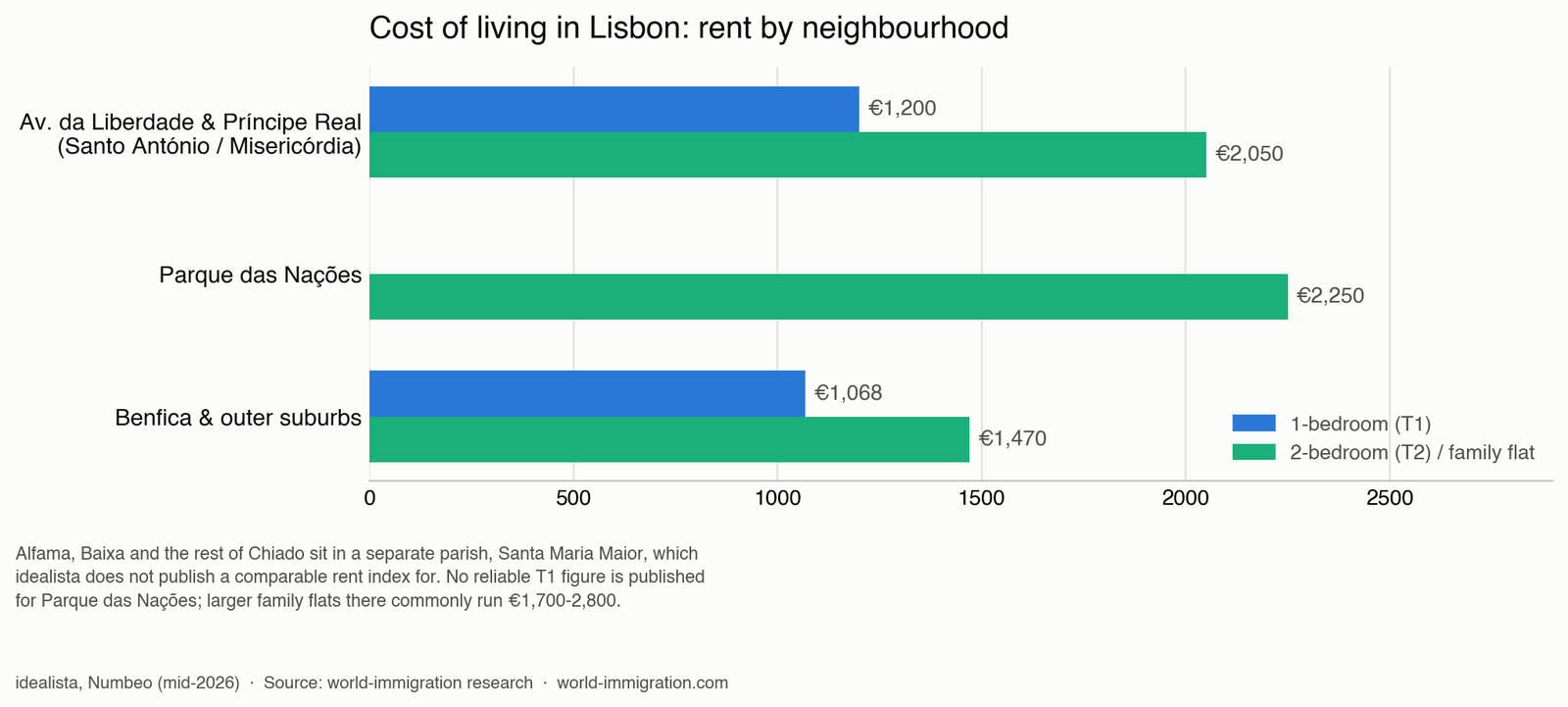
This is the Lisbon of the postcards and it is priced accordingly — though the numbers below actually describe the parishes just west and north of Alfama and Baixa, not those two neighbourhoods directly. Santo António, which covers Avenida da Liberdade, Marquês de Pombal and Rato and Misericórdia, which covers Príncipe Real, Bairro Alto and part of Chiado, top idealista’s table at around €27.2 and €25.0 per square metre in mid-2026, with the Avenida da Liberdade strip itself running higher again near €29.9.
Alfama, Baixa and the rest of Chiado actually sit in a separate parish, Santa Maria Maior, for which idealista does not publish a comparable rent index — treat it as commanding a similar or higher premium by reputation, without a clean figure to cite. In practice a small T1 across this broader central band lands around €1,150 to €1,250 a month and a T2 comfortably above €2,000. You are paying for walkability, the trams and the river views.
You are also buying into the noisiest, most tourist-dense part of the city, where short-term holiday lets compete for the same buildings and thin out long-term supply. If quiet matters to you, this is the trade-off to weigh hardest.
Parque das Nações — modern, family-friendly, priced for it
Built for Expo ’98 on the eastern riverfront, Parque das Nações is the anti-Alfama: wide pavements, new towers, a marina, good schools and easy metro access. It draws families and remote workers who want space and modern fittings over old-town character.
Reliable per-parish figures here are harder to pin down than for the centre, but idealista and Numbeo listings put larger flats commonly in a family band of roughly €1,700 to €2,800 a month. Treat that as indicative rather than precise, since the published data for this specific area is thinner. The direction is clear enough: a mid-to-upper tier, not a budget option.
Benfica and the outer suburbs — where the averages ease
Head away from the river and rent drops. Benfica sits around €17.5 per square metre on idealista’s index and the cheapest parishes inside the city proper, Santa Clara at about €15.3 and Lumiar near €16.6, come in well under the city-wide rate. These are residential, metro-connected districts with everyday shops and fewer tourists.
You give up the old-town character and pick up more floor space for the money, along with a shorter list of Airbnb-driven price pressure. For a longer stay on a steadier budget, this band is where I would start looking and the mechanics of signing a lease here are covered in Renting in Portugal.
Across the river and along the line — Almada, Cascais, Oeiras
The commuter belt splits sharply on price. Almada, directly across the Tagus and a short ferry or bridge from the centre, is one of the cheaper options on idealista’s municipality index, at roughly €15.5 per square metre. Oeiras, on the coastal line west of the city, sits near €17. Cascais, at the end of that same line, breaks the pattern: despite being a suburb, at around €20.2 per square metre it carries a seaside premium that rivals inner Lisbon.
The pattern is that distance from the centre lowers rent, but proximity to the Atlantic coast pushes it back up. Where a commuter town sits on that grid decides whether it saves you money or simply moves your spending from rent to the train. For the full weigh-up of which town suits which kind of life, see Best Place to Live in Portugal.
Everyday costs — groceries, utilities, eating out
Away from rent, Lisbon is more affordable than its housing suggests, which is much of its appeal. Numbeo’s July 2026 figures put a single person’s monthly spending excluding rent at about €756. Groceries for one, cooking most meals, land between €280 and €400 depending on how much you lean on imported goods.
According to Numbeo, basic utilities for a mid-sized flat (electricity, water, gas and rubbish) run around €150 a month, with home internet adding roughly €30 and a mobile plan near €16. A meal at an inexpensive restaurant sits about €15 and the lunchtime prato do dia often comes in under that.
One caveat on utilities. Lisbon’s mild climate keeps bills below a city that runs air conditioning year-round, but summers have grown hot enough that cooling is no longer optional for many and the older stone buildings of the centre can be cold and damp in winter with little insulation. Budget headroom for the July-August and January spikes rather than assuming the flat €150 holds every month.
Getting around — the Navegante pass
Public transport is one of Lisbon’s clearest bargains and the pricing has an unusual feature: according to Navegante, the monthly passes have not risen in seven years. The Navegante Municipal pass, covering the metro, buses, trams and funiculars inside Lisbon, is €30 a month.
The Navegante Metropolitano pass, which extends across all 18 municipalities of the metropolitan area (Cascais, Sintra, Almada, Oeiras and the rest included), is €40. That second figure is the one commuter-town residents care about, because it turns a Cascais or Almada train into a fixed monthly cost rather than a per-trip drain. Travel is free for under-23s and €20 a month for over-65s.
Single fares are a different story and they did move at the start of 2026 even as the passes held. According to Metropolitano de Lisboa, a pay-as-you-go metro trip on a loaded Navegante card (“zapping”) is €1.72, a contactless bank-card tap is €1.92 and a single bus ticket bought on board from Carris rose to €2.30. A 24-hour combined ticket is €7.25.
The physical card itself, a reusable smartcard now branded Navegante (it was called Lisboa Viva until a 2021 rebrand, a name you will still see in older guides), costs €7. My read is that if you are staying more than a couple of weeks, the monthly pass pays for itself almost immediately and removes any need to think about individual fares.
A monthly budget for Lisbon
The table below is my own estimate for 2026, built from the figures above rather than lifted from any single source. It assumes a comfortable but not lavish life in a mid-range neighbourhood such as Benfica or the edge of Parque das Nações, with a private health top-up and a fair amount of eating out. Someone happy in a cheaper outer parish, cooking at home, could sit under it; anyone set on a furnished flat in Chiado or Príncipe Real will run well above it, almost entirely on rent.
| Monthly expense (EUR) | Single person | Couple |
|---|---|---|
| Rent (mid-range T1 / T2) | €1,100 | €1,500 |
| Utilities (power, water, gas, rubbish) | €150 | €180 |
| Home internet | €30 | €30 |
| Groceries | €320 | €520 |
| Dining out & entertainment | €200 | €350 |
| Transport (Navegante pass) | €40 | €80 |
| Mobile phone | €16 | €32 |
| Private health top-up | €50 | €100 |
| Approximate total | €1,906 | €2,792 |
These land in the same territory as the aggregators. Numbeo’s own figures imply a single person spending roughly €1,830 to €2,190 a month including rent, depending on whether the flat is central and independent expat guides cluster around €1,900. A Numbeo-derived estimate puts a couple’s non-rent spending near €1,325, which sits close to the total above once a two-bedroom rent is added. None of these are precise. Use them as a planning band, then check the range against actual listings.
The trade-off nobody escapes — commute, price, or tourism
Every neighbourhood choice in Lisbon resolves to the same three-way tension and no option gives you all of it. Live in the historic centre and you get walkability and atmosphere, but you pay the highest rent and share your street with rolling suitcases and holiday lets.
Move out to Benfica, Lumiar or across to Almada and the rent eases and the streets quieten, but you take on a daily commute. Choose a coastal town like Cascais and you get the beach and the space, but the seaside premium can cancel the saving you came for and you are then reliant on the train.
People who have made the move tend to report that Lisbon takes time to reveal itself, that the first six months feel more expensive and more touristy than the version that settles in once you know your own neighbourhood.
Several also note that Porto, further north, runs cheaper for a similar quality of life, a fair point to hold if a specific Lisbon address is not what is drawing you. The way I would approach it is to decide which of the three you are least willing to compromise on (budget, commute, or being in the thick of it) and let that pick the neighbourhood, rather than starting from a rent figure alone.
What these numbers can’t tell you
Every figure here is a range, not a fixed index and there are a few reasons to hold them loosely.
- The official data lags. INE’s rent figures are the most authoritative source here, but the series was suspended between October 2025 and June 2026 for a methodology update and the latest quarter published since it resumed is Q1 2026. Lisbon rents have very likely kept climbing since, so the neighbourhood figures may already trail the live market. Check ine.pt and idealista for a newer quarter before you commit.
- Some of it is crowd-sourced. Numbeo’s cost figures are self-reported and drift week to week; two snapshots weeks apart disagreed on utilities by around a quarter. Cite them as an estimate band with a date attached, not as a settled price.
- Parque das Nações and the old core are the softest figures. Clean per-parish T1 and T2 averages were hardest to retrieve for exactly these areas, so treat those two as indicative and verify against live listings.
- Short lets skew the headline. Much of the historic centre’s stock is tied up in holiday rental, which inflates the visible asking prices and shrinks the long-term supply. What a resident actually signs for can differ from the tourist-facing numbers.
- For the specific parish you settle on, a week of watching current listings will beat any national average, including this one.
None of these figures mean much without something to weigh them against. For what a local salary actually buys in Lisbon versus a foreign or remote income, see Average Salary in Portugal.
Frequently asked questions
How much does it cost to live in Lisbon per month?
For a comfortable mid-range life in 2026, budget around €1,900 a month for a single person including rent and roughly €2,700 to €2,800 for a couple. Cooking at home in an outer parish brings that down; a furnished flat in the historic centre pushes it up, almost entirely through rent. Numbeo and independent expat guides land in the same band.
Is Lisbon expensive compared to the rest of Portugal?
Yes, markedly so on housing. Official INE data for the first quarter of 2026 put the median new-lease rent in the municipality of Lisbon at €17.42 per square metre against a national median of €9.46, close to double. Greater Lisbon as a whole sat about 52 percent above the national figure. Everyday costs like food and transport are closer to the national norm; it is rent that opens the gap.
Which Lisbon neighbourhoods are cheapest to live in?
Inside the city, idealista’s index puts the parishes of Santa Clara and Lumiar and the district of Benfica below the city-wide average, at roughly €15 to €18 per square metre. Across the river, Almada is cheaper again. Cascais is the trap: it is a suburb but carries a coastal premium that rivals central Lisbon, so distance from the centre does not always mean a saving.
How much is a monthly transport pass in Lisbon?
The Navegante Municipal pass, covering all public transport inside Lisbon, is €30 a month. The Navegante Metropolitano pass, valid across all 18 municipalities of the metropolitan area including Cascais and Almada, is €40. Both have been held at the same price for seven years. Travel is free for under-23s and €20 a month for over-65s.
Sources
- Instituto Nacional de Estatística (INE) — median rent on new lease contracts, Q1 2026 (published June 2026, after the series resumed): ine.pt
- idealista — Lisbon rental price index and neighbourhood report, 2026: idealista.pt
- Numbeo — Cost of Living in Lisbon (updated July 2026): numbeo.com
- Navegante — 2026 pass pricing announcement: navegante.pt
- Metropolitano de Lisboa — fares and Navegante card: metrolisboa.pt
- Carris — 2026 prices table: carris.pt

