
Most people searching for the best countries to move to already know they want to leave. The question that matters is which place will actually work for someone like them — not for a hypothetical skilled worker in their thirties with no dependants and a tech salary, but for their specific job, family situation and tolerance for cold winters or paperwork. That question does not have a ranking. It has trade-offs and most articles that promise a ranking are averaging across people with nothing in common.
I’ve lived in New Zealand my whole life, so I’ll be more direct about this country than the others. For the rest, I’m drawing on official government sources, current housing and salary data and a broad base of community reports from people who made the move.
The best countries to move to: visa eligibility narrows the field
Before lifestyle preferences matter, the visa pathway has to exist. This is what people planning a move discover too late: the destination they want may only want a very specific version of them. Getting clear on eligibility early prevents a lot of wasted research. The six countries below each have an accessible route for skilled workers, remote workers, or those with family connections — but the thresholds vary significantly.
| Country | Primary route | Key threshold (2026) | Language required? |
|---|---|---|---|
| New Zealand | Skilled Migrant Category / Green List | SMC: NZD $35/hr (ANZSCO 1–3) or $52.50 (4–5); AEWV: market rate (no median floor from March 2025) | English (implicit) |
| Australia | Skilled Nominated (190) / Skills in Demand (482) | 65 points minimum; state nomination | English (tested) |
| Canada | Express Entry | CRS points; ~109,000 Express Entry admissions targeted 2026 (380,000 total PR target) | English or French (tested) |
| Germany | EU Blue Card | €50,700/yr gross; €45,934 for shortage occupations | Not for application; practical need |
| Portugal | D8 Digital Nomad / D7 Passive Income | €3,680/month (D8); ~€820/month (D7) | Not for application; A2 for citizenship |
| Ireland | Critical Skills Employment Permit | €40,904/yr (listed roles); €68,911 (unlisted) | English (de facto) |
Thresholds current mid-2026. Official sources for each country are listed at the bottom of this article.
New Zealand: the candid case for and against
New Zealand has concrete quality-of-life advantages and a reputation it hasn’t fully earned. Growing up here, I took for granted the space, the coastline and mountains within an hour of any major city and the general sense of physical safety. Speaking to people who arrived from the UK or Europe, one of the things they mention is how much the isolation costs them emotionally before it costs them financially. The flight from Auckland to London is roughly 24 hours; a return economy ticket runs NZD $2,500–$5,000. For anyone with elderly parents or close family in the Northern Hemisphere, that is a recurring, expensive reality, not an abstract fact.
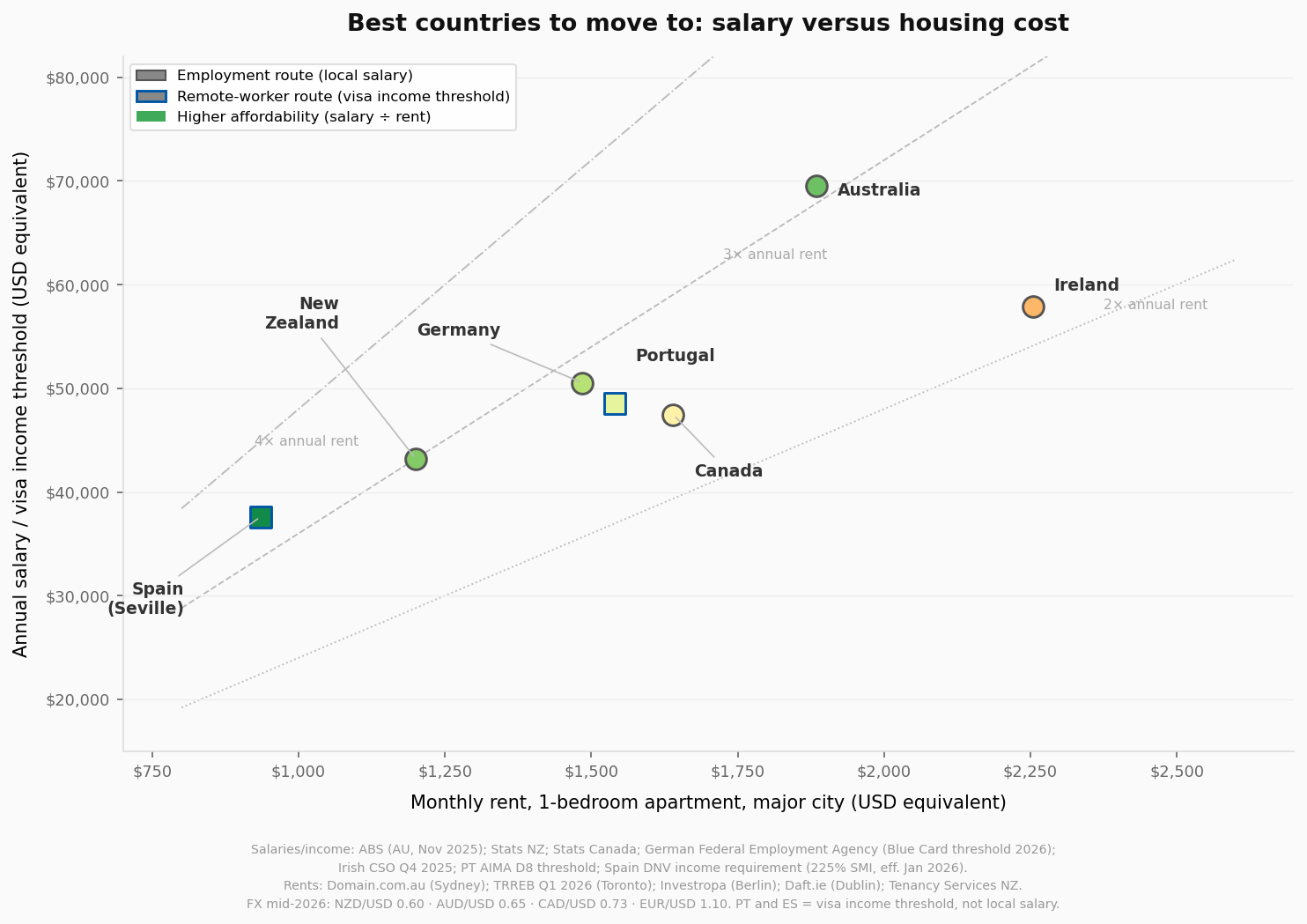
The financial picture is more complicated than the popular version. The median hourly wage is NZD $35.00 as of 2026, per Immigration New Zealand’s own benchmarks. The median annual earnings for a full-time employee are approximately NZD $72,000 (Statistics NZ, December 2025 quarter). Auckland’s median house price sits at approximately NZD $1.01 million; a one-bedroom apartment rents for roughly NZD $460–$470 per week. The “affordable Pacific” narrative is a decade out of date for anyone moving to a main centre — for a full breakdown of what day-to-day spending looks like, see our cost of living in New Zealand guide. Community reports from expat forums consistently note that New Zealand wages fall well below Australia, the UK and the United States, while housing and imported goods costs sit at or above many European cities.
The visa pathway has become more selective. The Skilled Migrant Category requires an accredited employer offering at least NZD $35.00 per hour for ANZSCO Levels 1–3 roles, or $52.50 for Levels 4–5. The Green List (205 occupations) offers faster routes: Tier 1 covers straight-to-residence for registered nurses, GPs, civil engineers and certain ICT roles. Those ICT roles require 200–208% of the median wage — roughly NZD $70–$72 per hour. An age cap of 55 applies. The authoritative list is at immigration.govt.nz. Our guide to New Zealand visa options covers all current pathways in detail.
New Zealand suits people who want to be here, not people for whom it is the path of least resistance. If the outdoors lifestyle, physical space and a stable anglophone society matter more than salary maximisation or European proximity, this is a strong choice — our full guide to whether New Zealand suits you goes deeper on those trade-offs. If wages and European accessibility are priorities, the data points elsewhere. If you’ve already decided, our complete guide to moving to New Zealand covers what comes next.
As we’ve covered in our article on renting in New Zealand, housing insulation is an adjustment, but one of the more counterintuitive differences for people arriving from Latin America or Southern Europe is the near-total absence of window bars. In those countries, security grilles are standard — in New Zealand they essentially do not exist. I’ve encountered them perhaps twice in my whole life. This is not neglect or naivety; it reflects how low the residential crime rate is.
New Zealand is safe and I say that having lived here my whole life. The one street I’d flag as an outlier is Karangahape Road in central Auckland — not for physical danger (by international standards I’d still call it safe and I’d walk it without hesitation at any hour) but for a visible public behaviour problem concentrated in one part of the street. Even then, it is a disorder issue more than a violence issue and it is the single exception in an otherwise very safe country.
Australia: higher wages, similar trade-offs
Australia is the obvious comparison for New Zealand and the numbers favour it on income. The average full-time salary is approximately AUD $107,000 (ABS, November 2025), compared to NZD $72,000 across the Tasman. Expat forums consistently report that people move from New Zealand to Australia when salary matters. The pattern is well-established enough that it has its own label in New Zealand public discourse.
The visa route is more elaborate. The Skilled Nominated visa (Subclass 190) offers permanent residence through a points test — 65 points minimum, plus state nomination worth an additional five points. Around 33,000 of these visas are available in 2025–26. The Skills in Demand visa (Subclass 482) is temporary for up to four years, with a path to permanent residence after two years with the same employer. High-demand occupations include healthcare, cybersecurity, renewable energy engineering and construction trades.
Medicare covers citizens and permanent residents. (New Zealand has its own publicly funded system — see our guide to healthcare in New Zealand for expats.) Temporary visa holders in their first years typically fall outside Medicare and need Overseas Visitor Health Cover — from approximately AUD $60–$80 per month for a basic plan, depending on age and provider. Out-of-pocket costs within Medicare are rising even for those covered; this is a documented policy concern. Housing costs in the major cities are comparable to New Zealand: Sydney’s median house price is approximately AUD $1.6 million (CoreLogic, mid-2026), Melbourne’s around AUD $980,000.
Australia suits people who want anglophone Pacific life with stronger wages and a larger labour market. The main friction points are a visa process that takes time to navigate and major-city housing costs that are not fundamentally better than New Zealand’s.
Canada: good immigration system, difficult housing market
Canada’s Express Entry system is often described as one of the most rational immigration programmes in the world and structurally that is fair. The Comprehensive Ranking System is transparent, the country targets 380,000 new permanent residents per year and settlement infrastructure — translation services, employment programmes, integration support — is funded at over a billion dollars annually. For a family relocating without strong English, this matters.
The problem is housing in Toronto and Vancouver. Those two metro areas contain roughly 25% of Canada’s population. Community reports from 2023 describe non-condominium homes under CAD $1 million as essentially unavailable in both cities. A thread on an expat forum read: “The cost of life is absurd, with respect to income. In Vancouver or Toronto, rents are completely out of control.” That view was consistent across multiple separate posts from people in different situations. Healthcare is universal for citizens and permanent residents, but provincial wait times in 2025 averaged 28.6 weeks between GP referral and specialist treatment, per the Fraser Institute.
Canada suits people whose destination is a regional city — Calgary, Edmonton, Halifax — rather than the two major metros, or those with family reunification needs the well-funded system can support. For those set on Toronto or Vancouver with ambitions of home ownership, the financial picture is hard to make work at immigrant entry-level wages.
Germany: the most underrated route for skilled workers
Germany is underrated in English-language discussion partly because the language barrier is assumed to be prohibitive. It is not, for the Blue Card route. There is no German language requirement for the application and many tech and finance roles in Berlin, Frankfurt and Munich operate in English. The assumption that Germany requires German fluency to enter is the most common misconception about this destination.
The EU Blue Card requires a recognised university degree and a gross salary of at least €50,700 per year in 2026 — reduced to €45,934 for shortage occupations including STEM, healthcare and IT. Citizens of Australia, New Zealand, Canada and the United States can enter Germany without a visa and apply for the Blue Card in-country. The Opportunity Card (Chancenkarte), a job-seeker visa that launched in June 2024, allows entry without a job offer for up to 12 months.
The language situation is more nuanced in practice. Community reports confirm that English-only employment is viable in Berlin’s startup sector and international companies — some environments have few German staff and operate entirely in English. Outside that bubble, German B2 or C1 becomes necessary for career progression in most other sectors. Degree recognition is a friction point: overseas qualifications must be validated through the Anabin database and those not listed require evaluation by the Central Office for Foreign Education (ZAB), which can take months. For spouses joining on a non-Blue-Card route, a German A1 certificate is required before a visa is granted; Blue Card holders’ spouses are exempt.
Germany suits skilled workers in STEM, ICT, engineering and healthcare who want EU membership, strong labour protections (six weeks statutory leave is standard) and quality public infrastructure and who are willing to invest in language over time. It is not a good fit for people who need English to remain viable indefinitely.
Portugal and Spain: the remote-work destinations
Portugal and Spain suit people who earn in a stronger currency and want to live in southern Europe. Both are better understood as lifestyle destinations for remote workers and passive-income retirees than as employment-immigration destinations in the traditional sense.
Portugal’s D8 Digital Nomad Visa requires monthly income of at least €3,680 from remote work outside Portugal. A first dependent adds 50% to that threshold; each additional dependent adds 30%. The path to citizenship is ten years of legal residence plus an A2 Portuguese language test — reduced to seven years for nationals of Portuguese-speaking countries (CPLP Mobility Agreement). Note: this extended timeline was enacted by the Portuguese Parliament in April 2026, up from the previous five-year requirement; confirm current status before applying. Portugal is no longer cheap in its major cities: Lisbon one-bedroom rents average €1,400 per month as of mid-2026; Porto runs €800–€1,000. Rent now represents 40–50% of a local family’s income in Lisbon and the community tension around this is well documented. The old Non-Habitual Resident tax regime that drew high-income expats from 2013 to 2023 is closed; the replacement IFICI scheme has different terms that require independent verification.
Spain’s Digital Nomad Visa requires approximately €2,849 per month (225% of Spain’s 2026 minimum wage, updated January 2026), with similar employment and qualification requirements. One-bedroom rents in Madrid and Barcelona run €1,400–€1,800 per month in city centres; Seville remains considerably cheaper at €800–€900, while Valencia and Malaga have seen sharper rises — one-bedroom rents in those cities now average closer to €1,200–€1,500. Spanish is effectively mandatory outside the tech hubs of the two major cities — integration for non-speakers is harder than the straightforward visa process suggests.
Both destinations suit remote workers who earn comfortably above the income threshold and either speak the language already or plan to learn it. They are poor fits for people at the income threshold rather than above it, or for those who need to find local employment without existing language skills. For a broader comparison of European living costs, including lower-cost alternatives to both countries, see our guide to the cheapest countries to live in Europe.
Ireland: English in the EU, with a severe housing problem
Ireland is the only English-speaking country in the European Union, which gives it a distinctive pull for anglophone non-EU nationals who want EU membership without a language barrier. The Critical Skills Employment Permit, updated from 1 March 2026, covers ICT, engineering, healthcare and financial services at a salary threshold of €40,904 for listed roles and €68,911 for unlisted roles. Google, Meta, Apple and Microsoft all have major Dublin operations and the permit process for those sectors is well understood.
The housing situation is severe. Available rental listings nationally fell below 1,800 in February 2026 — down 22% year-on-year. Dublin one-bedroom rents average approximately €2,000–€2,100 per month (Daft.ie Q1 2026). Rents are roughly 80% higher than a decade ago and 34% above pre-Covid levels. Ireland’s Department of Finance projects the housing crisis to last another 15 years. This is structural, not transient. Practical advice from expat forums: secure employment first, because a job offer significantly simplifies the housing search. Temporary accommodation and a PPS number before approaching landlords is effectively mandatory.
Ireland suits skilled workers in the Critical Skills sectors who want an English-speaking EU base and have the financial buffer to absorb Dublin-level housing costs during the establishment period. It is a poor fit for anyone arriving without a job offer.
What this cannot tell you
This article covers the structural picture behind the best countries to move to: visa thresholds, housing costs, wage benchmarks and the broad population each country tends to suit. It cannot tell you whether a specific employer will recognise your overseas qualifications, how quickly a particular visa will process given your individual circumstances, or what the tax implications of your income structure will be in a given jurisdiction. Tax and immigration law interact in ways that are specific to individuals and both change frequently. The figures here are drawn from government sources current to mid-2026, but visa thresholds, salary requirements and intake targets are adjusted annually.
It also cannot tell you how you will feel about isolation, language immersion, or leaving family. Those things matter enormously and are not predictable from data. The people I have seen make the most successful moves are the ones who were straight with themselves about what they were giving up, not only what they were gaining.
Frequently asked questions
Q: Which country is easiest to immigrate to as a skilled worker?
‘Easiest’ depends on your occupation, salary and nationality. Germany’s EU Blue Card is straightforward for degree-holders in STEM, healthcare and ICT and citizens of Australia, New Zealand, Canada and the United States can apply in-country without an embassy visa process. New Zealand’s Green List offers direct-to-residence for specific roles including registered nurses and civil engineers. For remote workers with sufficient income, Portugal and Spain’s nomad visas are accessible without an employer. The field narrows quickly once you apply your actual occupation and salary to each country’s specific thresholds — that exercise is more useful than any general ranking.
Q: Is New Zealand or Australia better for immigrants?
Australia has higher average wages — roughly AUD $107,000 versus NZD $72,000 — and a larger labour market. Both countries have elevated housing costs in their major cities. New Zealand offers a smaller, quieter lifestyle with specific natural-environment advantages. The consistent pattern in community reports is that people choose New Zealand when lifestyle and environment matter most and move to Australia when salary is the priority — see our guide to working in New Zealand for a full breakdown of the job market and salary ranges. For anyone weighing both, the practical question is usually which destination has a job offer on the table and which pathway clears their specific occupation at their current salary level.
Q: Which country offers the best quality of life for immigrants in 2025?
The World Happiness Report 2025 places Australia at eleventh globally. Germany consistently ranks high on indices weighting labour protections, healthcare and public infrastructure — six weeks statutory leave and compulsory health insurance are standard. New Zealand performs well on safety and natural environment but lower on wages relative to cost. The most useful framing is that “quality of life” means different things depending on your priorities: if outdoor space and anglophone culture matter most, New Zealand or Australia score well; if labour protections and EU mobility are the priority, Germany scores well; if climate and southern-European lifestyle in a lower-cost environment matter most, Portugal or Spain are the relevant comparison. The best destination is the one that matches your actual priorities, not a composite average of everyone else’s.
Sources and further reading
Official visa and immigration portals
- Immigration New Zealand — Green List occupations
- Immigration New Zealand — Skilled Migrant Category Resident Visa
- Australia — Skilled Nominated visa (Subclass 190)
- Australia — Skills in Demand visa (Subclass 482)
- Immigration, Refugees and Citizenship Canada — Express Entry
- Make it in Germany — EU Blue Card
- Germany Opportunity Card (Chancenkarte) — official information
- AIMA — Agency for Integration, Migration and Asylum (Portugal)
- Ireland — Critical Skills Employment Permit
Data and reports cited
- Stats NZ — Income and earnings data
- REINZ — New Zealand residential property data
- Australian Bureau of Statistics — Average Weekly Earnings
- Fraser Institute — Waiting Your Turn: Wait Times for Health Care in Canada
- World Happiness Report 2025
- Daft.ie Rental Report Q1 2026 (Ireland)

