
Moving to Colombia is one of those decisions that looks simple from a distance and gets more interesting the closer you get. I know this because I am partway through it myself. I keep a second home in Colombia, I have spent roughly six months there in total across visits, I have travelled to a few of the neighbouring South American countries and I am planning an extended stay of eighteen months to two years, partly to properly learn Spanish. So this cluster of articles is not detached content produced from a desk on the other side of the world. It is the research I am doing for my own move, written down as I go.
That framing matters, because most of what you read about moving to Colombia falls into one of two camps. There is the promotional version, where the country is cheap, warm and welcoming and nothing ever goes wrong. And there is the fearful version, which is usually written by people who have never been. The truth I have found sits in between and it is more useful than either. Colombia rewards patience and punishes assumptions. This overview is the map. The dedicated articles linked throughout go deeper into each part than a hub piece sensibly can.
Colombia at a glance
Before anything else, a quick-reference for the basics. Treat these as orientation, not the last word and I will come back to why that caveat matters more in Colombia than in most places.
| Population | Around 53 million (2026 estimate, DANE) |
| Capital | Bogotá (elevation about 2,640 m, Wikipedia) |
| Official language | Spanish (several indigenous and Creole languages are co-official regionally, Constitución Política de Colombia, Art. 10) |
| Currency | Colombian peso (COP) |
| Climate | Sitting near the equator, Colombia has no fixed seasons. Climate is set by altitude. Bogotá is cool and mountainous, Medellín mild year-round (the “eternal spring”) and the Caribbean coast around Cartagena is hot and humid. |
| Main visa routes | Three letter-categories, set out in Resolución 5477 de 2022: V (Visitor, includes the Digital Nomad and passive-income Rentista visas), M (Migrant, the settling-in category with the pension, marriage/family, sponsored-work and investment routes) and R (Resident, the long-term route). |
What moving to Colombia is actually like
The single thing I wish someone had told me at the start is that Colombia is not one country in the way a newcomer imagines. The regional differences are extreme and they catch people off guard. Cartagena and Bogotá are barely an hour apart by air and they may as well be different nations. The climate is different, the accent and everyday vocabulary are different, the pace is different and the attitude to a stranger is different. People who move expecting one national culture spend their first months quietly recalibrating.
Official information in Colombia is often unreliable too and not in a way that resolves with a little more reading. It shows up in different forms depending on who you ask. Long-term expat forums are full of people comparing notes on government websites that are out of date or contradict themselves, professionals who disagree with each other on the same tax or visa question and front-line staff who state something with total confidence only for a supervisor to overturn it later. The pattern has held for years, not a one-off run of bad luck: complaints about it turn up in threads years apart, from conflicting visa-income thresholds to confusion during the 2020 lockdowns to blanket tax notices sent to people who turned out not to owe anything. This is not corruption or malice so much as a system where the authoritative source is unsettled.
The practical response is the same one experienced expats arrive at. Verify anything that matters through several independent sources. Expect to redo paperwork. Never treat a first answer as final, especially a reassuring one. And apply an extra layer of scepticism to the regional angle, because a rule enforced strictly in one city is sometimes waved through in another. Once you stop expecting the tidiness of a Northern European bureaucracy, the friction becomes something to plan around rather than something that ruins your week.
The clearest version of this I have hit myself is not government paperwork but the everyday equivalent of it, a mobile phone plan. On more than one visit my monthly data allowance has run out before the month did, sometimes alongside a text asking me to confirm my IMEI number for reasons I never got a straight answer on, mixed in with the usual advertising. I needed a lot of data too, because you burn through far more of it working things out for yourself when you do not yet speak the language. Guests at my own wedding, confident they could sort it faster than I could, ran into exactly the same wall and found out I had not been exaggerating. The fix was always some combination of resetting the plan, topping up again, or giving up and switching providers outright. Going into a shop in person meant a long queue followed by a flat denial that the problem could exist, even with the phone in my hand showing it had already stopped working. Smaller stakes than a visa, but the same pattern — a confident answer that does not survive contact with what is actually happening on the device in front of you.
The visa landscape, at a glance
Colombia sorts its visas into three letter-categories. Get your category right first — the detail follows.
- V, the Visitor category. Temporary stays. It is home to the Digital Nomad visa aimed at remote workers and freelancers earning from outside Colombia and, since the 2022 restructure, the passive-income Rentista route too (an older classification still gets this wrong on some sites — Rentista used to be a Migrant visa and no longer is). It is the obvious route if you are keeping an overseas job or client base, or living on investment income without settling permanently and the category also covers short-term study via the Colombia Student Visa. None of it leads to residency on its own.
- M, the Migrant category. The settling-in tier. It holds the pension-based route (often called pensionado), routes tied to marriage or a Colombian partner or family member, sponsored work and property or business investment (the transaction side of buying is covered separately in Buying Property in Colombia). Most people intending to actually live in Colombia and to have that time count toward residency, land here.
- R, the Resident category. The long-term destination, usually reached after holding an M visa for a set period, five years on the standard track under Resolución 5477 de 2022. That period is faster for a marriage-based visa or a Colombian parent or child than for most other routes; the de facto partner version of the family route and the investment routes get no such discount and still need the full five years. Longer validity, fewer restrictions on time spent out of the country.
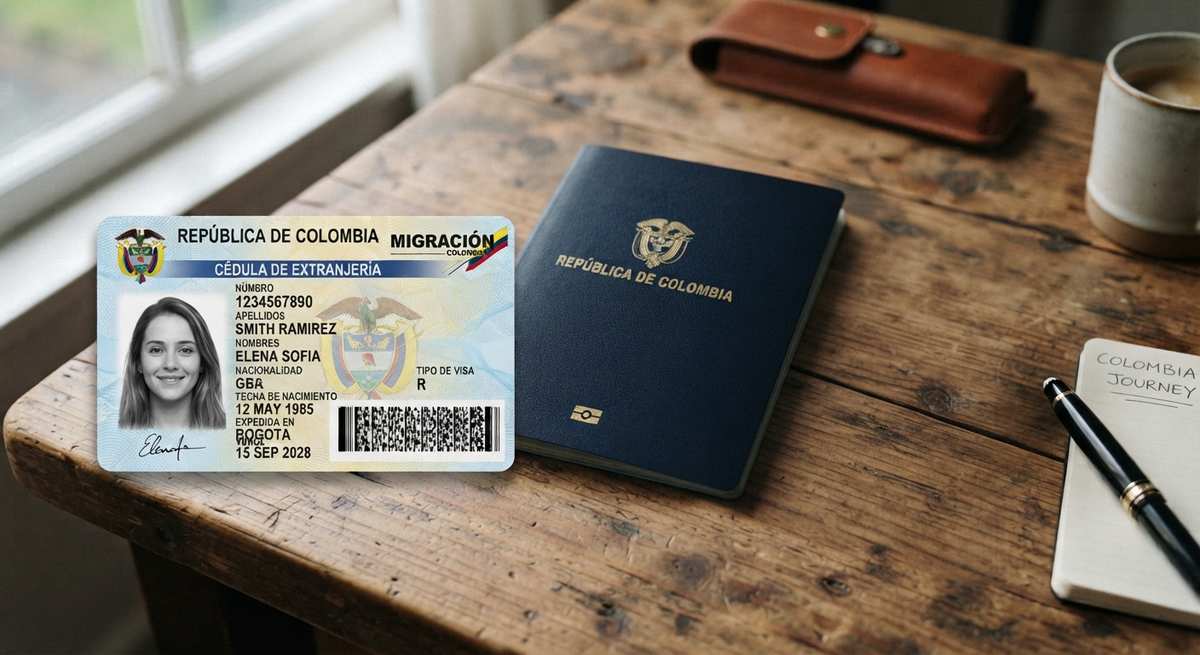
Three routes cover most readers of this site, so don’t assume you’re stuck with the one that gets talked about most before checking the other two. If you work remotely, Colombia’s Digital Nomad Visa is where to start. If you are moving on a pension or investment income, Retiring in Colombia is the one to read. And if you are married to, or in a long-term registered partnership with, a Colombian national, the Cónyuge/Compañero permanente visa deserves equal billing: unlike the other two it carries no income test at all. The marriage half of it also reaches permanent residency faster than almost any other route; the de facto partner version, somewhat unsurprisingly, does not get that same discount and needs the standard full term instead, a distinction the dedicated guide covers properly. Sponsored-work, investor and parent-of-a-Colombian-child routes exist too, for a smaller number of readers. I have kept the mechanics, income thresholds and paperwork out of this overview on purpose, because they change and because a dedicated visa-by-visa guide is where that detail belongs.
Where to live
Which city to settle in is the question newcomers ask most, usually before they have even arrived and it is a meaningful decision rather than a formality. The regional diversity that makes Colombia interesting also makes this choice consequential. A short orientation, then pointers to the articles that actually weigh it up.
- Medellín is the expat hub and the mild year-round climate is a large part of why. It is where the newcomer infrastructure is thickest and where a lot of remote workers cluster.
- Bogotá is the capital and the centre of the job market and business life. It is cooler, bigger and more of a working city than a lifestyle one, which suits some people and not others.
- Cartagena and the Caribbean coast offer a different pace entirely, hot and unhurried, with the trade-off that the heat and humidity are constant rather than a season you wait out.
I am not going to adjudicate the choice here, because it depends heavily on what you want and it deserves more than a paragraph. Best Place to Live in Colombia is the dedicated comparison, walking through the trade-offs across the main cities and if Medellín is already on your shortlist, Living in Medellín goes further into daily life there than I can in an overview.
What it costs
The affordability is a big part of why people move. But “cheap” is a blunt word that hides a lot of variation between cities, neighbourhoods and lifestyles and imported goods and comforts can cost more than you would expect. Exact prices shift year to year, so take this as a flavour rather than a fixed figure: I’ve found IT equipment to run around 10% more expensive than in New Zealand, including Apple products, despite Colombia’s closer proximity to the United States. The full breakdown of everyday costs lives in Cost of Living in Colombia, with a closer look in Cost of Living in Medellín for those weighing that city specifically.
Cost only makes sense next to income, so if you are considering local work rather than an overseas salary, the picture of typical Colombian earnings is the other half of the equation, covered in Average Salary in Colombia. For most foreigners the arithmetic that matters is an income earned abroad set against Colombian prices, which is exactly why the country appeals to remote workers and retirees.
Healthcare
Healthcare is a common surprise, in the good direction. Colombia’s system is generally well regarded, private care is affordable by the standards most newcomers are used to and the larger cities have well-equipped hospitals. The detail that trips people up is how the public and private options fit together, what a visa requires of you and how insurance works for a foreigner. That is a whole topic in itself and Healthcare in Colombia for Expats covers it properly.
Practical things that come up early
A few logistics surface almost immediately, before the bigger settling-in questions, so plan for them early.
- Banking. What to do with your existing overseas bank accounts and cards is one of the first practical puzzles. Many people keep an account back home running for a while rather than cutting ties straight away and work out local banking once they have the residency documents that make it easier.
- Ship or start fresh. Whether to ship a household of belongings or sell up and start over is a fork in the road. A striking number of people who have made the move chose to start fresh rather than pay to freight furniture across the world and were glad of it. The maths and the hassle both tend to favour travelling light. Even sending something small carries its own costs and customs surprises, which I have written up separately in why sending a parcel to Colombia costs more than you think.
- Language. Spanish ability shapes daily life more than almost anything else. People who arrive with only a few phrases describe far more friction in ordinary tasks than those who can hold a conversation. You do not need fluency to begin, but the gap between “no Spanish” and “some Spanish” is the difference between a hard first few months and a manageable one. It is a large part of why I am planning my own stay around learning the language properly rather than getting by.
The limits of an overview
A hub article like this can orient you, but it cannot make the decision for you and it would be doing you a disservice to pretend otherwise. My standing here is substantive but partial. I have a home in Colombia and time on the ground and I am careful to write from what I have actually seen rather than imply more.
Colombia rewards patience. The bureaucracy is inconsistent, the regional variety is pronounced and disorienting at first and the gap between the dream you arrive with and the country you actually meet is where most of the early disappointment lives. Pace of life is where I have felt this most directly. In Santa Marta I sat through a long wait for what should have been straightforward hospital attention and New Zealanders I know who have settled there describe the same unhurried rhythm as a kind of island time, easy to enjoy on a two-week holiday and harder to live inside day after day. Some people adapt to it without much trouble. Others find it wears on them long after the initial charm does, so be candid with yourself about which one you are before you commit to a place on the strength of a short visit. The dedicated articles in this cluster on cities, costs, visas and healthcare go deeper than this overview can and they are where I would send you next once you have decided the country is worth a closer look.
Frequently asked questions
Is it easy to move to Colombia?
Easier than many countries in terms of the visa routes on offer and the cost of living lowers the barrier further. The friction is not usually the visa itself, it is the inconsistent bureaucracy around it, the paperwork that has to be redone and the adjustment to a country that varies enormously region to region. Straightforward to start, patience required to finish.
What do I need to move to Colombia?
At minimum, the right visa for your situation (the V category for remote workers or passive investment income, or an M route such as the pension, marriage, or sponsored-work visa for those settling permanently), proof of the income, funds or relationship that route requires and a plan for healthcare cover. Practically, you also want a view on which city suits you, some Spanish and a decision on what to do with your existing bank accounts and belongings. Each of those has its own article in this cluster.
Is Colombia a good country to live in as a foreigner?
For a lot of people, yes, which is why the expat communities in Medellín and elsewhere keep growing. The climate options, the affordability, the healthcare and the pace of life are the draws. Set against that: the bureaucracy, the language barrier if you do not address it and the need to pick a region that fits you. It suits people who can hold a plan loosely and adapt and frustrates those who need everything to work the way it does back home.
Sources
- DANE (Departamento Administrativo Nacional de Estadística), Colombia population projections: dane.gov.co
- Resolución 5477 de 2022, Ministerio de Relaciones Exteriores (the visa-category restructure this cluster refers to throughout, including the three letter-categories and the five-year standard track to the R visa): official text
- Constitución Política de Colombia, Artículo 10 (official language and regional co-official languages): secretariasenado.gov.co
- Bogotá elevation (2,640 m): Wikipedia

