
Ask about a “Colombia work visa” and you can mean three quite different things, which is where most of the confusion starts. There is the visa for someone employed by a Colombian company. There is the Digital Nomad visa for someone who works remotely for a client or employer outside Colombia. And there is the working-holiday route that a lot of people assume every country offers, which Colombia does not run at all — it is not among the categories on Cancillería’s own list of visa types. They have different income tests, different paperwork and only one of them puts a Colombian employer on the hook for your application.
This guide is about the first of those: the employer-sponsored work visa, often called a Colombia work permit and formally the M visa in the “Trabajador” (worker) sub-category, set out in Resolución 5477 of 2022. If you have a job offer from a company registered in Colombia and you will be on their payroll, this is your route. If you are paid by a company outside Colombia, it almost certainly is not and I have flagged where you should be reading a different page instead.
Colombia work permit: what the M-Trabajador visa actually is
The M family is Colombia’s “Migrant” tier, the middle band between the short-stay V (Visitor) visas and the long-term R (Resident) visa. The Trabajador sub-category sits inside it and is built for one specific situation: a foreigner who will be employed by a Colombian-registered business. Not self-employed. Not paid by a foreign client. Not a business owner drawing income from their own Colombian company (that is a separate M sub-category, which I cover briefly further down). An actual employee, with a Colombian employer signing the contract. (Cancillería’s own classification of visa types sets out the V/M/R structure this way.)
That employer relationship is the defining feature of this visa and it shapes everything else: the paperwork, the financial tests and the single biggest pitfall, which is that the visa is tied to that one job. More on that below.
The sponsor’s income test: a company or an individual, not a fixed worker salary
One thing needs correcting up front, because it circulates as fact when it is not quite right: there is no fixed minimum salary a foreign worker has to earn to qualify for this visa. Colombian immigration tests your sponsor’s income, not yours and the multiple depends on what kind of sponsor is hiring you, per the Cancillería’s own M-Trabajador visa requirements.
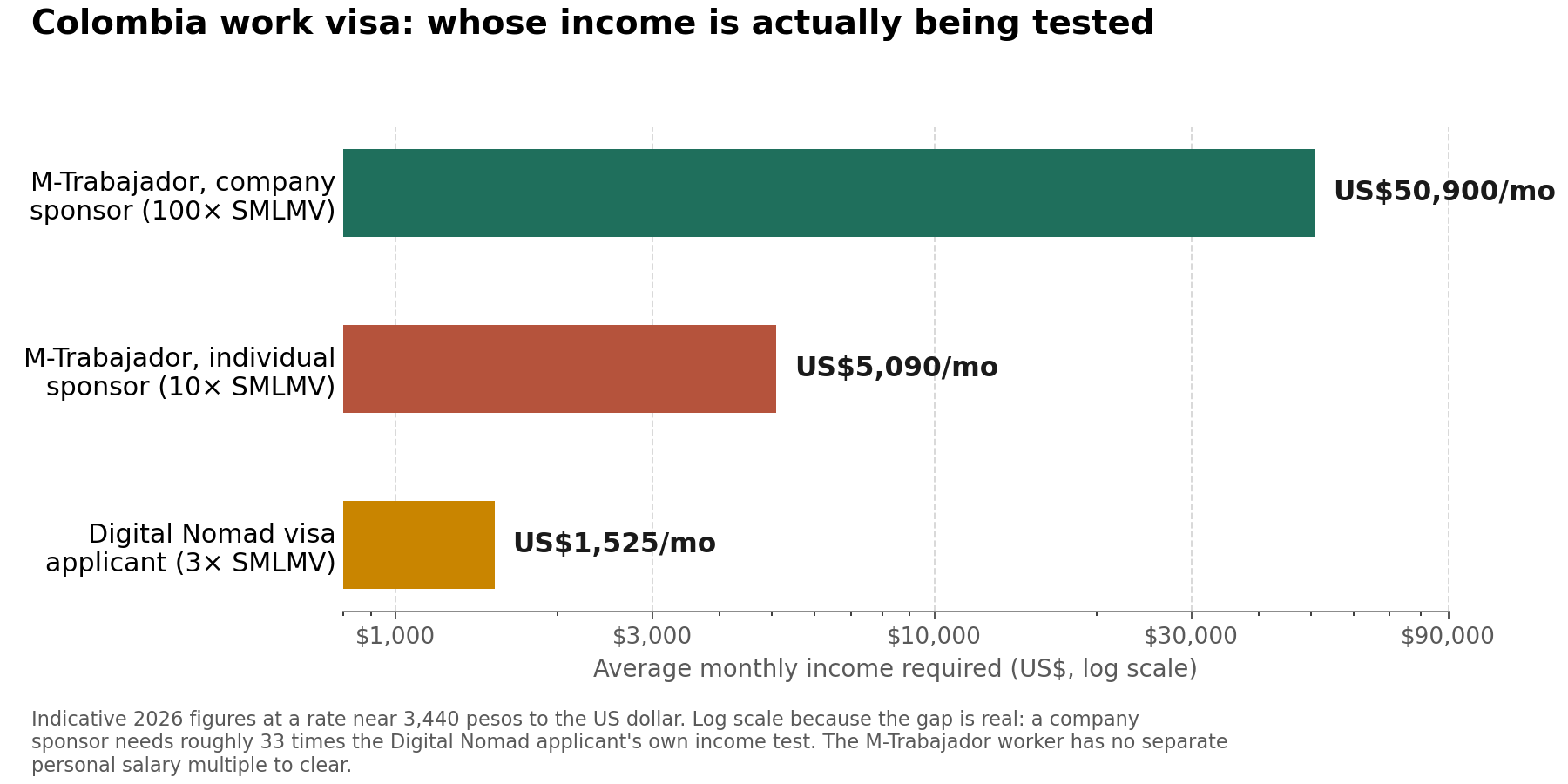
Colombia sorts sponsors into two kinds. A registered company (a legal entity) has to show average monthly income of at least one hundred times the SMLMV over the last four months of bank statements. An individual employer (a natural person hiring you directly, rather than through a company) faces a lower bar: ten times the SMLMV over the same four months (per Cancillería’s own M-Trabajador visa requirements). For 2026 that is roughly COP $175,090,500 a month for a company sponsor, or COP $17,509,050 a month for an individual one, both against 2026’s SMLMV of COP $1,750,905. At the current exchange rate of roughly 3,250 to 3,300 pesos to the US dollar — the peso hit a multi-year high against the dollar in July 2026, per the Banco de la República’s daily TRM — those work out to roughly US$53,000 and US$5,300 a month respectively. Exchange rates move, so treat the dollar figures as a guide and the peso figures as the ones that count.
Your own salary sits outside both of those figures. A visa officer checks that it fits the role and covers a reasonable cost of living in Colombia, but there is no separate multiple you personally have to clear. Sponsor income and worker salary are different tests and they get blurred across a lot of guides online, so I have corrected it here rather than repeat it. For what employers here typically pay and how that compares to the multiples above, see Average Salary in Colombia.
One caveat on the minimum-wage figure itself. The 2026 number went through a legal wobble early in the year (the original wage decree was provisionally suspended by the Consejo de Estado over a technical justification issue and a transitional decree kept the same figures in force), as Holland & Knight reported at the time. It is the same situation I walk through in the retiring in Colombia guide, so I will not re-run the whole saga here. The figures above are the ones in force.
The employer’s side (the part people miss)
Here is where the Trabajador visa stops looking like a form you fill in and starts looking like something your employer has to earn. Colombia does not simply rubber-stamp a foreign hire. The sponsoring company carries much of the weight in this application and if they have not done this before, walking them through it early saves time later. Beyond the income test above, the company’s requirements typically include the following, per Cancillería’s M-Trabajador visa page and the practitioner detail in Colombian Passport’s worker-visa guide.
- Proof it is a legitimate registered business. A Certificate of Legal Existence and Representation from the Cámara de Comercio (Chamber of Commerce), confirming the company genuinely exists and who is authorised to sign for it.
- A motivation letter. The employer writes to explain the role: your duties and why you suit them, your training and qualifications, why the position is not being filled by a Colombian and how many direct jobs the company creates. That third point is a soft labour-market-test element. It is not as demanding as the formal labour tests some countries run, but it means the company has to make a case, not just name a salary.
- A contract summary form. Signed by the company’s legal representative and by you, stating job title, duties, salary, hours, work location and contract duration.
- Your professional qualifications. For an unregulated profession, an apostilled or legalised and translated diploma, or proof of relevant work experience and training. For a regulated profession (the fields with a professional council, such as medicine, law or engineering), both you and the hiring company need the relevant permit from Colombia’s professional council for that field. That second requirement is easy to miss, because it puts a burden on the employer as well as the applicant.
- Standard admin. A passport with at least six months’ validity and a passport photo.
The practical read on all this: the quality of your application depends heavily on your employer being an established, well-documented Colombian company that is willing to do its part properly. If the job offer is from a tiny startup or a barely-trading entity, the 100× income test and the motivation letter are where things tend to come unstuck.
Fees and the process
The application goes through the Cancillería’s online visa portal (the Ministry of Foreign Affairs). There are two charges, at two stages.
- A study fee of around COP $207,900 (about US$52), paid when you submit, whether or not the visa is granted, per the Cancillería’s 2026 visa costs schedule.
- An issuance fee if the visa is approved. For an M visa this is higher than for a V visa, in the region of US$230 to US$270 for the M against roughly US$170 to US$235 for a V. Nationality can affect the exact figure, so check the official costs page for yours.
On timing, the study period is up to 30 calendar days (Article 13 of Resolución 5477, which replaced an older five-business-day rule). It can be faster, but plan around the 30-day ceiling rather than hoping for a quick turnaround.
Once the visa is granted there is a step that is easy to overlook and carries a penalty: you have to register with Migración Colombia for your Cédula de Extranjería (foreigner’s ID card) within 15 calendar days of the visa being issued, per Decreto 1067 de 2015‘s registration rule for foreigners. This is the standard rule across the M visas. There is a fine for missing the window and the exact amount is disputed across the sources I have seen, so I will not quote a precise figure. It is material, not trivial and the clock is short. I would put the appointment in the diary the day the visa lands.
The catch that matters most: the visa is tied to your employer
The M-Trabajador visa is granted for up to three years, or for a shorter period if your employment contract itself is shorter, per Cancillería’s M-Trabajador page. But the length is not the thing to watch. The thing to watch is that the visa is bound to that specific employer.
If you leave the job, whether you resign or you are let go, you lose the right to work more or less immediately. The visa does not travel with you to a new company. A new job means a new offer and, in most cases, a fresh visa application from the start. There is a visa-transfer procedure for narrower changes, such as a change in your job duties within the same employer, but moving to a different employer generally means beginning again. That changes how much weight you should put on the stability of the offer and it is the thing to understand before you sign.
I would treat this visa as a commitment to an employer as much as to a country. If there is any doubt about how long the role or the company will last, that doubt is also a doubt about your immigration status.
The residency track: five years to the R visa
The Trabajador visa can lead to permanent residency, but on the standard M-visa timeline, which is slower than some people expect. You need to hold the M-Trabajador visa continuously for five years, spending no more than 180 consecutive days out of Colombia in any single year of that period, before you become eligible for the R (Resident) visa (Resolución 5477 provides that an M visa is automatically extinguished after 180 continuous days abroad within any 365-day period; the five-year qualifying term is set out on Cancillería’s Visa R por tiempo acumulado page). Moving up to the R visa is done through a mandatory visa-transfer procedure, which has to be completed before the M visa expires.
This five-year clock is the ordinary M-visa path, not a shortcut. It is not the faster two-to-three-year track that applies specifically to the marriage route and the parent-of-a-Colombian-child route, which are different visas covered elsewhere. If you have read that residency in Colombia can take two or three years, that figure belongs to those family routes, not to employment.
How this differs from the other “work” visas
This is the distinction that sends most people to the wrong visa, so here it is in full.
It is not the Digital Nomad visa
The Colombia Digital Nomad visa is a V-family (Visitor) visa for people who work remotely for a client or employer outside Colombia. It is a different product entirely. There is no Colombian company sponsoring you, so there is no motivation letter and no labour-market-test element. The income test is only three times the minimum wage (around US$1,600 a month at current exchange rates, far below the Trabajador visa’s ten times) and it does not lead to residency at all. If you will keep working for a company that is not in Colombia, that is your visa and this page is not.
| M-Trabajador (work visa) | Digital Nomad (V visa) | |
|---|---|---|
| Who pays you | A Colombian-registered employer | A client or employer outside Colombia |
| Income test | Employer: 100× (company) or 10× (individual sponsor) | Applicant: 3× minimum wage (~US$1,600/mo) |
| Employer sponsorship | Required (letter, 100× income test) | None |
| Maximum validity | Up to 3 years | Up to 2 years |
| Path to residency | Yes, after 5 years | No |
The Digital Nomad validity above is the current headline figure for that visa; I have kept it short because it belongs to the other guide, where the detail lives.
It is not the Profesional Independiente (freelance professional) M visa
There is also a separate M sub-category, the Profesional Independiente (Independent Professional) visa, for someone practising a profession or independent activity in Colombia without an employment relationship — working on their own account rather than on a company’s payroll, per Cancillería’s Profesional Independiente requirements. The line between it and the Trabajador visa is straightforward: the Trabajador visa is for being employed by someone else’s Colombian company and the Profesional Independiente visa is for practising independently, on your own account. If you are working for yourself rather than for an employer, that is the route to look at, not this one.
And it is not a working-holiday visa (Colombia has none)
Colombia does not run a working-holiday scheme; it is not one of the categories on Cancillería’s official list of visa types. There is no reciprocal youth-mobility programme of the kind New Zealand, Australia or Canada offer, where a young person can arrive first and find casual work afterwards. For a younger applicant without a firm job lined up, the closest options are the Digital Nomad visa (if you already work remotely for a foreign employer) or this Trabajador visa (if you can secure a local job offer). Neither gives you the flexibility, or the freedom from an employer tie, that a working-holiday visa would.
Frequently asked questions
Does Colombia have a working holiday visa?
No. Colombia has no working-holiday or youth-mobility scheme comparable to the ones New Zealand, Australia or Canada operate — see Cancillería’s full list of visa types. If you want to work in Colombia, you need either a local job offer (the M-Trabajador visa on this page) or remote income from a foreign employer (the Digital Nomad visa). Both tie you to a defined situation rather than letting you arrive and look for casual work.
I work remotely for a company outside Colombia. Is this my visa?
Almost certainly not. Searches for a “Colombia remote work visa” usually land on the wrong page. If your salary comes from a company that is not registered in Colombia, the route built for you is the Digital Nomad visa, which has a much lower income test and no Colombian sponsor. This Colombia work visa (the M-Trabajador) is only for people employed by a Colombian-registered business.
Do I need a job offer before I apply?
Yes. This visa is built around a specific employer. Much of the application is the company’s to complete, including the motivation letter, the contract summary and its own financial evidence, so there is no way to apply speculatively and find the job later.
Can I change employers on this visa?
Not freely. The visa is tied to the employer who sponsored it. Moving to a different company generally means a new job offer and a fresh visa application. A visa-transfer procedure exists for narrower changes, such as a change in your duties with the same employer, but switching employers is treated as effectively starting again.
How long until I can get residency?
Five years of holding the M-Trabajador visa continuously, without more than 180 consecutive days abroad in any year, before you can move to the R (Resident) visa, per Cancillería’s Visa R por tiempo acumulado route. That is the standard employment timeline. The faster two-to-three-year paths people sometimes read about apply to the marriage and parent-of-a-Colombian routes, not to work.
What this guide can’t settle for you
A few things are outside what a reference page can pin down and naming them beats pretending otherwise.
- The exact fees and exchange rate on the day. Issuance fees vary by nationality and the peso moves. The dollar figures here are for orientation; the official Cancillería costs page is the number that binds.
- The late-registration fine. The 15-day Cédula de Extranjería deadline is firm, but the size of the penalty for missing it is reported inconsistently across sources, so I have not quoted a figure. Register on time and the question does not arise.
- Whether your specific employer qualifies. The 100× minimum-wage income test and the motivation letter turn on the company’s own finances and its case for hiring you. Only the company can confirm it can meet those and a marginal employer is where applications tend to fail.
- Regulated professions. If your field has a Colombian professional council, both you and your employer need its permit and the requirements there are field-specific and beyond a general guide.
For anything that turns on your nationality, your profession or the particular company, the official pages below are the authority and a Colombian immigration lawyer is worth the cost on a visa that ties your right to stay to a single job. For the wider picture of settling in, Moving to Colombia ties this cluster together.
Sources
- Cancillería de Colombia, Temporary Workers Visa: cancilleria.gov.co/en/temporary-workers-visa
- Expat Group, Colombia visa payment: cost, steps and deadlines: expatgroup.co
- Resolución 5477 de 2022, Article 13 (official text, on the 30-day study period): cancilleria.gov.co
- Presidencia de la República, 2026 minimum wage announcement: presidencia.gov.co
- Holland & Knight, on the minimum-wage decree’s legal challenge: hklaw.com
- Colombian Passport, on the M-Trabajador employer requirements: colombianpassport.com/colombian-visas/worker-visa-guide
- Cancillería de Colombia, Visa M Trabajador (official requirements): cancilleria.gov.co/v/trabajador
- Cancillería de Colombia, classes/categories of visas in Colombia (V/M/R structure): cancilleria.gov.co
- Cancillería de Colombia, 2026 visa costs schedule: cancilleria.gov.co/…/visa/costos
- Decreto 1067 de 2015 (foreigner registration and Cédula de Extranjería deadlines): funcionpublica.gov.co
- Cancillería de Colombia, Visa M Profesional Independiente (official requirements): cancilleria.gov.co/v/profesional
- Cancillería de Colombia, Visa R por tiempo acumulado (five-year residency route): cancilleria.gov.co/v/tiempoacumulado
- Cancillería de Colombia, visa transfer (traspaso de visa) procedure: cancilleria.gov.co/traspaso-visa
- Banco de la República, Tasa de Cambio Representativa del Mercado (TRM), used for the peso/dollar conversions on this page: banrep.gov.co
The employer-requirement detail on this page (the motivation letter, the company income test and the professional-council permits) reflects current guidance from Colombian immigration practitioners alongside the official Cancillería requirements. Requirements are updated periodically, so confirm against the Cancillería page before you apply.

