
If you work remotely and you have been eyeing Medellín or Bogotá for a longer stay, the question underneath the daydream is usually a practical one. How do you stay legally for more than the standard tourist window without pretending to be a tourist? The digital nomad visa Colombia offers is the government’s answer, a category created specifically for people who earn their living online from abroad. This is a look at how it works in 2026, who it fits and where the detail still needs checking against the source before you rely on it.
A note on standing first. I have a second home in Colombia and have spent a fair amount of time there, though not the way I have lived in New Zealand. So the mechanics below lean on Colombia’s official visa pages and the DIAN tax authority rather than my memory and I have flagged the points I could not confirm to the letter.
Digital nomad visa Colombia: what it actually is
The visa’s formal name is the Visa V Nómadas Digitales. It is a subcategory of Colombia’s Visitor (V) visa, introduced by Resolution 5477 of 2022 from the Ministry of Foreign Affairs (the Cancillería), which is still the governing rule as far as I could establish in mid-2026. The Cancillería issues the visa; a separate body, Migración Colombia, handles the identity card you register for once you arrive.
It is aimed squarely at remote workers and freelancers whose income comes from outside Colombia. That covers employees of a foreign company working over the internet, independent contractors serving clients abroad and people coming to start a digital or technology venture the government considers of interest to the country, the three categories set out in Resolución 5477 de 2022, Artículo 46. It is not a job-seeker visa and it does not put you into the Colombian labour market. If your plan is to be hired by a Colombian employer or to bill Colombian clients, this is the wrong visa and you would need a work visa instead.
Eligibility: income, foreign source and insurance
Three requirements do most of the work for the Colombia digital nomad visa, all set out in Resolución 5477 de 2022, Artículo 46. You need a passport from a country on Colombia’s short-stay visa-exemption list (most of Europe, North America, Australia, New Zealand and much of Latin America are on it, though the list is updated periodically, so check it directly). You need to prove a minimum monthly income. And you need private health insurance valid in Colombia for the length of your stay.
The income threshold is set at three times Colombia’s monthly minimum wage (Resolución 5477 de 2022, Artículo 46), evidenced by your bank statements for the three months before you apply. In 2026 that works out to roughly COP $5,252,715 a month, three times the COP $1,750,905 minimum wage fixed, on a transitional basis, by Decreto 159 de 2026, or somewhere around USD $1,525 depending on the exchange rate on the day the Cancillería reviews your file. For the fuller picture of what Colombians actually earn, see Average Salary in Colombia. Treat the dollar figure as illustrative rather than fixed. The underlying minimum-wage figure was also under legal challenge in early 2026: Decreto 159 itself states it holds only until the Consejo de Estado rules on the pending nullity action against it, so the exact peso number could still move mid-year. The three-times-minimum-wage rule itself is stable; the peso amount it produces is the part in flux.
The crucial qualifier is where that income comes from. It must be foreign-sourced. The visa authorises remote work for foreign companies and clients and it explicitly does not authorise paid work for a person or company based in Colombia (Resolución 5477 de 2022, Artículo 46). That distinction matters more than the headline number and it is the point people most often get wrong.
On insurance, the policy needs to cover accident, illness, maternity, disability, hospitalisation, death and repatriation for the full period you are requesting (Resolución 5477 de 2022, Artículo 46). I could not confirm a specific minimum coverage sum in the official material, so if a broker quotes you a figure as a hard requirement, verify it against the consulate rather than taking it on trust.
Eligibility at a glance (Resolución 5477 de 2022, Artículo 46)
- Passport from a country on Colombia’s visa-exemption list
- Income of about COP $5.25M a month (three times the minimum wage, ~USD $1,525), shown on three months of statements
- Foreign-sourced income only: a foreign employer, foreign clients, or a qualifying tech venture
- Health insurance valid in Colombia for the whole stay
- A letter from your employer or client, or proof of the business you run
- A motivation letter or business plan only if you are on the entrepreneurship track
Figures current as of mid-2026 and subject to change. Confirm at cancilleria.gov.co before you apply.
How long it lasts and whether it leads anywhere
The visa is granted for up to two years (Resolución 5477 de 2022, Artículo 46). The resolution itself does not spell out a renewal right and consulates appear to apply it inconsistently: some applicants have successfully reapplied for a further term, others have had a renewal refused. According to reporting from immigration consultancy Expat Group, some renewal refusals have cited work that was “not of interest” to Colombia, a phrase the resolution actually reserves for the entrepreneurship track rather than ordinary remote employment, so that qualifier is being applied more broadly in practice than the text itself supports. Either way, two years is generous compared with some nomad visas and long enough to settle into a city rather than treat it as a long holiday.
The point to be clear about is that it does not build toward permanent residency. Colombia’s Visa R “por tiempo acumulado” route only counts time held on Migrant (M) visa categories (Resolución 5477 de 2022, Artículo 90) and the Digital Nomad Visa being a Visitor (V) visa does not accumulate toward that residency clock. If long-term residency is the actual goal, this visa is a comfortable place to spend a couple of years, not the road there. I would plan the next move deliberately rather than assume it quietly converts into something more permanent, because it does not.
How to apply
The application is made online through the Cancillería’s visa portal at tramitesmre.cancilleria.gov.co. You complete the electronic form, upload your documents and the system issues a reference number. You then pay a study fee, the Cancillería reviews the file and if it is approved you pay a separate issuance fee. Colombian consulates abroad process visas through the same national system and if you are already legally in Colombia you can generally apply from inside the country rather than flying out to do it.
The documents the Colombia digital nomad visa needs come down to a handful of things, per Resolución 5477 de 2022, Artículo 46:
- The completed visa application form and a recent colour photo on a white background.
- A passport valid for at least six more months.
- A letter from your foreign employer or client stating the relationship and what you are paid, or proof that you own the business, in Spanish or English.
- Bank statements covering the three months before you apply.
- Your health insurance policy.
- A motivation letter or business plan, if you are applying on the entrepreneurship track.
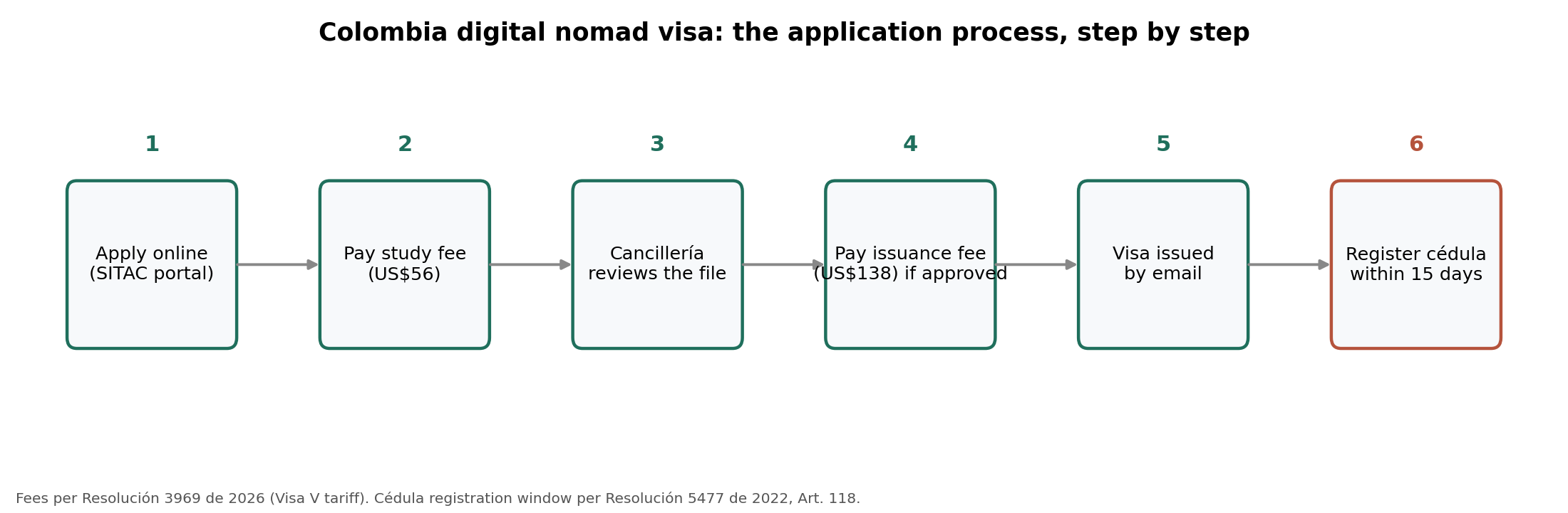
The current official tariff, set by Resolución 3969 of 2026, puts the combined cost of a Visa V, the category the nomad visa sits in, at USD $194: a $56 study fee plus a $138 issuance fee. Older guides still quote roughly $235 to $240, which was the rate through 2025 under the previous tariff and is now out of date. Processing time is harder to pin down. The resolution sets no fixed deadline for the study decision itself, only downstream payment windows once a decision is made, so reported timelines vary widely by consulate, from under two weeks to well over a month if extra documents are requested. Treat any specific week count, including one you read here, as a guide rather than a promise and confirm the current fee at cancilleria.gov.co before you budget around it.
One step trips people up after arrival. Because the visa runs longer than three months, you are required to register for a cédula de extranjería, the foreigner’s identity card, with Migración Colombia. The window is short, fifteen calendar days from when you enter the country or from when the visa is issued (Resolución 5477 de 2022, Artículo 118), so book that appointment early rather than leaving it.
What it does not let you do and the tax question
To restate the limit, the Digital Nomad Visa does not let you work for Colombian employers or take on Colombian clients for pay (Resolución 5477 de 2022, Artículo 46). Your income has to keep coming from abroad. Crossing that line is not a technicality; it is the difference between the visa you hold and a work visa you do not.
One more point and this is not tax advice: Colombian tax residency. Colombia applies a 183-day rule. If you are present for 183 days or more within any rolling 365-day period, you are treated as a tax resident, which can bring your worldwide income into scope for declaration to DIAN, the tax authority. It is a day-count test that applies regardless of visa type and a stay long enough to make the nomad visa worthwhile can easily cross it. Where a tax treaty or foreign tax credit applies there may be relief, but the mechanics get specific quickly. This is the point at which I would stop reading articles and talk to a tax professional who works with expatriates in Colombia.
How it compares to Colombia’s other visa routes
If the nomad visa does not quite fit, two other routes come up often, so know which lane you are in before you apply for the wrong one.
The Pensionado visa is for retirees drawing a pension and it sits in the Migrant (M) category, which means, unlike the nomad visa, time on it does count toward residency (Resolución 5477 de 2022, Artículo 77). The Rentista visa is for people living on stable passive income and requires proof of at least ten times the minimum wage in periodic income, a notably higher bar than the nomad visa’s three times (Resolución 5477 de 2022, Artículo 56). The Rentista sits in the Visitor (V) category under that same 2022 resolution, so like the nomad visa it does not accumulate toward residency, which is a common source of out-of-date advice online. The short version is that the nomad visa is for active remote earners, Pensionado is for pensioners and Rentista is for passive income at a higher threshold.
For a fuller treatment of the retirement routes, see Retiring in Colombia and for the wider picture of settling in the country, Moving to Colombia goes deeper than there is room for here. If you are still weighing whether the income maths works at all, Average Salary in Colombia is the place to start.
The limits of this guide
Two things this article cannot do for you. It cannot promise the figures above are still exact by the time you read it and it cannot stand in for the consulate. Colombia’s visa rules change, the peso amounts are tied to a minimum wage that was itself under legal dispute in 2026 and a few of the numbers here (the fees, the processing time, any insurance minimum) come from practitioner reporting rather than a line I could read directly off the official page. The structure of the visa is stable and well documented. The precise numbers are the part that moves.
So the sensible way to use this is as a map of how the visa works and whether it fits your situation, then to confirm the current requirements and costs directly with the Cancillería at cancilleria.gov.co, a Colombian consulate, or an immigration lawyer before you commit money or a plane ticket to it. That is not a disclaimer for its own sake. It is how I would approach it if I were applying this year.
Frequently asked questions
How much do I need to earn for Colombia’s Digital Nomad Visa?
The requirement is three times Colombia’s monthly minimum wage (Resolución 5477 de 2022, Artículo 46), shown across your last three months of bank statements. In 2026 that is roughly COP $5,252,715 a month, or about USD $1,525 depending on the exchange rate. The dollar figure shifts with the rate and the underlying minimum wage was in legal flux in early 2026, so confirm the current amount before you apply.
Can digital nomads work for Colombian companies on this visa?
No. The visa is for income earned from outside Colombia, whether from a foreign employer or foreign clients. It does not authorise paid work for a person or company based in Colombia (Resolución 5477 de 2022, Artículo 46). Taking on Colombian clients for pay would require a work visa instead.
How long does Colombia’s Digital Nomad Visa last?
It is granted for up to two years (Resolución 5477 de 2022, Artículo 46). The resolution does not spell out a right to renew and consular practice on reapplying for a further term is inconsistent, so do not assume it renews automatically. It does not count toward permanent residency either way, because it belongs to the Visitor (V) visa category rather than the Migrant (M) category that builds toward a Resident visa.
Will I have to pay tax in Colombia as a digital nomad?
Possibly. Colombia treats anyone present for 183 days or more within a rolling 365-day period as a tax resident, which can bring worldwide income into scope (DIAN, Concepto General 9079 de 2023). This applies regardless of visa type, so a long stay can trigger it. The specifics depend on treaties and credits, so this is a question for a tax professional who works with expatriates, not one to settle from an article.
Sources
- The Digital Nomad Visa’s legal basis, income test, insurance requirement and two-year validity (Resolución 5477 de 2022, Artículo 46), the Pensionado and Rentista visas (Artículos 77 and 56) and the Visa R “por tiempo acumulado” residency route (Artículo 90): SUIN-Juriscol, official compilation.
- The current visa fee tariff, USD $194 total for a Visa V (Resolución 3969 de 2026): Cancillería, official text.
- The 15-day cédula de extranjería registration window and its non-exemption for nomad-visa holders (Resolución 5477 de 2022, Artículo 118): SUIN-Juriscol, official compilation.
- The 2026 minimum wage of COP $1,750,905, fixed on a transitional basis pending a Consejo de Estado ruling (Decreto 159 de 2026): Cancillería, official text.
- The 183-day tax residency rule and its application to digital nomads regardless of visa type (DIAN Concepto General 9079 de 2023): DIAN, official concept.
- Reporting on renewal refusals citing work “not of interest” to Colombia being applied beyond the entrepreneurship track: Expat Group, “Visa Rejections Alert”.

