
Ask what the average salary in Colombia is and you will get a dozen confident answers, most of them wrong in some way. It sounds like a simple question and turns out to be awkward to answer well. Part of the difficulty is the income spread: a small number of professionals in Bogotá or Medellín earn many times what most of the country lives on and that gap pulls the “average” figure a long way above what a typical worker actually takes home. Part of it is the informal economy, large enough that ordinary wage statistics quietly miss around half the working population. And part of it is the currency, since everything here is earned in Colombian pesos (COP) and the peso moves against the US dollar, so any figure you convert for a foreign reader is only accurate on the day it was written.
None of that makes the question unanswerable. It just means the useful answer is a small set of numbers with their context attached, rather than one headline figure. In my time splitting the year between Colombia and New Zealand, the number that actually shapes daily life there is not the average salary in Colombia at all. It is the minimum wage, because so much of the economy is priced against it, so that is where it makes sense to start.
The 2026 minimum wage and the transport subsidy nobody mentions
Colombia sets a national minimum monthly salary (the salario mínimo legal mensual vigente, or SMLMV) by government decree each December for the year ahead. For 2026 the figure is COP $1,750,905 per month. On its own that converts to roughly USD $510 at a mid-2026 exchange rate of about 3,440 pesos to the dollar, though the rate drifts daily and you should check the live figure from Banco de la República, Colombia’s central bank, before relying on it.
There is a second number that trips up almost every newcomer, because it rarely appears in the headline. On top of the minimum salary, most workers receive a separate transport subsidy (the auxilio de transporte), set at COP $249,095 per month for 2026. It is paid to anyone earning up to twice the minimum wage, which is the large majority of formal employees, so in practice it functions as a near-universal top-up rather than a special allowance. Add the two together and the effective monthly floor for a full-time formal worker in 2026 is COP $2,000,000, or about USD $580.
One thing is unusual here: the 2026 wage decree was signed at the end of December 2025, but the increase was challenged in court in early 2026 and Colombia’s Consejo de Estado provisionally suspended it while the government reworked its justification. Workers have continued to be paid at COP $1,750,905 under a transitional decree, so the figure above is the one in force. It is just sitting on litigated ground rather than a clean, unchallenged decree, which is not the usual state of affairs — keep that in mind if you see conflicting reports.
Average versus median and why they pull apart
This is where most quick answers go astray. The average (the mean) is every income added up and divided by the number of earners. A handful of very high salaries drag it upward, so in a country with a skewed income distribution the average sits well above what a typical person earns. The median is the middle earner, the point where half earn more and half earn less. In Colombia the two diverge sharply and the median is the truer picture of “typical”.
International figures from the ILO’s ILOSTAT database put Colombia’s average monthly earnings at around COP $2,022,657 for 2025, roughly USD $590 at the current rate. I am relying on a secondary aggregator of ILOSTAT’s figures here rather than pulling ILOSTAT’s own raw tables directly, so treat the precision as indicative rather than exact. Colombia’s national statistics agency, DANE, does not publish a single tidy “average salary” headline of its own. What DANE does publish is more revealing anyway. Looking at its household survey for the first ten months of 2025, of roughly 23.7 million employed Colombians:
- Around 48% earned less than one minimum wage, close to half the working population, most of them self-employed or in the informal economy.
- About 10% earned roughly one minimum wage.
- The remaining 42% earned more than one minimum wage and only a thin slice of that group earned several times over.
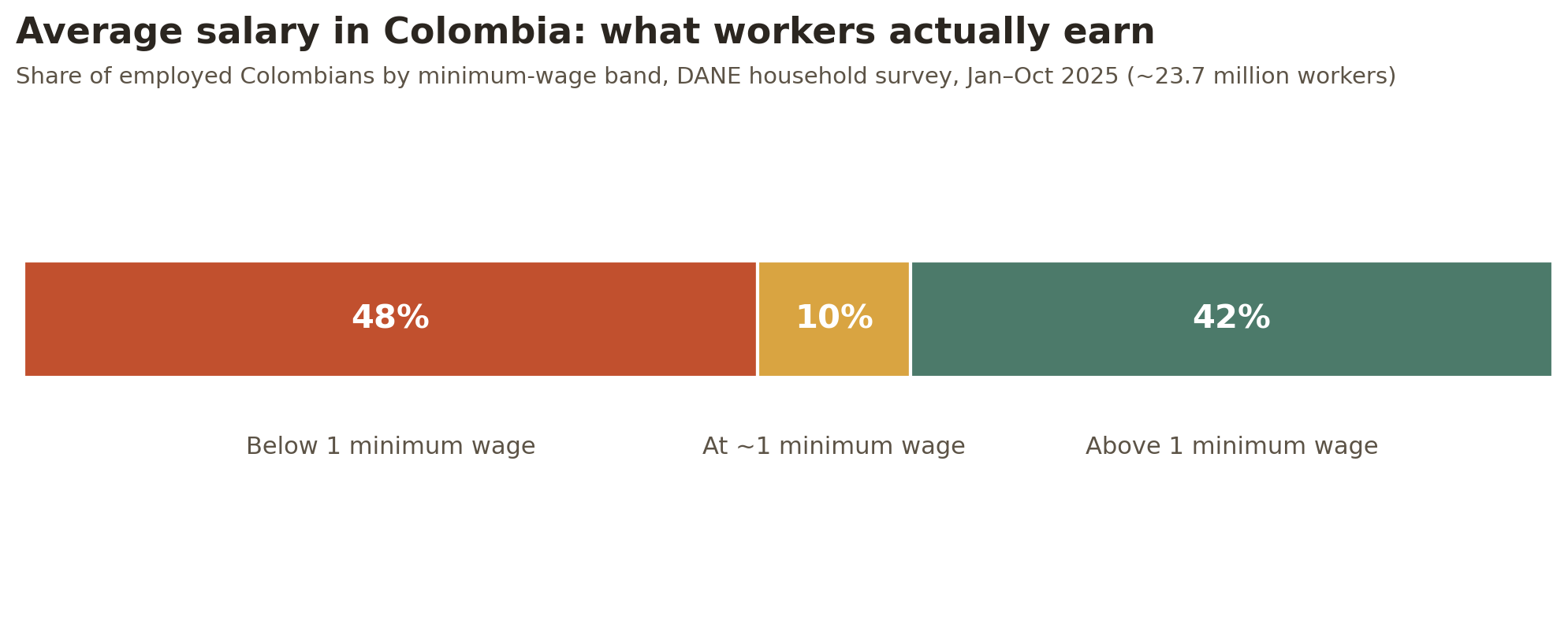
Read that back and the divergence explains itself. When nearly half the country earns below even the minimum wage, an “average” that lands a little above the minimum wage is technically correct and practically misleading. The median Colombian worker earns around the minimum wage or a little under it, not the average figure. If you take one thing from this article, that is it.
| Figure (2026) | COP / month | Approx. USD |
|---|---|---|
| Minimum salary (SMLMV) | $1,750,905 | ~$510 |
| Transport subsidy (auxilio de transporte) | $249,095 | ~$72 |
| Effective formal floor (combined) | $2,000,000 | ~$580 |
| Estimated national average earnings (ILOSTAT, 2025) | ~$2,020,000 | ~$590 |
USD conversions at roughly 3,440 COP/USD, mid-2026. The rate moves daily; check Banco de la República’s live TRM before relying on any figure.
City, sector and the formal–informal split
National figures flatten out enormous variation. A senior software developer, a mid-career engineer or an experienced manager in Bogotá or Medellín can earn several times the national average and the professional job markets in the two big cities run well ahead of smaller cities and rural areas. I have deliberately avoided precise salary tables for specific professions here, because the tech and professional figures that circulate online come mostly from recruiter blogs and self-reported aggregators with no stated method and they vary by two or three times between sources. Colombia’s main HR industry body, ACRIP, reported that salaries rose an average of about 7.1% across 2025, which gives a sense of the direction of travel. Beyond that, treat any confident “the average developer earns X” claim with caution.
The larger structural fact is informality. DANE puts labour informality at around 55% of the workforce in early 2026, roughly 12.8 million people, down slightly year on year but still more than half. The geography is stark: informality runs at about 41% across the 13 major metropolitan areas but climbs to over 83% in scattered rural areas. Informal work means no formal contract, often no minimum-wage guarantee and no transport subsidy and it is precisely the slice of earners that formal wage statistics undercount. That is the mechanism behind the “half the country earns below minimum wage” figure and it is why the formal-sector averages you read about only describe part of the picture.
What this means for an expat budget
For anyone moving to Colombia on foreign income or a remote salary, the practical takeaway is straightforward. A monthly income that would be modest in North America, western Europe, Australia or New Zealand places you well up the local distribution. As a rough anchor, USD $1,500 a month is close to three times the combined minimum wage and USD $2,500 sits a little over four times it, which puts either comfortably into the upper tier of Colombian earners. That is not a reason to feel wealthy so much as a reason to understand that your money reaches further than the headline exchange rate alone suggests.
What the salary picture does not tell you is what things actually cost, which is the other half of the equation. Rent, healthcare, groceries and the city you choose all move the number you need and I have kept that side out of this article on purpose so it stays focused on earnings.
One more distinction worth making: the figures above describe what Colombians earn and what a remote worker living on foreign income effectively competes against locally. They are not about the right to work for a Colombian employer. That is a separate legal question and if you want a local job rather than remote income, the route is the Colombia Work Visa (the employer-sponsored M-Trabajador), not something these salary figures grant on their own.
For the spending side of the ledger, see the companion guide, Cost of Living in Colombia: A 2026 Budget Guide and the wider Moving to Colombia overview for visas, healthcare and settling in.
Keep one currency point in mind for your planning. If any part of your income is paid in pesos, exchange-rate movement and local inflation both matter over time and a peso income does not always keep pace with rising costs as neatly as newcomers expect. It is a Colombia-specific risk to hold in mind, not a reason to avoid the move.
The limits of these numbers
A few things this data cannot do, because knowing the gaps is part of using the figures well.
- The average hides more than it reveals. In a distribution this skewed, the mean is the least useful single number. The DANE distribution and the median are closer to the truth of what people earn.
- Informality undercounts variation. With more than half of workers informal, official wage data speaks mostly for the formal minority and the earnings of the informal half are harder to measure and easier to miss.
- Data lags. DANE’s employment figures are fairly current, but income and poverty distributions run months behind, so the most recent detailed breakdown is usually a year or so old.
- Currency risk is real. Every USD figure here is a snapshot at roughly 3,440 pesos to the dollar. Move the rate a few hundred pesos either way and the dollar figures shift with it.
Frequently asked questions
What is a good salary in Colombia?
It depends heavily on the city, but as a benchmark, earning two to four times the minimum wage (roughly COP $3.5 million to $7 million a month, about USD $1,000 to $2,000) puts you comfortably into the middle-to-upper band of Colombian earners, since only a small share of the country earns above that. In Bogotá and Medellín, where costs are higher, the same figure stretches less than it would in a smaller city.
Is USD $1,500 a month a lot in Colombia?
By local standards, yes. At a mid-2026 exchange rate, USD $1,500 is close to three times the combined minimum wage, which places you well above most Colombian earners. It is a comfortable income in most of the country, though in the pricier neighbourhoods of the big cities it is closer to solid than luxurious. How far it goes depends far more on your housing and lifestyle than on the headline number.
What is the minimum wage in Colombia in 2026?
The 2026 minimum monthly salary is COP $1,750,905, plus a transport subsidy of COP $249,095 for most workers, giving an effective floor of COP $2,000,000 a month, about USD $580 at a mid-2026 rate. The wage increase was under legal challenge in early 2026 but has remained in force under a transitional arrangement.
Why is the average salary in Colombia higher than what most people earn?
Because a small number of high earners pull the average salary in Colombia up. Colombia’s income distribution is heavily skewed, so the mean sits well above the median. According to DANE, close to half of employed Colombians earn less than one minimum wage, which is why the median (the middle earner) is a far better guide to a typical income than the average.
Sources
- The 2026 minimum salary and transport subsidy: Presidencia de la República de Colombia and the transport subsidy detail via Ámbito Jurídico.
- The legal challenge to the 2026 wage decree and its provisional suspension: Holland & Knight; the transitional decree itself, Decreto 0159 de 2026.
- The peso/dollar exchange rate (TRM): Banco de la República.
- Labour informality and its urban/rural split: DANE, Empleo informal y seguridad social.
- The share of workers earning below, at and above one minimum wage: DANE, Mercado laboral (Gran Encuesta Integrada de Hogares), as reported by Infobae.
- Colombia’s average monthly earnings: ILOSTAT, Colombia country profile, figure cross-checked via Econotics.
- The 2025 average private-sector salary increase: El Espectador, on ACRIP’s salary and benefits survey.

