
Most people asking about buying property in Colombia are really asking two questions underneath. Am I even allowed to buy property as a foreigner? And if I am, what is the catch that nobody mentioned until I had already wired the deposit? Colombia is one of the more open property markets in Latin America for international buyers and the mechanics are not mysterious once they are laid out in order. The step that matters most is a single registration requirement that has nothing to do with the property itself and everything to do with whether you can ever get your money back out of the country.
This guide covers the property transaction itself: whether foreigners can buy, the one substantive legal restriction, the four steps from title search to registered ownership, what it actually costs and the candid picture on financing. It does not cover the investor visa. Buying property is one of the routes to Colombia’s M-Inversionista (investor) visa, if the purchase clears a value threshold, but that is an immigration question with its own rules, covered in Colombia Real Estate Visa. Here the job is the deal: how you go from an agreed price to your name on the public register, safely.
Can foreigners buy property in Colombia?
Yes and with fewer strings attached than most newcomers expect. Colombia has no broad ban on foreign ownership of residential property in its mainstream cities. You do not need to be a resident and you do not need to hold any particular visa to buy. A foreigner can legally purchase an apartment while in the country on a standard tourist entry. In practice a foreign buyer and a Colombian buyer are treated the same at the notary and on the register, which is not true everywhere in the region and is a large part of why Colombia reads as buyer-friendly. This is not just custom: the Constitution gives foreigners the same civil rights as citizens (Constitución Política, Art. 100) and Colombia’s foreign-investment rules set out an explicit equal-treatment principle, barring discriminatory conditions against foreign investors (Decreto 2080 de 2000, Art. 2).
There is a border-zone exception that gets repeated across expat property blogs and it is worth being precise about what actually holds up, because the popular version does not check out against its own stated legal basis. Several of those blogs attribute a Ministry of Defence authorisation requirement for foreigners buying land near an international border to Law 191 of 1995, Colombia’s border-zones law. Read directly, that law sets out development incentives for frontier municipalities; it does not itself impose a Ministry of Defence sign-off on land purchases (Ley 191 de 1995, full text). That specific claim is widely repeated but not one this guide can verify against the law it is credited to, so treat it as unconfirmed rather than settled fact. What is genuinely restricted and grounded in the Constitution and in law, is narrower and about land type rather than distance from a border: baldíos, land of state origin originally granted to settlers, cannot be freely accumulated or transferred outside strict limits (Constitución Política, Art. 64; Ley 160 de 1994) and forest reserves and other protected environmental zones carry their own separate acquisition limits. None of this reaches an ordinary titled city apartment, which is what almost everyone reading this is buying. The neighbourhoods foreign buyers actually cluster in, El Poblado in Medellín, Chapinero in Bogotá, Bocagrande in Cartagena, are titled urban property, not baldíos, forest reserve or contested border land. If Medellín is the city you are weighing up, see Living in Medellín for what daily life is actually like there, beyond the property listings. If you are looking at rural land, land of unclear origin, or anything inside a border department, that is exactly the case to raise with a lawyer before committing, not a footnote.
The registration step that protects your right to take your money home
If there is one thing in this whole guide I would not let slide, it is this, because it is the easiest to miss and the most expensive to get wrong. Foreign investment in Colombian real estate has to be registered with Banco de la República, Colombia’s central bank. The mechanism is a currency-registration form (commonly referred to as Form 4) filed through an authorised exchange-market intermediary, typically the bank that handles the inbound transfer of your purchase funds. It is a currency-control formality, not a tax and it is usually quick when done at the time the money comes in, per Banco de la República’s own Form 4 instructions.
Skip it and the consequence surfaces years later at the worst possible moment. Without that registration on record, you lose the legal right to repatriate your capital and any profit when you eventually sell. The property is still yours, but the money can become trapped in Colombia’s exchange system, converting and remitting it abroad legally depends on having documented that it arrived as registered foreign investment in the first place, which is exactly what Banco de la República’s own registration guidance says this filing protects. It is the kind of thing a buyer focused entirely on the apartment can wave through without realising what it protects. The fix costs nothing beyond attention: make sure the bank moving your funds files the foreign-investment registration as the money enters and keep the paperwork. Anyone selling you the property has no reason to remind you, so it falls to you and your lawyer to see it done.
The purchase process, step by step
A Colombian purchase runs through four stages, in a fixed order. The sequence matters, because ownership does not change hands at the moment you might assume and the protection you most need comes at the start, not the end.
1. Estudio de títulos (title search)
Before anything is signed, a property lawyer runs a title study through the Oficina de Registro de Instrumentos Públicos, the public-instruments registry run by the Superintendencia de Notariado y Registro. The search confirms the title is clean: no outstanding liens (an unpaid debt or legal claim registered against the property that a new owner could otherwise inherit), no mortgage still attached, no court orders or disputes hanging over it and, crucially, that the person selling actually holds the legal authority to sell. This is non-negotiable. Of every step here, this is the one I would never let a buyer skip to save the lawyer’s fee, because it is the only stage that catches a problem before your money is committed rather than after.
2. Promesa de Compraventa (promise of sale)
Once terms are agreed and the title checks out, both sides sign a Promesa de Compraventa, a legally binding preliminary contract. It pins down the details that a handshake leaves vague: the final price, the payment schedule, the delivery date, exactly what is included in the sale and which notary will handle the deed. Treat this as the document that actually holds the deal together, because it is enforceable and its terms carry through to closing, as set out in the standard buyer’s-process guides for a Colombian purchase (Stanford Baker).
3. Escritura Pública (public deed)
The deed is signed at a Notaría, in front of a notary, by both parties. The notary reads the deed aloud, both sides sign and it is certified. The appointment itself is short, usually one to two hours. It is a formal, verified step rather than a negotiation; the negotiating was done in the promise of sale. One thing that trips foreign buyers up: if you do not speak Spanish, an official translator or interpreter is required for this stage, which is a cost line in its own right (more on that below), a requirement several foreign-buyer guides confirm independently (The Latinvestor; Stanford Baker).
4. Registration
Signing the deed is not the finish line and this is the detail I would underline for anyone assuming otherwise. The signed deed goes back to the Oficina de Registro de Instrumentos Públicos to update the ownership record. Legal ownership only transfers when that registration finalises, which typically takes one to three weeks after the notary signing, not the moment the pen leaves the page, per the timelines reported by both The Latinvestor and Medellin Advisors. Until the register shows your name, the transfer is in progress rather than complete. Plan around that gap rather than being surprised by it.
What it actually costs to close
Total closing costs typically run 3.5 to 4.5 percent of the purchase price, on top of the price itself, consistent across the two independent cost breakdowns this guide checked (The Latinvestor; Global Property Guide). That is the number to budget against. The breakdown below shows where it comes from and who conventionally pays each piece, though several of these are negotiable, so settle them in the promise of sale rather than discovering the split at the notary. One line is easy to miss because plenty of guides leave it out entirely: a departmental tax and stamp charge (Rentas Departamentales) applies to every property purchase, not just high-value ones and it is often the single biggest line after the stamp tax on a bigger deal (Medellin Advisors).
| Cost | Typical rate | Who usually pays |
|---|---|---|
| Notary fees | ~0.3–0.7% of the transaction | Usually split buyer and seller |
| Registration fee | 1% of the sale price or cadastral value, whichever is higher | Buyer alone |
| Departmental tax and stamps (Rentas Departamentales) | ~1.0–1.5% of the transaction (varies slightly by department) | Usually split buyer and seller |
| Stamp tax (Impuesto de Timbre) | 0% below 20,000 UVT, then 1.5–3% in marginal bands above it (20,000 UVT is ~COP $1.05 billion at the 2026 UVT value) | Buyer by default, unless negotiated |
| Lawyer’s fees | ~0.5–1.5% of the purchase price | Buyer |
| Translation / interpreter (foreign buyers) | ~COP $800,000–3,000,000 (about US$230–870) | Foreign buyer |
| Total closing costs | ~3.5–4.5% of the purchase price | — |
Indicative 2026 figures. Rates are set by the property value and deal structure and several lines are negotiable between buyer and seller. Confirm current rates and thresholds with your lawyer before closing. Stamp tax bands: Estatuto Tributario, Art. 519, paragraph 3, as summarised by Ámbito Jurídico, applied to the 2026 UVT value of COP $52,374 (DIAN, via INCP). Other lines: The Latinvestor and Medellin Advisors.
Two things in that table stand out. The stamp tax only appears above a fairly high value threshold, so most ordinary apartment purchases never trigger it; if you are buying at the upper end, it is the line that moves the total most and it is negotiable as to who carries it. And the point that surprises people who assume foreigners get taxed more: there is no extra transfer tax charged simply because the buyer is foreign, consistent with the equal-treatment principle in Colombia’s own foreign-investment rules (Decreto 2080 de 2000, Art. 2). The costs attach to the property and the deal structure, not to your passport. The only foreigner-specific line is the translator and that is a service fee, not a levy. Some of these figures you can calculate precisely yourself; others are only approximations. The registration fee and the stamp tax are set by law as straightforward percentages: multiply your own price by the rate and the result is exact, though the registration rate is set departmentally and varies slightly within that 0.5 to 1 percent band, which is why it is quoted as a range rather than one figure. Notary fees work differently: they follow an official tiered fee schedule set by the Superintendencia de Notariado y Registro (Resolución 03915 de 2023) rather than a flat rate, so the percentage here is a rough average of what that schedule tends to produce for a typical residential price, not a number you can multiply directly. Ask the notary for the exact figure once a price is agreed. Lawyer’s fees work differently again, which will surprise readers used to a New Zealand-style market: there is no legally fixed rate and quoting the fee as a percentage of the purchase price is simply the common local convention, the way a real estate agent’s commission works everywhere, but extended here to lawyers too, which is not the norm in NZ. It is a negotiated market rate, not a legal one, so ask for a fixed quote up front rather than assuming the percentage is set in stone. Put in front of you visually, the split between the one-off fees and where the money actually goes looks like this.
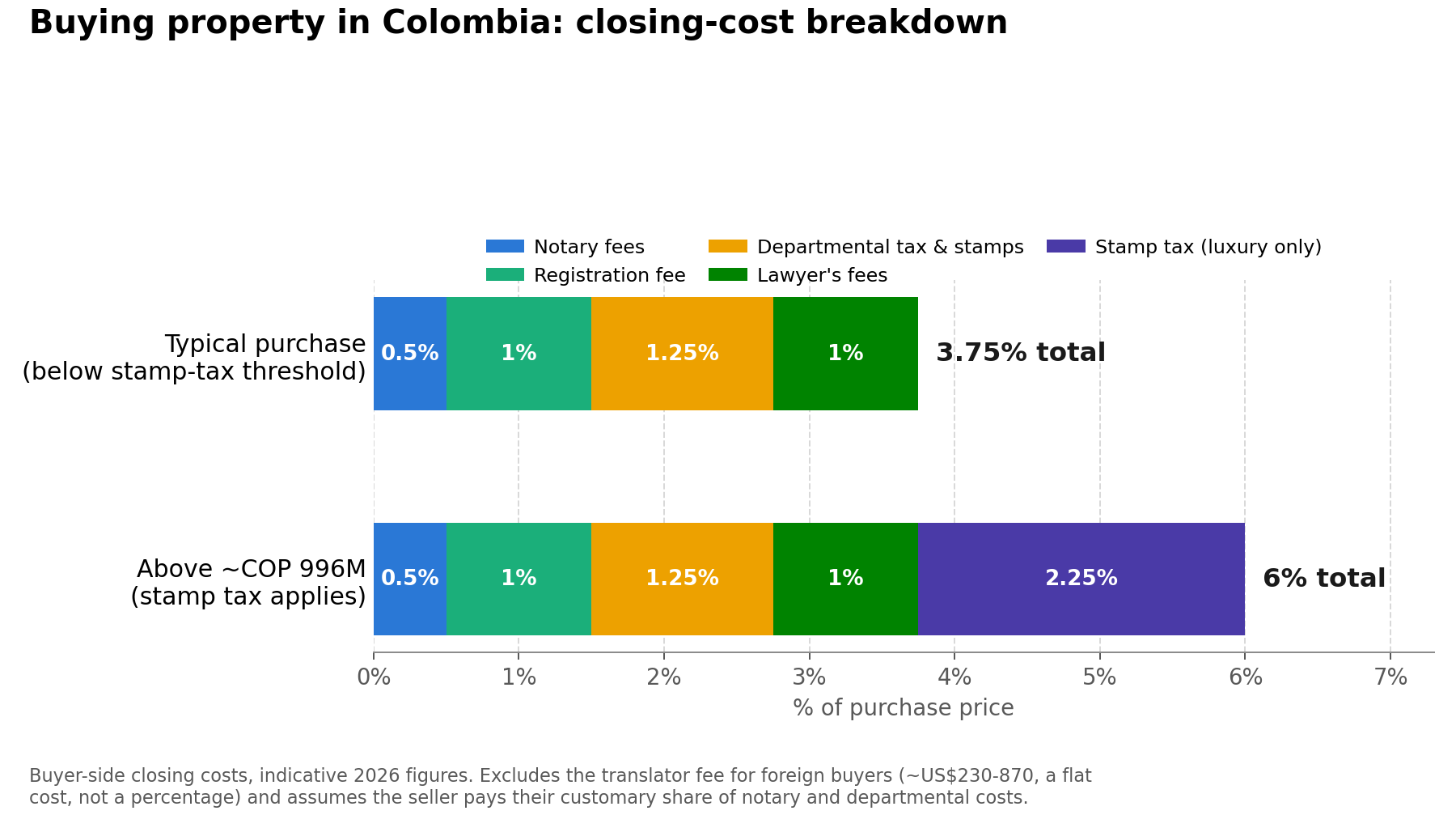
One practical constraint governs the timing of all of it. The funds need to be available before the closing date, because the notary verifies payment before executing and registering the deed, a sequencing confirmed by both The Latinvestor and Stanford Baker. This is not a market where you sign first and settle the money afterwards. If your purchase money is coming from abroad, that is also the natural moment to make sure the foreign-investment registration from earlier is filed as the transfer lands.
I can speak to a version of this closer to home – my wife bought her apartment in Bogotá off the plans (sobre planos), ahead of my first ever visit to Colombia. It does not run through the four stages above in quite the same order or on the same timeline. The trade-off is time: ours took so long to go from paper to a finished, liveable building that by the time the unit was actually in a state to put a mortgage on, she had already paid it off in instalments along the way. We ended up among the very first residents in the building and even after moving in, plenty of things were still not properly finished for years afterwards. The lifts took years to be installed, which matters more in Bogotá than it would at sea level, since the altitude makes stairs a serious problem for older residents especially. Hot water was slow to arrive too, so for a long stretch we relied on low-pressure plug-in shower heaters, or simply used a neighbour’s bathroom. The electricity ran unofficially off the developer’s own supply account before the building had its own proper connection sorted. None of that means buying off the plans is a bad idea, plenty of people do it and are glad of it, but it is a different risk profile from the resale process described above, so go in with your eyes open about the wait.
Financing: harder than for a local
Foreigners can get a Colombian mortgage, but I would set expectations low going in, because the gap between a citizen’s experience and a foreigner’s here is wide. Most banks require the applicant to hold a Migrant (M) or Resident (R) visa. A tourist or business visa is routinely rejected outright, so the visa that lets you buy in cash does not, on its own, get you a loan. On top of the visa, lenders generally want to see six or more months of local credit history and Colombian-sourced income, per The Latinvestor’s survey of foreign-buyer mortgage terms.
That last requirement is where this exact sort of buyer usually comes unstuck. Income earned entirely overseas, the remote salary or the foreign pension, is often discounted heavily or disregarded altogether in a Colombian bank’s affordability calculation. You can be comfortably solvent by any sensible measure and still fail the box the bank is ticking. Down payments for foreign applicants also run higher, in the range of 30 to 50 percent of the appraised value, well above what a local would put down (The Latinvestor).
Some banks do try to make this easier. Bancolombia, Davivienda, BBVA Colombia and Scotiabank Colpatria run dedicated international-client units set up for exactly this situation and they are the sensible first calls if you want to attempt local financing. Even so, the realistic picture, per The Latinvestor’s reporting, is that roughly only 15 to 20 percent of foreign mortgage applications get approved through the traditional banks. The upshot, plan around this from the start rather than discovering it late: most foreign buyers in Colombia pay cash, or arrange their financing from outside the country and bring the funds in. If your plan depends on a Colombian mortgage, treat that as the assumption most likely to fall through and have a cash route in reserve.
Renting it out: what a long tenancy does and doesn’t, do to your ownership
If you are buying to rent out rather than to live in yourself, there is a fear that deserves a direct answer, because it circulates informally among landlords in Colombia and it is not baseless: can a tenant who has been in the property for years, or decades, eventually claim it as their own? This is not a hypothetical worry raised for effect. Within our own extended family, two rental properties ended up in an unsettling position after a tenant of many years’ standing began treating the property as though it was theirs. Resolving it took sustained effort and exactly how it was ultimately settled is not something I can speak to with certainty. But the underlying question, what a long tenancy can and cannot turn into, matters before you become an absentee landlord.
The legal answer is that Colombian law makes this difficult for a tenant to achieve by simply staying put. Under the Civil Code, a tenant paying rent is a mere holder (tenedor), someone who explicitly recognises another person’s ownership rather than claiming the property as their own and the code is direct that the mere passage of time does not convert that recognition into ownership. Colombia’s acquisitive prescription (prescripción adquisitiva, the mechanism behind any Colombian equivalent of a squatter’s claim) runs for five years for a possessor with a just title and good faith, or ten years without one, but a paying tenant does not qualify as a possessor for either clock to start. For the clock to start at all, the tenant would need to do something the law calls interversión del título: openly and unambiguously repudiate your ownership, most obviously by simply refusing to keep paying rent and asserting the property as their own and even then the ten-year extraordinary period would need to run from that break, not from when the tenancy began (Gerencie.com, on the Civil Code’s prescription periods and mera tenencia).
Where the real risk lies is not the law itself but the paperwork behind it and the slowness of the court process either way. Removing any occupant in Colombia, disputed ownership or not, goes through a judge rather than the police and a contested case can run for months or years, under the same urban-lease framework that governs the tenancy itself (Ley 820 de 2003). Your strongest protection is the paper trail that proves the relationship was always a tenancy: a written lease contract, rent paid by traceable bank transfer rather than cash and dated receipts, because that is exactly the evidence that defeats an interversión del título claim before it starts. The situations that become worrying are the ones where the paperwork is thin, informal, or handled personally over many years without a lawyer’s eye on it, which is precisely the gap between renting to someone the family trusts and a properly documented commercial tenancy. If you are going to be an absentee or foreign landlord, a written, ideally professionally managed lease from day one is not bureaucratic caution. It is the thing that keeps a long tenancy a tenancy.
Where purchases go wrong
Most of what goes wrong in a Colombian purchase clusters around three avoidable mistakes.
- Skipping the title search to save money. The estudio de títulos is the cheapest insurance in the whole transaction and the only step that surfaces a hidden lien, an unresolved dispute or a seller without the authority to sell before your funds are gone. Cutting it is a mistake.
- Missing the Banco de la República registration. Because it sits outside the property paperwork and nobody in the sale has a reason to chase it, the foreign-investment registration is the easiest step to overlook and the one whose absence you feel only years later when you try to take your money out. Confirm it is filed as the funds arrive.
- Assuming financing will be straightforward. Walking in expecting a local mortgage to fall into place, on a tourist visa or on overseas income, is how a deal stalls. Sort out how you are actually paying before you commit to a purchase, not after.
- Renting out the property on a handshake. A verbal or informal lease, paid in cash with no receipts, is exactly the paperwork gap that turns a long, trusted tenancy into a stressful dispute later. A written contract and a traceable payment record cost little and are the strongest protection you have.
- Hiring on price for renovation and repair work. A cheap specialist who is only masquerading as a qualified one can leave you worse off than doing nothing. In our own building a water pressure problem is still unresolved to this day and because the wrong person was trusted to diagnose it, the building now treats the fault as unfixable. Quite a lot of this goes on in the trades here, so I weigh a tradesperson’s actual competence well above their quote.
What this guide cannot settle for you
This is the shape of a standard residential purchase; it is not legal advice for your specific deal and the one thing I would not do is buy in Colombia without a Colombian property lawyer of your own, independent of the seller and the agent, running the title study and reviewing the promise of sale. The cost figures here are indicative 2026 ranges and the exact rates, the stamp-tax threshold and the notary and registration schedules can move, so they want confirming against current figures before you close rather than being read as quotes.
Two areas sit deliberately outside this guide. The tax you will owe as an owner, annual property tax (predial) and any income or capital-gains exposure, is its own subject and turns on your residency and circumstances. And the immigration angle, whether a purchase is large enough to support an M-Inversionista investor visa, is a separate question with its own threshold (350 times the monthly minimum wage, which for 2026 is roughly US$188,600 at current rates) and its own process, covered in Colombia Real Estate Visa; if the visa is your actual goal, read that alongside this before you structure the buy. For the wider picture of settling in, Moving to Colombia and Cost of Living in Colombia cover the ground around the purchase. If retirement is the reason you are buying, see Retiring in Colombia for the visa and lifestyle side of that decision.
Frequently asked questions
Can foreigners buy property in Colombia?
Yes. Colombia places no broad restriction on foreign ownership of residential property in its mainstream cities, no residency or particular visa is required and a foreigner can legally buy while on a tourist entry, backed by the Constitution’s equal civil-rights guarantee and Colombia’s foreign-investment equal-treatment rule (Constitución Política, Art. 100; Decreto 2080 de 2000, Art. 2). Foreign and Colombian buyers are treated the same at the notary and on the register. Genuine restrictions exist for baldíos (state-origin rural land) and protected environmental zones, not for city apartments; a Ministry of Defence border-zone sign-off is repeated across expat property blogs but does not appear in the border-zones law (Law 191 of 1995) it is usually credited to, so this guide treats that specific claim as unconfirmed.
How much are closing costs when buying property in Colombia?
Budget roughly 3.5 to 4.5 percent of the purchase price (The Latinvestor; Global Property Guide). That covers notary fees (about 0.54 to 0.70 percent, usually split with the seller, set by the Superintendencia de Notariado y Registro’s tariff schedule), a registration fee of 1 percent of the sale price or cadastral value, lawyer’s fees of around 0.5 to 1.5 percent and, for foreign buyers, translator costs of roughly COP $800,000 to $3 million. A stamp tax of 1.5 to 3 percent applies only above 20,000 UVT, about COP $1.05 billion at the 2026 UVT value (Estatuto Tributario, Art. 519 §3, per Ámbito Jurídico). There is no extra transfer tax charged simply because the buyer is foreign.
Can foreigners get a mortgage in Colombia?
It is possible but difficult. Most banks require a Migrant or Resident visa and reject tourist or business visas and they typically want six or more months of local credit history and Colombian-sourced income, discounting income earned entirely overseas. Down payments for foreign applicants run 30 to 50 percent. Bancolombia, Davivienda and BBVA Colombia have international-client units, but only around 15 to 20 percent of foreign applications are approved through traditional banks, so most foreign buyers pay cash or finance from abroad (The Latinvestor).
Do I really need to register the purchase with the central bank?
If you are bringing money in from abroad, yes. Foreign investment in Colombian real estate must be registered with Banco de la República (via the currency-registration form, commonly Form 4, filed through an authorised exchange-market intermediary) at the time the funds arrive (Banco de la República, Form 4 instructions). Miss it and you lose the legal right to repatriate your capital and profit when you sell, so the money can become stuck in Colombia’s exchange system. It costs nothing beyond making sure the bank handling your transfer files it and keeping the paperwork.
Sources
- The Latinvestor, foreign ownership rights and border-zone restrictions: thelatinvestor.com/blogs/news/colombia-foreigner-rights
- The Latinvestor, total closing costs: thelatinvestor.com/blogs/news/colombia-total-closing-costs-buying
- The Latinvestor, mortgages for foreigners: thelatinvestor.com/blogs/news/colombia-mortgage
- Taxes for Expats, buying property in Colombia (steps, taxes, fees): taxesforexpats.com
- Stanford Baker, buying property in Colombia as a foreigner: blog.stanfordbaker.com/posts/buying-property-medellin-foreigner
- Global Property Guide, Colombian property taxes and costs: globalpropertyguide.com
- Medellin Advisors, gastos notariales (departmental tax and stamps breakdown): medellinadvisors.com
- Gerencie.com, prescripción adquisitiva de dominio (acquisitive prescription periods and mera tenencia): gerencie.com
- Ley 820 de 2003, Colombia’s urban housing lease law (official text): funcionpublica.gov.co
- Constitución Política de Colombia, Art. 100 (foreigners’ civil rights) and Art. 64 (baldíos and access to rural property): constitucioncolombia.com/articulo-100, constitucioncolombia.com/articulo-64
- Decreto 2080 de 2000, Colombia’s General Regime for Foreign Investment, Art. 2 (equal-treatment principle): banrep.gov.co
- Ley 191 de 1995, Colombia’s border-zones law, official full text (checked directly for the Ministry of Defence real-estate authorisation claim commonly attributed to it): funcionpublica.gov.co
- Ley 160 de 1994, regulation of baldíos and rural land access, official text: funcionpublica.gov.co
- Banco de la República, Form 4 instructions for the foreign-investment currency registration: banrep.gov.co
- Banco de la República, guidance on registering international investments (what the registration protects): banrep.gov.co
- Superintendencia de Notariado y Registro (SNR), title registry and certificado de tradición y libertad: supernotariado.gov.co
- Resolución 03915 de 2023, SNR’s notary tariff schedule: alcaldiabogota.gov.co
- Ámbito Jurídico, on Estatuto Tributario Art. 519 §3’s stamp tax marginal rates for real estate: ambitojuridico.com
- Instituto Nacional de Contadores Públicos, on DIAN’s 2026 UVT value (COP $52,374): incp.org.co

