
If you are in a relationship with a Colombian, or already married to one, the practical question tends to arrive fairly quickly. What does that actually mean for your ability to live there, legally and for the long term? This is the route people look up as the Colombia marriage visa and the good news is that it is one of the most accessible ways into the country’s whole system. There is no income test to clear and the work rights are open rather than restricted (Cancillería de Colombia). The marriage half of it also reaches residency faster than almost any other route, though, as it turns out, the de facto partner track does not get that same discount (more on that below), a timing difference set out in Resolución 5477 de 2022. Faster still, on a separate basis, is the route for foreigners who have a Colombian child. This guide sets out how both work in 2026, where they differ and the point at which residency and citizenship become different questions. If you are weighing this alongside the wider practicalities of relocating, our guide to moving to Colombia covers cost of living, healthcare and where to settle.
A word on where I am standing. I am married to a Colombian and this is the route I am on myself, which is part of why I wanted to get it right rather than repeat the half-correct version that circulates online. I also keep a second home in Colombia and have spent a fair bit of time there. That gives me a feel for the place and the paperwork, but it does not make me an immigration lawyer and Colombian visa practice moves with each year’s rules and varies between consulates. Treat this as a well-researched starting point, not legal advice on your own case.
What the Colombia marriage visa actually covers
The visa sits in the Migrant (M) family, under Resolución 5477 of 2022, the same restructure that reshuffled the retirement and nomad routes. Officially it is the visa for the spouse or permanent partner of a Colombian national. The detail that trips people up is that “spouse or permanent partner” is not one thing but two, with different mechanics and you need to know which lane you are in before you start gathering documents.
The Cónyuge route is for a formal marriage. The Compañero or Compañera Permanente route is for a de facto union, what Colombia calls a unión marital de hecho, a couple living together as partners without a marriage. Both lead to the same Visa M and the same open work rights, but they are proved differently, they carry different durations and one is a good deal more generous than the other (Cancillería de Colombia).
Marriage (Cónyuge): the paperwork chain
If you are married, the visa is built on the marriage itself and the friction is almost entirely in getting a foreign marriage recognised inside Colombia’s system. A marriage performed abroad has to be apostilled in the country where it took place, translated into Spanish by an official translator and then registered with Colombia’s civil registry so that it produces a Colombian marriage civil registry document (a registro civil de matrimonio) (Cancillería de Colombia). That registered document, rather than your original foreign certificate, is what the visa process ultimately leans on. A marriage performed in Colombia skips most of that chain, because it is already in the local registry. The pay-off for the extra steps is the longest validity of the family routes: once Cancillería grants a marriage-based Visa M, it is valid for up to three years from the date it is issued (not from your wedding date) and you reapply to continue if the marriage does. That three-year term is not a random number: it matches, almost to the day, the three continuous years of M-visa time the marriage route needs before you qualify for the R visa (Resolución 5477 de 2022, Art. 90), so a single grant is enough to carry you all the way to that eligibility point without a renewal in between. That is a coincidence of design and the permanent-partner route below does not share it.
I can speak to the getting-married-in-Colombia side of this, since my own wedding was in Villa de Leyva, arguably Colombia’s premier wedding town. The Church side is procedural. Between us we had to produce certificates of baptism, eucharist (first communion) and confirmation, plus a certificate proving neither of us had been married before. According to my wife, the priest covering Villa de Leyva serves a wide surrounding area and had to get a more senior priest to sign off on our documentation, though that step was internal and not something we dealt with directly ourselves. He was personable rather than stern about it and to make that point – knowing my IT background our first conversationhumorously consisted of him asking me if I could fix his iPad (which I did – and he made comment about it during the wedding vows), so it is the paperwork and the sacramental requirements that are followed seriously, not necessarily that the priests themselves are not personable. My wife, as the native Spanish speaker, handled the bulk of the actual paperwork.
The part that actually worried us was the sacramental side, not the paperwork itself. I had never been baptised, so I had to complete the whole set from scratch, baptism, eucharist and confirmation, each of which also needed its own godparents, on top of the godparents required for the wedding itself. That is normally a multi-year process, but the priests have some discretion to fast-track it and ours chose to. We got it done in under a year, but for a long stretch we did not know whether we would make it in time and we seriously considered abandoning the church wedding for a civil celebrant instead, simply because we had had no idea beforehand how much preparation a Colombian Catholic wedding actually demands. If you are planning to marry in a church in Colombia and are not already a practising Catholic, plan for this a long way ahead, further ahead than you would assume from outside. Because the marriage was Colombian from the start, none of this touched the apostille-and-translate chain described above; the paperwork that did run through that kind of channel was getting the marriage recognised legally in Colombia (and New Zealand) afterwards, since we had not had time to complete those steps while we were still in Colombia.
Permanent partner (Compañero/a Permanente): the shorter track
The de facto route exists precisely for couples who are committed but not married and Colombia takes it seriously as a legal status rather than treating it as second best. It is proved not with a marriage certificate but with a formal declaration of the union: a public deed, a judicial ruling, or a conciliation agreement that recognises the unión marital de hecho. The relationship generally needs to have been formalised for more than a year before it will support the visa (Cancillería de Colombia). The important asymmetry to know going in is duration. Where a marriage-based visa runs up to three years, the permanent-partner version is granted for up to only one year at a time (Cancillería de Colombia). It is a workable route, but it is the less generous of the two in a second way as well: unlike the marriage visa’s three-year grant lining up with its three-year residency requirement, this one-year grant does not cover the five years of accumulated time the partner route actually needs before the R visa becomes available (more on that mismatch below), a gap set out in Resolución 5477 de 2022, Art. 90. If a couple has the choice, that shorter renewal cycle and the residency gap behind it, should factor into the decision. There is a practical reason beyond the visa mechanics to weigh it seriously too: a Colombian church wedding, as I found out myself, can demand far more sacramental preparation than an outside couple expects (more on that above) and the de facto route sidesteps all of it.
| Cónyuge (marriage) | Compañero/a Permanente (permanent partner) | |
|---|---|---|
| Basis | A formal marriage | A de facto union (unión marital de hecho) |
| Key proof | Marriage certificate; if married abroad, apostilled, officially translated and registered in Colombia’s civil registry | Public deed, judicial ruling or conciliation agreement declaring the union |
| Relationship history required | The marriage itself | Union formalised for more than one year |
| Visa validity | Up to 3 years | Up to 1 year |
| Income test | None | None |
| Work rights | Open work permit | Open work permit |
| Counts toward residency | After 3 continuous years | After 5 continuous years (no discount — same as the standard M-visa track) |
Sources: Cancillería de Colombia, temporary visa for the spouse or permanent partner of a Colombian national; residency-accumulation figures per Resolución 5477 de 2022, Art. 90.
Same-sex couples are treated identically
This is a common and reasonable question and the answer is straightforward. Same-sex couples apply for the same Visa M under exactly the same requirements. Same-sex marriage has been legal in Colombia since a Constitutional Court ruling in April 2016 and a foreign same-sex spouse of a Colombian national is a spouse for these purposes, full stop. The permanent-partner route is likewise open to same-sex couples. There is no separate category, no additional threshold and nothing in the process that treats the marriage differently from an opposite-sex one.
No income test and open work rights
The feature that sets this route apart from the retirement visas is what it does not ask for. There is no fixed income threshold (Cancillería de Colombia). The whole basis of the visa is proving that the relationship is bona fide, not proving that you can support yourself to some multiple of the minimum wage, which is the hurdle the Pensionado and Rentista routes are built around. That said, it is not quite a free pass on money. Some applicants report that immigration officers can still probe financial stability informally during review, part of the broader question of whether the relationship holds up as authentic. What there is not is a published number you must hit, the way Pensionado demands three times the minimum wage and Rentista ten. On top of that, the visa carries an open work permit. You can take a job, freelance, or run a business in Colombia without the income restriction that hems in a retiree on a Pensionado visa. For a couple planning to actually build a life there rather than draw down savings, that combination, no income test and the freedom to work, is the part that makes this route stand out.
The other family route: parent of a Colombian child
There is a second family route that has nothing to do with your marital status and it is often confused with the marriage and partner routes described above. If you are the parent of a Colombian child, you can apply for a Visa M on that basis alone, whether or not you are married to or partnered with anyone and whether or not the other parent is Colombian. The qualifying fact is the child, not the relationship between the parents. The child can be Colombian by birth or by adoption and Cancillería runs a separate page for each: by birth and by adoption.
For a child born in Colombia, the documents come down to proving the parentage, your own lawful presence around the birth and that you can support the family (Cancillería de Colombia). In practice that means:
- The child’s Colombian birth certificate.
- The visa you held at the time of the child’s birth.
- A certificate of migratory movements for both parents, issued by Colombia’s migration authority.
- Proof of economic solvency: bank statements for the last six months, plus evidence of your source of income.
- A valid passport with your entry and exit stamps and a compliant photo.
Note that this route does ask for proof of economic solvency, where the spouse and partner routes do not put a number on it. It is not a fixed multiple of the minimum wage, but you are expected to show you can support the household, so the six months of statements matter here in a way they do not on the marriage track. The visa is granted for up to three years and carries the same open work permit (Cancillería de Colombia).
One feature makes this route quietly powerful for families. The parent who holds it can bring dependents onto it: a spouse or permanent partner, children up to 25 and children with a disability regardless of age (Cancillería de Colombia). So a foreign couple with a Colombian-born child can, in effect, use the child as the anchor for the whole family’s status, with one parent as the main holder and the rest as beneficiaries. That is a different shape from the spouse route, where the Colombian partner is the anchor and for some families it is the more natural fit.
The residency timeline and how it compares
This is where the three family routes stop being interchangeable. Set each against the standard five-year clock rather than assuming the family label buys the same discount everywhere. Colombia’s path to a Resident (R) visa normally runs through five continuous years on a Migrant (M) visa, the clock a work-visa holder or most other migrants are counting down. The marriage route cuts that to three years. The parent-of-a-Colombian-child route cuts it further, to two years, the fastest of the three. The permanent-partner route, somewhat surprisingly, gets no discount at all: it still needs the full five years, the same as a standard work or pension visa, spread across one-year grants that each need renewing along the way (Resolución 5477 de 2022, Art. 90). That is a meaningful asymmetry between marriage and de facto partnership that the “family route” label tends to flatten. Know it before you build a plan around one or the other.
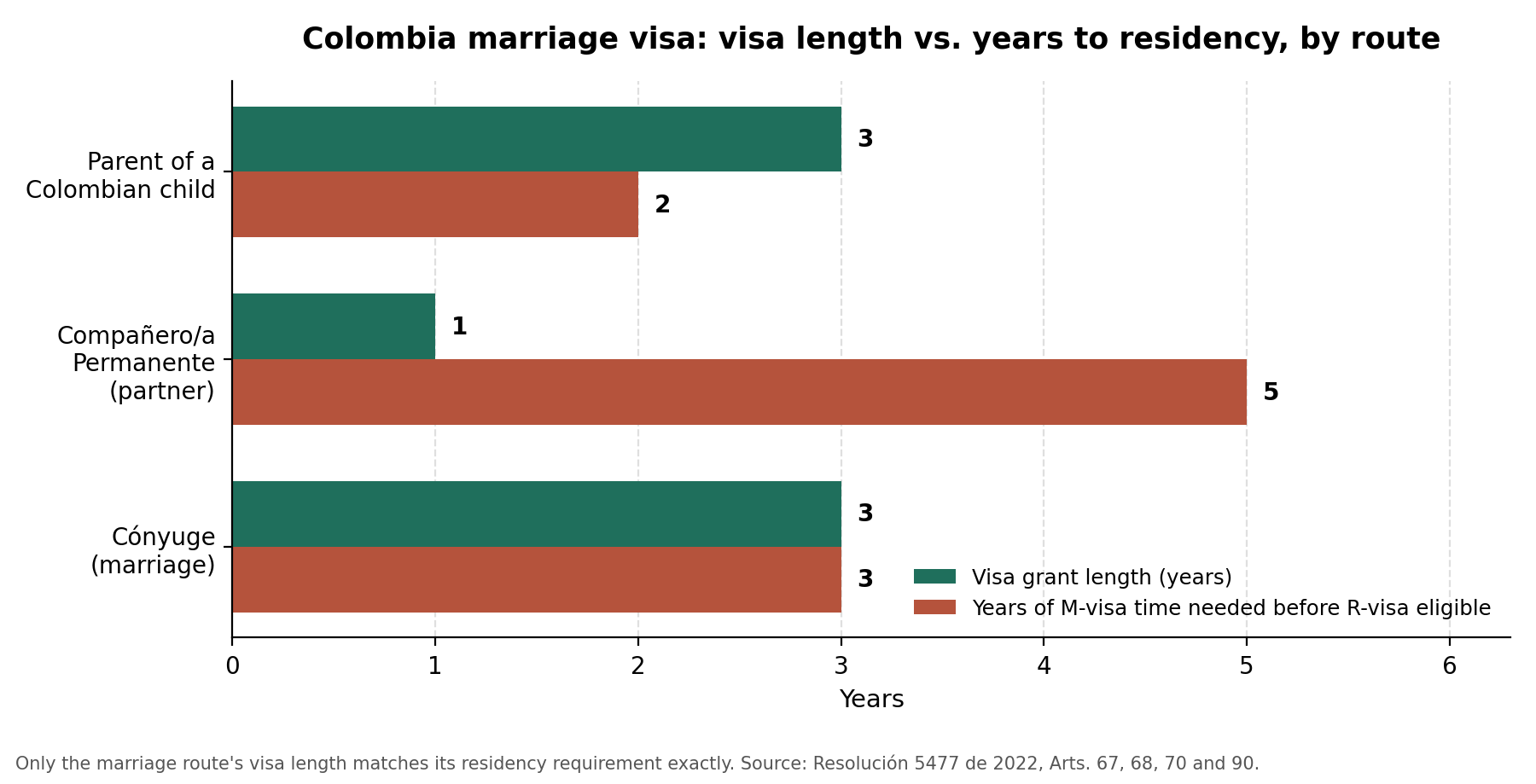
Set against the neighbours, marriage and a Colombian child are still quick. A retiree on the Pensionado visa is looking at the full five years before residency and time on the Rentista visa does not count toward it at all, because the 2022 restructure reclassified Rentista as a Visitor (V) visa. The Digital Nomad visa is in the same position: a comfortable couple of years, but a dead end as far as the residency clock is concerned, because it too is a Visitor visa. Against that field, marriage (three years) and a Colombian child (two years) are among the fastest legitimate routes to the R visa (Resolución 5477 de 2022, Art. 90). The permanent-partner route, for all its open work rights and lack of an income test, is not one of them: for residency purposes it is exactly as slow as the routes it otherwise looks nothing like.
The citizenship question, which is not the same thing
Residency and citizenship get blurred together constantly and they are different destinations. Residency (the R visa) lets you stay indefinitely; citizenship makes you Colombian, with a passport and the rest. They are reached by different processes, so keep them apart in your own planning.
On citizenship, the family connection does shorten the clock, but not in the standalone way it is sometimes described. Colombia’s current nationality law, Ley 2332 de 2023, requires that you already hold, or be a beneficiary of, the R visa before you can even apply and it counts the domicile period from the date that R visa was issued, not from your wedding date or the start of your M visa. The standard domicile requirement is five continuous years; it drops to two years for someone married to, in a permanent union with, or a parent of, a Colombian national. Stack that on the residency timeline above and the realistic minimum for the marriage route is the three years needed to qualify for the R visa, plus however long that application takes, plus a further two years of domicile once the R visa is granted, comfortably more than five years all told, not two. The parent-of-a-Colombian-child route compresses to roughly four years by the same logic and the permanent-partner route, needing the full five years just to reach the R visa in the first place, is the slowest of the three even before its own two-year domicile clock starts. Beyond the clock, the usual naturalisation requirements apply: proof of the marriage or partnership, a clean criminal record in both Colombia and your home country and a Spanish and civics test. That test is waived in full for applicants who completed secondary or tertiary study at a Colombian institution and those over sixty (Ley 2332 de 2023, Art. 13, also exempts applicants with a cognitive disability and those from indigenous communities sharing a border with Colombia); the Spanish-language portion specifically is only required at all if Spanish is not your first language, so a native speaker skips that part even without qualifying for the full exemption.
This is the single most common point of confusion in what circulates online about this route: the two-year figure is not a second clock running in parallel with your marriage; it is the domicile period required once you already hold the R visa, counted from the date that visa was issued. Reading it as “married two years, apply for citizenship” is the oversimplified version and it is where most of the out-of-date guides go wrong. Before you build a plan around a specific date, confirm the current sequence and processing times directly with Cancillería or an immigration lawyer, since Ley 2332 de 2023 replaced the previous nationality law and some guides online have not caught up.
The limits to keep in mind
What this guide cannot do is smooth over the friction in the process and that friction shows up even on an accessible route. The paperwork chain for a foreign marriage, apostille, official translation, then registration in the Colombian civil registry, is the part that eats time and patience and any one of those steps can stall on a technicality. Colombian bureaucracy is not uniform. Consulate practice varies from post to post, so two applicants with identical situations can receive different instructions and the same document can be accepted in one office and queried in another. That is consistent with the wider pattern across the system and it is not a reason to avoid the route, only a reason not to expect it to run to a fixed script.
The other limit is the one every visa article shares. Rules change, the government amends the resolutions periodically and the precise requirements and timelines here should be confirmed against the Cancillería portal or a lawyer before you commit money or flights. The structure of these routes is stable and well documented. The fine detail, especially anything touching citizenship, is the part that moves, so I’d get it confirmed by a professional for your own situation.
My own experience of the friction this section warns about ran in the opposite direction to the one it describes. Because I was married in Colombia rather than bringing a foreign marriage in, my paperwork problem was proving to New Zealand that a Colombian marriage had actually taken place, not the other way round, something we had planned to sort out in Colombia itself but ran out of time for. Shuttling documents to and from Colombia for that was not cheap; each round of couriering a form back for another stamp adds up and it is an expense this guide, being about the Colombia side only, does not cover. If your situation runs the same way mine did, budget for it separately.
Frequently asked questions
If I marry a Colombian, can I get citizenship?
Eventually, yes, but the two-year figure people quote is not a clock that starts on your wedding day. It is the domicile period required once you already hold the R (Resident) visa, counted from the date that visa was issued and reaching the R visa itself takes three years of marriage-based M-visa time first (Ley 2332 de 2023, Art. 9; Resolución 5477 de 2022, Art. 90). So the realistic total for the marriage route is a little over five years, not two, once R-visa processing time is added in. You will also need a clean criminal record in both countries and a Spanish and civics test, waived in full for those who studied at a Colombian institution and applicants over sixty; the Spanish-language portion specifically is waived on its own for native Spanish speakers, even without qualifying for the full exemption (Ley 2332 de 2023, Art. 13). Confirm the current sequence with Cancillería, since the governing law (Ley 2332 de 2023) is relatively recent and some guides online still describe the old rules.
Is there an income requirement for a Colombia marriage visa?
No fixed one. Unlike the Pensionado and Rentista retirement visas, which demand a set multiple of the minimum wage, the spouse and partner routes are based on proving the relationship is bona fide rather than proving income (Cancillería de Colombia). Immigration officers can still ask about financial stability informally during review, but there is no published threshold you have to hit. The parent-of-a-Colombian-child route is slightly different: it does ask for proof of economic solvency through six months of bank statements, though again without a fixed minimum figure (Cancillería de Colombia).
What is the difference between the marriage and permanent-partner visas?
Both lead to the same Visa M with open work rights, but they are proved and dated differently. The marriage (Cónyuge) route rests on a formal marriage certificate, which if issued abroad must be apostilled, translated and registered in Colombia’s civil registry and it is granted for up to three years. The permanent-partner (Compañero/a Permanente) route rests on a formal declaration of a de facto union that has existed for more than a year and it is granted for up to only one year at a time (Cancillería de Colombia). They also reach residency at different speeds: the marriage route counts toward the R visa after three years, while the permanent-partner route needs the full five, the same as a standard work visa, despite otherwise looking like the more flexible family option (Resolución 5477 de 2022, Art. 90). Same-sex couples use whichever of the two fits, on identical terms.
Do I need to be married to get residency through my Colombian child?
No. The parent-of-a-Colombian-child route is a separate basis that depends only on having a Colombian child by birth or adoption, not on your marital status or your relationship with the other parent (Cancillería de Colombia). It reaches the R visa in two continuous years, the fastest of the three family routes since marriage takes three and the permanent-partner route the full five (Resolución 5477 de 2022, Art. 90) and it carries the same open work permit; the holder can also bring a spouse or partner and children as dependents. For some families it is the more natural anchor, with one parent as the main holder and the rest joining as beneficiaries.
Sources
- Cancillería de Colombia — Temporary Visa for the spouse or permanent partner of a Colombian national: cancilleria.gov.co
- Cancillería de Colombia — Visa for the father or mother of a Colombian national by birth: cancilleria.gov.co/v/padreomadrenacional
- Cancillería de Colombia — Visa for the father or mother of a Colombian national by adoption: cancilleria.gov.co/v/madreopadre
- Resolución 5477 de 2022, Ministerio de Relaciones Exteriores (the governing visa framework): official text
- The current nationality/naturalisation law, including the R-visa prerequisite, the two-year domicile discount and the language/exam waivers (Ley 2332 de 2023, Arts. 9 and 13): Función Pública, official compilation.
- The residency-accumulation timetable by visa category, including the marriage (3 years), permanent-partner (5 years) and parent-of-child (2 years) figures (Resolución 5477 de 2022, Art. 90): SUIN-Juriscol, official compilation.
- Wikipedia, on same-sex marriage in Colombia: en.wikipedia.org/wiki/Same-sex_marriage_in_Colombia

