
For a certain kind of retiree, the sums stop working at home long before the desire to slow down does. A pension that felt comfortable on paper thins out against rent, power bills and the price of seeing a doctor and the question shifts from “where would I like to retire” to “where can I actually afford to.” Colombia comes up in that conversation more and more and for good reasons. It also comes wrapped in visa rules that changed materially in 2022 and are still settling, so a lot of what you will read online is out of date. This is my attempt to set out what retiring in Colombia involves in 2026, the two visa routes that matter and the places people trip up.
A note before the detail. I have a second home in Colombia and have spent a fair bit of time there, with travel around nearby parts of South America and I am planning a longer stay. That gives me a feel for the place and the paperwork, but it does not make me an immigration lawyer and Colombian visa thresholds move every year with the minimum wage. Treat this as a well-researched starting point, not legal advice.
Why retiring in Colombia appeals
The headline pull is cost. A pension that buys a modest life in New Zealand, Australia, the US or the UK tends to stretch a good deal further in Medellín, Bogotá or a smaller town and I will not re-run the numbers here because there is a separate guide for it, Cost of Living in Colombia. The second draw is climate variety, which surprises people. Because so much of the country sits at altitude, you are choosing a temperature by choosing an elevation rather than a season. Medellín’s year-round spring is the famous example, but the range runs from cool highland cities to warm coastal towns.
Healthcare is the third and for retirees often the deciding one. Colombia’s system delivers good care at a fraction of what the same treatment costs in most home countries and residents can enrol in the public and hybrid schemes. It is a big enough topic to have its own guide, Healthcare in Colombia for Expats and the short version is that you need the visa and residency step done first before you can access it. The expat community is sizeable and growing without being so large that it has flattened the local character, which is roughly the balance many people are after. For the wider picture of settling in, see the hub guide, Moving to Colombia.
The two visa routes: Pensionado and Rentista
Most retirees end up on one of two visas and the difference between them matters more than it used to. Colombia sorted its visas into three families, V for visitor, M for migrant and R for resident, back in 2017 under Resolución 6045. The 2022 restructure, Resolución 5477, kept that same three-family system but moved one of these two routes between families. That reshuffle is the part a lot of older guides have not caught up with.
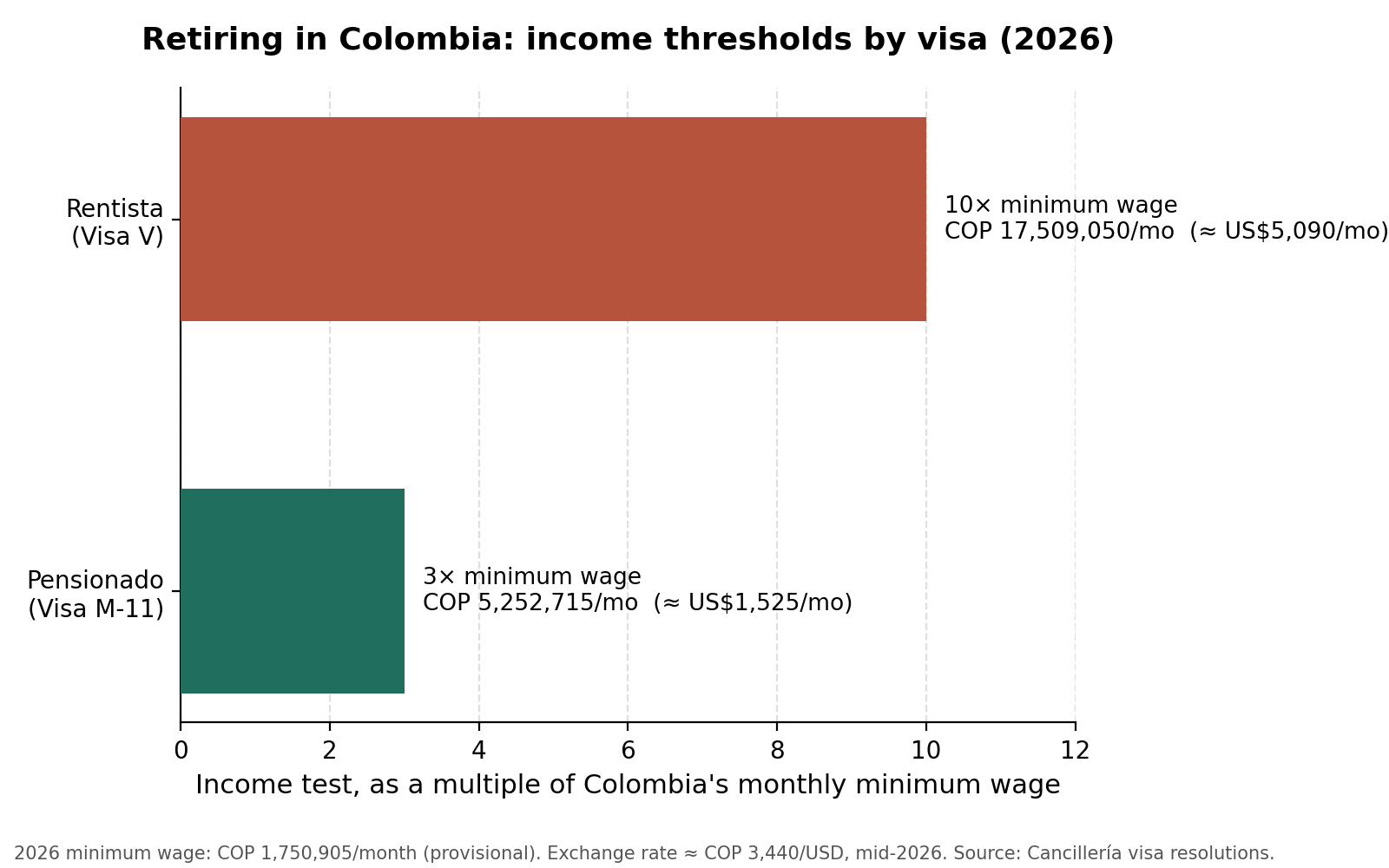
The Pensionado visa (now Visa M, sub-category M-11) is for people drawing a pension. That includes government pensions, Social Security retirement and employer or private pensions. The income test is three times Colombia’s monthly minimum wage. The Rentista visa (now Visa V) is for people living on other fixed, passive income such as investment returns, annuities, dividends or rental income, but not a salary from ongoing employment. Its income test is much steeper, at ten times the minimum wage.
Here is the part the old guides miss. Rentista used to be a migrant (M) visa; the 2022 restructure reclassified it downward to a visitor (V) visa. The practical consequence is significant: time spent on a Rentista visa no longer counts toward permanent residency, whereas time on the Pensionado (M-11) does. If your goal is to settle for good, the pension route is the one that builds toward an R (resident) visa; the rentista route, as it now stands, does not.
| Pensionado (Visa M-11) | Rentista (Visa V) | |
|---|---|---|
| Who it is for | Pension holders (government, Social Security, employer or private pension) | People living on passive income (investments, annuities, dividends, rent), not employment |
| Income test | 3× the monthly minimum wage | 10× the monthly minimum wage |
| Monthly income (2026) | ~COP 5,252,715 (roughly US$1,525) | ~COP 17,509,050 (roughly US$5,090) |
| Visa family | M (migrant) | V (visitor) |
| Counts toward residency? | Yes, after 5 continuous years | No |
Pensionado and Rentista are not the only doors in. If you have a Colombian spouse or permanent partner, the Colombia Marriage Visa reaches residency in as little as three years, faster than either retirement route. And if you would rather put capital into property than draw down a pension or investment income, the Real Estate Visa covers that investor path.
A word on those figures. The minimum wage for 2026 was set at COP 1,750,905 a month, which is what the thresholds above are built on. That figure is currently provisional: a court suspended the original decree in early 2026 and a transitional decree kept the same number in force pending a final ruling, so it is the operative wage but not yet settled law. The US-dollar equivalents are rougher still, because they move with the exchange rate. I have used a rate of about COP 3,440 to the dollar from mid-2026; the peso strengthened notably over the preceding year, so many competing pages quote lower dollar figures built on a weaker, older rate. Do not treat the dollar amounts as fixed. Check the current rate near your application date and work from the peso thresholds, which are the ones the consulate actually applies. For the fuller picture of what that minimum wage means in practice, see Average Salary in Colombia.
Where disability benefits fit
This is a common point of confusion. Disability benefits, such as US Department of Veterans Affairs disability compensation, are generally treated as pension income under the Pensionado (M-11) route, on the basis that they are permanent, recurring, lifetime payments from a government body. That puts them alongside Social Security retirement rather than in the passive-income Rentista bucket, despite the word “disability” making some applicants assume otherwise. The benefits letter needs the same handling as any foreign pension document, meaning notarisation, apostille and an official Spanish translation. One point drawn from applicants who have been through it, rather than from the rules: some report visa officers questioning mental-health-related ratings specifically. That is anecdotal, not a written requirement, but it is the sort of thing to have documentation ready for.
How the application works, step by step
The broad process has been stable since the 2022 restructure, though the fine detail can differ between consulates and change without much notice. The route most retirees follow looks like this.
- Gather your proof of income (the pension or benefits letter) and get it notarised, apostilled and translated into Spanish by an official translator.
- Apply online through the Cancillería (Ministry of Foreign Affairs) visa portal, uploading your documents and photo.
- Pay the study fee, a modest amount in the region of US$50, when you submit.
- Wait for the study period, which can run up to around 30 days.
- If approved, pay the visa issuance fee (higher for an M visa than a V visa) and receive the visa digitally by email.
- Once in Colombia, register with Migración Colombia for your Cédula de Extranjería (the foreigner ID card) within 15 calendar days.
That last step is easy to miss and it is the one I would set a reminder for. Missing the 15-day Cédula registration window brings a financial penalty. Sources agree the fine is material rather than a token amount, but they disagree on the exact figure (estimates I found ranged from a fraction of one minimum wage up to several times it), so I will not quote a precise number here. The safe reading is that it is large enough to hurt and easily avoided by registering promptly. The Cédula is also what unlocks enrolment in the health system, so there is a practical reason beyond the fine to get it done early.
Common pitfalls
The single biggest trap when retiring in Colombia is outdated information. Colombia’s requirements changed materially in 2017 and again with the 2022 restructure and a great deal of guidance online, including some otherwise useful expat sites, still describes the old system. The Rentista-is-a-migrant-visa error above is the clearest example. Consulate practice can also vary from post to post, which means two applicants can receive different instructions. The habit that serves people best is to verify anything that matters directly with a Colombian consulate or an immigration lawyer, rather than trusting the first article that ranks.
Couples hit a specific version of this. Some report being told that both partners must independently meet the income threshold for a Pensionado visa, rather than one qualifying as the primary earner and the other joining as an economically dependent beneficiary. Other applicants describe the opposite. It appears to be one of those points where consulates are inconsistent, so if you are applying as a couple, confirm how your specific consulate treats it before assuming either answer.
The last pitfall is unofficial “helpers.” Plenty of legitimate facilitators exist, but the process is also fertile ground for people who invent requirements or inflate costs and agencies pushing an unnecessary insurance policy onto a foreigner as a supposed requirement is a documented pattern. One account describes a facilitator presenting an expensive travel-insurance policy, well over a thousand US dollars, as a supposed visa requirement that the applicant could not confirm was actually demanded by the government. I would treat any single-source requirement that only your facilitator seems to know about as a prompt to check it against the official portal or a lawyer before paying.
Healthcare once you are resident
For most retirees the excellent Colombian health system is a large part of the appeal and the mechanics are straightforward once the visa is sorted. Enrolment in Colombia’s public and hybrid schemes runs off your Cédula, so the sequence is visa first, then residency registration, then health cover. The care itself is well regarded and inexpensive by home-country standards, which is why so many people weigh Colombia against cheaper-but-thinner options and land here. Because it deserves proper treatment rather than a paragraph, the detail lives in its own guide, Healthcare in Colombia for Expats.
The limits of this guide
What this cannot do is stand in for current, case-specific advice and the reasons are built into how Colombia sets its rules. The income thresholds are pegged to the minimum wage, which is reset every year, so the peso figures above will be wrong within twelve months and the dollar figures are already only as good as today’s exchange rate. The 2026 wage itself is under legal challenge as I write. Consulate practice varies and the government amends the visa resolutions periodically, as it did in 2024. None of that makes the overall picture unreliable, but it does mean the precise numbers and steps should be confirmed against the Cancillería portal or an immigration lawyer before you commit money or book flights. If you are choosing between the two routes with residency in mind, that confirmation is worth paying a professional for. That said, this guide is not a substitute for advice on your own situation.
Frequently asked questions
How much income do you need to retire in Colombia?
For the pension-based Pensionado visa, you need income of three times Colombia’s monthly minimum wage, which works out to roughly COP 5.25 million a month in 2026, in the region of US$1,500 depending on the exchange rate. The passive-income Rentista visa is far higher at ten times the minimum wage, roughly COP 17.5 million a month, or around US$5,000. Because the minimum wage is reset yearly, check the current figure near your application date.
What is the difference between a Pensionado and a Rentista visa?
The Pensionado (Visa M-11) is for people drawing a pension and needs income of three times the minimum wage. The Rentista (Visa V) is for people living on passive income such as investments or rent and needs ten times the minimum wage. The other key difference is that the Pensionado is a migrant visa whose years count toward permanent residency after five years, while the Rentista is now a visitor visa and does not build toward residency.
Is Colombia a good place to retire?
For retirees whose main pressures are cost of living and healthcare, it is a strong option: living costs are well below most home countries, care is good and inexpensive once you are enrolled and the climate can be chosen by altitude rather than endured by season. The trade-offs are the paperwork, which is more changeable than in some countries and the value of learning some Spanish. I have also found there is an incredible amount of things to do and the people are truly very welcoming. Whether it suits you comes down to your income route and how permanently you want to settle.
Can I get permanent residency in Colombia as a retiree?
Yes, but the route matters. Five continuous years on the Pensionado (M-11) visa makes you eligible to apply for the R (resident) visa. Time on the Rentista visa does not count toward residency at all, because the 2022 restructure reclassified it as a visitor visa. If long-term settlement is the goal, the pension route is the one that builds toward it.
Sources
- The 2017 visa framework (Resolución 6045) that first created the V/M/R system: ICBF legal compilation.
- The 2022 restructure (Resolución 5477) that reclassified the Rentista visa: Cancillería, official text.
- The Pensionado (M-11) visa’s terms: Cancillería, Special Temporary Pensioner’s Visa.
- The Rentista visa’s income test and its exclusion from residency: Medellin Lawyer, on the Rentista visa.
- Disability benefits as qualifying pension income and consulate scrutiny of mental-health ratings: Medellin Lawyer, on the Pension visa.
- Visa study and issuance fees: Cancillería, Costs, means of payment and service offices.
- The 30-day study period: Colombia Law Connection, on visa processing time.
- The 15-day Cédula de Extranjería registration window: Servicio Legal; the penalty for missing it (figures vary by source): Expat Group, on Migración Colombia fines.
- The 2024 amendments to the visa resolutions: Infobae.
- The 2026 minimum wage figure, COP $1,750,905: Presidencia de la República.
- The court suspension of the 2026 wage decree: Holland & Knight, on the Consejo de Estado’s provisional suspension; the transitional decree that kept the figure in force: Decreto 159 de 2026.
- The peso/dollar exchange rate (TRM) used for the US-dollar conversions: Banco de la República.
- The pattern of facilitators upselling unnecessary insurance policies as a supposed visa requirement: Colombian Visa Services, on avoiding scams.

