
Most people weighing a move to Medellín arrive with one number in their head. It came from a video, a forum post, or a friend of a friend and it is almost always someone else’s neighbourhood in someone else’s year. That is the problem behind the question of what the cost of living in Medellín actually is. The city does not have a single answer, because the gap between its cheapest and priciest barrios is wider than the gap between many whole cities.
Our national guide, Cost of Living in Colombia: A 2026 Budget Guide, sets the countrywide picture. This article does the opposite job. It stays inside Medellín and looks at how much your budget shifts once you choose where in the city to live. I have a second home in Colombia so some of what follows is first-hand and some is drawn from current 2026 figures. I have tried to be clear about which is which.
One note on currency before the figures. Most cost-of-living data for Colombia is quoted in US dollars, so I have kept that convention and added Colombian pesos (COP) where it helps. As of early July 2026 the officially certified TRM exchange rate was trading around COP 3,250 to COP 3,350 to the US dollar and across 2026 as a whole it has ranged from about COP 3,250 to COP 3,800. That swing alone moves a dollar-denominated budget by more than fifteen percent, so keep it in mind as you read.
Rent varies more by neighbourhood than by city
Rent is where Medellín’s averages become close to useless. The crowd-sourced site Numbeo puts a one-bedroom flat in the city centre at around COP 2.99 million a month (roughly US$870) and one outside the centre at about COP 2.11 million (US$610) as of its July 2026 update. Those numbers are a starting point, but the barrio you choose pulls you a long way either side of them.
El Poblado — the priciest and the most expat-dense
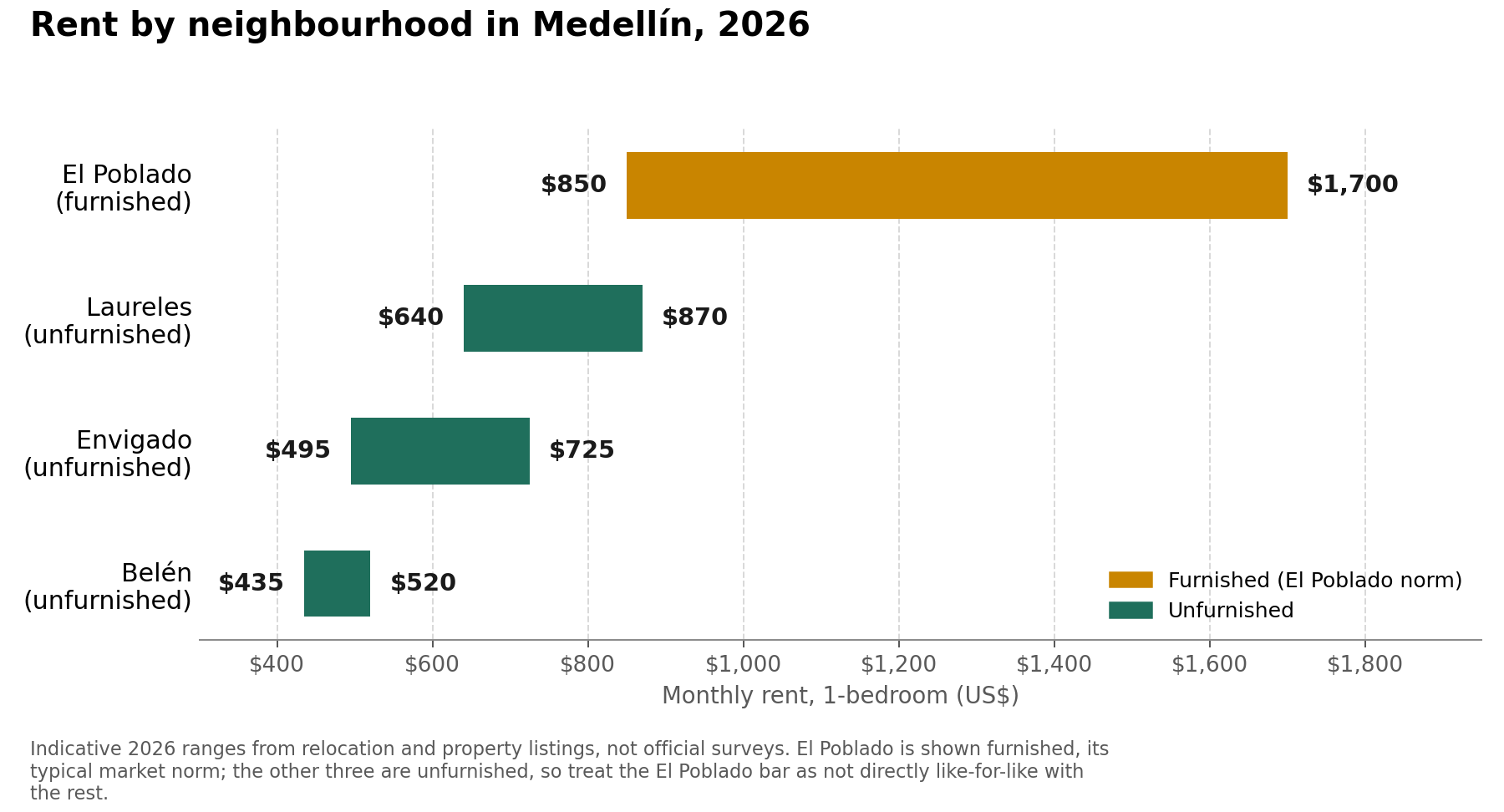
El Poblado is where most newcomers land and it carries a premium for it. According to Colombia Move’s 2026 neighbourhood rent survey, a furnished one-bedroom here runs roughly COP 4.5 to 7 million a month (about US$1,100 to US$1,700), with furnished two-bedrooms running higher again, in the region of US$1,300 to US$2,400 and the Manila, Provenza and Poblado Lleras micro-zones a further 15 to 25 percent above that. It is walkable, green, full of cafés and coworking spaces and priced accordingly. In my time there, El Poblado is the one part of the city that consistently feels priced for outsiders rather than locals and by some accounts a comparable flat costs more here than its equivalent in Bogotá.
Laureles — mid-range, more local, increasingly popular
Laureles is the neighbourhood most people move to once El Poblado’s prices sink in. It is flatter, more residential and more Colombian in feel, with a one-bedroom typically quoted at US$640 to US$870 unfurnished (about COP 2.2 to 3 million), per Colombia Move’s 2026 rent survey. You give up some of El Poblado’s polish and pick up an everyday-Medellín feel, along with a smaller monthly outlay.
Envigado and Belén — quieter and more space for the money
Envigado is technically its own municipality on Medellín’s southern edge, quieter and more family-oriented, where a one-bedroom typically runs COP 1.7 to 2.5 million (roughly US$495 to US$725) and a two-bedroom often runs COP 2.3 to 3.5 million (roughly US$670 to US$1,015). Belén, a mostly residential barrio west of the river, sits lower again, with one-bedrooms around COP 1.5 to 1.8 million (about US$435 to US$520). Neither is an expat hub, which is rather the point if your priority is a longer stay on a steadier budget. These suburb-level figures come from Colombia Move’s 2026 rent survey and other relocation and property blogs rather than official surveys, so treat them as informed ranges, not precise readings.
One Colombia-specific mechanic sits underneath all of this. Every address carries an estrato, a socioeconomic rating from 1 to 6 that sets how much you pay for utilities, with lower strata subsidised and higher ones surcharged, under the national framework DANE (Colombia’s national statistics agency) publishes for this system. Most housing that suits an incoming expat sits in estrato 4 to 6, which means the same flat in a higher stratum can carry noticeably steeper utility bills. It is not something you meet in most countries, so ask a landlord about it before signing.
Everyday costs — groceries, dining, transport, utilities
Away from rent, Medellín is where a modest income stretches. A meal at an inexpensive restaurant runs around COP 25,000 (about US$7) and the standard set lunch, the menú del día, often lands below that. Groceries reward cooking at home. Numbeo’s crowd-sourced basket puts milk at roughly COP 4,300 a litre, a dozen eggs near COP 8,900 and a kilo of chicken around COP 28,000. For a single person cooking most meals, a grocery budget of US$200 to US$300 a month is a workable planning figure, though it climbs quickly if you lean on imported goods.
Transport is one of Medellín’s better bargains. The Metro, the only urban rail system in Colombia, is clean, safe and cheap. A single ride costs COP 3,820 with the reloadable Cívica card (COP 4,400 in cash) after the January 2026 fare adjustment, so a little over US$1 a trip. The Cívica card itself is free to obtain from a Metro customer-service point, so there is no up-front cost to using it. Combined with the cable-car lines and an integrated bus network, most people get by without a car and a monthly transport spend of US$40 to US$60 covers a lot of movement.
Utilities are low by design and the reason is the climate. Medellín sits at around 1,500 metres and holds a spring-like temperature year-round, so almost nobody runs air conditioning or heating. Numbeo’s figure for basic utilities on an 85 square-metre flat (electricity, water, gas, rubbish) is about COP 340,000 a month, near US$100, with home internet at 60-plus Mbps adding roughly COP 99,000 (US$29). Independent expat guides land in a similar band, commonly US$70 to US$120 depending on the flat and its estrato. That is materially less than a coastal city where cooling runs constantly.
A monthly cost-of-living budget for Medellín
The table below is my own estimate for 2026, built from the figures above rather than lifted from any single source. It assumes a comfortable but not lavish life in a mid-range neighbourhood such as Laureles or Envigado, with private health cover (see Healthcare in Colombia for how that system works) and a fair amount of eating out. Someone happy in a local barrio like Belén, cooking at home, could sit well under it; anyone set on furnished El Poblado living will run above it, mostly on rent.
| Monthly expense (USD) | Single person | Couple |
|---|---|---|
| Rent (mid-range 1–2 bed) | $500 | $750 |
| Utilities (power, water, gas, rubbish) | $100 | $140 |
| Home internet | $30 | $30 |
| Groceries | $250 | $450 |
| Dining out & entertainment | $200 | $350 |
| Transport (Metro & occasional taxi) | $50 | $90 |
| Mobile phone | $15 | $30 |
| Private health cover | $60 | $120 |
| Approximate total | $1,205 | $1,960 |
These land close to figures long-time residents have described for years, with a single person living well on something over US$1,200 and a couple near US$2,000, adjusted upward for inflation and a stronger rental market since. If you want the wider picture of what daily life in the city is actually like, that sits in Living in Medellín: What It’s Actually Like (2026 Guide).
How Medellín compares to Bogotá and the coast
Medellín used to be the clear budget choice among Colombia’s big cities. That gap has narrowed and on the latest reading it has reversed. Numbeo’s live city comparison currently puts Medellín’s rents around 23 percent above Bogotá’s and its overall cost of living roughly 8 percent higher, while some month-to-month comparisons still call the two cities about level. That sits alongside a separate, structural finding from Banco de la República, reported by El Tiempo: Medellín overtook Bogotá in 2024 as Colombia’s most expensive city for rent, after Bogotá had led for most of the period since 2008. The two data sets measure different things, a live consumer-price comparison versus a longer institutional trend, but they point the same direction. Medellín is no longer reliably cheaper than the capital, especially on housing.
The Caribbean coast splits in two. Cartagena runs slightly above Medellín on cost of living including rent, pushed up by tourism and the near-constant need for air conditioning, so it is not the saving people expect. Santa Marta, further along the coast, runs meaningfully cheaper, around 19 percent lower than Cartagena on Numbeo’s comparison and is the actual budget option if coastal heat suits you. This is only an orientation; the full city-by-city weigh-up belongs in Best Place to Live in Colombia: Where Should You Settle?.
What these numbers can’t tell you
Every figure here is a range, not a precise index and there are a few reasons to hold them loosely.
- Currency movement. A budget quoted in dollars rises and falls with the peso. The officially certified TRM rate has swung by more than fifteen percent against the US dollar across 2026 alone, which changes your dollar cost without a single local price moving.
- Inflation is live. Colombia’s official statistics agency, DANE, recorded Medellín’s annual inflation at 5.06 percent in December 2025, close to the national 5.10 percent; by June 2026 that had risen to 6.98 percent for Medellín against 6.14 percent nationally, one of the highest readings of any Colombian city, as reported on the June release. Any figure in this article is a snapshot, not a fixed price.
- Neighbourhood boundaries blur. Barrios shade into one another and a street near El Poblado’s edge can price like El Poblado. The estrato system means two similar flats a block apart can carry different utility bills.
- Some of the data is crowd-sourced. Numbeo and expat-guide figures come from a self-selecting sample of travellers and newcomers, so they skew toward the expat end of the market. The DANE inflation figures are the only official numbers here and they measure change over time, not the price of any one flat.
The way I would use this article is as a planning range, then verify against actual listings for the specific barrio you are considering before you commit to anything. For the wider picture of settling in, Moving to Colombia ties this cluster together.
Frequently asked questions
What is the cost of living in Medellín per month?
For a comfortable mid-range life in 2026, budget around US$1,200 a month for a single person and roughly US$1,900 to US$2,100 for a couple. Cooking at home in a local barrio can bring that well down; furnished living in El Poblado pushes it up, mostly through rent.
Is El Poblado expensive?
It is the most expensive part of Medellín and it carries a clear expat premium. Furnished one-bedrooms commonly run US$1,100 to US$1,700 a month in 2026, well above equivalent flats in Laureles, Envigado or Belén. You pay for the walkability, the amenities and the concentration of other newcomers.
Is Medellín cheaper than Bogotá?
Not reliably any more. Medellín was long the cheaper big city, but 2026 analysis puts its overall cost of living slightly above Bogotá’s and its rents substantially higher, with housing the main driver. Day-to-day spending on food and transport remains similar between the two.
Which Medellín neighbourhoods are cheaper to live in?
Laureles offers a mid-range, more local alternative to El Poblado, while Envigado and Belén sit lower again and give more space for the money. None are expat hubs, which is part of why they cost less and, for a longer stay, part of their appeal.
Sources
- Numbeo, Cost of Living in Medellín (rent, groceries, utilities, internet) and city comparisons (Medellín vs Bogotá; Cartagena vs Medellín and Santa Marta): numbeo.com
- Colombia Move, rent in Medellín by neighbourhood (2026 prices, furnished and unfurnished): colombiamove.com
- Infobae, on Medellín’s rising cost of living versus Bogotá (Numbeo data): infobae.com
- El Tiempo, on Banco de la República data showing Medellín overtook Bogotá as Colombia’s most expensive rental market: eltiempo.com
- DANE, Índice de Precios al Consumidor, December 2025 and June 2026 (Medellín and national annual inflation): dane.gov.co / dane.gov.co
- Cambio Colombia, reporting DANE’s June 2026 inflation release (Medellín among the highest of any Colombian city): cambiocolombia.com
- DANE, Estratificación Socioeconómica (the estrato system, how it sets utility pricing): dane.gov.co
- Metro de Medellín, 2026 fare structure (Cívica card and cash fares): metrodemedellin.gov.co
- El Tiempo, on the January 2026 Medellín public-transport fare adjustment (Metro and Cívica card fares): eltiempo.com
- TRM Hoy, historical Colombian peso / US dollar exchange-rate tracker (officially certified TRM): trmhoy.co
Neighbourhood-level rent figures are drawn from relocation and property blogs rather than official surveys, so treat them as informed ranges rather than precise readings and verify against current listings for the specific barrio you are considering.

