
My wife doesn’t often try sending a package to Colombia because it generally isn’t affordable. Not long ago she made an exception and sent a light $180 puffer jacket to my mother-in-law which weighed about 260 grams. She couldn’t get one there so we thought it was worth it. Unbelievably it cost about $245 to send it via DHL but what surprised us more was that there were still other charges on the receiving end my mother-in-law had to pay on top!
It was a small parcel with an inexpensive item inside, yet by the time it reached its destination it had cost so much more we were regretting it. This article is about why sending a package to Colombia costs so much and what makes up the price.
Two exemptions people mix up
There are two separate rules that apply when sending a package to Colombia, yet they get treated as if they are one. They aren’t.
The first is the import tariff. Colombia waives the tariff (the arancel) on postal parcels valued at USD $200 or under no matter which country they come from. DIAN, Colombia’s tax and customs authority, sets this out on its own page for postal traffic and urgent shipments under Decreto 1090 de 2020. That waiver is universal. A parcel under USD $200 owes no tariff whether it was posted from Miami, Madrid or Auckland.
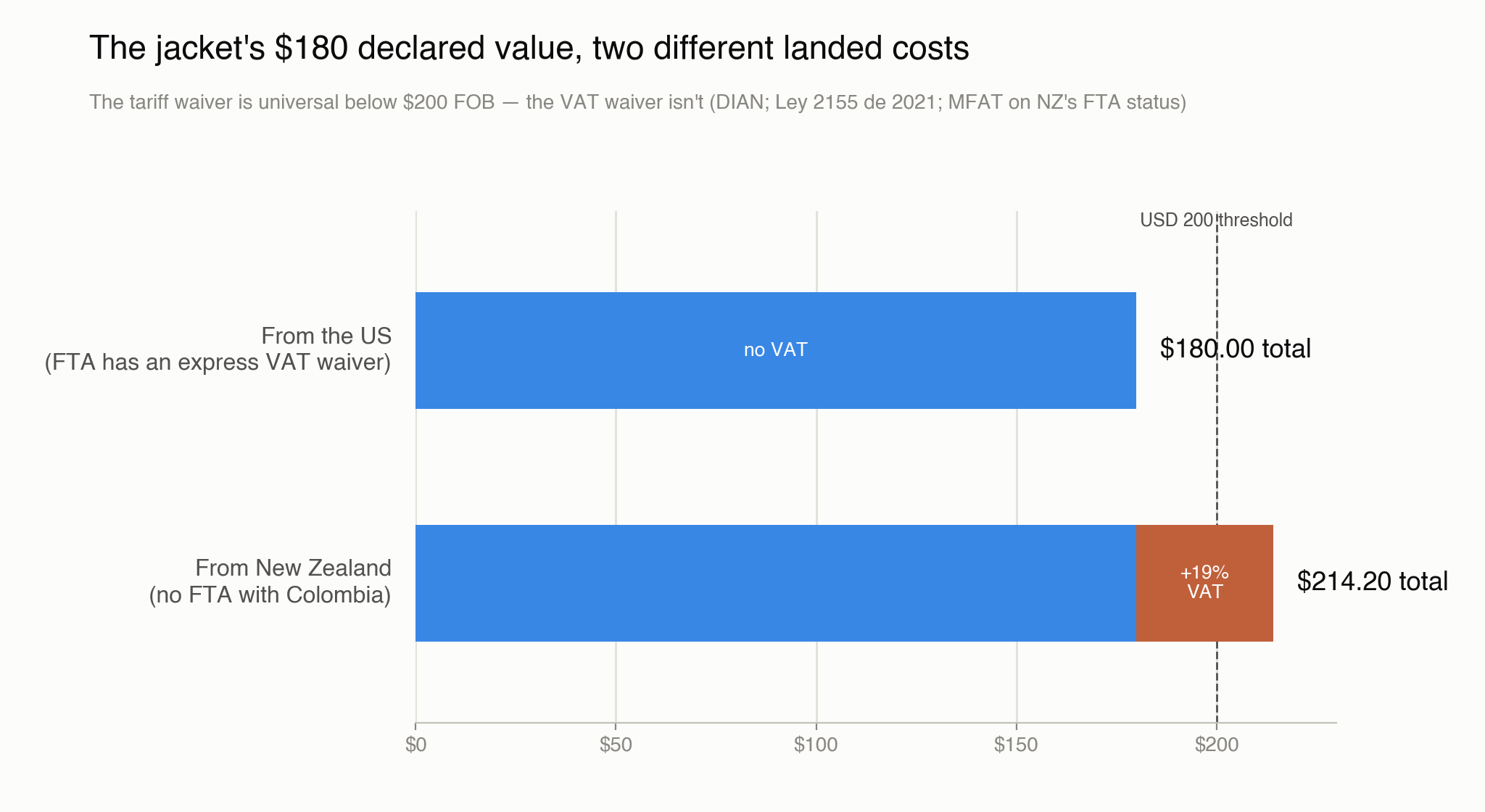
The second rule is the one we assumed came bundled with the first, yet it does not work the same way. The 19% VAT (IVA in Colombia) on a qualifying non-commercial parcel under USD $200 is only waived when the parcel comes from a country which has a free trade agreement with Colombia and even that is not the complete story. In addition, the clause has to be in the agreement as well. This mechanism sits in Ley 2155 de 2021 amended by Ley 2277 de 2022. A tax-services firm, Auren Colombia, spells out the free-trade-agreement condition in plain terms which covers the law and DIAN’s own guidance.
And unbelievably, even that is still not all of it and recipients describe this pattern over and over. Someone overseas pays to send a parcel, assumes the transaction is finished and then the person in Colombia gets a message asking for money before the parcel will be handed over. This release fee can cover the VAT owed, a customs-handling charge, a last-mile delivery cost or some mix of the three, depending on the courier and how the shipment was classified. From the receiving end it feels like paying for the customs costs twice. It is easy to miss when you are budgeting only for the postage you can see at the counter.
The United States is one of the countries that clears both hurdles because its trade agreement with Colombia carries that express VAT clause. A parcel posted from the US under USD $200 can arrive with no tariff and no VAT. It is the exception rather than the rule. Most countries (New Zealand included) do not have that clause.
Why a parcel from New Zealand doesn’t get the same break
As per the above explanation, currently New Zealand has no free trade agreement with Colombia at all. The agreement that might eventually cover it, (the New Zealand-Pacific Alliance FTA covering Colombia, Chile, Mexico and Peru), is still under negotiation according to New Zealand’s Ministry of Foreign Affairs and Trade. No signed agreement means no express VAT clause for Colombia to point at.
So a parcel sent from New Zealand clears the tariff hurdle, because the USD $200 waiver applies to every country but will still owe the 19% VAT.
One more thing worth being precise about: the USD $200 threshold is a FOB value, meaning the goods alone, and Decreto 1090 de 2020’s own text says so directly, “sin incluir los gastos de entrega” — without including delivery expenses. What the courier charges to ship the parcel has no bearing on whether the goods themselves clear the value test. The jacket’s $180 declared value is what gets checked against the $200 line, not the $180 plus whatever DHL charged to send it.
The real cost of sending a package to Colombia and why the cheapest option isn’t one
When sending a package to Colombia this size, NZ Post’s cheapest tracked service (Economy Tracked) prices it at NZD $31.49. Its Express tier is NZD $180.74. DHL quoted NZD $236.71 to $276.85 for the identical parcel, and UPS came in at NZD $379.64, all quoted 23 July 2026 and all excluding whatever Colombia charges on arrival.
The NZD $31.49 option looks like the obvious choice until you look at whether it actually turns up. My wife’s warning is corroborated by warnings from other local Colombians that most of the time these untracked options either never arrive or turn up months late. This same account recurs independently across expat forums going back two decades with DHL named again and again by posters who never spoke to each other as the carrier that actually delivers. While not 100% universal (plenty of people report years of trouble-free postal shipments), it is consistent enough that the cheap tier isn’t a real option for anything you actually want to arrive.
So the real choice is between NZ Post Express, DHL and UPS. Even UPS though is reported to be unreliable and I’d take the NZ Post option as unconfirmed, but at least that has a $10,000 insurance clause.
Common questions
Does Colombia charge import tax on packages under $200?
The import tariff is always waived under USD $200, whichever country the package comes from.
Why is a parcel from New Zealand more expensive than one from the US?
Both clear the tariff because that waiver applies to every country. Only the US clears the VAT as well, because its trade agreement with Colombia has the express clause that New Zealand does not.
Is it worth using the cheapest shipping option to Colombia?
Not for anything you actually want to arrive. When sending a package to Colombia, the cheap, untracked tier has a well-documented pattern of parcels not turning up or arriving months late. A tracked option, whether NZ Post Express or a courier like DHL, is worth the extra cost.
All of this is about sending a package to Colombia, not moving your life there. If a parcel is the easy part and you are actually weighing a full relocation, my wider guide to moving to Colombia covers the rest of it.
Sources
- DIAN, Modalidad de tráfico postal y envíos urgentes: dian.gov.co
- Decreto 1090 de 2020 (full text, via DIAN’s legal compilation), the source for the FOB/”sin incluir los gastos de entrega” wording: normograma.dian.gov.co
- Auren Colombia, Exclusión del impuesto sobre las ventas para envíos no mayores a USD 200: auren.com
- New Zealand Ministry of Foreign Affairs and Trade, New Zealand-Pacific Alliance free trade agreement overview: mfat.govt.nz
- NZ Post, live quote for a 0.26 kg parcel to Colombia, obtained 23 July 2026 via nzpost.co.nz
- DHL Express, live quote for a 0.26 kg parcel to Colombia, obtained 23 July 2026 via dhl.com/nz-en
- UPS, live quote for a 0.26 kg parcel to Colombia, obtained 23 July 2026 via ups.com

