
Most of the routes into Ireland run through the employment permit system, which means a job offer, a sponsoring employer and a salary threshold before you ever board a plane. The Ireland working holiday visa sits outside all of that. It lets a young traveller arrive first, settle in and then find work, rather than lining up the work before the move.
For a backpacker or someone early in their career it is one of the few ways to spend a year in the country on your own terms, funding the trip as you go instead of committing to a single role from the outset.
The scheme’s formal name is the Working Holiday Authorisation, or WHA and the point that matters most before you read any further is that it is bilateral. Ireland negotiates it country by country, so the terms are not uniform. Two travellers standing in the same hostel in Galway can be on the same programme with different age cut-offs, different durations and different rules about how long they may stay with one employer. A single flattened summary would mislead you. The table below sets out what each nationality actually gets.
Who is eligible and on what terms
The Ireland working holiday visa is open to a defined list of nationalities, each under a separate agreement negotiated by the Department of Foreign Affairs with that country.
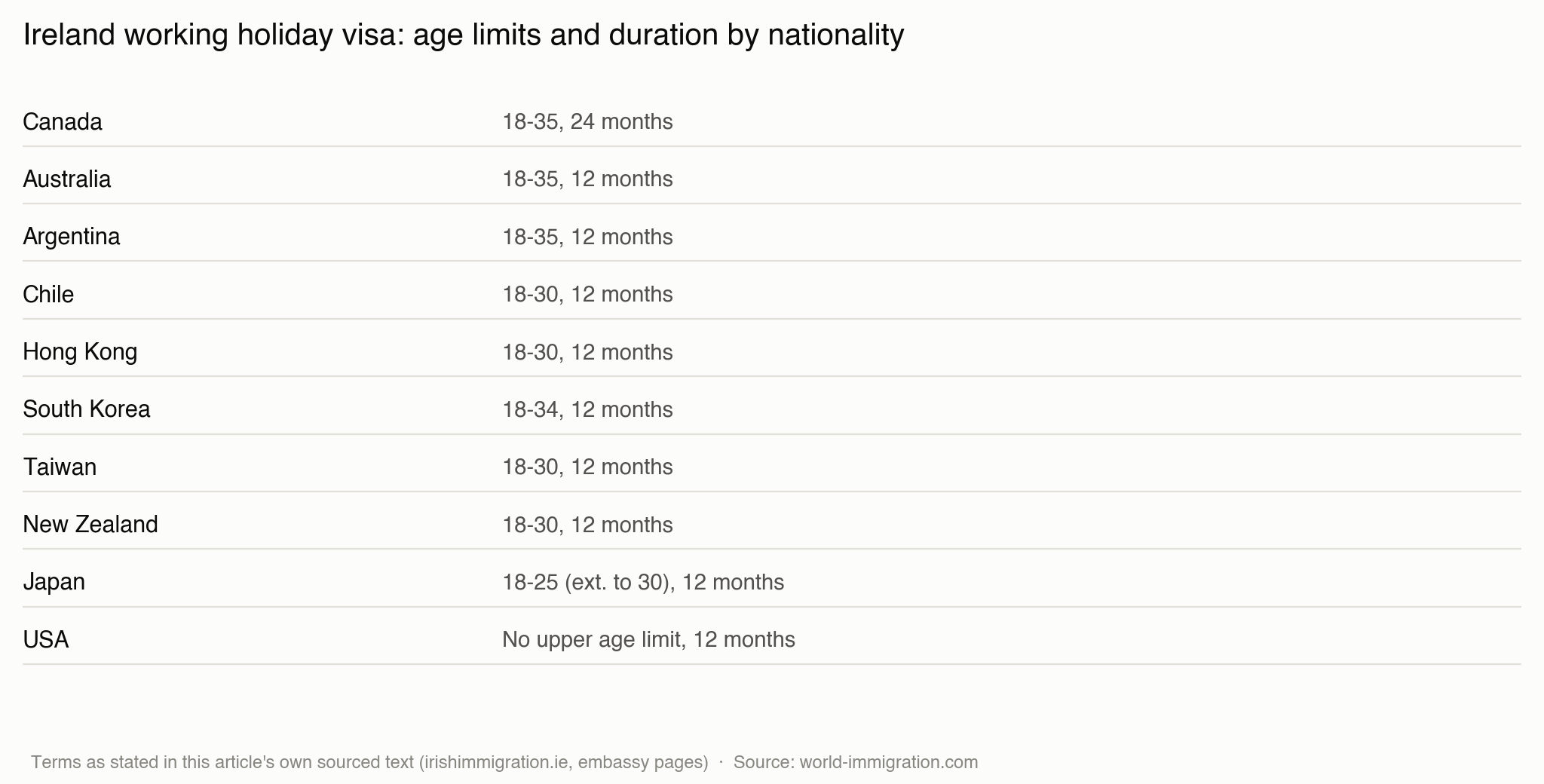
| Nationality | Age | Duration | Notes |
|---|---|---|---|
| Australia | 18–35 | 12 months | Max around 6 months per employer |
| Canada | 18–35 | 24 months | The only nationality with a two-year term |
| New Zealand | 18–30 | 12 months | Mirror of the reciprocal NZ scheme |
| Argentina | 18–35 | 12 months | Quota around 200 places |
| Chile | 18–30 | 12 months | Quota of 200 places a year (two rounds of 100), doubled from 100 in 2023 |
| Hong Kong | 18–30 | 12 months | Quota around 200 places; capped at 3 months per employer |
| Japan | 18–25 | 12 months | Extendable to 30 if currently employed or studying |
| South Korea | 18–34 | 12 months | Age ceiling raised from 30 to 34 and quota expanded to 800 places a year under a 2023 revision |
| Taiwan | 18–30 | 12 months | Quota around 400 places a year; 2026 applications opened 1 November 2025 |
| USA | No upper age limit | 12 months | Education-gated, not age-based — see below |
Three of these terms changed recently enough to flag directly. Chile’s quota doubled from 100 to 200 places a year in 2023, per the Embassy of Ireland in Chile. South Korea’s scheme was revised with effect from 29 March 2023, raising the age ceiling from 30 to 34 and expanding the quota to 800 places a year, per the Embassy of Korea in Ireland. Taiwan’s 2026 window opened on 1 November 2025, confirmed on the Department of Justice’s own 2026 application form.
The United States entry is the outlier, there is no age band because eligibility rests on your studies, not your birthday. You must be enrolled full-time in post-secondary education, or have graduated within the previous twelve months, to qualify, per the Embassy of Ireland in the USA.
The authorisation then runs twelve months and unlike Hong Kong or Taiwan it carries no published annual quota or fixed opening date: applications go directly to the relevant US Consulate General or Embassy at any time, in a two-stage process (initial eligibility documents, then return tickets and insurance once approved in principle). Treat it as a graduate-and-student route rather than the open backpacker scheme the other nationalities enjoy.
The separate US-Ireland J-1 summer scheme
Americans reading about Ireland will run into a second programme that is easy to confuse with the WHA, so it helps to separate them clearly. Alongside the year-long Working Holiday Authorisation there is an older US-Ireland Holiday Working Agreement, which also covers a J-1-style summer work-and-travel scheme running the other way. That one is for Irish students travelling to the United States during their summer break, arranged through sponsor organisations rather than applied for directly, not for Americans coming to Ireland.
The J-1 route is arranged through Irish partner agencies such as SAYIT and USIT, working with US State Department-designated sponsors CIEE and InterExchange, who actually issue the DS-2019 sponsorship document. With that in hand the Irish student then obtains the actual US visa from the US Embassy in Dublin or the Consulate in Belfast.
The way I would think about it is: the WHA is the full-year authorisation Americans apply for themselves to work in Ireland, while the J-1 summer programme sends Irish students the other way to the United States on a shorter, sponsor-managed scheme. If you are American and planning a trip to Ireland, the WHA above is your route; the J-1 detail here exists only so you do not confuse the two.
Money, insurance and the admin
Across nationalities the financial and administrative requirements are broadly consistent, even where the age and duration differ. The proof-of-funds figure is tied to whether you already hold a return ticket. Expect to show around €1,500 if you have a return flight booked, or around €3,000 if you do not — the baseline figure used for the US route, though several nationalities set their own local-currency amount instead (Australia AUD 2,500/5,000, New Zealand NZD 2,500/5,000, Taiwan a flat €4,000 bank statement plus separate medical-insurance proof).
Hong Kong is the largest outlier, where the consulate asks for HKD 40,000 with a return ticket or HKD 60,000 without, roughly €4,480–€6,720 at current exchange rates. The larger sum covers the cost of getting yourself home should the year not go to plan.
- Proof of funds of roughly €1,500 with a return ticket, or around €3,000 without one (Hong Kong is a notable exception, at HKD 40,000/60,000)
- Health or medical insurance covering your stay
- A passport that meets your own nationality’s specific validity rule, which varies a great deal — for example at least three months beyond your planned departure date for Australians, a full year beyond your date of entry for US citizens, or 15 months from the authorisation’s issue date for Hong Kong applicants
- A clean police or criminal record
- An application lodged at your home-country Irish embassy or consulate
Taiwan is the exception on where you apply. Taiwanese applicants go through Immigration Service Delivery (formerly the Irish Naturalisation and Immigration Service, INIS) rather than an embassy. Processing times vary by nationality and run well under that in most cases — around 15 working days for Australia, 20 working days for Hong Kong and four to six weeks for Canada — and the fee also varies depending on your agreement, so budget for both the wait and the cost when you plan your departure.
Because official fee and quota figures change from year to year, my advice is to confirm the exact numbers with the relevant embassy or the Irish immigration service before you commit to travel dates.
What work you can actually do
The appeal of the scheme is how little it restricts the kind of work you take on. Under the WHA there is no limit on the type of legal employment you may do, which is what makes it suit hospitality, retail, seasonal farm work, office temping or anything else you can find once you arrive. The constraint is not the job, it is the duration with any one employer.
Most nationalities are capped at around six months with a single employer, which nudges the programme towards short-term and seasonal roles rather than a settled year-long post. Hong Kong holders face a tighter cap of three months per employer. The design is deliberate: the authorisation is meant to fund a holiday, not to become a back-door route into permanent employment with one company.
One point I will not overstate either way is self-employment. The available sources do not document it clearly, so rather than guess I would put that question directly to the embassy if working for yourself is part of your plan.
What the working holiday visa does not do
WHA holders are on Stamp 1 and they are explicitly barred from changing or upgrading their immigration status while inside Ireland. You cannot move from the working holiday authorisation to a Stamp 4, nor can you switch onto a General Employment Permit or a Critical Skills Employment Permit from within the country. If a job you take turns into something an employer wants to sponsor long-term, the sponsorship still has to be applied for from outside the state.
Two further limits follow from that. When the authorisation expires you must leave Ireland; to come back on a different footing you would apply for fresh permission from abroad. And the time you spend on a working holiday does not count towards permanent residency or citizenship. It is a year in the country and a year of work, but it does not build the residence clock that longer-term migrants rely on. Go in treating it as a self-contained trip and you will not be caught out when the twelve months are up.
The reciprocal side: Irish citizens and New Zealand
Because these agreements are bilateral, the traffic runs both ways. Irish citizens aged 18 to 30 qualify for the mirror-image New Zealand Working Holiday Visa, a twelve-month authorisation on the same principle. The mechanics differ slightly at the edges: the holder must enter New Zealand within twelve months of the visa being issued and the twelve-month clock then starts from the actual date of entry rather than the date of issue. It is context more than the focus here, but it shows the symmetry these schemes are built on.
This article is part of our Ireland cluster, which covers the full move end to end.
Frequently asked questions
How long can I stay on the Ireland working holiday visa?
For most nationalities the authorisation runs twelve months. Canada is the single exception with a two-year term. When the period ends you must leave Ireland, since the permission cannot be extended or converted from inside the country.
Can I switch to a work permit while I am in Ireland?
No. WHA holders are on Stamp 1 and are barred from changing their immigration status in-country. Any move to a Stamp 4, a General Employment Permit or a Critical Skills Employment Permit has to be applied for from outside the state, even where an employer is willing to sponsor you.
Is the US Working Holiday Authorisation the same as the J-1 summer programme?
No, they are two different schemes and they run in opposite directions. The US WHA is the year-long authorisation Americans apply for themselves to work in Ireland, open to students and recent graduates with no upper age limit. The J-1 summer work-and-travel programme is the shorter scheme that sends Irish students the other way, to the United States, run through sponsor organisations using DS-2019 sponsorship, with the visa issued by the US Embassy in Dublin or the Consulate in Belfast. If you are American planning a move to Ireland, the WHA is the one that applies to you.
Does time on a working holiday count towards residency?
No. A working holiday year does not count towards permanent residency or citizenship in Ireland. If longer-term settlement is your aim, treat the WHA as a standalone trip and plan a separate route from outside the country afterwards.
Sources
Several of the official pages block automated access, so treat these as the authoritative places to confirm current fees, quotas and application windows directly before you apply.
- Irish Immigration Service, Working holidays in Ireland — irishimmigration.ie
- Department of Foreign Affairs, Working Holiday Authorisation (overview of all partner countries) — ireland.ie
- Embassy of Ireland, Chile — increase in Working Holiday Agreement places to 200 a year — ireland.ie
- Embassy of Ireland USA, Working Holiday Authorisation — ireland.ie
- Ireland.ie, US-Ireland Holiday Working Agreement (J1) — ireland.ie
- US Department of State (BridgeUSA) — designated Exchange Visitor Program sponsors
- Embassy of Ireland, Australia — Working Holiday Authorisation
- Embassy of Ireland, Canada — Working Holiday Programme
- Embassy of Ireland, New Zealand — Working Holiday Authorisation
- Embassy of Ireland, Hong Kong — Working Holiday Authorisation
- Embassy of Korea, Ireland — Working Holiday Programme
- Department of Justice — WHA 2026 Application Form (PDF)
- Citizens Information, Working Holiday Visas in Ireland — citizensinformation.ie
- Immigration New Zealand, Ireland Working Holiday Visa (the reciprocal NZ side) — immigration.govt.nz

