
If you have reached a guide titled “moving to Ireland”, your choice is probably half-settled already. Maybe a job offer landed, maybe a partner is Irish, maybe you have simply had enough of wherever you are and a small English-speaking island on the western edge of Europe has started to look like the answer.
What most people want at this stage is not persuasion but orientation: what the place actually is, what it will cost, what nobody warned them about and what they need to sort out before the flights get booked. That is what this article is for. It sits at the top of a larger set of Ireland guides on this site and points you toward the detailed ones as they become relevant.
Two things shape almost every decision that follows. The first is your passport, because moving to Ireland is a formality for some nationalities and a permit application for others. The second is housing, which is the single hardest part of settling in the country right now and the part newcomers consistently underestimate. Get your head around those two early and the rest is manageable.
What Ireland actually is, in numbers
The figures below come from the Central Statistics Office (CSO) and the Residential Tenancies Board (RTB), the two bodies that publish the official counts most relevant to anyone relocating.
- Population: 5,458,600 (CSO, April 2025) — a small country by European standards, growing quickly through migration.
- Capital and largest city: Dublin. County Dublin holds roughly 1.57 million people, about 28.7% of the country (CSO, April 2025) and the Greater Dublin Area around 2.07 million, close to 40.5% of the national population (CSO, Census 2022).
- Languages: English is the everyday language for the vast majority. Irish (Gaeilge) is the first official language and about 39.8% of people reported some ability to speak it in Census 2022, though only around 72,000 use it daily outside the education system.
- Average rent: roughly €1,750 to €1,780 a month for registered new tenancies nationally (RTB Rent Index, Q4 2025). Asking rents on fresh listings run higher and Dublin sits well above the national figure.
- Earnings: average gross weekly earnings of about €1,012 to €1,076 (CSO, late 2025 to early 2026), which annualises to roughly €52,000 to €56,000. The median is much lower, closer to €38,000 (CSO Earnings Analysis, 2024) — more on that gap below.
- Climate: temperate oceanic — mild, damp, changeable, no real temperature extremes and a lot of rain.
- Currency: the euro, adopted as book money on 1 January 1999 and in notes and coins from 1 January 2002 (Central Bank of Ireland).
- EU status: a full member since 1 January 1973 (CSO), but not part of the Schengen Area — a distinction that matters, covered in the next section.
One caveat on the economics before you read too much into the headline numbers. Ireland’s GDP is heavily distorted by the accounting of large US multinationals — Apple, Meta, Google and a cluster of pharmaceutical firms run European operations here, drawn in part by a 12.5% corporate tax rate (Revenue).
Both the Irish Times and Euronews have cautioned against reading Irish GDP at face value, pointing out that a large share of it reflects the tax and accounting activity of multinationals rather than the underlying domestic economy (Irish Times, Euronews). Corporation tax receipts, projected at more than €35 billion for 2026 and enough on their own to cover most of the health and education budgets, are concentrated in a handful of companies (Irish Times) and the European Commission warned in June 2026 that this reliance on so few taxpayers poses a risk to the stability of Ireland’s public finances (Irish Times). For your purposes the takeaway is simple: the country is genuinely prosperous, but the averages are pulled upward by a slice of the economy most residents never touch.
The EU, the Common Travel Area and why Ireland is not in Schengen
Ireland joined what was then the EEC on 1 January 1973, alongside the United Kingdom and Denmark (CSO) and it is today a full member of the European Union. That means citizens of the EU, the wider EEA and Switzerland have freedom of movement: they can move to Ireland, live there and work there with no visa at all.
Where the confusion creeps in is Schengen. Ireland is not in the Schengen Area, the zone of European countries that abolished internal border checks. The Amsterdam Treaty (1997) gave Ireland and the United Kingdom a Schengen opt-out and that opt-out was tied to preserving something older: the Common Travel Area, or CTA. The CTA predates the EU and links Ireland, the United Kingdom and the Crown Dependencies (Citizens Information).
Under it, Irish and British citizens can move, work, study, vote and access welfare and health services across both jurisdictions, with no routine passport control travelling between Ireland and the UK. It was reaffirmed by a UK-Ireland Memorandum of Understanding in May 2019 and recognised in the EU-UK Withdrawal Agreement’s Ireland and Northern Ireland Protocol after Brexit, according to Citizens Information.
The practical upshot: if you are British you have close to the same rights as an Irish citizen through the CTA. If you are from elsewhere in the EU or EEA you have freedom of movement into Ireland but should not assume a Schengen visa or a Schengen entry covers you — it does not. And if you are from outside all of that, Ireland is a separate immigration system with its own permits.
Dublin and everywhere else
Ireland is small enough that you can drive across it in an afternoon, but the split between Dublin and the rest of the country is real and it will affect where you end up. Close to two in five people live in the Greater Dublin Area (CSO, Census 2022) and that concentration drives the jobs market, the rents and the pace of life. Most multinational employers are in or around Dublin, salaries there run higher and so does the cost of living, with rents that outstrip the national average by a wide margin.
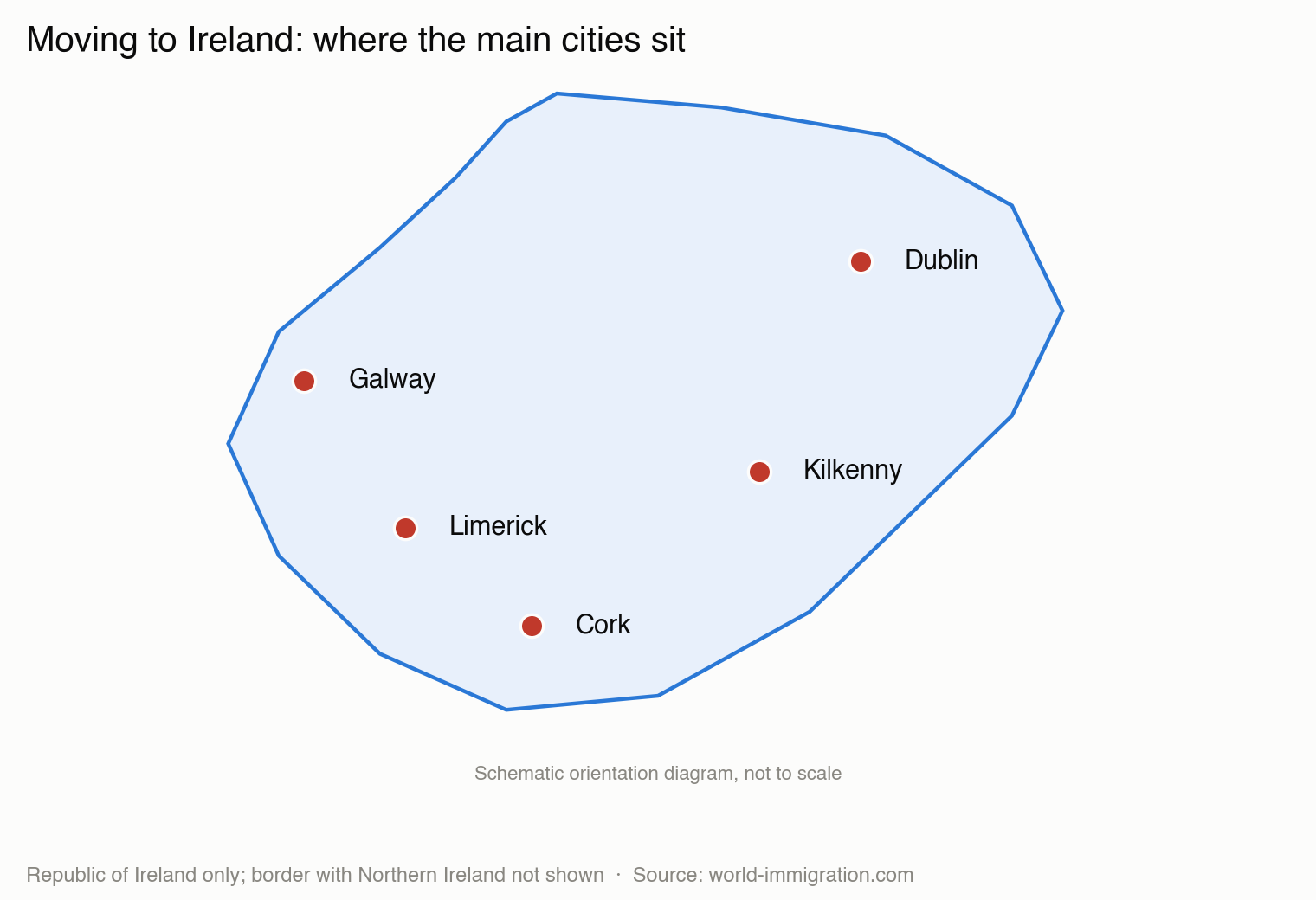
Outside the capital the picture changes. Cork, in the south, is the second city and has its own pharmaceutical and tech base. Galway on the west coast is smaller, younger and closer to the wilder Atlantic scenery people picture when they think of Ireland. Limerick and Kilkenny give you a sense of the mid-sized and smaller towns where housing is easier and life is quieter.
My read is that the trade-off most newcomers face is between Dublin’s job density and everywhere else’s affordability and space. If your role ties you to a Dublin office, you take Dublin’s housing market with it. If your work is remote or flexible, the rest of the country opens up and your money goes considerably further.
One geographic detail to know is that rainfall varies a lot across the island. Dublin sits on the drier east coast and takes roughly 700 to 900mm of rain a year. The west coast is markedly wetter, in the region of 1,000 to 1,250mm. That is a genuine regional difference rather than just national colour and if grey damp weather wears on you it is a factor in where you choose to settle.
What surprises people who move here
Every country has a gap between the brochure and the lived reality. In Ireland the gap tends to show up in a few consistent places and aggregated newcomer sentiment lines up closely with the official data on each.
Housing is the hard part. The rental shortage is severe — Daft.ie’s Q1 2026 report put Dublin’s rental vacancy rate at close to 1%, among the tightest on record (Daft.ie Rental Report, Q1 2026). Viewings for a well-priced flat can draw dozens of applicants and landlords can pick and choose in a way that leaves newcomers without an Irish rental history at a disadvantage. This is the single issue I would sort out before anything else.
What I would do here is line up short-term accommodation for the first month or two rather than assume you will walk into a lease on arrival and start the search well before you land. The detail on rents, deposits and tenant rights sits in the dedicated renting guide in this cluster.
The cost of living is higher than most expect. Ireland ranks as the second most expensive country in the EU, with consumer price levels around 36% above the EU average in 2025 (Eurostat) and that is before the rent. Groceries, eating out, energy and services all sit above the European average. The prosperity is genuine but so is the outlay and the two-speed economy means the tech-and-pharma salaries that make the averages look comfortable are not what most people earn.
Healthcare exists but is not instant. The public system runs through the Health Service Executive (HSE). It is there and it works, yet waiting times for non-urgent treatment are a longstanding problem, which is why around 46% of the population also carries private health insurance to sit alongside the public entitlement (Health Insurance Authority, via RTÉ). If you are moving from a country with fast public healthcare, the wait for routine procedures is an adjustment. The expat healthcare guide in this cluster goes into how the public and private layers fit together.
The pub is community infrastructure. This one surprises people in a good way. The local pub in Ireland is not simply somewhere to drink; it functions as a social hub, a meeting point and, in smaller places, a genuine centre of local life. For a newcomer without a ready-made network it is often the fastest route into one.
The weather is a slow adjustment. Not the cold — Ireland rarely gets truly cold or truly hot — but the persistent grey and damp. If you are coming from a sunnier climate, the changeable skies and short winter days take some getting used to. Plenty of people will settle in fine and a few will genuinely struggle with it.
Moving to Ireland from the US, or from further afield
If you are coming from outside the EU, EEA or Switzerland — the United States, Canada, Australia, South Africa, India and so on — Ireland is a separate immigration system and you will need permission to live and work there. A US passport lets you enter for a short visit without a visa, but that is a visit, not the right to settle or take a job. For that you generally need an employment permit, administered by the Department of Enterprise, Trade and Employment, or another qualifying immigration permission through the Department of Justice’s immigration service at irishimmigration.ie, with tax registered separately through Revenue once you start earning.
The route depends entirely on your situation. A skilled job offer usually points toward a Critical Skills or General Employment Permit. Younger applicants from certain countries may qualify for a working holiday arrangement. Students, retirees and people claiming Irish ancestry each have their own path. Rather than compress all of that into a paragraph and get it half-right, the way I would go is to read the specific visa and permit guides in this cluster, which set out each option and its conditions in full. The pointers at the end of this article link them.
One point I would lean toward flagging for anyone with Irish heritage: citizenship by descent is a genuinely wide door. If you have an Irish-born grandparent, you may be entitled to Irish citizenship and, with it, the same free movement an EU passport carries. It is one of the more generous ancestry provisions in Europe and it can change your entire immigration picture, so check it before assuming you need a permit.
Moving to Ireland with a family
If children are coming with you, two things deserve early planning: schools and childcare. School places, especially in popular areas around Dublin, are worth securing as far ahead as you can rather than sorting on arrival. Childcare is the bigger financial shock. Childcare costs in Ireland rank among the highest in Europe (The Journal) and a full-time crèche place in Dublin commonly runs €1,100 to €1,400 a month before any state subsidy is applied, according to a county-by-county parent survey (Newstalk); costs outside Dublin are typically lower.
There are subsidy schemes that bring the net figure down, but the gross cost is high enough that it should feed directly into your salary calculations rather than being treated as a detail. The fuller breakdown of family costs, schooling options and the subsidies you can claim sits across the cost-of-living and visa guides in this cluster, which I would read before you commit to a city or a neighbourhood.
A note on salaries before you plan a budget
Because the salary question drives everything else, it is worth being precise about it even here. The CSO’s headline average earnings of around €52,000 to €56,000 a year sit well above what a typical worker takes home. The CSO’s own Earnings Analysis using Administrative Data Sources for 2024 puts median weekly earnings at €730.89, roughly €38,000 a year, against a mean of €942.73, about €49,000.
That gap is the two-speed economy in one line: multinational tech, pharma and finance pay lifts the average, while the median reflects what most people actually earn. When you budget for moving to Ireland, plan around the median for your sector rather than the national headline. The dedicated average-salary guide in this cluster breaks the figures down by industry and region.
What this guide cannot tell you
This is an orientation, not personalised advice and a few things sit outside what any general guide can settle for you. Your exact immigration route depends on your nationality, your job and your family circumstances and permit rules and thresholds change — confirm the current position on irishimmigration.ie or with a solicitor via the Law Society of Ireland’s Find a Solicitor register before you rely on it.
Tax residency and how your income is treated is a matter for Revenue and, if your affairs cross borders, an accountant who understands both countries. Rents and childcare costs change and the figures here reflect the most recent official releases at the time of writing rather than a quote for your situation. Treat this article as the map and the cluster guides plus get a professional adviser for the detail.
What to read next
This is the hub for the Ireland cluster. Depending on where you are in your decision, these are the guides to go to next:
- Is Ireland a good place to live?
- Average salary in Ireland
- Cost of living in Ireland
- Cost of living in Dublin
- Life in Ireland
- Best place to live in Ireland
- Renting in Ireland
- Working in Ireland
- Healthcare in Ireland for expats
- Buying property in Ireland
- Ireland Work Permit & Visa Options
- Ireland Working Holiday Visa
- Ireland Student Visa
- Retiring in Ireland (Stamp 0)
- Irish Citizenship by Descent
- Ireland’s Golden Visa Is Gone
Frequently asked questions
Do I need a visa to move to Ireland?
It depends on your nationality. Citizens of the EU, the EEA and Switzerland have freedom of movement and need no visa. British citizens have close to the same rights through the Common Travel Area. Everyone else — including US, Canadian and Australian citizens — needs an immigration permission such as an employment permit to live and work there — employment permits are arranged through the Department of Enterprise, Trade and Employment, while other immigration permissions go through irishimmigration.ie. If you have an Irish-born grandparent, check citizenship by descent first, as it can remove the need for a permit entirely.
Is Ireland in the EU and the Schengen Area?
Ireland has been a full EU member since 1973, but it is not in the Schengen Area. It holds a Schengen opt-out tied to preserving the Common Travel Area with the UK. So a Schengen visa does not cover entry to Ireland and there is no routine passport control travelling between Ireland and the United Kingdom (Citizens Information).
Is English enough to live in Ireland?
Yes. English is the everyday language for the vast majority of people and is used across work, services and daily life. Irish (Gaeilge) is the first official language and is taught in schools and used in some western communities, but you do not need it to settle, work or get by anywhere in the country.
How much does it cost to rent when moving to Ireland?
Nationally, registered new-tenancy rents average around €1,750 to €1,780 a month per the RTB’s Q4 2025 index, with asking rents on fresh listings running higher. Dublin sits well above that, with city-centre two-bed rents approaching €2,700 a month (Daft.ie Rental Report, via The Journal). Beyond the price, the harder issue is availability — the rental market is tight and popular listings attract many applicants, so plan for a competitive search rather than an easy one.
Sources
- CSO — Population and Migration Estimates, April 2025
- CSO — Census 2022 Profile 8: The Irish Language and Education
- Citizens Information — Common Travel Area between Ireland and the UK
- CSO — Earnings and Labour Costs, Q4 2025 final / Q1 2026 preliminary
- CSO — Earnings Analysis using Administrative Data Sources, 2024
- Residential Tenancies Board — Rent Index, Q4 2025
- Met Éireann — Rainfall
- CSO — Census 2022 Profile 1: Population Distribution and Movements
- Central Bank of Ireland — Banknotes & Coins
- CSO — Ireland and the EU at 50
- Revenue — Corporation Tax, Basis of Charge
- Irish Times — “Welcome (back) to the era of Leprechaun economics”
- Euronews — “Irish economic miracle explained: Why all that glitters isn’t gold”
- Irish Times — Cliff Taylor on Ireland’s 2026 corporation tax take
- Irish Times — “Reliance on US multinational tax take poses risks, European Commission warns”
- Daft.ie Rental Report, Q1 2026 (via RTÉ)
- The Journal — Daft.ie rental report on Dublin rents
- Eurostat — Household consumption price levels across the EU in 2025
- The Journal — childcare costs in Ireland vs Europe
- Newstalk — childcare costs by county
- Health Insurance Authority, via RTÉ — health insurance coverage
- Law Society of Ireland — Find a Solicitor

