
Dublin is where most people arriving in Ireland probably end up looking first, but it is also where the numbers are hardest to justify on their own. The city sits well above the rest of the country on almost every housing measure, so a budget built on national averages will come up short here.
The cost of living in Dublin is driven overwhelmingly by rent, with everyday prices sitting a notch above what you would pay in Cork or Galway rather than in a different league. My aim below is to keep this Dublin-specific, so I have left the national picture to our separate Cost of Living in Ireland guide and focused on what remains once you draw a boundary around the capital.
In summary, Dublin city rent for a two-bedroom apartment averaged around €2,609 in the first quarter of 2026 according to the Daft.ie Rental Report, up 6.9% on the year. A separate reading of the Q4 2025 data reported by TheJournal.ie put the Dublin city two-bed closer to €2,700, up roughly 3% year-on-year.
The two figures use slightly different windows and samples, so treat the low-2,600s to high-2,600s as a range rather than a fixed number. Against a national two-bedroom average of about €2,086 in Q4 2025, as reported in the same Daft.ie rental report coverage, Dublin city runs roughly 29% higher on a like-for-like comparison. Neighbourhood rental guides such as HomeScout’s 2026 Dublin rent guide put a one-bedroom in the city somewhere around €1,750 to €1,920 a month in early 2026 — a secondary-source estimate rather than an official RTB or Daft.ie figure, which benchmark on two-bed units for the city; other rental guides put the citywide one-bed average somewhat higher, so treat this as indicative rather than exact.
Cost of living in Dublin: rent by neighbourhood, where the money goes
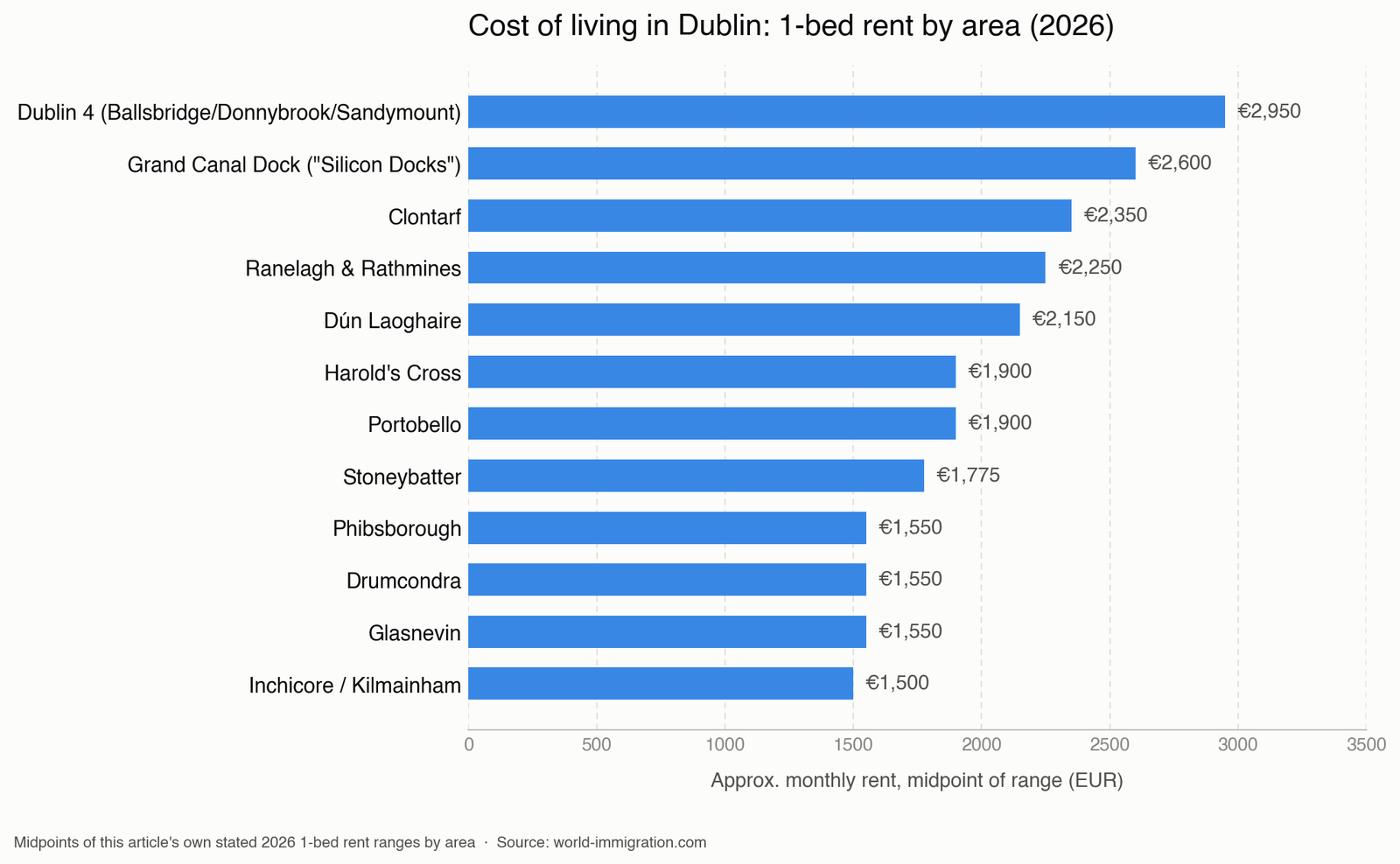
Rent is the single decision that sets your Dublin budget and it swings by well over a thousand euro a month depending on which side of the city you land in. The ranges below are for a one-bedroom in 2026, drawn from neighbourhood-level rental guides such as HomeScout’s 2026 Dublin rent guide rather than an official index — the RTB and Daft.ie reports quoted elsewhere in this piece only break rents down to city and county level, not by neighbourhood. I want to be upfront that different sources disagreed by €100 to €300 in several areas, so I have presented bands rather than pretending there is a precise figure. Read them as “roughly what to expect” and not as quotes.
| Area | Approx. 1-bed monthly rent (2026) | Notes |
|---|---|---|
| Glasnevin | €1,350–€1,750 | Northside, near DCU and Botanic Gardens |
| Inchicore / Kilmainham | €1,300–€1,700 | West of centre, on the Luas Red Line |
| Drumcondra | €1,300–€1,800 | Northside, good bus corridor to the centre |
| Phibsborough | €1,400–€1,700 | Close-in northside, walkable to town |
| Stoneybatter | €1,600–€1,950 | Popular, low-rise, north of the Liffey |
| Harold’s Cross | €1,700–€2,100 | Southside village feel, near the canal |
| Portobello | €1,600–€2,200 | Canal-side, central, wide price spread |
| Ranelagh & Rathmines | €1,900–€2,600 | Prime southside, high demand |
| Dún Laoghaire | €1,900–€2,400 | Coastal, 25–35 min DART commute |
| Clontarf | €2,100–€2,600 | Coastal northside, family-oriented |
| Grand Canal Dock (“Silicon Docks”) | €2,300–€2,900 | Tech-employer belt, modern blocks |
| Dublin 4 (Ballsbridge / Donnybrook / Sandymount) | €2,400–€3,500+ | The most expensive addresses in the city |
The pattern that jumps out is a rough south-east premium. The southside villages of Ranelagh, Rathmines and the Dublin 4 postcodes command the top of the market, while the inner northside and the west of the city (Inchicore, Drumcondra, Glasnevin) sit noticeably lower for what is often a similar commute.
If I were choosing on value alone, the close-in northside and the areas along the Luas Red Line are where I would look first, because you get proximity without the southside premium. Sharing a house rather than renting a one-bed is another way a new arrival can make Dublin work, which reduces the per-person figure.
The supply shortage that sets the price
None of these prices make sense without the supply picture behind them, which in Dublin is severe. On 1 February 2026 there were just 859 homes available to rent across the entire city, down 29% year-on-year and off by about a third versus the same point the year before, according to TheJournal.ie’s coverage of the Daft.ie Rental Report.
Dublin’s rental vacancy rate is estimated at around 1%, per property-guide sites such as HomeScout — a secondary-source estimate rather than an official RTB or Daft.ie statistic, but consistent with the razor-thin stock numbers above. In practice that means at any given moment almost nothing is empty and available. That scarcity is what turns a viewing into a bidding scramble and it is the reason budgeting alone will not secure a place — you will very likely need to move quickly when something appears.
Several pressures stack up at once. Dublin hosts the European headquarters of Google and Meta, plus TikTok’s, based at the Sorting Office in the docklands (Silicon Republic), so tech-sector demand concentrates well-paid workers in a small area. A large international-student population competes for the same stock each September. Underneath both is a long run of underbuilding and the Irish Times has reported that future supply is under further threat after new builds fell sharply.
On top of that, a Cabinet housing committee briefing estimated that around 10,000 of the roughly 32,000 properties advertised nationally for short-term letting could potentially be suitable for long-term housing instead, according to the Irish Examiner — properties that, on this estimate, sit outside the long-term rental pool rather than having been actively diverted from it. The combination is why Dublin behaves like a market with structurally too few homes and why I would not assume any prices will ease in the near term.
Dublin versus the rest of Ireland
Firstly, Dublin rents run roughly 29% above the national average on the like-for-like two-bedroom comparison. That gap is large and it is not closing in absolute terms. The second thing is the growth rate: rent increases outside Dublin have been running at around 7% year-on-year on average — Cork 7.5%, Galway 11.4%, Waterford 6.9%, Limerick 5% — against Dublin’s own rate of increase at somewhere between 3% and 7% depending on the source and quarter, according to TheJournal.ie’s reporting of the Daft.ie figures.
My read is that these two facts are easy to blur into a misleading conclusion. A faster growth rate in the regions does not mean Dublin is becoming more affordable relative to the country. It means the rest of Ireland is catching up in the pace of increases, while Dublin still sits far higher in actual euro. If you are weighing the capital against a regional city, the level gap is the number that affects your rent cheque — the narrowing growth rate is a trend, not a discount.
Getting around: the Leap Card
Transport is one area where Dublin is comparatively good on a newcomer’s budget, tap on with a Leap Card and you pay a flat 90-minute fare that covers Dublin Bus, the Luas trams and most DART and commuter rail — €2 for an adult, €1 for a young adult or student and 65c for a child.
Those fares run about 30% cheaper than paying a cash single, according to the Leap Card’s own fares page and there is daily and weekly fare capping within Zone 1 so your spend is limited no matter how many trips you take. For most people living and working inside the city, that flat fare removes the need to think about which transport mode you use at all.
If you are arriving before you have sorted a permanent card, there is a Leap Visitor Card for: €8 for one day, €19 for three days and €40 for seven, with unlimited travel across the same network, according to the same Leap Card fares page. It buys you time to find your feet before setting up a standard Leap Card.
Everyday prices: a crowd-sourced sense-check
Beyond rent and transport, the day-to-day cost of living in Dublin is a step above the national average without being dramatic. The figures below come from Numbeo, which is crowd-sourced rather than an official price index, so use them as a directional sense-check and not as a primary source.
- Cappuccino: around €4.40
- Mid-range restaurant meal for two: around €90
- Monthly gym membership: around €58
- Utilities for an average apartment: around €210–€230 a month
Irish electricity prices are the highest in the EU — around 40% above the EU average as of late 2025, according to Eurostat data reported by the Irish Times and a poorly insulated older flat can push the bill above the range above in winter. Everything else on the list is the kind of expense that adds up quietly rather than dominating a budget the way rent does.
This article is part of our Ireland cluster, which covers the full move end to end.
Frequently asked questions
How much more expensive is Dublin than the rest of Ireland?
On the like-for-like two-bedroom comparison, Dublin city rent runs roughly 29% above the national average — about €2,600 to €2,700 in the city against a national figure near €2,086 in Q4 2025, per the Daft.ie Rental Report. That level gap is the number that affects your rent and it is not closing even though rent growth outside Dublin has recently been faster than in the capital.
Which Dublin neighbourhoods are cheapest to rent in?
The inner northside and the west of the city tend to sit lowest — Inchicore, Kilmainham, Drumcondra and Glasnevin were all in the €1,300 to €1,800 range for a one-bedroom in 2026, according to neighbourhood rental guides such as HomeScout’s 2026 Dublin rent guide. The southside villages of Ranelagh and Rathmines and the Dublin 4 postcodes command the highest rents. Sharing a house rather than renting a one-bed is how most new arrivals bring the per-person cost down.
Why is it so hard to find a place to rent in Dublin?
Supply is the core issue. On 1 February 2026 only 859 homes were available to rent across the whole city, down 29% year-on-year, per TheJournal.ie’s coverage of the Daft.ie Rental Report and the vacancy rate is estimated at near 1% by property-guide sites such as HomeScout. Concentrated tech-sector demand, a large international-student population, years of underbuilding and an estimated 10,000 short-term-let properties nationally that could otherwise be long-term housing (Irish Examiner) all pull in the same direction. Being ready to move fast when a listing appears matters as much as budget.
Is public transport in Dublin expensive?
Not by the standards of the rent. A TFI Leap Card gives a flat 90-minute fare of €2 for adults across bus, Luas and most rail, about 30% cheaper than a cash single, with daily and weekly fare capping in Zone 1, as per the Leap Card fares page. A Leap Visitor Card (€8 for one day, €19 for three, €40 for seven) covers you while you settle in.

