
Ask around before a move to Ireland and Dublin will come up first, almost by reflex. It is the capital, the biggest job market and the place most newcomers can already picture. But the biggest city is not always the right one for the person moving there and the best place to live in Ireland depends a great deal on what you are trying to get out of the move.
Someone chasing a tech salary at a European headquarters faces a very different sum from a family weighing rent against a garden, or a graduate who wants a walkable city with a cultural pulse. This piece weighs the four cities most newcomers actually choose between, keeps measured figures separate from reputation and points to who each one tends to suit.
One distinction matters before any of the numbers make sense. The level of rent in a city and the rate at which that rent is climbing are two separate things and they point in different directions in Ireland right now. Dublin remains by a clear margin the most expensive place to rent, yet, according to the Daft.ie Rental Report for the first quarter of 2026, its rents are currently growing more slowly than the smaller cities.
That does not mean the gap is closing in cash terms. A slower percentage rise on a much larger base still leaves Dublin well ahead in what you actually pay each month. Keep the two ideas apart as you read and the picture stays clear.
What the rent figures actually say
The Daft.ie Rental Report for the first quarter of 2026 put the national average rent for a two-bed apartment at just over €2,100 a month, after open-market rents jumped 4.4 per cent in the quarter alone, the sharpest quarterly rise on record since the series began in 2002. Year on year, the sharpest growth was outside the capital. Galway rents rose about 18 per cent, Cork about 13 per cent, Waterford about 8 per cent, Limerick about 10 per cent and Dublin about 6.9 per cent, as reported by RTE’s coverage of the report.
Read quickly, that list makes Dublin look like the calm option. In absolute terms it is still the dearest by a distance. The smaller cities are catching up in growth rate, not catching down in price. For the deposit rules, notice periods and the practical side of finding a home once you have picked a city, our Renting in Ireland guide covers the national picture.
There is a second, softer data source many people lean on and it deserves a clear label. Numbeo is crowd-sourced, built from figures that ordinary users submit rather than from official statistics, so treat its indices as a rough read on sentiment rather than a survey you could quote in a report. With that caveat in place, its Cork-versus-Dublin comparison is striking.
On Numbeo’s figures, Cork scores a Quality-of-Life Index of 189.24 against Dublin’s 151.77, a Purchasing Power figure of 129.94 against 109.91, a Safety Index of 62.86 against 45.92 and a slightly lower Cost-of-Living Index at 72.85 against 76.23. The property-price-to-income ratio tells a similar story, at 4.91 for Cork against 8.88 for Dublin. Crowd-sourced or not, that spread lines up with the lived reputation of the two cities.
The four cities, weighed one at a time
Dublin
Dublin is the default for a reason. It is Ireland’s dominant job market by volume and the landing point for the European headquarters of a long list of major tech firms, among them Google, Meta, Microsoft, LinkedIn and Stripe.
If your field is software, finance or the professional services that cluster around them, the sheer number of openings here is hard to match anywhere else on the island. Transport is the strongest of the four, with the widest bus network, the DART and Luas lines and an international airport that connects to most of the places you would want to reach.
The cost is the obvious counterweight. Rent sits well above the national average and housing pressure is a constant feature of life here rather than a passing squeeze. Dublin also carries a mixed international reputation on liveability. Mercer’s Quality of Living survey placed Dublin 43rd globally in 2024, down one place from 42nd in 2023, which reads as comfortable rather than exceptional for a Western European capital. My reading is that Dublin earns its place through opportunity and connections, not through the day-to-day ease that smaller Irish cities can offer for the money.
Cork
Cork is the city most often floated as the alternative to Dublin and the figures give that argument some backbone. Its rents are rising fast, up around 13 per cent year on year, yet the absolute level and the property-price-to-income ratio both sit well below Dublin’s. On the employment side Cork carries a strong presence in pharma, tech and cybersecurity and Apple’s European headquarters, employing around 6,000 people, is based at Hollyhill on the city’s northside, which anchors a good deal of the local tech economy. For someone in those sectors the trade of a smaller job pool against noticeably lower living costs can come out in Cork’s favour.
Cork also has a reputation for a distinct civic character and here it is fair to separate the measurable from the felt. The English Market is a concrete example rather than a slogan. Founded in 1788 and documented by Cork City Council as one of the oldest municipal markets in Europe still trading, it sits at the heart of the historic commercial centre and functions as a point of local identity rather than a tourist add-on.
The wider claim that Cork feels friendlier or more self-contained than Dublin is reputation, not data, so I would treat it as a hypothesis to test on a visit rather than a settled fact.
Galway
Galway is the smallest of the four cities considered here and the one where the rent trend gives most pause. Its rents rose about 18 per cent year on year, the steepest climb in the group, so a lower starting base is being eaten into quickly.
On the safety measure Galway reads well on the same crowd-sourced Numbeo scale, with a Crime Index of 30.98 against Dublin’s 54.08, which puts its Safety Scale at 69.02 against Dublin’s 45.92. As with the Cork figures, that is sentiment data rather than official crime statistics, so I would weight it lightly and check it against how a neighbourhood actually feels.
Where Galway makes its case is character and specialism. It is known for MedTech and software and the University of Galway gives it a genuine university-town feel that shapes the rhythm of the place. The Galway International Arts Festival, founded in 1978 and running for two weeks in late July, gives the city a cultural identity out of proportion to its size.
Galway suits people who want a compact, walkable base with a strong sense of place and who work in one of its niche sectors. The pinch point is supply. A small city with rising demand and fast-growing rents can be a hard place to find somewhere to live at short notice.
Limerick
Limerick tends to be underrated in these comparisons and on the numbers it has a case. Rent growth was the mildest of the smaller cities at around 10 per cent year on year and the overall cost of living sits below Dublin’s. The city has drawn recent manufacturing and tech investment, among it Analog Devices’ €630 million expansion of its Raheen semiconductor R&D and manufacturing facility, so the job market is broadening rather than static.
Its standout feature is connectivity most Irish cities outside Dublin simply lack. Shannon Airport, around twenty minutes away, offers direct transatlantic flights, with Aer Lingus serving Boston and New York year-round and United and Delta running seasonal services to Chicago and New York, which for anyone with family or business ties to North America is a practical advantage that rarely shows up in a cost table.
The University of Limerick reinforces the picture. It ranked first in Ireland for international-student satisfaction and happiness in the I-Graduate International Student Barometer and it runs a cooperative-education programme that UL describes as the largest in Europe, the structured work-placement model that ties study to paid industry experience. For a graduate or a family valuing that route into work, Limerick offers a combination of lower cost, transatlantic reach and a well-regarded university that the flashier cities do not quite replicate. The counterweight is that its job market, while growing, is still narrower than Cork’s or Dublin’s, so much depends on your field.
The middle ground: commuter towns like Maynooth
There is a third option that sits between committing to Dublin’s prices and giving up on Dublin’s job market altogether and it is one a lot of families may settle on. Maynooth in County Kildare works as a clear example. The 2022 Census put its population at 17,259 and it sits on the Western Suburban rail line running to Dublin Connolly, Pearse, Tara Street and Docklands, roughly 27 minutes from the city centre by car. You get Dublin’s employment within reach without paying Dublin’s inner-city rent.
The local figures, drawn from Leinster Insider‘s profile of the town, sketch a settled commuter community rather than a dormitory. The median home costs around €470,000 to buy or around €1,966 a month to rent and about 61 per cent of homes are owner-occupied against roughly 34 per cent renting. The most common way people get to work is still the car, at about 50 per cent, despite the rail line.
That mix says something useful. A commuter town trades a share of convenience and daily travel time for space, a lower rent than the capital and a place that functions as a town in its own right. If your work anchors you to Dublin but your budget or your preference does not, this is the option to weigh seriously.
Comparing the four at a glance
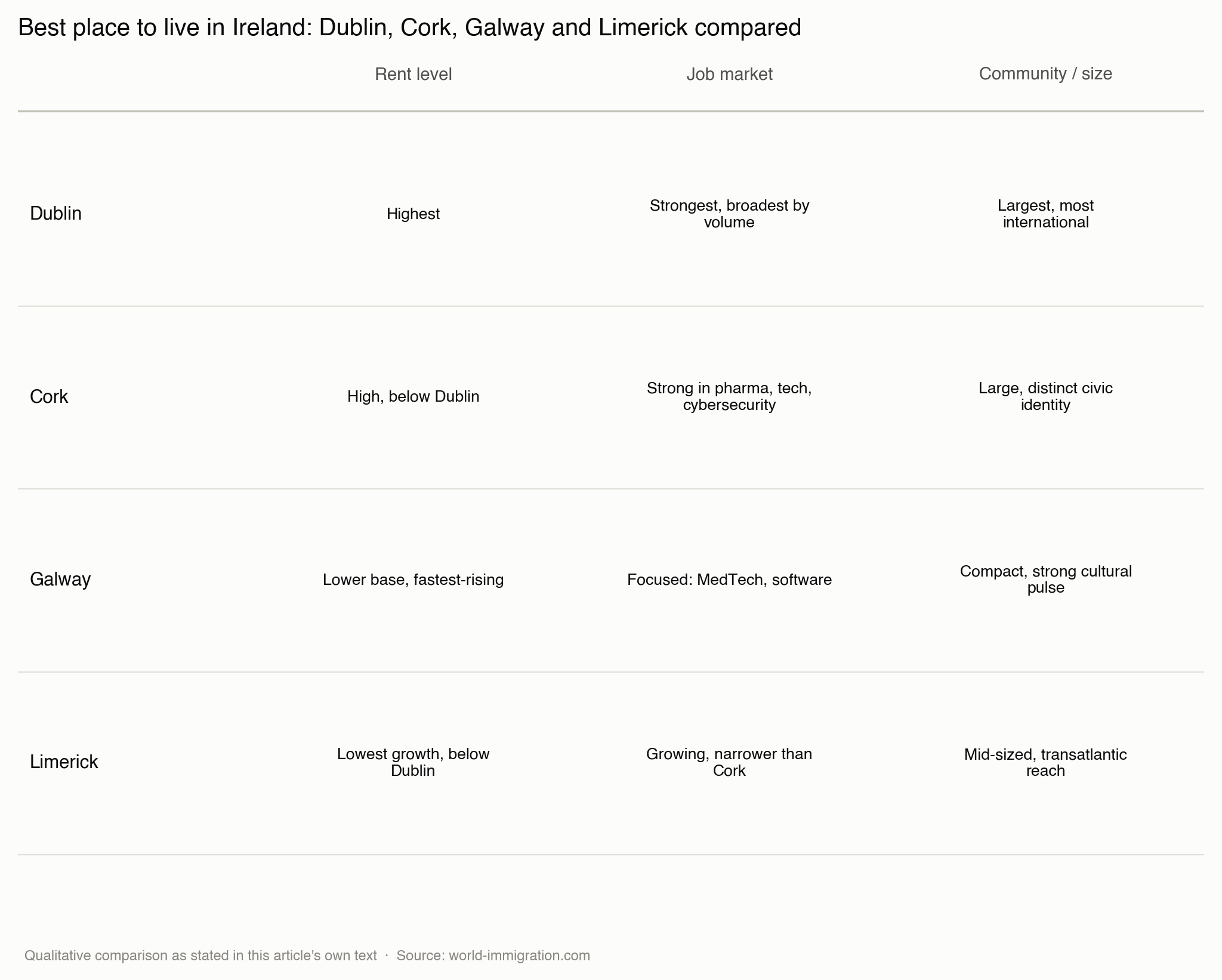
A table cannot settle a decision this personal, but it can line the cities up on the factors that tend to swing it. The ranking below is qualitative and relative, not a precise score and it separates what the figures support from what is a matter of reputation. Rent level reflects absolute monthly cost rather than the current growth rate, which as noted runs the other way for Dublin.
| City | Rent level (absolute) | Job market strength | Community / city size |
|---|---|---|---|
| Dublin | Highest | Strongest, broadest by volume | Largest, most international |
| Cork | High, below Dublin | Strong in pharma, tech, cybersecurity | Large, distinct civic identity |
| Galway | Lower base, fastest-rising | Focused: MedTech, software | Compact, strong cultural pulse |
| Limerick | Lowest growth, below Dublin | Growing, narrower than Cork | Mid-sized, transatlantic reach |
Read the table alongside the sections above rather than on its own. Galway’s low rent base carries the caveat of the steepest rise in the group and Limerick’s narrower job market is the flip side of its lower cost and Shannon connection. No single column decides the question.
So what is the best place to live in Ireland for you?
There is no single best place to live in Ireland, only a best fit for a given set of priorities and the four cities sort fairly cleanly once you name yours. Dublin is the pick when career reach is the deciding factor and the salary can absorb the rent. The volume of roles, the headquarters presence and the transport links are unmatched and you pay for all three.
Cork is the strongest all-rounder for someone who wants a genuine city with lower costs than the capital and a foot in pharma, tech or cybersecurity. The quality-of-life sentiment runs in its favour even after you discount the crowd-sourced source. Galway suits people who value a compact, cultural base and work in its niche sectors, provided they can weather a tight and fast-rising rental market.
Limerick is the value play with an unusual advantage, offering lower costs, a well-regarded university and a transatlantic airport twenty minutes away, so long as your field fits its narrower market. For anyone tied to Dublin work but not to Dublin prices, a commuter town such as Maynooth is the pragmatic middle route. My advice is to decide which one or two of those factors you cannot compromise on before you compare anything else, because that choice does most of the work.
This article is part of our Ireland cluster, which covers the full move end to end.
Frequently asked questions
Is Cork cheaper than Dublin to live in?
On the available figures, yes. Cork’s absolute rents and its property-price-to-income ratio both sit below Dublin’s and crowd-sourced Numbeo data points the same way on cost of living and purchasing power. The caveat is that Cork’s rents are currently rising faster than Dublin’s, at around 13 per cent against 6.9 per cent year on year, so the gap is narrowing in growth terms even while Dublin stays dearer in cash.
Which Irish city is best for tech jobs?
Dublin, by volume and by the presence of the European headquarters of firms including Google, Meta, Microsoft, LinkedIn and Stripe. Cork follows as the second centre, with a strong pharma, tech and cybersecurity cluster anchored by Apple’s European headquarters. Galway is a smaller but real option in MedTech and software and Limerick’s tech and manufacturing base is growing, helped by investments such as Analog Devices’ Raheen expansion. The right answer depends on your specialism rather than headcount alone.
Are commuter towns like Maynooth a good compromise?
For people whose work ties them to Dublin but whose budget does not stretch to inner-city rent, they can be. Maynooth sits about 27 minutes from Dublin by car and is on the rail line into the city centre, with rents below the capital and a settled, mostly owner-occupied community. The trade is daily travel time and the fact that most residents still commute by car despite the train, so weigh the journey against the saving.
How reliable are the quality-of-life rankings for Irish cities?
Treat them by source. Mercer’s Quality of Living survey is a structured index and placed Dublin 43rd globally in 2024, which is a considered ranking. Numbeo’s quality-of-life and safety scores are crowd-sourced from user submissions, so they read as sentiment rather than official statistics. Both are useful as a starting point, but neither substitutes for visiting a neighbourhood and judging how it feels for the way you plan to live.
Sources
- RTE, coverage of the Daft.ie Rental Report, Q1 2026 (published 20 May 2026)
- Numbeo, Quality of Life comparison, Cork vs Dublin (crowd-sourced)
- Numbeo, Crime comparison, Dublin vs Galway (crowd-sourced)
- Cork City Council, History of the English Market
- Galway International Arts Festival
- Leinster Insider, Living in Maynooth
- Iarnród Éireann, Maynooth Commuter line summary
- RTE, Dublin ranked 43rd in Mercer’s global Quality of Living index (2024)
- IDA Ireland, “IDA Ireland welcomes Apple in Cork and Dublin”
- IDA Ireland, Analog Devices €630 million Limerick investment announcement
- Shannon Airport, Wikipedia (routes and location)
- University of Limerick, ranked first in Ireland for international-student satisfaction
- University of Limerick, 50 years of the Cooperative Education programme

