
If you have landed here after searching for the Ireland golden visa, the first thing to know is that there is nothing to apply for. The scheme closed to new applicants at the end of business on 15 February 2023 and it has not been replaced. Several pages still ranking for this search haven’t caught up.
One is titled with a year that predates the closure entirely and a handful of migration-agent sites continue to describe a “donation stream” as though you could still lodge a file tomorrow. You can’t. This article sets out what actually happened, why it happened and what a person with capital to invest can realistically do about Ireland today.
What the Ireland golden visa was
The formal name was the Immigrant Investor Programme, usually shortened to the IIP. It ran from 2012 and offered residency in exchange for a qualifying investment or endowment. For a decade it was Ireland’s version of the residence-by-investment products that Portugal, Greece, Malta and Spain have all offered in some form. Over its life it brought in a cumulative almost €1.252 billion, the bulk of it from Chinese nationals. It was, by the numbers, a success on its own terms. That makes the way it ended all the more striking.
The closure and the scramble at the deadline
The announcement came from then-Minister for Justice Simon Harris on 14 February 2023, with the programme shutting to further applications from close of business the following day. Applicants had roughly one working day’s notice. That is not a wind-down. There was no phased exit for prospective new applicants, no grace period to complete a file already in progress, just a door that closed overnight.
Existing and already-approved projects were not cancelled retroactively and applications already lodged continued to be processed. So the closure was prospective, not a clawback. But the near-zero notice produced exactly what you would expect: a chaotic last-minute filing surge as applicants and their advisers rushed to get files in before the shutter came down.
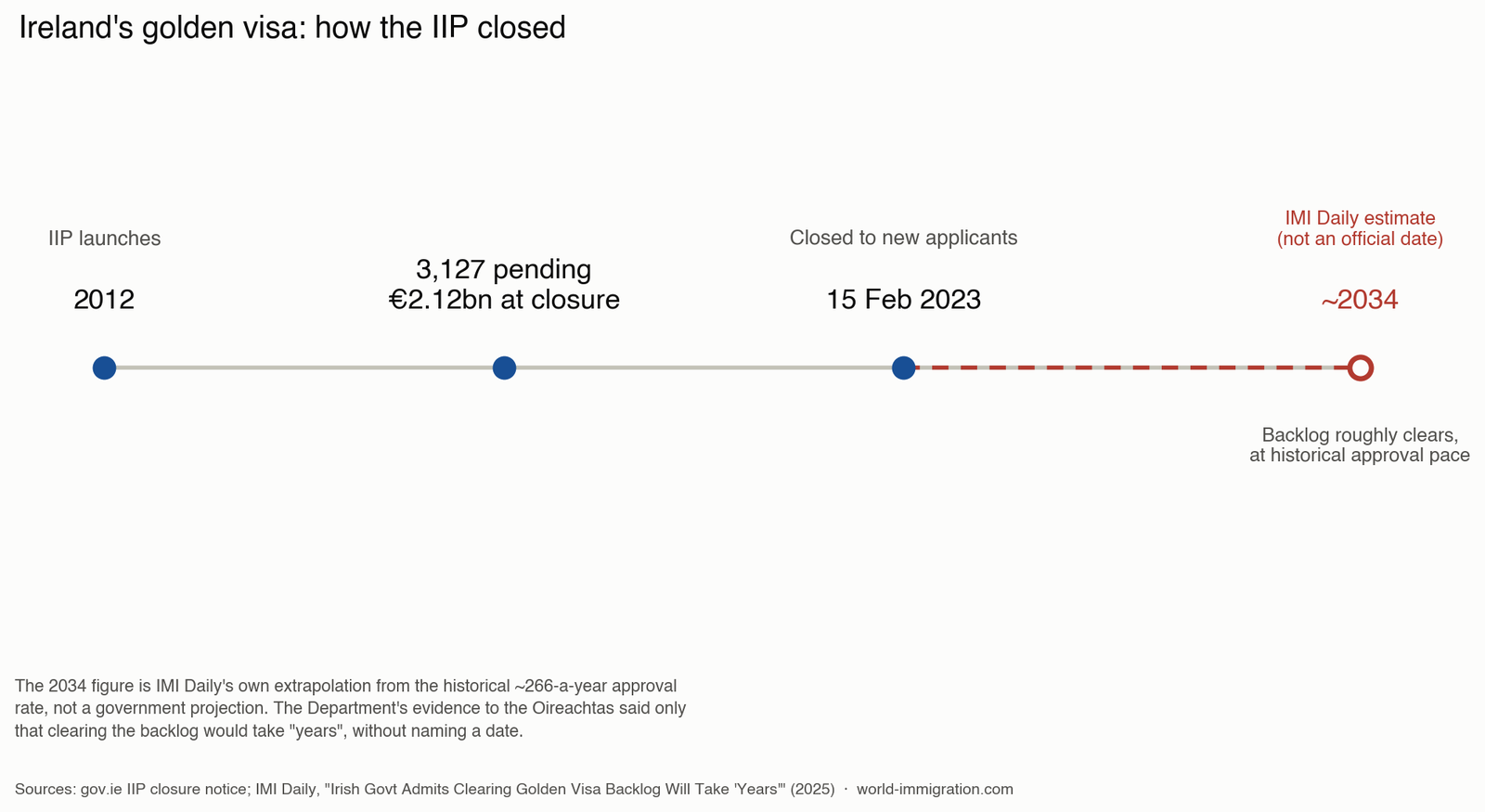
The scramble left a large backlog behind. Within months of closure there were 3,127 pending applications on hand, representing over €2.12 billion in proposed investment, most of them filed in that final rush. Clearing that queue has taken years and it is the source of a figure that keeps being misread.
In 2024 the Department approved 538 applications, a record and more than double the 2023 total. A further 208 were approved in the first half of 2025. Those are not new applicants. Every one of them is a pre-closure file working its way through the system. At the historical approval rate of around 266 applications a year since 2017, IMI Daily has calculated the backlog would not fully clear until around 2034 — its own extrapolation, not a government projection; the Department’s own evidence to the Oireachtas said only that clearing it would take “years.”
Why it closed — the official line and the fuller story
The government’s own explanation is brief. Material on gov.ie and irishimmigration.ie states the programme had “fulfilled its purpose” and that investment-for-residency routes were no longer considered a good fit. It points to concerns raised generally by the European Commission, the Council of Europe and the OECD about border security, money laundering, tax evasion and circumvention of EU law.
The Irish Times reported on 26 April 2024 that concern inside the Department of Justice ran much longer than the closure date suggests. A 2019 internal audit, undisclosed until the 2024 reporting, flagged problems nearly four years before the programme shut. A follow-up strategic review by EY in November 2020 raised concerns about due-diligence and anti-money-laundering checks.
It warned that the due-diligence providers vetting applicants “may come under pressure” to give favourable reports and that officials faced difficulty establishing appropriate controls to mitigate the risk of financial crime. Read against that backdrop, “fulfilled its purpose” looks less like a natural retirement and more like a decision that had been building for years.
The proximate trigger appears to have been volume. The Irish Times ties the closure directly to a surge in Chinese applications: 1,275 in 2022 alone, roughly 25 a week. A scheme already carrying unresolved due-diligence questions, suddenly running that hot from a single source market, is a scheme heading for the exit. My reading is that the timeline explains the abruptness better than the official language does. A programme quietly winding down does not shut with one day’s notice. One that has become a liability does.
The 2025 calls for an investigation
On 15 April 2025 RTÉ’s Morning Ireland reported two findings that turned the closure from old news back into a live story.
The first is an accountability gap. Since 2012 the programme had approved 2,472 project applications and yet the Department of Justice could not say how many actual immigration permissions — the residency grants that are the entire point of the scheme — those approvals produced. That is not evidence of fraud. It is something closer to a missing ledger: a decade-long programme selling residency, unable to state how much residency it had granted. For a route sold on the promise of tight vetting, not being able to count the outputs is its own kind of finding.
The second is more specific and, to my mind, harder to explain away. 83 applications submitted after the 15 February 2023 closure date were still being processed. These are files that, on the face of it, should never have entered the system at all. That irregularity is what prompted the calls for an investigation. Sinn Féin pushed for one.
Sophie in ‘t Veld, the former MEP who acted as rapporteur on the EU’s golden-visa and passport legislative proposal, criticised the government for not closing the scheme immediately and argued that post-closure applications should not have been processed at any point. The scheme is reported to have generated roughly €500 million in investment activity in the two years after being axed, which is a large tail for a programme officials describe as shut.
None of this amounts to proven wrongdoing and it is fair to keep the two findings separate. A data gap and a batch of late-processed files are administrative failures, not a scandal in themselves. But they are the reason the story still has legs in 2025 and they are a useful corrective to any page that presents the IIP as a clean, well-run route you have merely missed the chance to join.
What the scheme used to offer
For context only — none of this is available now — the IIP ran on four investment routes. All of them required the applicant to hold personal net wealth of at least €2 million, with the invested funds coming from the applicant’s own resources rather than a loan.
- Enterprise Investment — €1 million into an Irish enterprise, held for a minimum of three years.
- Investment Fund — €1 million into a fund regulated by the Central Bank of Ireland, held for at least three years.
- REIT — €2 million into an Irish-listed Real Estate Investment Trust, held for at least three years.
- Endowment — a €500,000 philanthropic donation to a pre-approved arts, sport, health, culture or education project, reduced to €400,000 where five or more applicants pooled together.
The endowment route is the one that keeps resurfacing in stale marketing copy, usually rebranded as a “donation stream”. It is the cheapest of the four, which is presumably why it is the one agents are keenest to keep alive on the page. It is as closed as the other three.
The stale-content problem
A number of migration-agent sites continue to market the endowment or “donation stream” as if new applications were possible. Some describe it as “the most viable option available”. Others cite the 2024 and 2025 approval figures as proof the route is open, when those approvals are backlog clearance of pre-2023 files and nothing more.
I would not accuse any single site of acting in bad faith. The likelier explanation is ordinary: these are commercial pages with a financial incentive to have a live Irish product to sell and an understandable reluctance to update a page that still ranks and still converts. But the pattern is what it is.
When you see an “Ireland investor visa” pitch that quotes a recent approval count as evidence of an open channel, treat the recent number as the tell. Approvals going up while applications are closed is precisely what a backlog looks like. No primary government source confirms any currently open application channel of any kind. If a page cannot link you to gov.ie or irishimmigration.ie confirming an open route, that is because there isn’t one.
What is actually available to an investor today
If you have capital and Ireland in mind, two routes are live. Neither is a passive investment-for-residency product and that distinction is the whole point.
Stamp 0 is the route for persons of independent means, retirees among them. It asks for individual income of at least €50,000 a year (€100,000 joint for a couple), a lump sum roughly equal to the price of a home and private health insurance. You cannot work on it, it is granted a year at a time and renewed annually and average processing runs about four months.
It is explicitly not a path to permanent residence or citizenship. It suits someone who wants to live in Ireland on their own funds rather than someone buying a route to a passport. We cover the income tests, the lump-sum expectation and the renewal mechanics in full in our separate Retiring in Ireland article, which is the better place to plan a Stamp 0 move.
The Start-Up Entrepreneur Programme, or STEP, is the one sometimes sold as an IIP “replacement”. That framing is misleading and the dates give it away — STEP has run since 2012, alongside the IIP rather than after it, so it cannot be a replacement for something it predates. More importantly it is a different kind of permit. STEP requires an actual operating High Potential Start-Up: an innovative product or service judged capable of creating 10 jobs and €1 million in sales within three years.
You need minimum funding of €50,000, plus €30,000 for each additional founder and the proposal goes to a quarterly evaluation committee. The initial residence period is two years. This is an active-business permit for people who intend to build and run a company in Ireland. It is not a cheque you write in exchange for a residence card and anyone pitching it as the new golden visa has either misunderstood it or is counting on you to.
So the summary is short. The Ireland golden visa is gone, it has not been replaced by an equivalent and the routes that remain are a means-tested residence permit for the independently wealthy and a working permit for founders. If a page tells you otherwise, check the date on it before you check your bank balance.
This article is part of our Ireland cluster, which covers the full move end to end.
Frequently asked questions
Can I still apply for the Ireland golden visa?
No. The Immigrant Investor Programme closed to new applications from close of business on 15 February 2023 and has not reopened. No official government source describes any open investment-for-residency channel as of 2026. Any page inviting a fresh application is out of date or selling something it cannot deliver.
Why are applications still being approved if the scheme is closed?
Because approvals in 2024 and 2025 are the Department working through a backlog of files lodged before the closure, not new entrants. At closure there were 3,127 pending applications and at the historical approval pace IMI Daily has calculated the queue would not clear until around 2034 — a media estimate, not an official one; the Department itself has only said clearing it will take “years.” A rising approval count reflects backlog clearance, not an open route.
Is there a replacement golden visa in Ireland?
No direct equivalent exists. The Start-Up Entrepreneur Programme is sometimes marketed as a successor, but it is an active-business permit requiring a High Potential Start-Up rather than a passive investment product and it has run since 2012. Stamp 0 lets a person of independent means live in Ireland on their own funds, though it does not lead to permanent residence or citizenship.
What did the Ireland golden visa cost when it was open?
Thresholds ran from a €500,000 endowment (€400,000 where five or more applicants pooled) up to €2 million into an Irish-listed REIT, with €1 million enterprise and fund options in between. Every route also required personal net wealth of at least €2 million, drawn from the applicant’s own resources rather than borrowed. These figures are historical and no longer accepted.
Sources
- gov.ie — Minister Harris announces closure of the Immigrant Investor Programme
- Immigration Service Delivery — FAQs: Closure of the Immigrant Investor Programme
- Immigration Service Delivery — Processing of IIP applications on hand following closure
- RTÉ News — “Calls for investigation into axed golden visa scheme” (15 April 2025)
- Irish Times — “Concerns for years in Department of Justice over immigrant investor programme” (26 April 2024)
- Irish Times — “Hundreds of Chinese millionaires approved for Irish ‘golden visas’ after scheme closed” (8 September 2025)
- Investment Migration Insider — “3,127 Ireland IIP Applications Worth €2.12 Billion Pending After Torrent of Last-Minute Filings” (27 May 2023)
- Immigration Service Delivery — Start-up Entrepreneur Programme (STEP)
- Immigration Service Delivery — Start-up Entrepreneur Programme Guidelines (PDF, September 2023)
- irishimmigration.ie — “I want to retire to Ireland”
- Citizens Information — “Retiring to Ireland”

