
Somewhere in most family stories with an Irish thread there is a grandmother born in County Clare, or a father who left Cork as a boy and never spoke much about it. For a lot of people that thread is enough to ask a practical question: does an Irish grandparent or parent give me a claim to a passport?
Irish citizenship by descent is one of the more generous ancestry routes in Europe, but it is also one of the most precise. This guide sets out exactly where each generation stands, what the Foreign Births Register asks for and what it now costs and — for readers with no Irish ancestry at all — how the residence route to naturalisation works instead.
One distinction runs through the whole of Irish citizenship by descent, so it is worth fixing before anything else: some people are Irish citizens automatically from the moment they are born, whether or not they ever fill in a form, while others are only entitled to become citizens and must register first. Getting that difference right is the difference between having a birthright to prove and having a right to claim.
Irish citizenship by descent through a parent
The parent route splits cleanly into two cases and which one applies to you turns on a single fact: where your Irish parent was born.
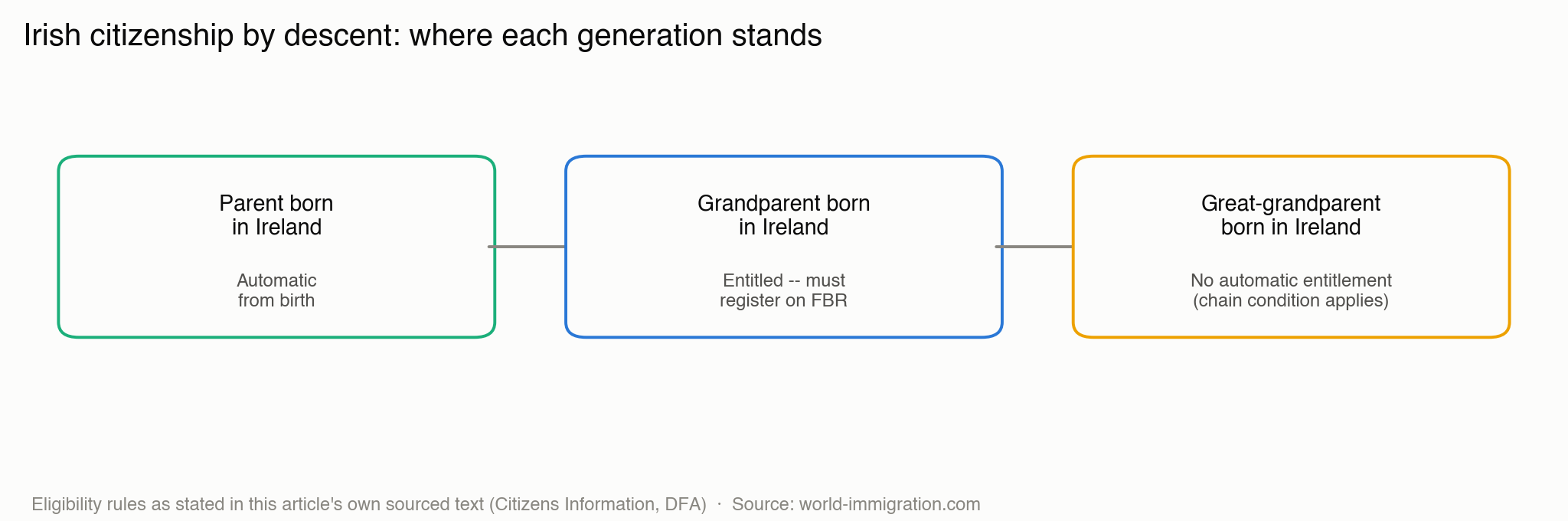
Parent born in Ireland — automatic from birth
If your parent was born in Ireland and was an Irish citizen at the time you were born, you are an Irish citizen automatically, from birth. There is no registration step involved in being a citizen — the status is yours already and always has been.
What you do still have to do is prove it when you want something concrete out of it, such as an Irish passport. In practice that means producing your parent’s Irish birth certificate alongside your own, so the passport office can trace the line. The paperwork is an evidence exercise, not an application to acquire a status you don’t yet hold.
Parent born outside Ireland — entitled, but must register
Now the other case. If your parent was born outside Ireland but was themselves an Irish citizen when you were born — say they were a citizen by descent, by naturalisation or by post-nuptial declaration — you are not automatically a citizen. You are entitled to become one and you get there by registering your own birth on the Foreign Births Register (FBR).
The detail that catches most families off guard is the timing: in this case citizenship takes effect from the date of registration, not from your birth. That matters if you later have children of your own, because the clock on the next generation only starts once you are registered. I would treat that as the most consequential sentence in this whole article for anyone planning around it.
There is one exception to the register-first rule. If your Irish-citizen parent was abroad in the public service at the time of your birth — in diplomatic or state service, for instance — no FBR registration is needed and the automatic-from-birth treatment applies instead.
Descent through a grandparent
The grandparent route is where Irish citizenship by descent gets most of its reputation and it is the one a large share of applicants use. If one of your grandparents was born in Ireland but neither of your parents was born there, you are entitled to citizenship — but, as with the register-first parent case, it is not automatic. You claim it by entering your own birth on the Foreign Births Register. Until that entry is made you are not yet an Irish citizen; once it is, you are and you can then apply for a passport.
Foreign birth registration Ireland: what the FBR application asks for
The FBR application is document-heavy by design, because the whole point is to trace an unbroken line back to the Irish-born ancestor. Expect to supply the following for yourself:
- Your original civil birth certificate.
- Your marriage certificate or change-of-name documents, if either applies to you.
- A certified photocopy of your current state-issued photo ID.
- Two proofs of address.
- Four photographs, two of which must be independently witnessed.
On top of your own documents you supply the records for the person the claim is based on — your parent and/or grandparent as the case requires. That means their original birth certificate, marriage certificate and ID and a death certificate where the person has passed on. Everything has to be independently witnessed by a professional witness who applies an official stamp. The application starts online and is then posted in with the original documents, so nothing is decided on the strength of the web form alone.
Fees and processing time
The official 2026 fees are €278 in total for an adult — €270 for registration and the certificate, plus €8 postage — and €153 for a minor, made up of €145 plus the same €8 postage. Processing currently runs at around 12 months, with applications handled in strict order of the date they were received.
That is a marked improvement on the roughly two-year backlog reported as recently as February 2024, which is why I would be careful with older third-party pages and forum threads: many still quote the longer wait and a fair number quote fees that have since changed. Go by the current official figures rather than a screenshot from two years ago.
Once your entry is made on the Foreign Births Register you are an Irish citizen and only at that point can you apply for an Irish passport. The passport application cannot run ahead of the FBR — registration has to complete first, then the passport follows.
Great-grandparent and beyond
There is no automatic entitlement to Irish citizenship through a great-grandparent alone. A great-grandchild can be entitled to citizenship by registering their own birth on the Foreign Births Register — but only if their parent had already registered on the FBR by the time the great-grandchild was born.
Read that condition slowly, because it is the crux. The line only reaches from one generation to the next when each generation registers on the FBR before the following generation is born. If your grandparent’s line was never registered before your parent arrived, or your parent’s line was never registered before you arrived, the chain is broken — and it is broken permanently for that branch.
I haven’t found any mechanism to reach back, neither the Citizens Information nor the Department of Foreign Affairs describes a method to register a deceased ancestor and revive a lapsed line — the registration condition is framed only in the past tense (“had already registered by the time you were born”), with no provision for closing the gap after the fact. On that basis, once the window in a given generation closes it stays closed, which is why two cousins with the same Irish great-grandparent can end up with entirely different answers.
Beyond the great-grandparent, there is no automatic claim at all based on more distant ancestry. Cousins, aunts, uncles and earlier ancestors give no entitlement on their own. The only route that remains is a discretionary grant of citizenship by the Minister on the basis of “Irish association” under Section 16(1)(a) of the Irish Nationality and Citizenship Act 1956 — defined as a blood or adoption relationship to an Irish citizen. That is decided case by case, at the Minister’s discretion, with no guaranteed outcome.
Naturalisation by residence — no Irish ancestry required
If none of the descent routes reach you, the door isn’t shut — it just opens through residence instead of ancestry. Naturalisation is the standard way someone with no Irish family becomes a citizen and it rests on time actually lived in the country under the Irish Nationality and Citizenship Act 1956, as amended.
The standard residence requirement
The standard route asks for one year of continuous reckonable residence in the State immediately before you apply, plus a further four years of reckonable residence within the preceding eight years. In shorthand that is five years out of the last nine. Up to 70 days’ absence is allowed in that final continuous year — entry and exit days are not counted against you — and up to 30 further days on top of that for documented exceptional circumstances.
Not all time in Ireland counts. Reckonable residence excludes time spent on a student visa (Stamp 2 or 2A, though a “young adult” exception applies in some cases), any undocumented time and time spent as an international-protection applicant while awaiting a decision. Nationals of the EEA, the UK and Switzerland are treated more simply — they don’t need the reckonable-residence calculation and instead supply a documentary history of their residence.
Spouses and civil partners of Irish citizens
Marriage or civil partnership to an Irish citizen shortens the road. The requirement drops to three years of marriage or civil partnership together with three years of reckonable residence, with the couple living together and an intention to go on residing in the State. It is a reduced bar rather than an automatic grant — the residence still has to be evidenced.
The 2026 change for International Protection applicants
People granted International Protection used to qualify for naturalisation after three years of reckonable residence. From 8 December 2025 that changed: new applications now require five years, in line with the standard route. Applications received before that date are still assessed under the old three-year rule, so the cut-off matters for anyone close to it.
Fees, the ceremony and how long it takes
There is a non-refundable application fee of €175 to lodge the application. If it is approved, a certification fee then falls due: €950 for a standard adult, €200 for a minor or for the widow or widower of an Irish citizen and no charge at all for recognised refugees or stateless persons.
The sequence runs like this. You apply online under the 1956 Act, the application goes to the Garda Síochána for “good character” vetting, a decision is made, you pay the certification fee and you then attend a citizenship ceremony where you make a declaration of fidelity to the nation and loyalty to the State. The naturalisation certificate is issued after the ceremony and only once you hold it can you apply for an Irish passport. Official guidance puts most applications at around 19 months from lodgement to decision, so this is a route measured in patience as much as paperwork.
Dual and multiple citizenship
Ireland places no restriction on holding more than one citizenship. Under Irish law you are not required to give up any other citizenship to become an Irish citizen by naturalisation, nor to claim Irish citizenship by birth, by descent or on any other basis. As far as Dublin is concerned you can hold your existing passport and an Irish one side by side.
The one caveat sits with the other country, not with Ireland. Some states require their nationals to renounce a prior citizenship on their own terms and that is entirely outside Ireland’s control. Before you register or naturalise, check whether your current country of citizenship imposes any such condition — the Irish side won’t, but yours might.
This article is part of our Ireland cluster, which covers the full move end to end.
Frequently asked questions
Am I automatically an Irish citizen if my grandparent was Irish?
No. A grandparent born in Ireland gives you an entitlement to Irish citizenship, not automatic citizenship. You have to register your own birth on the Foreign Births Register first and you become a citizen from the date that registration is made rather than from your birth. A parent born in Ireland is the case where citizenship is automatic; a grandparent is the case where you must register.
How much does the Foreign Births Register cost and how long does it take?
As of 2026 the total is €278 for an adult (€270 registration and certificate plus €8 postage) and €153 for a minor (€145 plus €8). Processing runs at roughly 12 months, in strict order of the date each application is received. Older pages that quote a two-year wait are out of date — that was the backlog around early 2024 and it has since come down.
Can I get Ireland citizenship through a great-grandparent?
Only in a narrow case. A great-grandparent gives no automatic entitlement. You qualify through a great-grandparent solely if your own parent had already registered on the Foreign Births Register before you were born — the line must be registered in each generation in turn. If that step was missed, the branch is closed for good and the only remaining path is a discretionary Ministerial grant on the basis of Irish association, which is decided individually with no guarantee.
What if I have no Irish ancestry at all — is Irish naturalisation possible?
Yes. Irish naturalisation by residence needs no ancestry. The standard requirement is five years of reckonable residence out of the last nine, including one continuous year immediately before you apply. Spouses and civil partners of Irish citizens have a reduced requirement of three years of marriage or partnership plus three years of residence. Approval leads to a citizenship ceremony, after which the naturalisation certificate is issued and you can apply for an Irish passport.
Sources
- Citizens Information — Irish citizenship through birth or descent
- Citizens Information — The Foreign Births Register
- Citizens Information — Becoming an Irish citizen through naturalisation
- Ireland.ie, Department of Foreign Affairs — Registering A Foreign Birth
- Immigration Service Delivery — Dual Citizenship
- Immigration Service Delivery — Applications based on Irish descent or Irish associations
- Immigration Service Delivery — Changes to citizenship for people granted International Protection
- Berkeley Solicitors — Processing Times for Foreign Birth Registration (February 2024, cited for historical backlog comparison)

