
Most people searching for a New Zealand work visa already have a specific situation in mind. They have a job offer, or a trade, or a profession, or a partner who already lives here. The worry is not “does NZ have immigration?” — it is “which of these routes actually fits me and what is the catch?” The answer depends almost entirely on what you bring to the table and the official guidance from Immigration New Zealand (INZ) is thorough but not always easy to map against your own circumstances. This article is an attempt to do that mapping directly and it sits alongside our broader guide to moving to New Zealand for the wider costs and settling-in picture.
Upfront: the system has changed significantly since 2022 and the popular accounts of it — forums, Reddit threads, immigration blogs — have not always kept up. The Skilled Migrant Category no longer uses an expression-of-interest ballot, since the AEWV no longer requires the median wage (removed 10 March 2025). The Green List has grown twice in 2025 alone — primary and intermediate teachers were added to Tier 1 and ten trades occupations were added to Tier 2. If you are reading advice from 2021 or earlier, treat it as background, not current guidance.
The Two Things Every Route Comes Down To
Before getting to the individual visas, it helps to understand the two dimensions that determine your options. The first is whether you are looking for temporary work or a path to residence. The second is whether your occupation is on the Green List. Those two factors do more to determine your route than anything else.
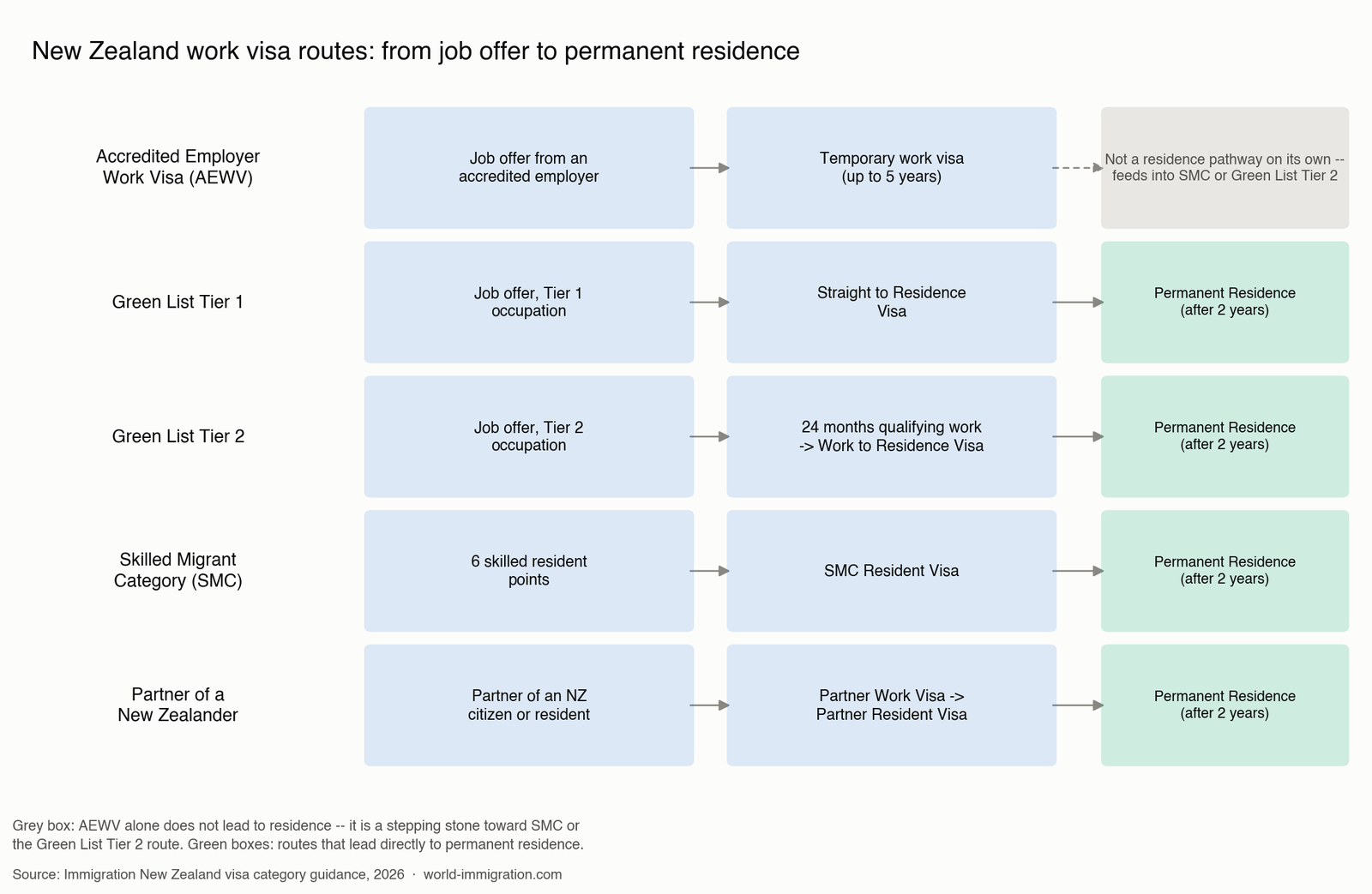
If you want temporary work only, the Accredited Employer Work Visa (AEWV) is the main route, supplemented by the Working Holiday Visa for those under 30 (or 35 for UK and Canadian citizens). If you want residence and your job is on Green List Tier 1, you can apply for residence directly via the Straight to Residence Visa. If it is on Tier 2, you need 24 months of NZ work first under the Work to Residence Visa. If it is not on the Green List at all, the Skilled Migrant Category (SMC) is usually the way — but that also requires NZ work experience to accumulate enough points.
The practical consequence: very few people move to NZ and immediately obtain residence. Most spend at least one to three years on a temporary visa first. Planning for that intermediate period is not optional — it is the normal path.
Accredited Employer Work Visa: The Standard Work Visa Route
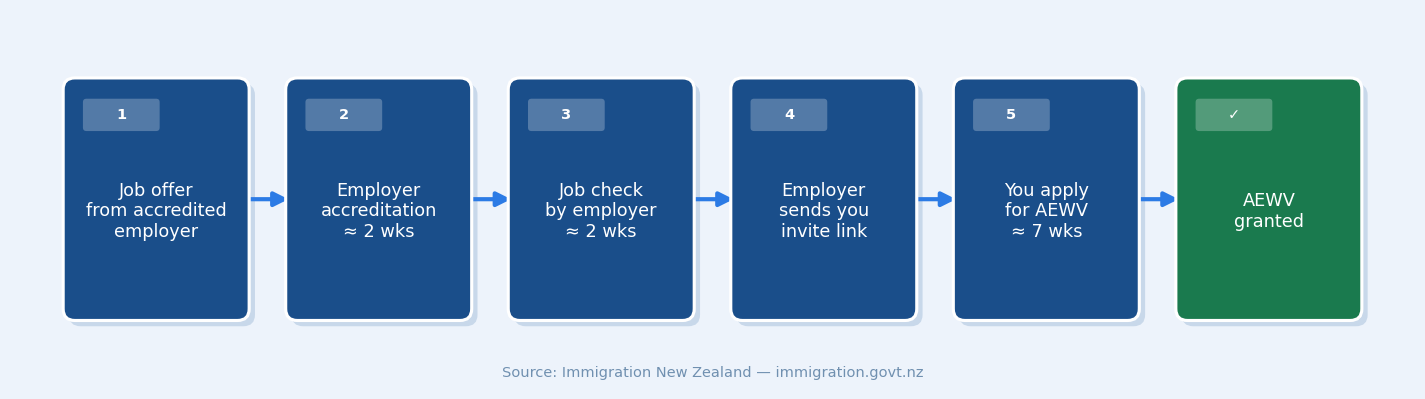
The AEWV replaced the old Skilled Migrant and Essential Skills work visas in 2022. It works in three steps, set out by INZ’s employer accreditation and job check process: the employer gets accreditation from INZ, the employer completes a job check for the specific role and then you apply using an invite link the employer generates for you. You cannot initiate this visa yourself — it requires an employer to go first.
The skill floor is a minimum of two years of relevant work experience, or a level 4 or higher NZQCF qualification. As of 10 March 2025, INZ reduced this from three years to two, which widened the eligible pool. A CV alone is not enough — you need payslips, tax certificates, or formal employment records on letterhead to prove the experience.
The wage requirement changed significantly on 10 March 2025. Before that date, AEWV workers had to be paid at or above the median NZ wage (currently NZD $35.00 per hour — see our average salary in New Zealand article for what typical roles actually pay). That requirement was removed. Workers now only need to receive NZ minimum wage ($23.50 per hour from 1 April 2025) plus market rate for their role. This was a deliberate policy relaxation to make the visa accessible to a wider range of industries, particularly hospitality and retail. It also creates more scope for exploitation at the lower end, so prospective migrants at entry-level wages should look carefully at what “market rate” actually means for their specific role.
Processing time: employer accreditation and job check each run about two weeks (80th percentile). Your own AEWV application takes around seven weeks for most roles, five weeks for Green List roles. Cost to you: from NZD $1,540.
Duration is tied to your ANZSCO skill level — ANZSCO (Australian and New Zealand Standard Classification of Occupations) is the joint framework Statistics NZ and INZ use to rank every job role from level 1 (senior managers and professionals) to level 5 (labourers). INZ assigns your occupation to a level when assessing your application. Per INZ’s guidance on how long you can stay on an AEWV, skill levels 1 to 3 (managers, professionals, technicians) can hold the AEWV for up to five years. Levels 4 and 5 (trades, operators, labourers) are capped at three years. After exhausting the maximum continuous stay, you must leave NZ for approximately 12 months before you can reapply.
The catch: the AEWV is tied to that specific employer. If you leave the job, the visa effectively lapses and you must find another accredited employer or leave. Not every employer holds accreditation — smaller businesses in particular may not have gone through the process. And level 4 to 5 workers cannot use the AEWV itself as a path to residence. They need to accumulate time toward the Green List Tier 2 route or SMC points separately.
Green List Tier 1: New Zealand Work Visa Direct to Residence
If your occupation is on Green List Tier 1 and you have a job offer from an accredited employer, you can apply for the Straight to Residence Visa without any waiting period in NZ first, per INZ’s Green List pathway to residence. This is the most direct route to permanent residence INZ offers and it is fast for those who qualify.
Tier 1 occupations include registered nurses, general practitioners, midwives, secondary and primary school teachers, civil and mechanical engineers, software engineers, ICT security specialists, clinical psychologists, radiographers and a number of specialist medical roles. Primary and intermediate teachers were added to Tier 1 from 26 March 2025, which was significant for the education sector. The full list is searchable at immigration.govt.nz — the representative occupations listed here are not exhaustive and your specific role may or may not be on it.
The residence visa costs from NZD $6,450 (a fee plus immigration levy). Processing is around four months at the 80th percentile. The age cap is 55. English language evidence is required, with test results no more than two years old — extended to five years from 24 August 2026 for applicants with a recognised occupational registration.
The catch: many Tier 1 occupations require New Zealand professional registration before you can work in the role legally. Teachers must register with the Teaching Council of Aotearoa New Zealand. Nurses must register with the Nursing Council of New Zealand. The visa itself may come through faster than the registration does. Budget time for that process — it varies by profession but can add months to the timeline and you cannot start work until registration is complete.
Green List Tier 2: Work to Residence for Trades
Tier 2 covers a different set of occupations — mainly trades and technical roles that are in demand but not classified as shortages severe enough for Tier 1. Electricians, plumbers, diesel motor mechanics, telecommunications technicians, early childhood teachers and special needs teachers are all on Tier 2. From 18 August 2025, ten additional trades occupations were added: metal fabricators, fitters, welders, panel beaters, vehicle painters, paving plant operators and several related roles.
The Work to Residence Visa requires you to accumulate 24 months of qualifying Tier 2 work within a 30-month window. Those 24 months do not need to be continuous — a gap of up to six months between periods of qualifying work is permitted. Once you have the 24 months, you apply for the residence visa. Processing is around 3.5 months at the 80th percentile.
The wage thresholds for Tier 2 are role-specific and in some cases well above the general median. An electrician or plumber needs to earn NZD $35.00 per hour. A telecommunications technician or civil machinery operator needs NZD $40.25 per hour (median wage plus 15%). A crane operator, metal fabricator, or pressure welder needs NZD $45.50 per hour (median wage plus 30%). These thresholds are multipliers of the immigration median wage and update when it changes — the figures here reflect the 9 March 2026 median of NZD $35.00 per hour; earlier INZ announcements quoted lower figures based on the previous median. Pay must stay at or above the applicable threshold throughout the qualifying 24 months — a period at reduced pay stops counting.
The catch: the Tier 2 path is 24 months longer than Tier 1. You are working toward the residence visa, not holding it. The wage floor is enforced at the employer level — not every employer in the trades pays above the required threshold. Age cap is the same as Tier 1: 55.
Skilled Migrant Category: The Points Route to Residence
The Skilled Migrant Category Resident Visa (SMC) is the points-based residence route for people whose occupation is not on the Green List. The misconception to correct is that the old expression-of-interest pool no longer exists. Since it reopened on 9 October 2023, if you meet the requirements, you submit an expression of interest and receive a direct Invitation to Apply — no queue, no ballot. You then have four months to complete the full application. For the full points breakdown and a walk-through of the calculator, see our dedicated Skilled Migrant Visa guide.
You need six skilled resident points. Points come from a primary category (three to six points) plus New Zealand work experience points (one per year, up to three). The primary categories are: occupational registration in NZ (three to six points depending on type), qualifications (a bachelor’s degree earns three points, rising to four from 24 August 2026), or income level (three points at 1.5 times the median wage, four points at twice the median, six points at three times the median).
What this means in practice: someone with an overseas bachelor’s degree and no NZ work experience has three points and cannot yet apply. Claiming 1.5 times the median wage does not add to that total — qualifications and income sit in the same primary category, so you take whichever gives the higher score, not both stacked together. Reaching six points from income alone needs three times the median wage (NZD $105.00 per hour from 9 March 2026). Short of that, three years of NZ skilled work — earning one point per year — is what closes the gap. That is why the pathway almost always requires a period in NZ on an AEWV or other temporary visa first.
The job must be with an accredited employer, at least 30 hours per week and permanent or on a fixed-term contract of at least 12 months. Wage threshold for the job itself: NZD $35.00 per hour for ANZSCO skill levels 1 to 3, or NZD $52.50 per hour for levels 4 to 5.
From 24 August 2026, two additional pathways open alongside the points system. The Skilled Work Experience pathway needs five or more years of relevant experience plus two years of NZ skilled work at 1.1 times the median ($38.50 per hour). The Trades and Technician pathway needs a level 4 qualification plus 2.5 years of relevant experience and 1.5 years of NZ trade work at the median wage. Neither new pathway accepts self-employment as qualifying work experience. There is a 10-year lookback for relevant experience and a four-year window for the required NZ skilled work.
SMC processing is around four months. Cost: from NZD $6,450 (fee plus levy). An interim visa issues automatically if your current visa expires while the SMC processes — you do not need to apply for it separately.
The catch: you almost certainly need to already be in NZ on a temporary visa when you apply. The points arithmetic usually requires NZ work experience. Self-employed people are excluded from the new 2026 pathways (though the existing points route may still accommodate them in some circumstances). Red List occupations are excluded entirely.
Working Holiday Visa: The Fastest Entry, But Not a Career Path
The Working Holiday Visa is what most people under 30 should consider as a first step. It requires no job offer, costs from NZD $770 and processes quickly — INZ’s published wait times currently show most Working Holiday Visa applications completed within about three weeks, though this figure moves week to week and is worth checking before you apply. You can work in temporary roles across most industries, study for up to six months and travel freely. NZ has working holiday agreements with over 40 countries — see our dedicated working holiday visa guide for the current country-by-country quotas and how the seasonal-work extension works.
Duration is 12 months for most countries. UK and Canadian citizens get better arrangements: UK nationals can stay for up to 36 months on a WHV and Canadians up to 23 months. The age limit for most countries is 18 to 30. UK and Canadian citizens have an extended limit of 18 to 35. Those are hard cutoffs — there is no discretion above the maximum age.
Some country schemes have annual quotas that fill quickly: Thailand is capped at 100 per year, China at 1,000, Philippines at 100, Vietnam at 200. If you are from one of these countries, check whether the quota for the current year has already filled before planning around this visa. Some schemes also require a tertiary qualification or English proficiency evidence even though the visa is a temporary holiday permit.
The catch: this visa explicitly prohibits permanent employment. You cannot take a job that is permanent. You also cannot use it as a direct path to residence. Many people do use it as an entry route to NZ, find an employer who then sponsors them for an AEWV and begin building toward residence from there — but that transition is not guaranteed. It depends entirely on finding an employer willing to go through the accreditation process for you.
One extension is available: if you complete three months or more of seasonal work in horticulture or viticulture, you can apply for a three-month Working Holiday Extension. One extension per person, cost from NZD $800.
Partner and Family Routes
If you are in a genuine and stable relationship with a New Zealand citizen or resident, you have two visa options. The Partner of a New Zealander Work Visa is a temporary visa that gives you open work rights — you can work in any legal job — and lasts one year initially (extended to three years if you have been together for over 12 months). Cost: from NZD $1,630. Processing: around five weeks.
After holding the work visa, or if your relationship is already well established, the Partner of a New Zealander Resident Visa leads to residence. You must have been living with your partner in a genuine and stable relationship for at least 12 months at the time of application. INZ assesses the relationship on evidence of shared finances, time spent together, social recognition and a clear commitment to remain in NZ — our New Zealand partner visa guide covers what that evidence actually needs to look like. Processing is the slowest of any route — around seven months at the 80th percentile. Cost: from NZD $5,360 (fee plus levy for family category).
The catch: per INZ’s own sponsorship-eligibility rule, a New Zealand citizen or resident can sponsor only one partner for residence in any five-year period and a maximum of two in their lifetime. If your partner has previously sponsored someone else for residence within the past five years, this route is not available to you. INZ applies the “genuine and stable” test in practice, not as a box-ticking exercise.
Investor Routes: What the Numbers Actually Are
The Active Investor Plus Visa — often searched for as the “New Zealand golden visa,” a label INZ itself does not use — has two categories. The Growth category requires a minimum NZD $5 million investment in higher-risk NZ businesses, held for at least 36 months, with a minimum of 21 days physically present in NZ during the investment period. The Balanced category requires NZD $10 million across a broader range of instruments, held for 60 months, with 105 days of NZ presence (reducible by 14 days per extra NZD $1 million invested in Growth-category instruments, up to a maximum reduction of 42 days). The application fee is NZD $27,470 in total.
A smaller-scale option is the Business Investor Work Visa, a temporary four-year visa for people who want to invest in and actively run an existing NZ business. After three years of running the business (with NZD $1 million or more invested), or 12 months with NZD $2 million or more, a residence visa is available. The business must remain solvent, employ five or more full-time staff and create at least one new NZ job. You must be physically in NZ for 184 or more days per year.
The catch: these routes are designed for substantial, active capital deployment. The NZD $5 million minimum for Active Investor Plus is a very high threshold. Not every investment qualifies — INZ vets proposed investments. Passive investment in property does not count. Philanthropy has been accepted in the Growth category since 1 June 2026, but capped at 20% of the total investment.
Key Fees and Processing Times at a Glance
| Visa | Typical cost | Processing (80th %ile) | Leads to residence? |
|---|---|---|---|
| Accredited Employer Work Visa (AEWV) | From NZD $1,540 | 7 weeks (5 for Green List) | Not directly |
| Green List Tier 1: Straight to Residence | From NZD $6,450 | ~4 months | Yes, immediately |
| Green List Tier 2: Work to Residence | From NZD $6,450 | ~3.5 months | Yes, after 24 months NZ work |
| Skilled Migrant Category Resident Visa | From NZD $6,450 | ~4 months | Yes |
| Working Holiday Visa | From NZD $770 | ~3 weeks | No |
| Partner of a NZer Work Visa | From NZD $1,630 | ~5 weeks | Not directly |
| Partner of a NZer Resident Visa | From NZD $5,360 | ~7 months | Yes |
| Active Investor Plus Visa | From NZD $27,470 | ~10.5 weeks (approval in principle) | Yes, after investment period |
Source: Immigration New Zealand fee schedules and processing time estimates (immigration.govt.nz, 2025–2026). Processing times are 80th percentile figures and can vary. Costs include application fee plus immigration levy where applicable.
The Typical Pathway in Practice
Most people’s New Zealand work visa route to residence looks like this: they arrive on a Working Holiday Visa, find a job (see our guide to working in New Zealand for how that job search actually goes), transition to an AEWV when their employer gets accreditation, accumulate NZ work experience toward SMC points or Tier 2 qualifying months and then apply for residence after one to three years. The system is designed around that sequential approach, even if it is not advertised that way.
The exception is Tier 1 Green List professions. A nurse, teacher, or engineer with the right qualifications and a job offer can skip the queuing entirely and go straight to residence from offshore. That is the policy intent behind the Green List — to make NZ immediately accessible to professionals it urgently needs, without requiring them to bank years of local experience first.
What This Cannot Tell You
This article maps the visa routes and their requirements as of mid-2026. It cannot tell you whether your specific occupation is on the Green List — use the INZ search tool directly for that. It cannot tell you whether your particular qualifications will satisfy INZ’s requirements, especially if they are from a country whose credentials NZ does not have a standard agreement with. It cannot tell you how long the professional registration process will take for your specific regulated profession, as that is controlled by each council (Teaching Council, Nursing Council, Engineers New Zealand) independently of INZ.
It also cannot tell you whether a specific employer is accredited or will seek accreditation for you. That is a commercial decision for each employer. And it cannot account for policy changes after publication — INZ has changed these settings several times in the past three years alone and will likely do so again. Check immigration.govt.nz directly before making any major decision and consider getting licensed immigration advice for complex situations. Licensed Immigration Advisers are regulated in NZ and searchable on the Immigration Advisers Authority register. For context on what you can expect to earn once you arrive, see our article on the average salary in New Zealand.
Frequently Asked Questions
Q: How long does a New Zealand work visa take to process?
The AEWV takes around seven weeks at the 80th percentile for most applicants, or five weeks for Green List roles. Before you apply, your employer must complete accreditation (about two weeks) and a job check (one to two weeks). Total time from first employer steps to visa in hand is typically 10 to 14 weeks. If you are applying for residence rather than a work visa, the Skilled Migrant Category and Straight to Residence Visa each take around four months. The Partner of a New Zealander Resident Visa is the slowest at around seven months.
Q: Can I get a New Zealand work visa without a job offer?
Not for most main routes. The AEWV requires a specific accredited employer to initiate the process. Green List visas require a job offer with an accredited employer. The Skilled Migrant Category requires skilled employment in NZ — either a current job or a job offer meeting the wage and hours requirements. The Working Holiday Visa is the exception: it requires no job offer and can be applied for independently, then used to find work once you arrive. It is an option for those under 30 (or under 35 for UK and Canadian citizens) who want to explore NZ’s job market in person before committing to a longer-term visa.
Q: Does the New Zealand work visa lead to permanent residence?
The AEWV itself does not lead to residence. It is a temporary visa and must be used as a stepping stone toward a residence pathway. Green List Tier 1 (Straight to Residence Visa) grants residence immediately. Green List Tier 2 (Work to Residence Visa) grants residence after 24 months of qualifying NZ work. The Skilled Migrant Category grants residence once the application is approved, provided you meet the points threshold and wage requirements. From any of these resident visas, you can apply for a Permanent Resident Visa after two consecutive years of holding the residence visa. New Zealand citizenship is generally available after five years of residence.
Sources
Every figure in this article traces back to Immigration New Zealand’s own published pages and news releases, current as of mid-2026. The primary sources used, grouped by topic:
- Immigration Advisers Authority — licensed adviser register
- Accredited Employer Work Visa — main visa page, 10 March 2025 median wage and experience changes, employer accreditation and job check process, how long you can stay on an AEWV and ANZSCO skill level finder
- New Zealand minimum wage — Employment New Zealand, minimum wage increase from 1 April 2025
- Green List and residence pathways — Green List roles search, Green List pathway to residence, Straight to Residence Visa, Work to Residence Visa, primary and intermediate teachers added to Tier 1 (26 March 2025), ten trades occupations added to Tier 2 (18 August 2025) and 2026 Tier 2 wage rate changes
- English language testing — test validity extended to five years from 24 August 2026
- Professional registration — Teaching Council of Aotearoa New Zealand, Nursing Council of New Zealand
- Skilled Migrant Category — main visa page and points table, qualification points changes, further changes effective 24 August 2026 (new pathways, Red List), Trades and Technician pathway eligible roles and SMC interim visa
- Working Holiday Visa — who can apply, United Kingdom Working Holiday Visa, Canada Working Holiday Visa, 2026 opening dates for capped schemes and Working Holiday Extension Work Visa
- Partner visas — Partner of a New Zealander Work Visa and Partner of a New Zealander Resident Visa (including the sponsorship-eligibility rule)
- Investor visas — Active Investor Plus Visa, philanthropy option added 1 June 2026 and Business Investor Work Visa
- Fees and processing — how much visa applications cost, resident visa wait times and work visa wait times (both update weekly — treat the figures in this article as a snapshot, not a live guarantee)
- Permanent residence and citizenship — Permanent Resident Visa and New Zealand citizenship presence requirements

