
If you have typed “New Zealand golden visa” into a search box, you are probably expecting to find one specific thing, a route where enough money buys residence, quickly and without much friction. That is what the phrase promises everywhere else it appears. So the first thing to sort out is what you will find at the end of that search, because it is likely not what you are expecting.
That is to say, New Zealand has no visa, no law and no Immigration New Zealand (INZ) category called a “Golden Visa.” What exists is an investor residence route with a formal name, a defined set of rules and thresholds that sit a long way above what most people can afford.
This article is about closing that gap, what the “New Zealand golden visa” refers to, why the label attached itself to it and whether the Active Investor Plus visa itself resembles what you were searching for. If you are mapping your options more broadly, the moving to New Zealand hub and the New Zealand work visa guide cover the routes that do not require millions in capital.
There Is No “Golden Visa” — Here Is What People Mean
‘Golden Visa’ is not a term the New Zealand government uses. Immigration New Zealand’s own Active Investor Plus Visa page carries no “golden visa” branding, official or informal, it names the route only as the Active Investor Plus visa. The phrase is an industry and media label and in New Zealand’s case it has been draped over one specific route, the Active Investor Plus (AIP) Resident Visa.
The label comes from outside government. Global residency-advisory firms market the AIP under the “New Zealand Golden Visa” banner because that is the phrase their clients search for and mainstream financial press has followed suit in headlines.
Even a major global law firm’s December 2025 web page, opens with the heading “New Zealand’s Golden Visa Programme – the Active Investor Plus visa”, which is a precise illustration of the nickname being the one clients search for, not the one government prints. So if you searched that term and landed on a slick page titled “New Zealand Golden Visa,” you were reading marketing copy, not a government scheme by that name.
The term itself started with Portugal, which launched its residency-by-investment programme in October 2012, informally known from the outset as “Visto Gold” in Portuguese and international press rather than as an official government name. From there the media generalised “Golden Visa” to cover every country’s investment-residence route. The label stuck hardest to the European programmes it was coined for. New Zealand’s AIP has no comparable government-adjacent branding at all, official or informal, which is exactly why the mismatch between what you searched for and what you will find is so wide.
The Active Investor Plus Visa, in Full
The AIP is a residence-by-investment visa, relaunched in a substantially new form in April 2025. It grants residence, not citizenship and it is built around one requirement above all others: you place a defined amount of capital into a vetted set of New Zealand investments, hold it for a fixed term and spend a minimum number of days in the country during that period. It is not a wire-the-money-and-you-are-in arrangement. The capital has to be actively placed and kept in qualifying instruments for the full term.
Since the April 2025 relaunch the visa has two categories and they differ in more than the headline figure. Choosing between them is a trade of capital and risk against time in the country.
Growth category
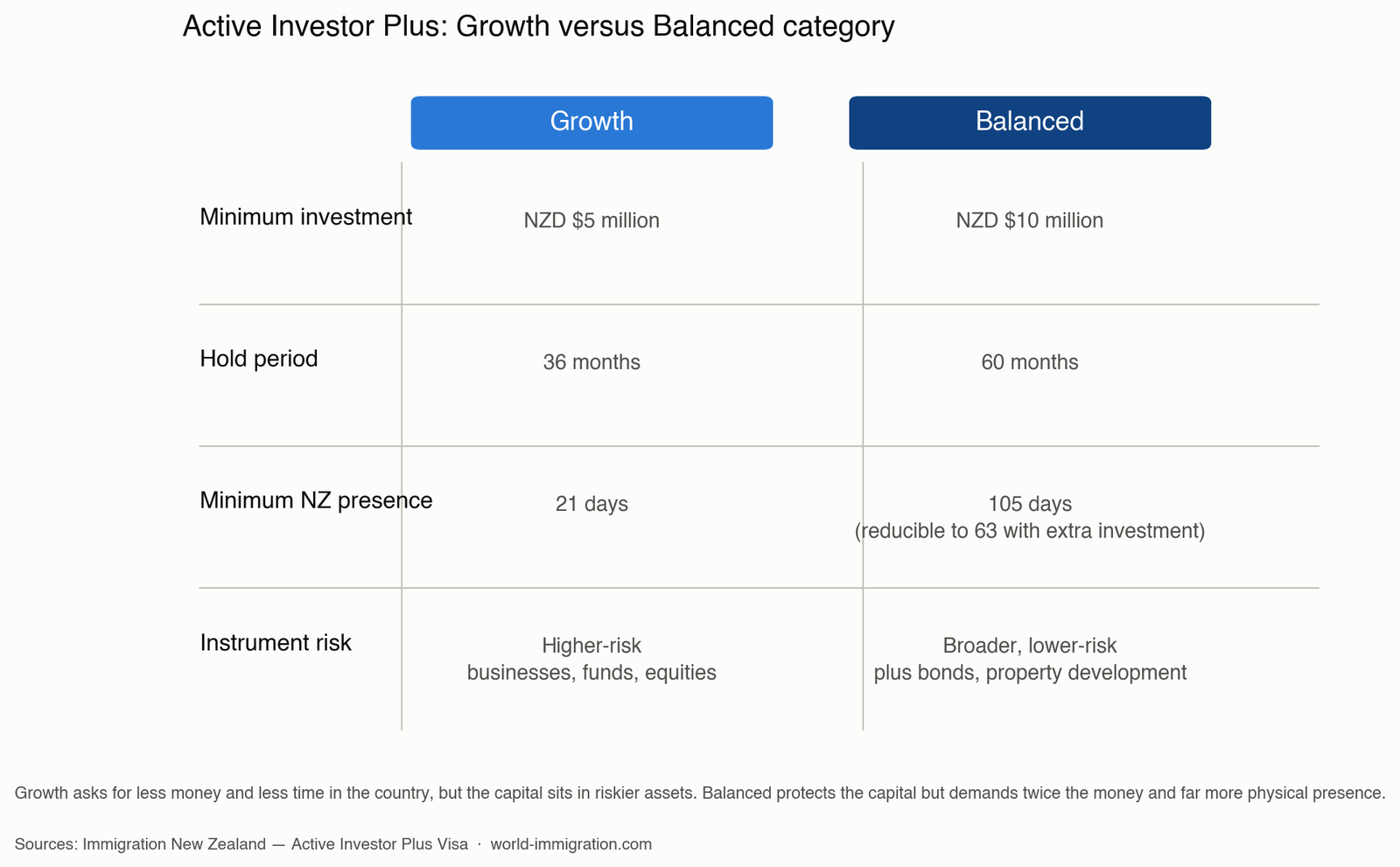
Immigration New Zealand’s Active Investor Plus Visa page sets the Growth category at a minimum of NZD $5 million, held for 36 months, placed in higher-risk instruments: direct investments into New Zealand businesses, managed funds drawn from an Invest New Zealand pre-approved list and listed equities. The physical-presence obligation is light, at a minimum of 21 days in New Zealand across the full three years. Philanthropic donations are accepted as part of the qualifying capital, but capped at 20% of the total, so charity cannot be the bulk of what you commit.
Balanced category
The same INZ page sets the Balanced category at a minimum of NZD $10 million, held for 60 months, across a broader and lower-risk range: everything the Growth category allows, plus New Zealand government, local-government and corporate bonds and property development. The presence obligation is much heavier at 105 days over the five years. That figure can be reduced by 14 days for every additional NZD $1 million invested in acceptable Growth-category instruments (philanthropy excluded), up to a maximum reduction of 42 days. In practice, committing NZD $13 million total brings the presence requirement down to 63 days.
The logic of the two tiers is a mirror image. Growth asks for less money and less time in the country, but the capital sits in riskier assets. Balanced protects the capital in safer instruments, but demands twice the money and far more of your physical presence. Which one fits depends on whether your scarce resource is capital, appetite for risk, or the number of days you can spend in New Zealand.
The fee
INZ’s current AIP visa page states the cost as from NZD $27,470. That is the government charge for the application as a single figure. You may see older summaries that add a separate immigration levy on top to reach a higher total; the current INZ page does not carry a separate levy line for this visa, so NZD $27,470 is the number to plan against. It is, of course, a rounding error next to the multi-million-dollar investment itself.
What counts and what does not
This is where the “any large investment qualifies” assumption comes apart. Invest New Zealand, a dedicated government agency created for the scheme, vets what counts as acceptable capital. The most common misconception is that you can buy a house and call it your investment. You cannot: passive residential property is explicitly not an acceptable AIP investment. Buying an existing home does nothing toward your qualifying capital.
There is a separate, easily confused housing right. Since 6 March 2026, AIP holders (and holders of the older Investor 1 and Investor 2 visas) can apply for Overseas Investment Office consent to buy or build a residential property worth NZ$5 million or more to live in personally. That is a right to house yourself layered on top of the visa, not a way to satisfy the investment. The full detail on that carve-out sits in our buying property in New Zealand guide.
No English test
The April 2025 relaunch removed the English-language requirement that applied to the AIP’s predecessor categories. That distinguishes it from almost every other New Zealand residence route. The skilled migrant and most work-to-residence pathways all require English evidence. For the AIP specifically, there is no language test to pass.
Why the Search Term Sets the Wrong Expectation
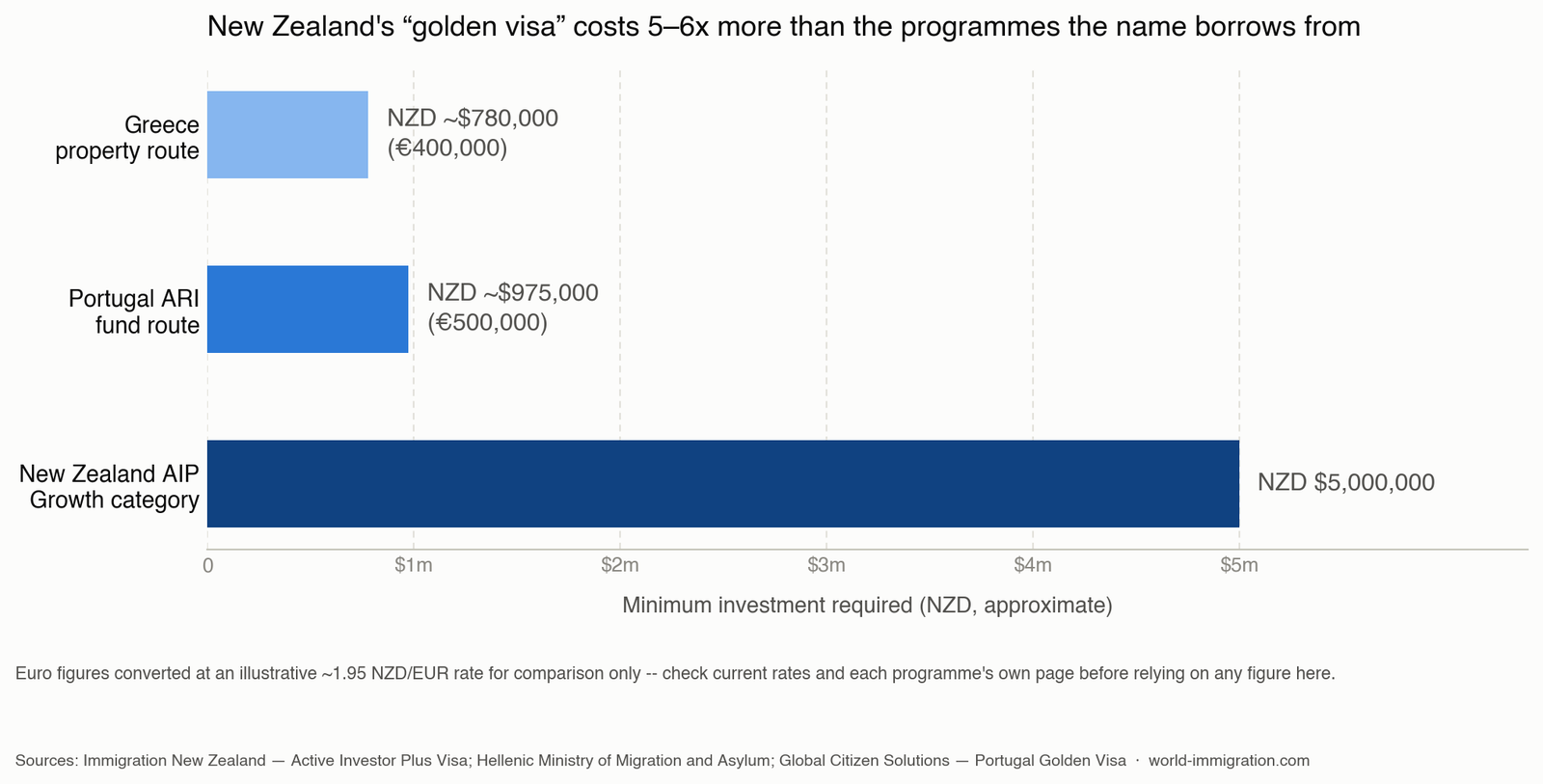
The reason “New Zealand golden visa” misleads is that the European programmes it borrows its name from are built on the opposite design choices. Portugal’s ARI (Autorização de Residência para Investimento, the route everyone actually means when they say “Portugal golden visa”) grants residence through investment thresholds in the hundreds of thousands of euros, with its fund route now the main path after real estate was removed in recent reforms.
Greece still allows property investment from €400,000 in most regions up to €800,000 in Athens, Thessaloniki, Mykonos, Santorini and the more populous islands; a €250,000 floor exists too, but only for converting a commercial building to residential use or restoring a listed building, not as a lower regional tier. Both also carry light presence obligations — Portugal’s stay rule is widely reported as seven days in the first year and 14 days in each subsequent two-year period, deliberately designed for investors who never intend to relocate.
Set that against the AIP’s own published figures, a NZD $5–10 million floor and 21 to 105 days of required presence. New Zealand’s route is not designed as a light-touch passport of convenience. It is aimed at investors prepared to commit substantial capital and, in the Balanced category especially, meaningful time in the country. Importing the European assumptions — cheap, hands-off, buy-and-forget — onto the AIP is the category error the search term encourages and it is the single most useful thing to unlearn before going further.
It Is an Active Programme, Not a Dead Letter
Part of why the “golden visa” search term keeps attaching to the AIP is that the scheme is being used. INZ’s own figures, covering 1 April 2025 to 24 May 2026, record 734 applications and 294 approvals, with NZD $4.29 billion added to the investment pipeline or already committed since the relaunch. Of that, NZD $2.57 billion sits in the pipeline (applications in progress or approved in principle) and NZD $1.72 billion has actually been committed and transferred to New Zealand.
The Growth category accounts for about 70% of committed capital. The most popular instruments have been managed funds under Growth and bonds under Balanced. The top source countries by number of applications are the United States, China and Hong Kong.
Those numbers matter for one reason. This is a live, growing route with billions flowing through it, which is precisely why an industry has grown up marketing it under a borrowed name.
What This Cannot Tell You
This article explains what the “New Zealand golden visa” search term points to and how the Active Investor Plus Visa is structured as of mid-2026. It cannot tell you whether a specific fund, business or bond will be accepted as qualifying capital — that assessment sits with Invest New Zealand, case by case and the pre-approved fund list changes over time. It cannot give you tax, currency or investment advice; the AIP is a capital-deployment decision as much as an immigration one and the two need to be planned together with professionals in both fields.
It also cannot promise the thresholds and timeframes above will hold. New Zealand has changed its investor-visa settings more than once in recent years, the April 2025 relaunch being the latest large revision and the March 2026 property-purchase carve-out shows the rules around it are still moving. The figures here are drawn from Immigration New Zealand and Invest New Zealand’s own current pages. Check both directly before committing to anything and use a Licensed Immigration Adviser (regulated in NZ and searchable on the Immigration Advisers Authority register) for a real application.
Frequently Asked Questions
Q: Is there really no New Zealand golden visa?
Correct. No visa, law or Immigration New Zealand category carries that name — INZ’s own Active Investor Plus Visa page is the closest thing to an official description and it never uses “golden visa.” “Golden visa” is a media and industry label applied to the Active Investor Plus (AIP) Resident Visa from the outside. When residency-advisory firms and financial press write “New Zealand Golden Visa,” the AIP is the route they are describing. The New Zealand government itself has never used the phrase.
Q: What happened to the New Zealand entrepreneur visa?
Many people who search “New Zealand golden visa” are actually after a cheaper business route than the multi-million-dollar AIP and often have the old Entrepreneur Work Visa in mind. That route is closed: INZ stopped accepting new Entrepreneur Work Visa applications from 26 August 2025, having found it delivered low application volumes, high decline rates and weak economic impact. It was replaced by the Business Investor Work Visa, which opened in November 2025.
That visa has two pathways. The standard route is NZD $1 million invested in an established business, with three years running it before residence eligibility; the fast-track is NZD $2 million invested, with 12 months. You must additionally hold at least NZD $500,000 in reserve to live on, the business must employ five or more full-time staff and create at least one new job for a New Zealander and you need to be 55 or under, with acceptable business experience and English-language proficiency (which the AIP does not require).
It is still a serious threshold, but an order of magnitude below the AIP’s $5–10 million and it is a work visa earned by running a business rather than residence bought with capital alone.
Q: Does the Active Investor Plus Visa lead to citizenship?
Not directly. The AIP grants residence. Citizenship still runs through New Zealand’s standard residence-based process afterwards — the Department of Internal Affairs’ citizenship-by-grant presence requirements require holding a resident-class visa and being physically present in New Zealand for a set number of days across a set number of years before you can apply. Anyone selling the AIP as a way to “buy a passport” is describing something it does not do. It is a residence visa with an investment and a physical-presence commitment attached and citizenship is a separate step down the line.
Q: How much money do you actually need for the AIP?
Per Immigration New Zealand’s Active Investor Plus Visa page, the floor is NZD $5 million for the Growth category, held 36 months in higher-risk instruments with 21 days of NZ presence, or NZD $10 million for the Balanced category, held 60 months in a broader lower-risk range with 105 days of presence (reducible by investing more).
On top of the capital, the government application fee is from NZD $27,470. Passive residential property does not count toward the investment and philanthropy is capped at 20% of the Growth-category total. If those figures are beyond reach, the AIP is not the route and the New Zealand work visa pathways are the ones to look at instead.
Sources
- Immigration New Zealand — Active Investor Plus Visa
- Immigration New Zealand — 2025 changes to the Active Investor Plus Visa and statistics
- Dentons — New Zealand’s Golden Visa Programme: the Active Investor Plus visa (December 2025)
- Immigration New Zealand — Acceptable investments for an Active Investor Plus Visa
- Invest New Zealand — Acceptable investments for the Active Investor Plus visa
- Invest New Zealand — About Active Investor Plus
- Toitū Te Whenua Land Information New Zealand (LINZ) — Investing in residential land over $5 million
- New Zealand Legislation — Overseas Investment (National Interest Test and Other Matters) Amendment Act 2025
- Immigration New Zealand — Business Investor Work Visa
- Immigration New Zealand — Business Investor Visa offers new immigration options for investors
- Immigration Advisers Authority — Register of licensed immigration advisers
- New Zealand Government — Presence requirements for NZ citizenship by grant
- Global Citizen Solutions — Greece Golden Visa: The Expert Investor’s Guide
- Global Citizen Solutions — Portugal Golden Visa: Changes, Updates and Developments
- Wikipedia — Portugal Golden Visa
- Portugalist — Portugal Golden Visa Stay Requirements

