
There is a particular worry that comes with a partner-based visa and it has nothing to do with fees or processing queues. It is the question of whether a private relationship, the ordinary shape of two people building a life together, will read as convincing to a case officer who has never met you. Couples ask it constantly. Is what we have enough? Do we have the right documents? What if the way we actually live does not match what an immigration department expects a couple to look like? That anxiety is the emotional core of a New Zealand partner visa and it is usually a bigger source of stress than the money or the wait.
Anyone who has lived in New Zealand for a while will have met several people who moved here this way. Partnering with a New Zealander is one of the most ordinary and unremarkable immigration stories there is, not a fringe case and the pathway is well established in Immigration New Zealand‘s (INZ) rules. This article sets out how the two partner visas work, what the “genuine and stable relationship” standard actually asks for and the handful of rules that decide the outcome before evidence even comes into it. It expands on the brief partner section in our broader guide to the New Zealand work visa and sits alongside the wider moving to New Zealand hub.
Two Visas, Not One
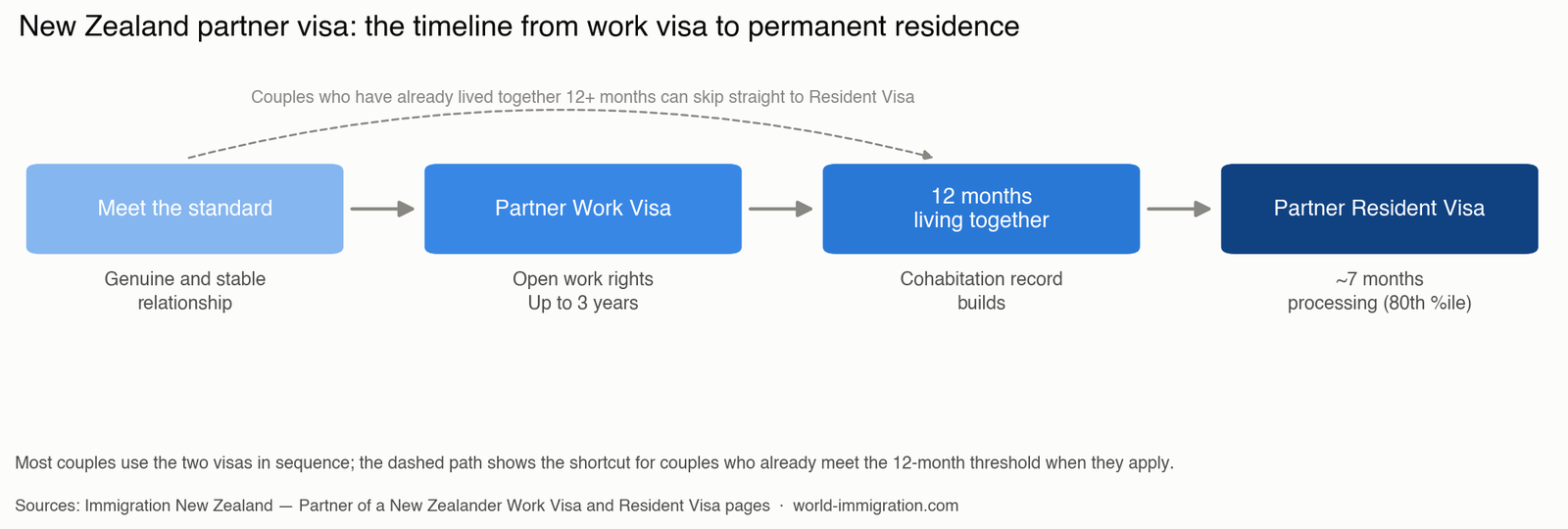
The first misconception to clear up is that there is a single “partner visa”. There are two and they do different jobs. The Partner of a New Zealander Work Visa is temporary. It gives you open work rights, meaning you can take any legal job rather than being tied to one employer. Since 1 October 2024 it runs longer than older advice suggests: if you and your partner have already lived together for 12 months or more, INZ grants it for up to three years; if you have lived together less than 12 months, the first grant is for one year, with further work visas available up to a three-year total. The Partner of a New Zealander Resident Visa is permanent residence. It is the one that lets you stay indefinitely and it carries the heavier evidence burden and the longer wait.
Most people use them in sequence. You come in on the work visa, live and work here while your relationship record builds and apply for residence once you meet the threshold. Couples who have already been living together for a year or more can skip straight to the resident visa if they prefer. The work visa is not a lesser version of the resident visa. It is a different tool and for a couple who have not yet spent twelve months under one roof it is often the only one available at first.
| Partner Work Visa | Partner Resident Visa | |
|---|---|---|
| What it gives you | Temporary stay with open work rights | Permanent residence |
| Relationship requirement | Genuine and stable relationship; no fixed minimum time living together | At least 12 months living together in a genuine and stable relationship |
| Typical cost | From NZD $1,630 | From NZD $5,360 (fee plus levy) |
| Processing (80th %ile) | Around 5 weeks | Around 7 months |
| Leads to residence? | Not directly; commonly held first, then converted | Yes, this is residence |
Source: Immigration New Zealand partner-visa pages and fee schedule (immigration.govt.nz, 2026). Processing figures are 80th percentile estimates and shift with application volumes.
What “Genuine and Stable” Actually Means
Immigration New Zealand does not just want proof that you are a couple. Its own partnership guidance asks for evidence that the relationship is both genuine, meaning it is not an arrangement entered into for immigration and stable, meaning it is likely to last. Those two words carry the whole assessment and a marriage certificate on its own does not settle either of them.
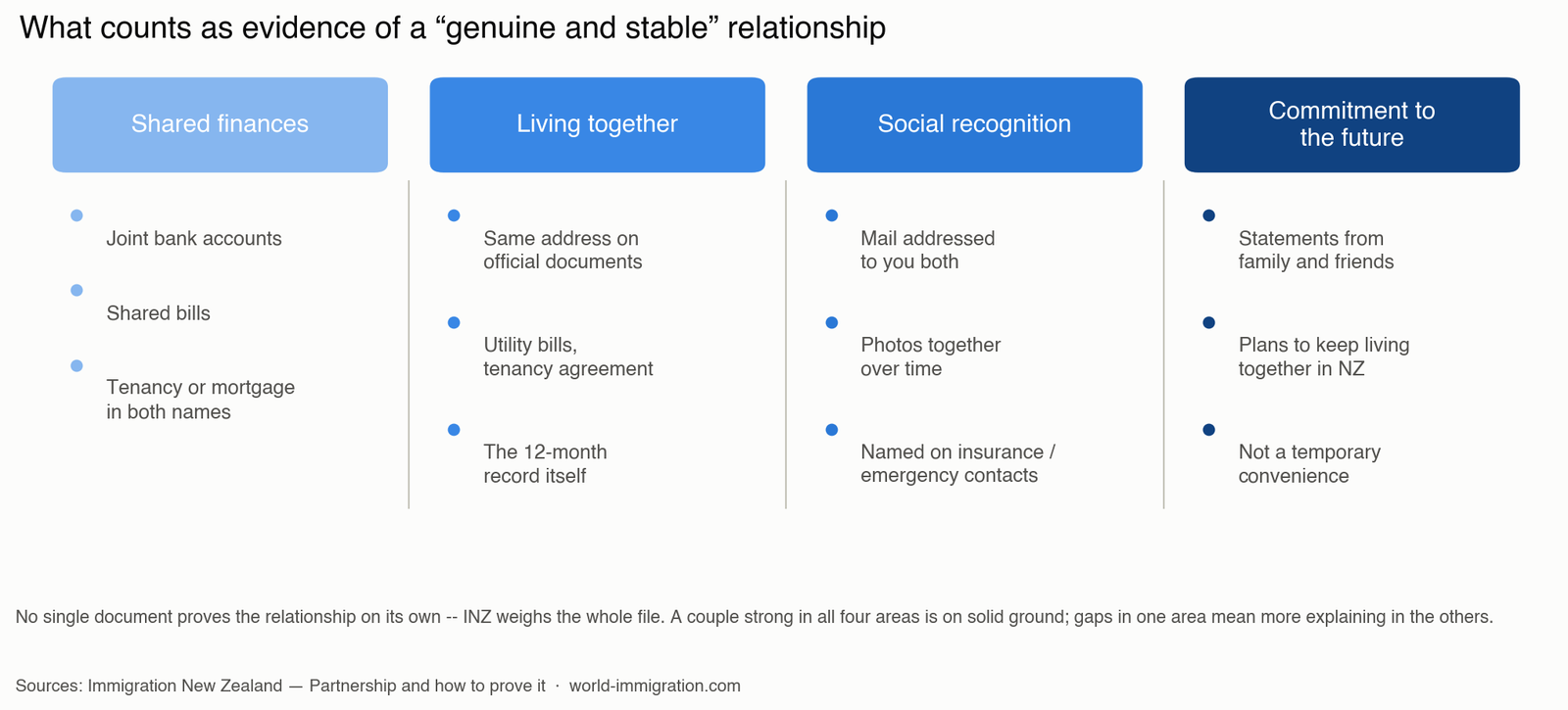
In practice INZ looks across four broad areas of your life together. The first is shared finances: joint bank accounts, shared bills, a tenancy or mortgage in both names, evidence that your money is entangled rather than kept strictly separate. The second is living together, which is where the twelve-month clock lives for residence. The third is social recognition, the sense that the people around you treat you as a couple: correspondence addressed to you both, photographs over time, statements from family and friends, being named on each other’s insurance or emergency contacts. The fourth is a shared commitment to the future, including a clear intention to keep living together in New Zealand rather than the relationship being a temporary convenience.
No single document proves any of this by itself. The assessment is cumulative. A couple with a joint mortgage, three years of shared bank statements and a wedding attended by both families is on very solid ground. A couple who have kept their finances separate, lived apart for stretches and have few photographs together will have more to explain, even if the relationship is entirely sincere. The standard rewards a paper trail that most people never think to keep while they are simply living their life, which is exactly why it lands as intrusive to so many New Zealanders. Being asked to document a private relationship for a government agency strikes most people here as bureaucratic and slightly uncomfortable, even when they understand why the rule exists. That reaction is normal and it does not mean anything is wrong with your application.
One practical point that comes up often in migrant discussion: if you are unsure whether your evidence is strong enough, you can phone Immigration New Zealand directly on its general enquiries line and ask before you submit. Sanity-checking your documents that way is a legitimate step, not a sign of a weak case. A short call early beats a decline months later, especially where your circumstances are unusual.
Marriage, Civil Union, or De Facto — All Count Equally
Immigration New Zealand’s own partnership definition recognises three kinds of relationship: marriage, civil union and a de facto relationship with no formal registration at all. All three are treated the same way against the genuine-and-stable standard. A de facto couple who have never married are not at a disadvantage and a married couple do not get a shortcut. Legal formality changes which certificate you can attach, not whether you still have to prove the substance of the relationship.
The same equality applies regardless of the sexes of the partners. Same-sex couples are assessed under exactly the same partnership definition, with no separate process and no additional hurdle. That reflects New Zealand law directly. The Marriage (Definition of Marriage) Amendment Act 2013 extended marriage to same-sex couples across the country from August 2013 and civil unions have been available to both same-sex and opposite-sex couples since 2005. A same-sex de facto couple, a same-sex married couple and an opposite-sex married couple all meet INZ on identical terms.
This is not a safe assumption to carry across borders. A number of the other countries covered on this site do not extend equivalent immigration recognition to same-sex partnerships and some do not recognise unmarried de facto relationships either. If you are comparing New Zealand against other destinations, the equal treatment here is a concrete point in its favour, not a technicality.
The 12-Month Living-Together Requirement
For the resident visa, the headline number is twelve months — Immigration New Zealand’s own criteria require you to have been living with your partner “in a genuine and stable relationship for at least 12 months when you apply.” The detail people miss is what those twelve months have to be. It is not twelve months of dating and it is not twelve months of being officially a couple. It is twelve months of actually living together in a genuine and stable relationship. A pair who met three years ago but spent most of that time in different countries, kept apart by work postings or visa limits, can struggle to show a continuous twelve-month period under the same roof. This is one of the more common friction points in these applications and it stalls more couples than any question about whether the relationship is sincere.
The system has a built-in answer for couples who are not there yet and it is the Partner of a New Zealander Work Visa, which does not require a fixed period of living together, only that the relationship is genuine and stable now. So the usual approach for a couple who have been apart is to get the work visa first, move in together in New Zealand and let the cohabitation record accumulate before applying for residence once the twelve months are behind them. Couples short of the residence threshold generally take this route rather than seeking a waiver of the twelve-month requirement.
The evidence is easiest to gather when it starts from day one of living together, not from the day an application gets decided on. Retroactively reconstructing a year of shared life from memory is far harder than keeping a joint account open and a couple of letters addressed to both partners. The couples who find the twelve-month requirement easy are usually the ones who never treated their paperwork as a chore in the first place.
How Often One Person Can Sponsor a Partner
There is a rule that decides some applications before evidence is even looked at and it sits with the New Zealand partner rather than the applicant. Immigration New Zealand’s own eligibility criteria state that a sponsor must not have acted as a partner in a successful resident visa application within the past five years, or in more than one successful resident visa application ever. Put simply, they can only have done this once before, ever and not within the last five years.
This is not discretionary. If your New Zealand partner previously helped a former partner gain residence this way within the past five years, the resident-visa route is closed to your relationship for now, no matter how strong your evidence is. The sponsor signs a declaration confirming their history on the official Partnership Support Form (INZ 1178), so it is not something that can be quietly overlooked. It is a hard limit designed to stop the pathway being used repeatedly and it is one of the first things to check if your partner has been married or in a serious partnership before.
The five-year window matters as much as the lifetime cap (see Immigration New Zealand’s eligibility criteria above). A partner who sponsored someone eight years ago has one sponsorship left and can use it now. A partner who sponsored someone two years ago has to wait, even though they are within their lifetime allowance of two. If this applies to you, it is the single most important fact to establish before you spend anything on an application.
If the Relationship Ends Before Residence Is Granted
The rule turns entirely on timing.
If your relationship ends while a resident-visa application is still being processed, Immigration New Zealand’s own guidance on what to do if your relationship ends requires you to let them know immediately. This is not optional and staying silent can be treated as withholding relevant information, a character issue with consequences of its own, separate from the visa itself. Because the eligibility rests on being in the relationship, an application will generally be declined if the relationship has ended by the time a decision is made. The criteria are simply no longer met.
Once the resident visa is actually granted, a later break-up does not put your residence at risk. INZ confirms that your residence status remains unchanged if the relationship ends after the visa is granted. The vulnerable window is before the grant and Immigration New Zealand’s own guidance on changes to your circumstances lists a partnership breakdown as something that can still affect a visa you hold but have not yet used to enter New Zealand — so the gap between an offshore grant and your first entry is not automatically safe either. Anxious applicants get this wrong in both directions. Some believe their residence is never fully secure, which is not the case. Others assume the temporary work-visa stage already protects them, which it does not.
When the relationship ends because of family violence
One case needs to be handled on its own, because the ordinary rule above would otherwise trap people in danger. If your New Zealand partnership has broken down because of family violence, you are not forced to choose between your safety and your immigration status. There is a dedicated pathway for exactly this: the Victims of Family Violence Resident Visa and a corresponding Work Visa that covers the time while the resident application is assessed.
It covers violence from the partner and also from someone else in the household, such as a family member of your partner, provided you were living with the person who was abusive. Both the Resident Visa and the Work Visa carry no application fee and no immigration levy. The Resident Visa processes in around six months at the 80th percentile; the Work Visa is treated as high priority and is faster, so it can cover the interim and can be renewed while the resident application continues to be assessed. The intent is straightforward. No one should have to stay in an abusive relationship simply to hold on to a visa.
If this applies to you, the official Immigration New Zealand pages on the Victims of Family Violence visas set out the evidence that qualifies and specialist family-violence support services in New Zealand can help you through the process safely. This article is a starting point, not a substitute for that direct help.
What This Cannot Tell You
This article maps the partner-visa rules as they stand in 2026, drawn from Immigration New Zealand’s own partner-visa pages, its fee schedule and the Partnership Support Form. It cannot tell you whether your particular collection of evidence will satisfy the case officer assessing it, because that is a judgement made on the whole file, not on any checklist. Two couples with similar documents can get different questions depending on the gaps in their record.
It cannot confirm your New Zealand partner’s sponsorship history for you. Only they can and it is the one fact that can quietly close the resident-visa route regardless of everything else. It cannot account for policy changes after publication and INZ adjusts its settings regularly. And it cannot replace advice tailored to a complicated case, such as a relationship with long periods apart, a prior sponsorship, or a family-violence situation. For anything on that list, check immigration.govt.nz directly and consider a Licensed Immigration Adviser, who is regulated in New Zealand and searchable on the Immigration Advisers Authority register.
If your next step after a partner visa is settling in as a family, our moving to New Zealand with a family guide covers schools, childcare and the practicalities of settling in and if bringing an ageing parent over later is part of the plan, the New Zealand parent visa guide covers that separate route.
Frequently Asked Questions
Q: Do we have to be married to get a New Zealand partner visa?
No. Immigration New Zealand’s own partnership definition recognises marriage, civil union and de facto relationships equally and a de facto couple who have never married can qualify for both the work visa and the resident visa. Marriage does not shortcut the assessment either. Whatever your legal status, you still have to show the relationship is genuine and stable through evidence of shared finances, living together, social recognition and a shared commitment to the future. The certificate you can attach differs; the standard you must meet does not.
Q: How much evidence is enough for the “genuine and stable” test?
There is no fixed quantity, because Immigration New Zealand weighs the whole file rather than counting documents. A strong file usually spans all four areas it assesses — joint finances, time living together, recognition by the people around you and a clear intention to keep living together in New Zealand — rather than piling up many documents of one kind. If you are unsure, you can phone Immigration New Zealand’s general enquiries line and ask before you submit, which is a legitimate step. The couples who run into trouble are generally those who kept their lives strictly separate on paper, not those who lack sincerity.
Q: What happens to my visa if we break up?
It depends on timing. Immigration New Zealand’s own guidance on what happens if your relationship ends is clear: if you break up while a resident-visa application is still being processed, you must tell them immediately and the application will generally be declined because the criteria are no longer met. Staying silent can be treated as withholding relevant information. If the resident visa has already been granted, a later break-up does not affect your residence at all. The exception is family violence: if the relationship ended because of abuse, the Victims of Family Violence Resident Visa and Work Visa exist so you are not forced to stay in the relationship to keep your status and both carry no fee.
Q: Can my partner sponsor me if they have sponsored someone before?
Only within limits. Immigration New Zealand’s own eligibility criteria state a citizen or resident can support at most one successful partnership-based resident visa in any five-year period and no more than two in their lifetime. So if your partner sponsored a former partner within the last five years, the resident-visa route is closed to you for now, even with strong evidence. If it was longer ago and they have not used up their lifetime limit of two, they can sponsor you. Confirm this before you spend anything, because it is a hard rule rather than a discretionary one.
Sources
- Immigration New Zealand — Partner of a New Zealander Work Visa
- Immigration New Zealand — Partner of a New Zealander Resident Visa
- Immigration New Zealand — Fees, decision times and where to apply
- Immigration New Zealand — Partnership and how to prove it
- Immigration New Zealand — If your relationship ends
- Immigration New Zealand — Changes to your circumstances
- Immigration New Zealand — Contact us
- New Zealand Legislation — Marriage (Definition of Marriage) Amendment Act 2013
- New Zealand Legislation — Civil Union Act 2004
- Immigration New Zealand — Partnership Support Form for Residence (INZ 1178)
- Immigration New Zealand — Victims of Family Violence Resident Visa
- Immigration New Zealand — Victims of Family Violence Work Visa
- Immigration New Zealand — Evidence of family violence for victims of family violence visas
- Immigration Advisers Authority

