
If you are weighing up a move to New Zealand, one question sits underneath almost every other, which is will I actually be better off? You may have seen figures like $70,000 or $80,000 thrown around as the average salary in New Zealand and they sound reasonable. What those headlines rarely explain is that the number depends heavily on which average you use, which sector you are in and which city you land in.
This article walks through what the official data actually shows, what take-home pay looks like after the New Zealand tax system has taken its share, how salaries vary by region and industry and where the squeeze actually falls. The numbers come from Statistics New Zealand, the Inland Revenue Department (IRD) and the Ministry of Business, Innovation and Employment (MBIE).
The Median Versus the Mean: Which Number Should You Use?
The single most common mistake I see in salary discussions about New Zealand is treating the mean and the median as interchangeable. They are not and the difference is not a technicality.
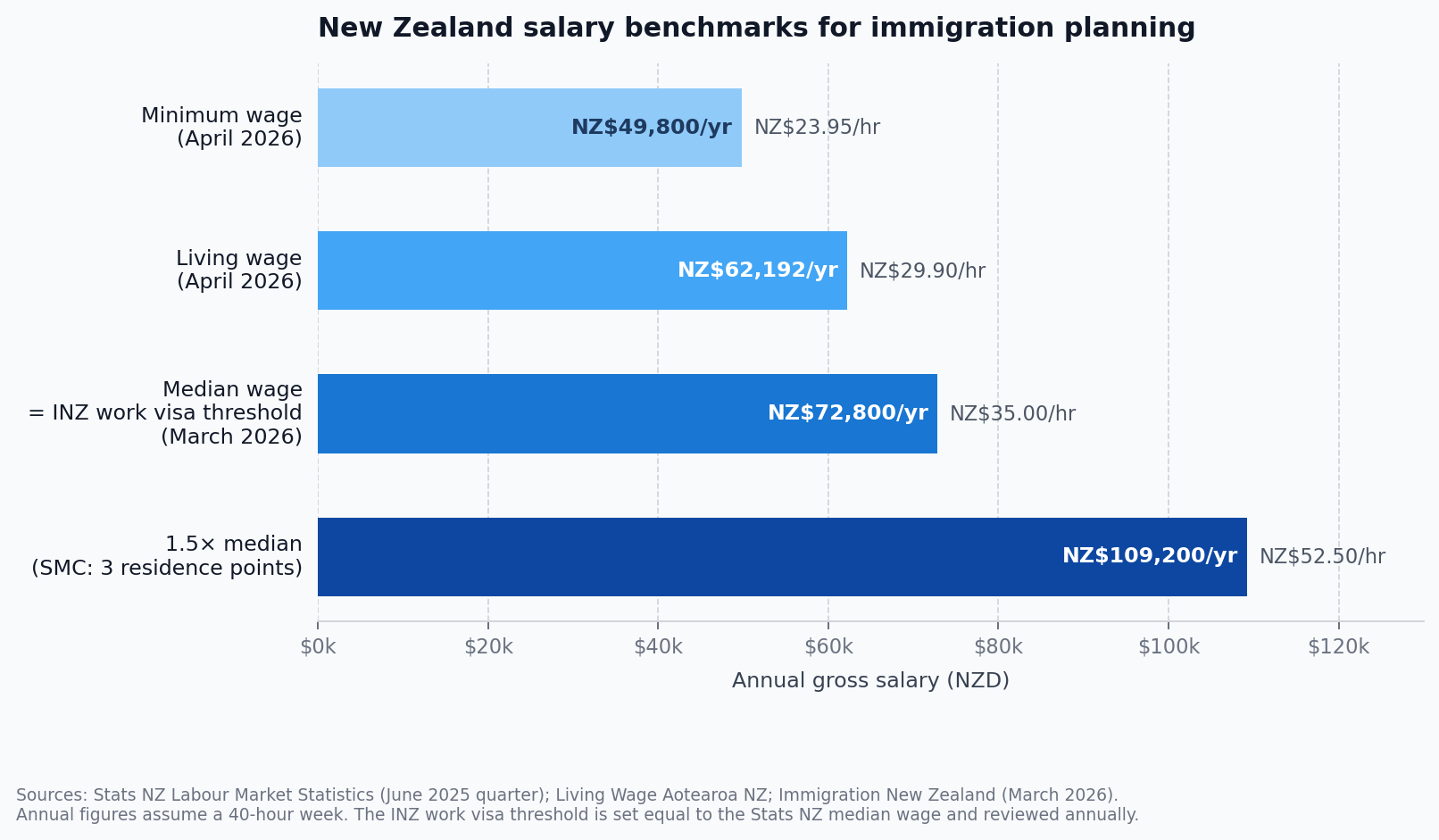
Statistics New Zealand publishes both from its quarterly Labour Market Statistics series. In the year to the June 2025 quarter, median hourly earnings from wages and salaries rose to NZ$35.00 per hour, according to Stats NZ’s Labour Market Statistics (Income) release. For a standard 40-hour week, that works out to NZ$72,800 per year.
The mean (average) ordinary time hourly earnings, a separate measure from Stats NZ’s Quarterly Employment Survey, were NZ$44.12 per hour as at the March 2026 quarter, which is considerably higher. The reason the mean is higher is straightforward, a relatively small number of very high earners, particularly in professional services and specialist medicine, pull the average upward.
The full-time equivalent median annual salary is often quoted as around NZ$69,836, but the median weekly income from all sources, including part-time workers and those working reduced hours, was only NZ$959 per week in the same Stats NZ quarter. That is closer to NZ$49,868 per year. If you arrive and spend three to six months in part-time or contract work while building a permanent role, this lower figure is the more relevant benchmark for your first year.
The practical takeaway: when a job advertisement quotes a salary, or when a recruiter gives you a range, you are looking at gross full-time figures. The median matters most as a reference point for what is typical in a full-time role once you are established. In immigration and policy discussions, NZ$72,800 per year is the number used when citing the average salary in New Zealand.
What You Actually Take Home: Tax, ACC and KiwiSaver
New Zealand’s PAYE (Pay As You Earn) system deducts income tax at the source (your employer does it for you). The current tax thresholds have been in effect since 31 July 2024 and continue unchanged through the 2025–26 tax year (1 April 2025 to 31 March 2026), as per Inland Revenue’s tax rates for individuals.
| Income range | Tax rate |
|---|---|
| $0 – $15,600 | 10.5% |
| $15,601 – $53,500 | 17.5% |
| $53,501 – $78,100 | 30% |
| $78,101 – $180,000 | 33% |
| $180,001 and above | 39% |
On top of PAYE, two further deductions apply to most employees. The ACC earner’s levy, which funds New Zealand’s no-fault accident compensation scheme, sits at 1.67% of gross earnings for the 2025–26 year, as per IRD’s ACC earner’s levy rates. KiwiSaver, New Zealand’s workplace retirement savings scheme, defaults to a 3.5% employee contribution from 1 April 2026 (up from 3%), as per IRD’s KiwiSaver changes notice.
Your employer must also contribute a minimum of 3.5% of your gross salary on top of what you earn — this is an employer cost, not a deduction from your pay, but it is useful to factor it in when comparing total compensation across countries.
The table below gives approximate take-home figures at common salary levels. These are based on the standard M tax code, with no student loan. Use the IRD’s online PAYE calculator at ird.govt.nz for exact figures, as your circumstances may differ.
| Gross annual salary | Approx. net after PAYE + ACC | After PAYE + ACC + KiwiSaver 3.5% | Weekly take-home (approx.) |
|---|---|---|---|
| $50,000 | ~$41,500 | ~$39,800 | ~$765 |
| $60,000 | ~$48,800 | ~$46,700 | ~$898 |
| $70,000 | ~$55,600 | ~$53,200 | ~$1,022 |
| $80,000 | ~$62,400 | ~$59,600 | ~$1,146 |
| $100,000 | ~$75,500 | ~$72,000 | ~$1,384 |
| $120,000 | ~$88,500 | ~$84,300 | ~$1,622 |
At the median salary of roughly $70,000 gross, take-home is around $1,000 per week after PAYE, ACC and KiwiSaver. That is the typical number for a full-time employee in an established role. Student loan repayments add a further 12% on income above NZ$24,128, so for anyone arriving with a New Zealand student loan, the effective deduction is higher still.
Many people arriving from Australia or the United Kingdom are surprised by the tax at mid-range salaries. At $80,000 gross, the effective combined deduction including KiwiSaver is roughly 25.5%. That is not unusual by OECD standards, but it is higher than some arrivals expect if they have only looked at the headline figures.
Average Salary in New Zealand by Region
The average salary in New Zealand shifts considerably by region. Stats NZ’s own income data confirms Wellington as the highest-earning region, reflecting its concentration of central-government roles. The full regional breakdown below is compiled from recruitment and salary-comparison sources rather than a single official Stats NZ regional table, so treat the individual figures as indicative rather than exact — the ranking (Wellington ahead of Auckland and with both of those well ahead of the smaller regional centres) is the reliable part.
| Region | Median annual salary | Mean annual salary |
|---|---|---|
| Wellington | $75,000 | $90,000 |
| Auckland | $68,000 | $82,000 |
| Christchurch / Canterbury | $63,000 | $74,000 |
| Tauranga / Bay of Plenty | $62,000 | $73,000 |
| Hamilton / Waikato | $60,000 | $71,000 |
| Dunedin / Otago | $58,000 | $69,000 |
| Southland / Invercargill | $58,000 | $68,000 |
| Hawke’s Bay | $56,000 | $66,000 |
| Northland | $52,000 | $62,000 |
| Gisborne / Tairāwhiti | $50,000 | $60,000 |
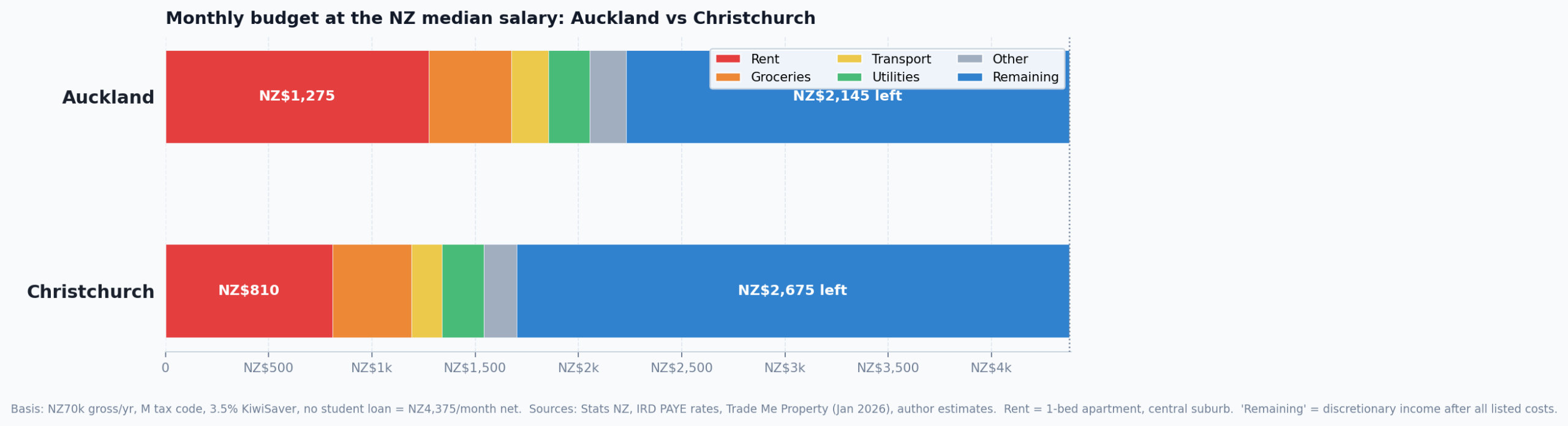
Wellington’s lead reflects the concentration of central government roles and professional services. For anyone in IT, engineering, or professional services, I’d look at Christchurch seriously. The salary gap relative to Auckland is around $5,000 per year at the median, while median one-bedroom rents run roughly NZ$810 per month in Christchurch versus NZ$1,275 in central Auckland, according to Trade Me Property’s rental price index. Over a year, that rent differential alone is more than NZ$5,500. On that arithmetic, Christchurch comes out ahead in purchasing power for most mid-range earners.
Regional cities such as Palmerston North, Napier and Nelson offer further cost reductions, though job availability in specialist roles is smaller outside the main centres. Remote work has changed this calculation somewhat — I have many many colleagues that work from far away places that I interact with from Auckland on a daily basis. In addition my employer recruits from anywhere nationally. Working remotely for an Auckland or Wellington employer while living in a cheaper regional city is a viable and increasingly common arrangement.
Salary by Industry and Profession
The average salary in New Zealand varies more by sector than almost any other factor and the difference between the lowest and highest-paying industries is fairly stark. The figures below draw on the Hays FY26/27 Salary Guide, SEEK reporting via RNZ and Statistics New Zealand occupational data for the 2025–26 period; treat them as indicative bands rather than a single official schedule, since no government pay scale covers most of these roles.
| Sector | Typical gross annual range |
|---|---|
| IT and technology | $100,000 – $190,000 (software engineer to technical lead); architects and senior specialists $180,000–$350,000+ |
| Finance and insurance | $110,000 – $175,000 (accountant to financial controller) |
| Healthcare and social services | $65,000 – $400,000+ (wide by role) |
| Engineering and construction | $85,000 – $165,000 (civil, structural and building services) |
| Public administration | $75,000 – $105,000 |
| Education and training | $55,000 – $120,000 |
| Manufacturing and trades | $58,000 – $95,000 |
| Agriculture, forestry and fishing | $55,000 – $85,000 |
| Retail, hospitality and tourism | $45,000 – $65,000 |
A few specific roles stand out for people considering a skilled migrant pathway. General practitioners’ pay varies widely by ownership structure and hours, but salaried roles typically fall between NZ$180,000 and NZ$280,000 according to recruitment-site salary data (there is no single national GP pay scale) and hospital specialists can reach NZ$400,000 or more. Registered nurses start at around NZ$75,000 (Step 1 of the scale) and move to over NZ$106,000 at the top step, per the Te Whatu Ora/NZNO nursing MECA pay scale, plus penal rates for nights, weekends and public holidays.
Systems engineers saw one of the largest pay increases in late 2024, averaging NZ$118,608, a 12.8% rise (SEEK data via RNZ). The highest average across all occupations tracked by SEEK was GPs, at NZ$220,935.
Within technology, the spread between generalist and specialist roles is wider than most sectors: a software engineer in Auckland typically earns NZ$120,000–$145,000, a technical lead NZ$150,000–$190,000 and solution or enterprise architects NZ$180,000–$250,000. Cyber security leadership (CISO) and AI specialist roles sit above NZ$200,000, with senior AI and data leadership reaching NZ$280,000–$350,000 (Hays FY26/27).
For trades roles, which feature prominently on Immigration New Zealand’s Green List, the figures are more specific. Metal fabricators and welders on the Green List must be paid at least NZ$90,750 per year (NZ$43.63 per hour) and panel beaters and vehicle painters are set at a minimum of NZ$80,267 per year (NZ$38.59 per hour), as per Immigration New Zealand’s Green List roles page. These are the immigration-specified minimums, not typical market rates — actual offers may exceed them.
The Immigration Wage Floor and Why It Matters
From 9 March 2026, the median wage set by Immigration New Zealand is NZ$35.00 per hour, equivalent to NZ$72,800 per year on a 40-hour week, per Immigration New Zealand’s wage rate requirements for visas. This figure appears throughout the immigration system as a reference point.
For the Accredited Employer Work Visa (AEWV), most roles must pay at or above the median wage. For the Skilled Migrant Category, salary relative to the median affects how many points a candidate earns: 1.5 times the median (NZ$52.50 per hour, NZ$109,200 per year) earns three points; twice the median (NZ$70.00 per hour, NZ$145,600 per year) earns four points, as per Immigration New Zealand’s SMC pay-rate table.
Parent Resident Visa sponsors face a similar multiple, not a flat median-wage figure. From 30 April 2026, a single sponsor must earn at least 1.5 times the median wage (around NZ$109,200 per year), rising to twice the median (around NZ$145,600) for joint sponsors, with the minimum increasing by half the median wage for each additional parent sponsored (up to six), as per Immigration New Zealand’s announcement on Pacific and parent visa income thresholds.
What this means practically: the immigration median wage functions as a de facto floor for skilled migrants. A job offer below NZ$35.00 per hour creates visa complications regardless of what the employer is willing to pay — see our guide to New Zealand work visas for how this plays out across each visa route. If you are negotiating a salary as part of a visa application, the immigration threshold is not just a background detail — it is a hard constraint that can affect whether the visa is approvable at all.
Salary Versus Cost of Living: The Full Picture
A salary figure without cost context is close to useless for planning purposes. Here is what the numbers look like when you put them alongside living costs (our full cost of living in New Zealand guide breaks this down city by city).
For a single person excluding rent, monthly costs in New Zealand typically fall between NZ$790 and NZ$1,020. Add a one-bedroom apartment at NZ$1,275 per month in Auckland, as per Trade Me Property’s rental price index and total monthly outgoings for a single person sit around NZ$2,000–$2,500.
At the median take-home of roughly NZ$4,375 per month (after PAYE, ACC and 3.5% KiwiSaver on a NZ$70,000 salary), the discretionary margin in Auckland is NZ$1,875–$2,375. That is not poverty — but it leaves little room for error, particularly in the first year before permanent residency when access to some government support is limited.
In Christchurch, where one-bedroom rents average around NZ$810 per month (using the same Trade Me data), the same earnings leave closer to NZ$2,500–$3,000 per month after all expenses. The difference compounds quickly over a year.
Housing affordability is the structural pressure point. Comparing the June 2024-year median house sale price (NZ$753,500) with median household equivalised disposable income (NZ$51,597), Stats NZ data puts the national house-price-to-income multiple at around 14.6 times. Auckland is consistently the least affordable major region on this measure — its multiple runs higher than the national figure, not lower — while smaller centres such as Invercargill and Palmerston North sit well below it.
By international benchmarks, a multiple this high qualifies as severely unaffordable (a multiple of 3 or under is considered affordable, per the median-multiple standard used by the UN, World Bank and OECD). Buying in the early years of arrival is unlikely to be realistic for most migrants unless they arrive with substantial capital.
The comparison with Australia matters too. Average nominal salaries in Australia run roughly 15–25% higher than equivalent New Zealand roles, according to salary-comparison sources (there is no single official measure of the gap). In the year ended December 2024, 47,300 people migrated from New Zealand to Australia against 17,300 the other way, a net loss of 30,000 (the largest calendar-year loss since 2012), as per Stats NZ’s international migration release.
The salary differential is one acknowledged factor. The purchasing power gap narrows on a PPP-adjusted basis (purchasing power parity or PPP – adjusting for the fact a dollar buys more in some countries than others) and Australia has higher costs in several areas, but the raw nominal gap has been a feature of both economies for decades. Community reports from expat forums (as well as locals like me) consistently echo the sentiment that New Zealand is chosen for lifestyle, environment and culture rather than financial maximisation.
Wage Growth and the Job Market in 2025
Average ordinary time hourly earnings grew 3.1% in the year to March 2026, according to Statistics New Zealand’s Quarterly Employment Survey. That follows a 4.5% rise in the year to June 2025 — both years above inflation, which is a shift from the preceding period. For context, the Council of Trade Unions reported that in 2024, around 70% of workers received pay rises below inflation and 44% received no pay rise at all. The picture has improved since then, but wage growth is moderating from its post-pandemic peak.
The job market itself has tightened considerably (see our guide to working in New Zealand for the fuller picture). Nationwide job listing volumes fell 19% in the October–December 2025 quarter compared with the previous quarter, with Wellington and Auckland down 21–24% over the same quarter and Auckland job ads down 14% year-on-year (56% over three years), as per Trade Me Jobs’ quarterly data reported via Scoop.
Specialist technology, healthcare and trades roles remain different: skill shortages in those areas are driving the sector-specific wage increases that dominate the headline growth figure. For a software engineer or a registered nurse, the market is still relatively favourable. For someone arriving in a generalist administrative or retail role, competition for roles has been reported as intense, with some individual roles drawing well over a hundred applicants.
The manufacturing, transport and logistics sector saw the largest wage growth reported in late 2024, up 15.5% on average (average NZ$58,240). Educators saw 12% growth (average NZ$72,010) over the same period, according to SEEK data reported by RNZ. These are sector averages — individual outcomes depend heavily on employer, location and experience level.
The Minimum Wage and the Living Wage
From 1 April 2026, the adult minimum wage rises to NZ$23.95 per hour — NZ$958 per week for a 40-hour week, or roughly NZ$49,800 per year gross, per Employment New Zealand’s announcement. On a standard tax code with 3.5% KiwiSaver, take-home at the minimum wage is around NZ$39,000–$40,000 per year, or just under NZ$770 per week.
The independent living wage, calculated by the Family Centre Social Policy Research Unit and administered by Living Wage Aotearoa NZ, sits at NZ$28.95 per hour from 1 September 2025, rising to NZ$29.90 per hour from 1 April 2026, as per Living Wage Aotearoa NZ. This is the rate independently calculated as the minimum required for a worker to meet basic needs, including modest participation in community life. The gap between the statutory minimum and the living wage is roughly NZ$6 per hour — a meaningful difference when projected across a full year.
In cities with high rents, particularly Auckland and Wellington, workers on or near the minimum wage may find that basic living costs consume most or all of take-home pay after rent. This is not a theoretical observation — Living Wage Aotearoa NZ notes that many low-paid workers are struggling to cover rent, power and food at the minimum rate. For migrants arriving in entry-level or hospitality roles, this is a concrete planning constraint, not a marginal one.
What This Article Cannot Tell You
Salary data has limits. The figures in this article reflect the 2025–26 period. Immigration settings, tax brackets, KiwiSaver rates and the minimum wage all change annually — some of the specifics here will be outdated within 12 months. Always verify current rates directly from ird.govt.nz, employment.govt.nz and immigration.govt.nz before making decisions.
The regional and industry averages are indicative, not contractual. Individual role salaries vary by employer, organisation size, negotiation and the specific skills you bring. A software engineer with ten years of experience at a global firm will command a different outcome than the sector average implies.
What this article cannot account for at all: your specific visa conditions and whether they constrain which employer you can work for, how a career break during migration affects your local market positioning and how fast you will be able to find a role in your field after arriving. The job market picture changes regularly and the listings decline described above is a headwind that the salary tables do not capture. Salary benchmarks tell you what you might earn once employed, they do not tell you how long that might take.
The average salary in New Zealand sits at a median of NZ$72,800 per year gross, but that figure is not the same in Christchurch as it is in Auckland and it says nothing about visa eligibility, role availability, or what a junior versus senior position actually commands. The sections above try to give those numbers the context they need before you make a decision around them.
Frequently Asked Questions
Q: What is a good salary in New Zealand for a comfortable life?
When thinking about what makes a good average salary in New Zealand, city of residence matters as much as the figure itself. There is no single answer, but as a working benchmark: a gross salary of NZ$80,000–$100,000 per year in a regional city outside Auckland, or NZ$90,000–$110,000 in Auckland or Wellington, typically provides a comfortable single-person lifestyle with scope for modest saving.
At the median of around NZ$70,000 gross in Auckland, take-home after tax and KiwiSaver is roughly NZ$1,000 per week. After rent of NZ$1,275 per month for a one-bedroom apartment, the remaining discretionary income is manageable but not generous. A couple earning between them will have substantially more breathing room. At the minimum wage, covering rent and essentials in Auckland is tight.
Q: How does the average salary in New Zealand compare to Australia?
Nominal salaries in Australia average roughly 15–25% higher than equivalent New Zealand roles, per salary-comparison sources. On a purchasing power parity (PPP) basis, the gap narrows because some costs are higher in Australia, but it does not close entirely. This gap is long-standing and is one reason migration from New Zealand to Australia has consistently run higher than the reverse — Stats NZ data shows 47,300 people migrated from New Zealand to Australia in the year ended December 2024, against 17,300 the other way, a net loss of 30,000.
The trade-off most people make is that New Zealand offers a different lifestyle, lower population density and shorter commutes in most cities. Those benefits matter, but they are not financial ones.
Q: What is the median wage threshold for a New Zealand work visa?
From 9 March 2026, the median wage as set by Immigration New Zealand is NZ$35.00 per hour, which equates to NZ$72,800 per year for a 40-hour week, per Immigration New Zealand’s wage rate requirements for visas. Most skilled migrant work visas, including the Accredited Employer Work Visa, require the role to pay at or above this rate. Some occupations on the Green List have specific minimum rates set above the median.
If a job offer is below NZ$35.00 per hour, check carefully whether it qualifies for the visa pathway you are applying through — in many cases it will not, regardless of what the employer offers or agrees to pay. Check current thresholds directly at immigration.govt.nz before applying, as the median wage is reviewed and updated regularly.
This article is part of our New Zealand cluster, which covers the full move end to end.
Sources
- Stats NZ — Labour Market Statistics (Income), June 2025 quarter
- Stats NZ — International migration release, net migration loss to Australia 2024
- Inland Revenue (IRD) — Tax rates for individuals
- Inland Revenue (IRD) — ACC earner’s levy rates
- Inland Revenue (IRD) — KiwiSaver changes
- Inland Revenue (IRD) — PAYE calculator
- Inland Revenue (IRD) — ird.govt.nz (general)
- Immigration New Zealand — Wage rate requirements for work visas
- Immigration New Zealand — Skilled Migrant Category pay-rate table
- Immigration New Zealand — Green List roles
- Immigration New Zealand — Income thresholds for Pacific and parent visa categories
- Immigration New Zealand — immigration.govt.nz (general)
- Employment New Zealand — Minimum wage increase, 1 April 2026
- Employment New Zealand — employment.govt.nz (general)
- Living Wage Aotearoa NZ — current living wage rate
- Living Wage Aotearoa NZ — livingwage.org.nz (general)
- New Zealand Council of Trade Unions — union.org.nz
- Te Whatu Ora / NZNO — Nursing Workforce MECA pay scale (PDF)
- Hays — FY26/27 Salary Guide
- Trade Me Property — Rental Price Index
- Trade Me Jobs, via Scoop — quarterly job market data, Q4 2025
- interest.co.nz — house price-to-income multiples explainer

