
Getting accepted onto a course in Colombia is usually the straightforward part. The question that follows — which visa actually lets you turn up and study — is where it gets murky, because Colombia sorts its visas by letter and the student route sits in a family that behaves quite differently from the one most people assume it does.
This guide is for a foreigner who has been accepted, or is about to enrol, at a Colombian educational institution and needs the right visa to study there. If you are a Colombian looking to study abroad, this is the wrong article — that is a different process handled by the destination country, not by Colombia. And if your actual plan is to work or to settle permanently, a Colombia student visa is not the tool for that either, a point covered in detail further down because it is where people so often go wrong.
What the Colombia student visa is and who qualifies
The formal name is the Visitor (V) visa in the “Estudiante” category (Article 36 of Resolución 5477 de 2022). It is issued to a foreigner enrolled at a recognised Colombian educational institution: a university, a language school, a technical institute, or an approved exchange or short-course programme.
The trigger for needing one is course intensity, not simply how long you are here. Colombia’s own rule for this visa sets the bar at a minimum of ten hours of class a week (Cancillería, Temporary Student’s Visa). Below that — a short, low-intensity course — a visa generally is not required at all and a standard visitor entry can cover you. If you are only in Colombia for a fortnight of casual, few-hours-a-week Spanish classes, you likely do not need this visa; book an intensive course at that ten-hour pace or above for even that same fortnight and you likely do. If you are enrolling for a semester, you do.
The word “recognised” is carrying weight in that sentence. The institution has to be one Colombia formally acknowledges and it is the institution that supplies several of the documents below. Booking a course with an outfit that cannot issue a proper enrolment letter is the first way this process stalls.
Colombia student visa requirements: the documents you will need
The paperwork is not exotic, but two items in particular take time to prepare, so start them early. Here is what the application asks for, per Article 36 of Resolución 5477 de 2022 and the Cancillería’s own Temporary Student’s Visa page.
- An enrolment letter from the recognised Colombian institution, confirming you have a place on the course.
- Proof of financial solvency — bank statements and sponsor support where relevant, showing you can cover both tuition and living costs for your stay.
- Health insurance covering medical risk, hospitalisation and repatriation, valid for the full period of the visa you are requesting.
- A criminal background check from your country of citizenship, apostilled or legalised and translated into Spanish.
- The institution’s registration form, signed by a school official, confirming the class schedule meets the minimum ten-hours-a-week intensity.
The two that need a head start are the background check and the health insurance. The background check has to be apostilled or legalised in your home country and then translated into Spanish and each of those steps runs on its own timetable that you do not control. Leave it to the last fortnight and it becomes the thing holding up the whole application.
Fees and the ongoing cost most people forget
There are two visa fees and they are charged at different stages. Neither is large by immigration standards and both sit noticeably below the equivalent Migrant (M) visa fees — which is consistent with the pattern across Colombia’s system, where the Visitor family costs less than the Migrant family (Colombia Move, 2026 Colombia visa guide).
| Charge | Approximate cost | When it is paid |
|---|---|---|
| Evaluation / study fee | ~US$52 (about €46) | On submission — non-refundable |
| Issuance fee | ~US$177 (about €155) | On approval |
The evaluation fee is non-refundable and is paid when you submit, whatever the outcome, so have the application in good order before you lodge it. The issuance fee only falls due if you are approved. Cancillería does not publish a single itemised fee table for this visa on its own site; the figures above are corroborated by Colombia Move’s 2026 visa-fee breakdown, so confirm the exact amount at the point you pay.
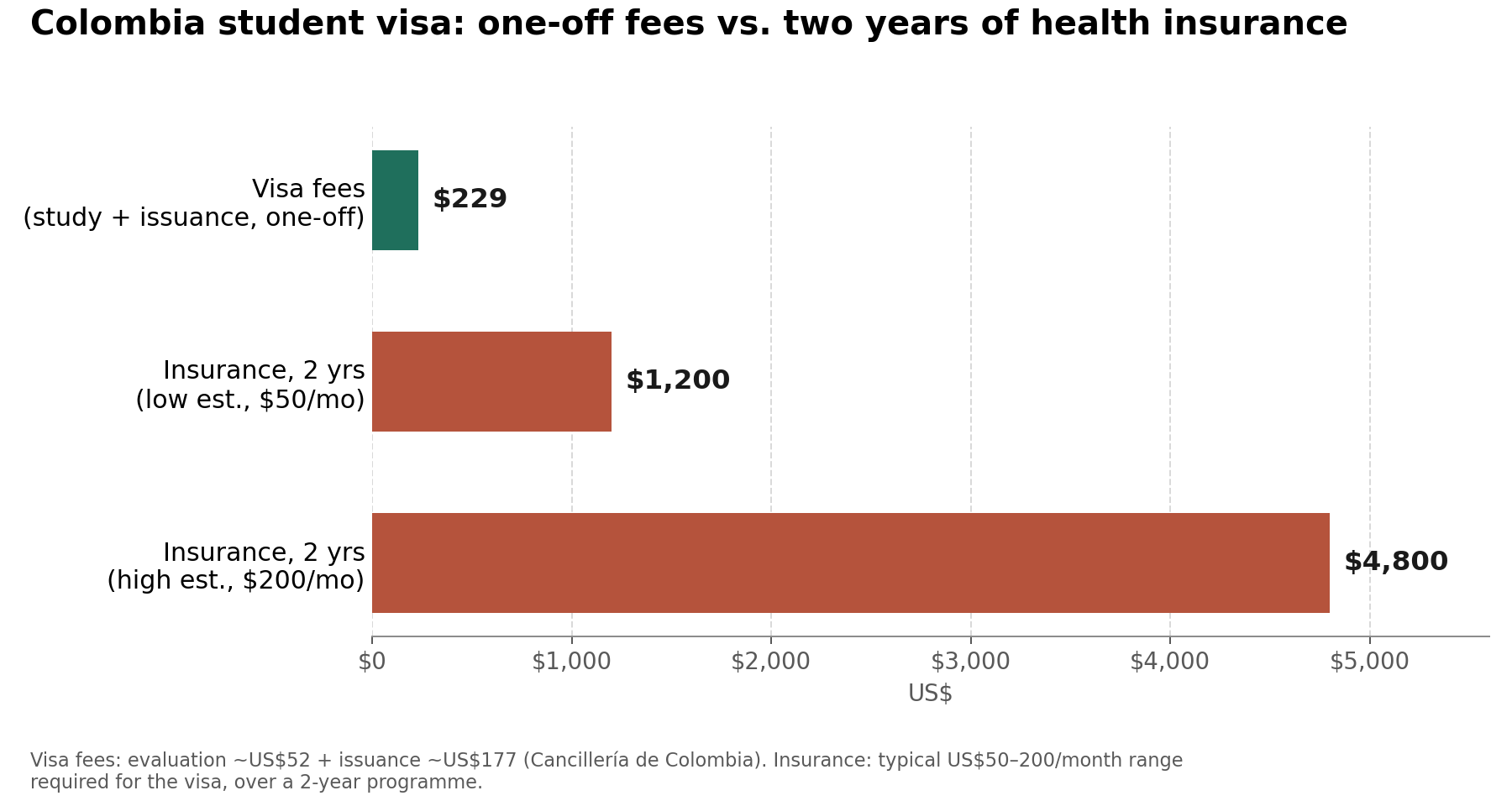
The figure people leave out of their budget is the health insurance and it is the one that keeps costing money the whole time you are here. Cover that satisfies the visa (medical, hospitalisation and repatriation) typically runs somewhere in the region of US$50 to US$200 a month, depending on the level of cover and your age — a range from Colombia-focused visa-insurance guides (Medellín Guru, on travel insurance meeting the visa requirement) rather than a figure Cancillería itself publishes. That is a recurring expense sitting on top of tuition, rent and the one-off visa fees and I would fold it into the cost of the year from the outset rather than treating it as an afterthought. Over a two-year programme it can easily outweigh every other visa-related cost combined. For the wider cost picture — rent, groceries, transport — see the companion guide, Cost of Living in Colombia and for how the health system itself works once you are here, see Healthcare in Colombia. Set against the one-off fees, the insurance bill for the whole programme looks like this.
How long the visa lasts
The visa is granted for the length of your academic programme and it is renewable if the programme runs longer than the term you were first given. In practice that usually means it is issued for up to two years at a time (Article 36, Resolución 5477 de 2022).
Some guides quote a three-year ceiling instead and that is worth flagging as wrong for the current visa rather than leaving it as unresolved variance. Article 36 of Resolución 5477 de 2022 sets the V-Estudiante visa’s validity at “hasta dos (2) años” — up to two years, full stop — with no three-year variant in force. The three-year figure still circulating online most likely reflects the pre-2022 regime, when Colombia ran separate V and M visa categories for students before Resolución 5477 folded them into this single V-Estudiante visa; treat it as out of date rather than an alternative that might apply to you. Confirm the specifics of your own programme directly with Cancillería (Colombia’s foreign ministry) all the same, since the visa is granted for the length of the course itself, up to that two-year cap.
The two limits to know before you commit
This is the part where a student visa stops being a general-purpose “live in Colombia” permit and starts showing its edges. Two limits trip people up more than any other part of this visa, so here they are directly.
Work rights: very limited and no full-time work
The student visa does not permit full-time work. There is one exception and it is narrow: postgraduate students may work up to twenty hours a week, but only if the employer formally registers the arrangement with both Migración Colombia and the Ministry of Labour (Article 36, Resolución 5477 de 2022). An undergraduate or a language-school student on this visa cannot work at all.
So if part of your plan is to earn while you study, be candid with yourself about which category you fall into. For most students the answer is that a student visa and a work-capable visa are two different things and they cannot simply be combined. If working is an actual part of the plan rather than a maybe, you are usually better served by a different route from the outset — the Colombia work visa if you have an employer, or the Colombia digital nomad visa if your income comes from clients or an employer outside Colombia. Trying to make a student visa carry a working life is the wrong shape for the job.
Dependents: generally not included
The student visa generally does not let you bring a spouse or children as dependents. The exception mirrors the work-rights one: postgraduate students may, under certain conditions, be able to include dependents (Article 36, Resolución 5477 de 2022). Everyone else should assume they cannot.
That is a sharp contrast with the family-based routes, which exist precisely to bring a partner or children along and are built around dependents from the ground up. If moving as a family is the point, a student visa is not the vehicle for it — look at those routes instead rather than trying to stretch this one to fit.
The residency reality check
This is the point that surprises people most and it is the one I would want a prospective student to understand before they arrive. Because the student visa sits in the Visitor (V) family, time spent on it does not count towards a Resident (R) visa (Resolución 5477 de 2022, Artículo 90). In that respect it behaves exactly like the Rentista and digital nomad visas covered elsewhere in this Colombia cluster.
The five-year clock that leads to permanent residency only runs on Migrant (M) visas and it genuinely is five years for most M-visa categories, though a handful of family-based ones (spouse, or parent of a Colombian child) accrue faster (Resolución 5477 de 2022, Artículo 90). So a couple of years studying in Colombia, however settled you become, does not pre-load your residency timeline. If you finish your studies and decide you want to stay for good, you would need to transition onto an M-visa first (a work or investor visa, or a family-based route, depending on your circumstances) and the residency clock effectively starts then. The study years do not carry over.
None of that makes the student visa a poor choice for studying. It just means it is a study visa and not a stepping stone to residency in the way people sometimes assume. If long-term settlement is the actual goal, it is better to know that going in and to think about the M-visa route you would eventually need rather than expecting the student years to count.
What a Colombia student visa cannot do for you
Naming the limits is the fairest way to end, because most of the disappointment around this visa comes from expecting it to do jobs it was never designed for. To gather the caveats in one place:
- It will not let you work full-time and for undergraduate and language students it does not permit paid work at all.
- It will not, in the general case, bring your partner or children with you as dependents.
- It will not build residency — the years on it do not count towards the five needed on an M-visa.
- It will not cover you medically on its own; the health insurance is a separate, ongoing cost you carry throughout.
What it does do, it does well: it gives a foreign student a straightforward, comparatively inexpensive, legitimate basis to study in Colombia for the length of a programme. Held to that job, it is a good visa. The trouble only starts when it is asked to be a work permit, a family visa or a residency pathway, none of which it is. If any of those is your actual aim, the practical move is to plan around the visa that is built for it. For the wider picture of settling in Colombia, see the hub guide, Moving to Colombia.
Frequently asked questions
What are the Colombia student visa requirements?
Five core documents, per Article 36 of Resolución 5477 de 2022: an enrolment letter from a recognised Colombian institution; proof you can financially support yourself through the course; health insurance covering medical care, hospitalisation and repatriation for the full visa period; an apostilled or legalised criminal background check from your country of citizenship, translated into Spanish; and the institution’s registration form, signed by a school official, confirming your classes meet the minimum ten-hours-a-week intensity.
Can I work on a Colombia student visa?
Not in general. Undergraduate and language-school students on this visa cannot work at all. The single exception is for postgraduate students, who may work up to twenty hours a week and only if the employer registers the arrangement with both Migración Colombia and the Ministry of Labour (Article 36, Resolución 5477 de 2022). If earning while you are in Colombia is important, a work visa or the digital nomad visa is usually the better fit.
Does a Colombia student visa lead to residency?
No. It is a Visitor (V) visa and time on a V-visa does not count towards permanent residency. The five-year clock for a Resident (R) visa only runs on Migrant (M) visas (Resolución 5477 de 2022, Artículo 90). To settle permanently after studying, you would need to move onto an M-visa (such as a work, investor or family-based route) and the residency timeline effectively begins from there.
How much does the Colombia student visa cost?
There are two visa fees: an evaluation fee of roughly US$52, paid on submission and non-refundable and an issuance fee of about US$177 if you are approved (Colombia Move, 2026 Colombia visa guide; Cancillería does not publish these amounts directly). Beyond those one-off charges, budget for the health insurance the visa requires, which typically runs around US$50 to US$200 a month for the whole time you are studying.
Can I bring my family on a Colombia student visa?
Generally no. The student visa does not usually allow a spouse or children to come as dependents. Postgraduate students may be able to include dependents under certain conditions, but for undergraduate and language students it is not an option (Article 36, Resolución 5477 de 2022). Moving as a family is better handled through a family-based route designed for dependents.
Sources
- Cancillería de Colombia — Temporary Student’s Visa (official).
- Cancillería de Colombia — Resolución 5477 de 2022 (official text, for the V/M/R visa families).
- Expat Group — Colombia Student Visa guide.
- Medellín Lawyer — The Colombian Student Visa.
- Medellín Guru — Travel Insurance: Meets the Health Insurance Requirement for Colombia Visas.
- Colombia Move — Colombia Visa Guide 2026: Types, Costs & How to Apply.
Fees, thresholds and rules change and individual cases turn on detail. Treat this as an informed starting point and confirm the specifics for your own programme with Cancillería before you lodge anything.

