
There is a particular kind of person the Colombia real estate visa — officially the Resident Investor’s Visa, under the M-10 sub-category (Resolución 5477 de 2022) — is built for and it is worth being clear about who that is before anything else. It is someone who was going to put money into Colombia anyway, an apartment in Medellín, a stake in a Colombian business and who would like that investment to also buy them the right to live in the country. It is not a back door for people without the capital and it is not a cheaper or faster route to residency than the family and pension visas. If you are picturing an investment visa as a shortcut, this is not that. If you already have the money in play and residency is the thing you actually want out of it, this is the visa that connects the two.
A note on standing first. I have a second home in Colombia and have spent a fair amount of time there, so this is not a country I am describing from a distance. It is not, though, the same as having personally run an investment-visa file through the Cancillería, so the figures and requirements below lean on Colombia’s official visa material and current tax and central-bank sources rather than my own paperwork and I have flagged where a number is the kind that fluctuates. The visa itself sits under Resolución 5477 de 2022, the same Ministry of Foreign Affairs rule that governs most of Colombia’s current visa categories and it belongs to the Migrant (M) family.
Two routes into the same visa
The investor visa is really two doors into one category. You can qualify by buying real estate, or by investing in a Colombian company and the two sit at very different price points. Both are M-visas, both give you the same residency clock and both hinge on the same central-bank registration covered further down. What differs is the amount and the specific document that proves you have actually done what you claim.
Colombia sets the thresholds as multiples of its monthly minimum wage, the SMLMV, rather than as fixed peso or dollar figures, which is why the numbers you see quoted online vary so much depending on when they were written. For 2026 the SMLMV is COP $1,750,905 a month. That figure carries the same caveat as every other Colombian visa this year. The minimum wage was under legal challenge in early 2026 and is set on a somewhat unsettled basis, so treat the peso totals as firm-for-now rather than fixed. Worth knowing before you compare against an older guide, the 2026 minimum wage rose by roughly 23 percent on 2025’s COP $1,423,500 (CNN, December 2025), which has pushed the real-estate threshold visibly higher than the figures still circulating on a lot of expat sites. For the fuller picture of what that minimum wage means in practice, see Average Salary in Colombia.
The real estate route
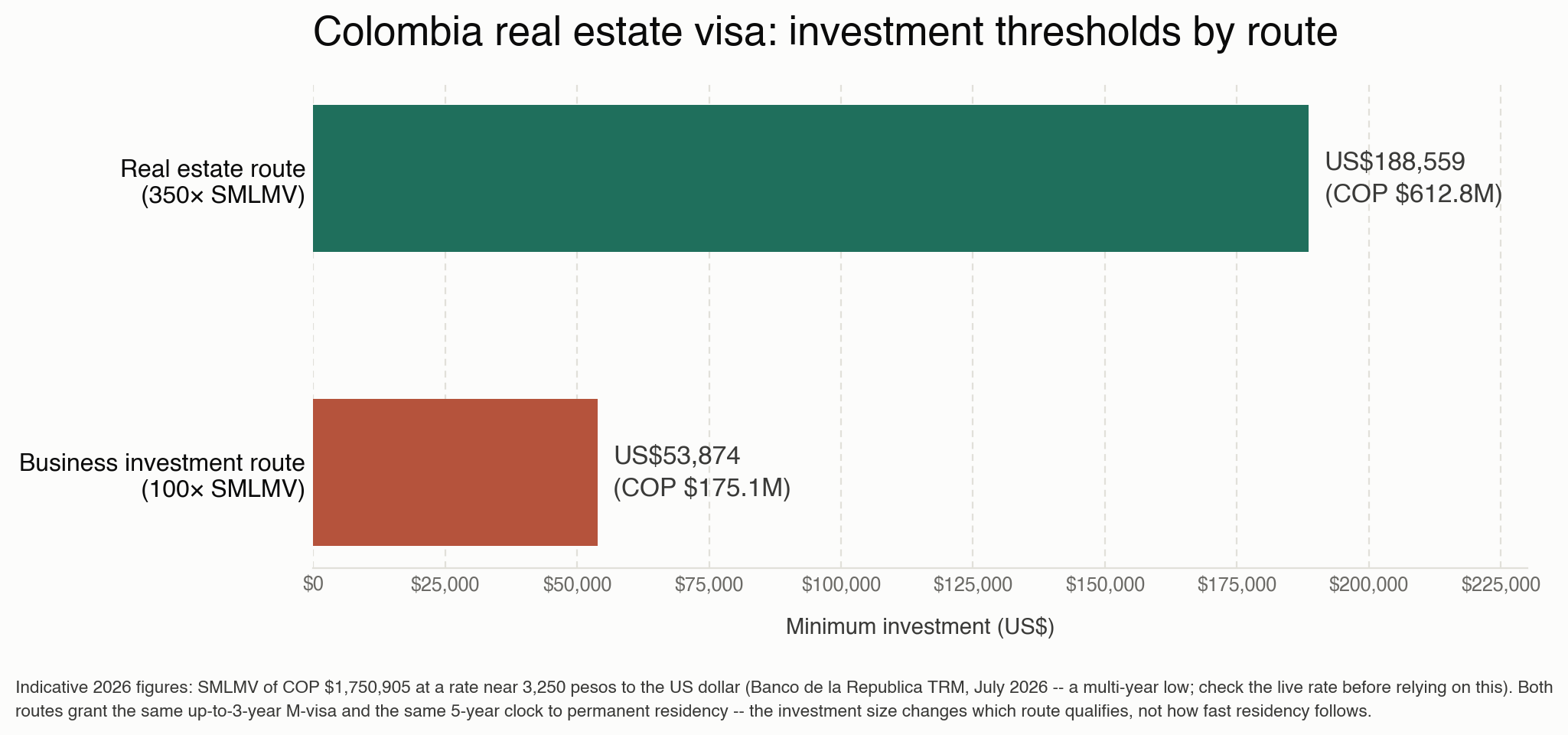
The property route asks for an investment of at least 350 times the monthly minimum wage. At the 2026 figure that is COP $612,816,750, which comes to roughly USD $188,600 at a rate near 3,250 pesos to the dollar — Banco de la República’s TRM fell to a seven-year low near that level in mid-2026, down from around 3,440 earlier in the year. The dollar number is part of that sentence but the peso threshold is what the Cancillería actually measures against and the exchange rate on the day does the rest, so read the USD figure as indicative rather than a line you can bank on.
The document that anchors this route is the certificado de tradición y libertad, the certificate of tradition and freedom, which is the public register’s record of a property’s ownership and any encumbrances. For the visa it has to show two things: that the property is titled exclusively in your own name and that its value clears the threshold, per the Cancillería’s own Resident Investor’s Visa document requirements. The important consequence and the one that catches people who assume the visa comes first, is the order of operations. You buy the property, register the title and then apply. The title certificate is a required document in the application itself, so there is no version of this where the visa is approved on the strength of an intended purchase. It is a buy-first visa. Alongside the certificate, the transaction needs to be traceable, a verifiable trail of the money and the purchase, not simply a value asserted on a form.
The business investment route
The business route is far cheaper to enter, at a minimum of 100 times the monthly minimum wage. For 2026 that is COP $175,090,500, or about USD $53,900 at the same near-3,250-peso rate. It covers both starting a Colombian company and buying shares in an existing one, which makes it the more flexible of the two for anyone whose plans are commercial rather than residential.
Here the paperwork has to tell a consistent story about a company rather than a property. Colombia’s investor-visa rules require a certificate of existence and legal representation for the business and a share composition certificate signed by a qualified accountant that sets out your ownership stake and the value of the paid, registered capital (Resolución 5477 de 2022). The point that trips applications is that the accounting records have to match. The bank trail and the accounts need to line up with the share certificate; a number that appears on the certificate but has no corresponding movement in the books is the sort of inconsistency that stalls a file. The visa officer is checking that the investment is genuine and documented, not that a figure has been typed into the right box.
The two routes side by side
| Real estate route | Business investment route | |
|---|---|---|
| Minimum investment | 350 × SMLMV = COP $612,816,750 (~USD $188,600) | 100 × SMLMV = COP $175,090,500 (~USD $53,900) |
| What it buys | Property titled in your own name | A new Colombian company or shares in one |
| Key proving document | Certificado de tradición y libertad (title certificate) | Certificate of existence + accountant’s share-composition certificate |
| Central-bank step | FDI registration with Banco de la República, before applying | FDI registration with Banco de la República, before applying |
| Validity | Up to 3 years | Up to 3 years |
| Counts toward R visa | After 5 continuous years (standard M timeline) | After 5 continuous years (standard M timeline) |
Indicative 2026 figures, based on an SMLMV of COP $1,750,905 and a rate near 3,250 pesos to the US dollar (Banco de la República’s TRM, a multi-year low as of July 2026, down from around 3,440 earlier in the year). The peso thresholds move with the minimum wage and the dollar values move with the exchange rate, which moves daily. Confirm both against current figures before you rely on them.
The FDI registration that decides whether you have a valid application at all
If there is one step in this whole process I would not let anyone treat as optional, it is this, because getting it wrong does not weaken the application, it voids it. Both routes require the investment to be registered as Foreign Direct Investment with Banco de la República, Colombia’s central bank and that registration has to be completed before the visa application is filed with the Cancillería. Skip it, or leave it until after and there is no valid application to consider. It is not a document that makes a stronger case; it is the thing that makes the case exist.
This is the same central-bank registration that comes up when you buy property in Colombia and it wears two hats depending on why you are looking at it. Seen from the property-transaction side, it is what protects your right to take your capital and profit back out of the country when you eventually sell. Seen from the visa side, which is the angle that matters here, it is the gatekeeper that determines whether your investment counts as the kind of registered foreign investment the visa is built on. Both are true at once. The reason it trips people is that it sits outside the visa paperwork entirely, so a buyer focused on the apartment or the share purchase can complete the deal, feel finished and only discover the gap when the visa application will not stand up. The fix is sequencing: register the investment with Banco de la República as the money comes in, keep the documentation and only then file with the Cancillería.
The other documents
Beyond the route-specific proof and the FDI registration, the rest of the file is the standard Cancillería set (Resident Investor’s Visa requirements) and none of it is unusual for a Colombian visa.
- A valid passport.
- A criminal background check from your country of origin, apostilled and officially translated into Spanish.
- A passport photo meeting the Cancillería’s specifications.
- The route-specific proof: the title certificate for real estate, or the company existence and share-composition certificates for a business.
- Proof of the FDI registration with Banco de la República.
How long it lasts and where it leads
The Colombia real estate visa is granted for up to three years. There is a condition on holding it that is easy to overlook and expensive to breach. The visa is cancelled if you are absent from Colombia for more than 180 continuous days (Cancillería, Resident Investor’s Visa). This is a residency visa in more than name; it expects you to actually be present and a long stint abroad can quietly end it.
On where it leads, this is the point I would be most careful not to oversell. Time on the investor visa counts toward the Resident (R) visa after five continuous years, per Resolución 5477 de 2022. That is the standard Migrant-visa timeline and it is worth setting against the faster routes people sometimes assume apply here. The two-to-three-year paths to residency in Colombia belong specifically to the marriage or partner visa and to being the parent of a Colombian child; those are a different category with their own article on this site. The investment routes do not share that acceleration. If you are choosing between visas partly on how quickly they reach permanent residency, the investor visa is the five-year clock, not the short one.
It is also worth placing this against the visa people most often confuse it with. The Colombia Digital Nomad Visa is a Visitor (V) visa and time on a V visa does not accumulate toward residency at all, so an investor visa and a nomad visa are not two versions of the same thing. If retirement is the actual goal, Retiring in Colombia covers the Pensionado route, which is usually the cheaper and more natural fit for someone drawing a pension than tying up USD $188,600 in property to reach the same place.
The tax reality that the visa articles skip
This is the part a lot of “buy the visa” write-ups leave out and it is the part that changes the maths for some people. Two separate tax questions attach to an investment of this kind and they are worth keeping distinct.
The first is capital gains on the property itself. Colombia treats a property held for more than two years favourably (Estatuto Tributario, Art. 300). The gain on a sale after that point is taxed at a flat 15 percent for a non-resident, Colombia’s standard rate for occasional gains (ganancia ocasional) on assets held two years or more (Estatuto Tributario, Art. 316). Older guides sometimes quote a lower figure left over from before a tax-reform update, so treat 15 percent as the current number and confirm it has not moved again by the time you sell. Sell inside two years and the treatment flips: Article 300 itself reclassifies the gain as ordinary income rather than ganancia ocasional, taxed at 35 percent for a non-resident (Estatuto Tributario, Art. 247), which is a large enough gap to make the holding period a genuine planning point rather than a footnote.
The second question is the one that catches people who buy the visa and then also spend serious time in the country, which is, of course, exactly what a three-year residency visa invites you to do. Spend more than 183 days in Colombia within a 365-day period and you become a Colombian tax resident (DIAN, Estatuto Tributario Art. 10). At that point it is not only your Colombian income that is in scope. Your worldwide income becomes taxable in Colombia, reported to DIAN, the tax authority (PwC Worldwide Tax Summaries). That is a materially different exposure from owning a Colombian asset while living elsewhere and it is precisely the trap in the “just buy the property and get the visa” framing, which almost never mentions the day count. Where a tax treaty or a foreign tax credit applies there may be relief, but the specifics get technical quickly and in this case I would simply put the question to a tax professional who works with expatriates in Colombia. Treat the rates above as orientation, not advice and get the current figures confirmed before you plan around them.
What this visa is not a substitute for
One thing worth stating flatly, because it reframes the whole decision: you do not need this visa to buy property in Colombia. Foreigners can buy freely without any particular visa, on a standard tourist entry (see Buying Property in Colombia for the purchase mechanics and their own sourcing) and the property transaction has its own separate set of rules. So the Colombia real estate visa is not the price of admission to the market. It is specifically for the person who wants the residency benefit tied to an investment they were making anyway, or who is investing partly because that residency benefit is the point.
Because of that, this article deliberately stops at the immigration threshold and the process. It does not cover the mechanics of the purchase itself, the title search, the notary, the closing costs, the financing, which are a different job with their own pitfalls. Those live in Buying Property in Colombia and if a purchase is how you intend to qualify, I would read the two together: that article for how to safely get your name on the register, this one for how to turn the completed purchase into residency. The order matters, because as covered above, the title has to be registered before the visa can be filed. For the wider picture of settling in, Moving to Colombia ties this cluster together.
The limits worth knowing
A few things this article cannot do for you. It cannot promise the peso thresholds are still exact by the time you read it, because they are pinned to a 2026 minimum wage that was itself under legal dispute and the dollar equivalents move with the exchange rate on the day. It cannot stand in for the Cancillería or for a Colombian immigration lawyer and the investor visa is document-heavy enough, with the accountant’s certificate, the title certificate and the central-bank registration all having to agree with each other, that it is not a file I would assemble without professional help. And it deliberately does not settle your tax position, which turns on your own residency and circumstances and wants a specialist rather than an article.
The way to use this, then, is as a map of how the visa is structured, which route fits and the two steps that quietly sink applications, the FDI registration and the tax-residency day count, before you confirm the current numbers and requirements directly with the Cancillería at cancilleria.gov.co or with an immigration lawyer. That is genuinely how I would approach it if I were applying this year.
Frequently asked questions
How much do you need to invest for the Colombia real estate visa?
The property route requires an investment of at least 350 times Colombia’s monthly minimum wage (Cancillería, Resident Investor’s Visa). For 2026 that works out to COP $612,816,750, roughly USD $188,600 at a rate near 3,250 pesos to the dollar (Banco de la República’s TRM, a multi-year low as of mid-2026). The peso threshold is what the Cancillería measures, so the dollar figure shifts with the exchange rate and the whole amount rose noticeably in 2026 when the minimum wage went up about 23 percent. The business investment route is much lower, at 100 times the minimum wage, or around COP $175,090,500 (about USD $53,900).
Do you need a visa to buy property in Colombia?
No. Foreigners can buy property in Colombia freely, without any particular visa and even on a tourist entry. The real estate investor visa is a separate thing. It is for turning a qualifying purchase into the right to live in the country, not permission to buy. If the residency benefit is not what you are after, you can own Colombian property without this visa at all. The purchase mechanics are covered in Buying Property in Colombia.
Does the Colombia investor visa lead to permanent residency?
Yes, but on the standard timeline. As a Migrant (M) visa, time held counts toward the Resident (R) visa after five continuous years (Resolución 5477 de 2022). It does not share the faster two-to-three-year path that applies to the marriage or partner visa and to parents of a Colombian child. The visa is valid for up to three years and is cancelled if you are absent from Colombia for more than 180 continuous days, so it expects genuine presence.
What is the FDI registration and why does it matter for the visa?
It is the registration of your investment as Foreign Direct Investment with Banco de la República, Colombia’s central bank (Form 4 instructions). For the investor visa it has to be completed before you file the application with the Cancillería and skipping it does not just weaken the application, it means there is no valid application at all. The same registration also protects your right to repatriate your capital and profit when you eventually sell, so it does double duty. It sits outside the visa paperwork, which is exactly why it is the step people most often miss.
Sources
- Ministry of Foreign Affairs (Cancillería), Resident Investor’s Visa: cancilleria.gov.co/en/resident-investors-visa
- Resolución 5477 de 2022 (Ministerio de Relaciones Exteriores), official compilation, incl. the 350/100 SMLMV investor-visa thresholds and the five-year Migrant-to-Resident timeline: SUIN-Juriscol
- Banco de la República, TRM (exchange-rate) glossary and live figure: banrep.gov.co
- Banco de la República, Form 4 instructions for the foreign-investment currency registration: banrep.gov.co
- Banco de la República, guidance on registering international investments (what the registration protects): banrep.gov.co
- DIAN, tax residency (Estatuto Tributario, Art. 10 — the 183-day test): dian.gov.co
- Estatuto Tributario, Art. 300 (two-year holding period), Art. 316 (15% non-resident ganancia ocasional rate) and Art. 247 (35% non-resident ordinary-income rate): estatuto.co/300, estatuto.co/316, estatuto.co/247
- CNN en Español, 2026 minimum-wage increase (23 percent over 2025): cnnespanol.cnn.com
- Citizen Remote, Colombia M-10 Real Estate Investor Visa: citizenremote.com/visas/colombia-m10-real-estate-investor-visa
- Citizen Remote, Colombia M-6 Business Investor Visa: citizenremote.com/visas/colombia-m-6-business-investor-visa
- Medellin Lawyer, Colombia Investor Visa: medellinlawyer.com/colombia-investors-visa
- Taxes for Expats, buying property and property taxes in Colombia: taxesforexpats.com
- PwC Worldwide Tax Summaries, Colombia individual other taxes: taxsummaries.pwc.com/colombia/individual/other-taxes and individual residence (worldwide-income scope for tax residents): taxsummaries.pwc.com/colombia/individual/residence
- Presidencia de la República, 2026 minimum wage (SMLMV): presidencia.gov.co
- Medellin Advisors, Colombian investment visa guide (FDI registration sequencing): medellinadvisors.com

