
Ask a room of newcomers where the best place to live in Colombia is and you will get a different answer from each of them, usually delivered with total conviction. That is not because they are wrong. It is because Colombia is not really one place. It is a country where you can climb from Caribbean heat to a cold Andean plateau in the course of a single flight and where the city that suits a remote worker in their thirties can be exactly the wrong choice for a retiree who wants cool air and quiet. So the starting point is that there is no single best city, only a best city for a given set of priorities.
This piece is a comparison to help you narrow the field, not a verdict handed down from on high. I have spent time living in Colombia and travelling around it, so some of this is what I have seen first hand and some is drawn from official geography and the accounts of people who have settled in each city. For the broader case for Colombia, the diversity, the cost, the visa routes, Moving to Colombia is the place to start. Here the job is narrower, which city.
Start with the decision, not the map
Before looking at individual cities, it helps to be clear about what you are actually optimising for, since the best place to live in Colombia depends entirely on the answer. In my experience the choice comes down to a handful of things and once you know which ones matter most to you, the shortlist writes itself.
- Climate. This is the big one in Colombia and it is set largely by altitude rather than season. Broadly you are choosing between tropical coastal heat, cool mountain air, or the temperate middle ground that made Medellín famous. Get this wrong and nothing else will make you happy.
- Budget. Costs vary meaningfully between cities and even between neighbourhoods within them. I have kept exact figures out of this article on purpose, because they date quickly and Cost of Living in Colombia keeps them more current. What matters here is the relative tier.
- Remote-work infrastructure. Internet access itself is not the constraint it might sound like. Colombia’s mobile network reaches the large majority of the population, with fixed broadband well established in urban areas, so a working connection is rarely the issue in the cities compared here. What narrows the field is coworking space and a ready-made community of other remote workers and only a couple of cities have that in depth. Colombia’s geography also plays in remote workers’ favour, its proximity to the United States generally means lower latency on calls and cloud services hosted there than from more distant markets, even though measured broadband speeds between Colombia and New Zealand are broadly comparable, with New Zealand’s mobile network the faster of the two.
- Community versus opportunity. Do you want the biggest established expat community, which points you at Medellín, or the biggest formal-economy job market, which points you at Bogotá?
- Family and pace. Schools, healthcare and a quieter setting pull in a different direction again, often toward the mid-size cities that get less attention.
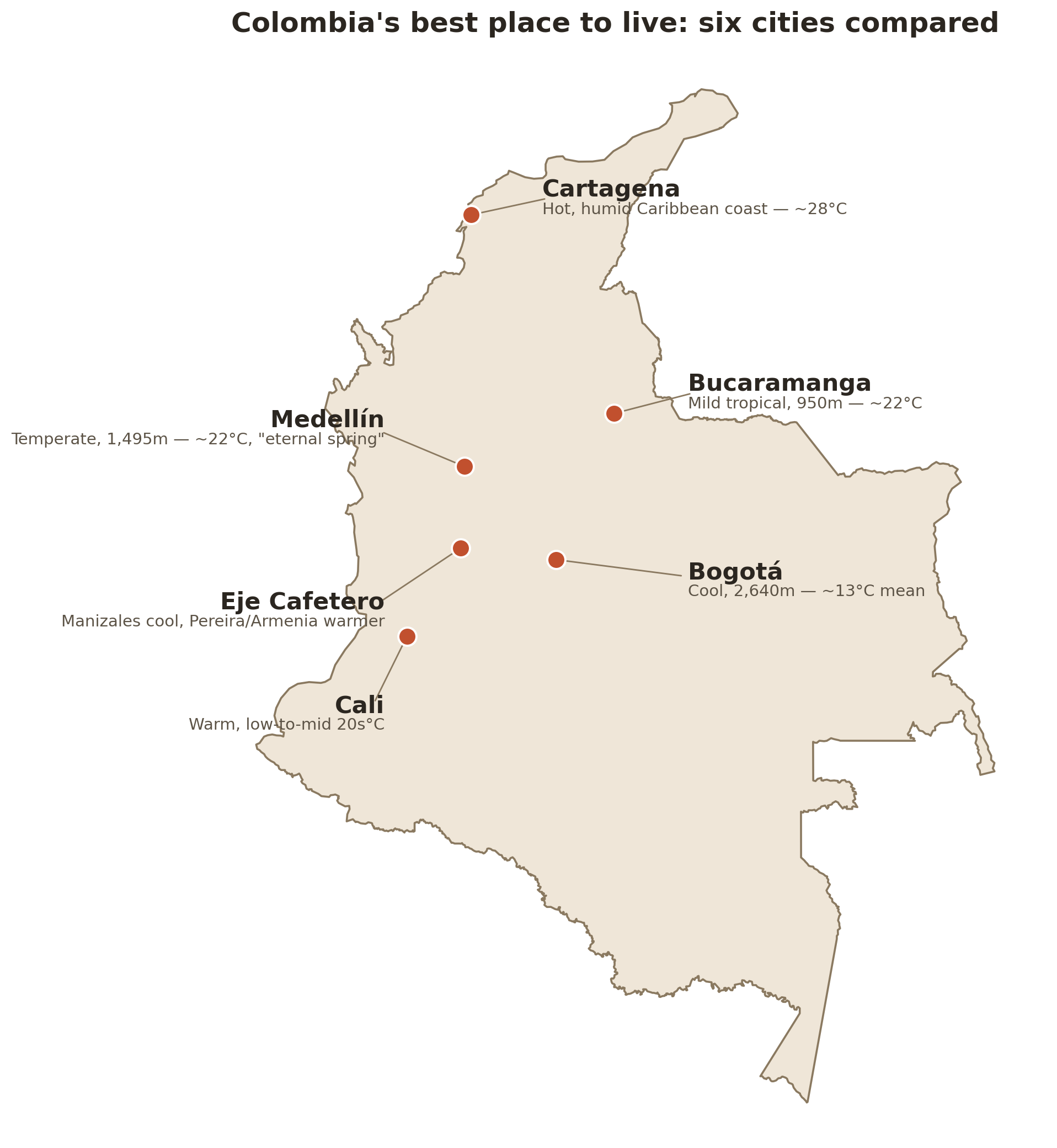
The cities, compared
Here is the shape of the field at a glance, before the detail on each.
| City | Climate | Cost tier | Suits |
|---|---|---|---|
| Medellín | Temperate, ~22°C, spring-like | Mid to higher for Colombia | Remote workers, established expat community |
| Bogotá | Cool, ~13°C mean, high altitude | Higher end, wide range | Career and formal-economy opportunity |
| Cartagena | Hot and humid tropical coast | Inflated by tourism | Coastal life, colonial setting |
| Bucaramanga | Mild tropical, ~22°C | Lower, good value | Quiet mid-size base, healthcare |
| Eje Cafetero | Cool to warm by altitude | Lower | Retirees, cool-climate seekers |
| Cali | Warm, low-to-mid 20s°C | Moderate | Warm-climate city life, dance culture |
Medellín — the default, for good reasons
Medellín sits at roughly 1,495 metres in the Aburrá Valley and that altitude gives it an average temperature around 22°C with very little seasonal swing. That is the basis of the “eternal spring” nickname and it is the single biggest reason the city has become Colombia’s expat capital. The remote-work infrastructure here is established rather than emerging, with coworking spaces, a large English-speaking community and neighbourhoods like El Poblado and Laureles that expats gravitate toward.
Two caveats on that. First, the “eternal spring” branding oversells the day-to-day. From what I have seen and what long-term residents consistently report, the weather is temperate but cloudier and wetter than the postcard suggests, with stretches of grey and rain even in the nominal dry months. It is comfortable, not perpetually sunny.
Second, that same expat gravity has a downside. Rents in the most popular pockets, Laureles in particular, have risen sharply since 2020 and there is an ongoing, unresolved argument about how much of that is remote workers, how much is short-let conversion and how much is a broader housing squeeze. The related risk is insularity, it is easy to land in Medellín and spend a year inside an English-speaking bubble that could be almost anywhere. If your reason for moving to Colombia is Colombia itself, guard against that deliberately. For the neighbourhood-level detail, Living in Medellín goes deeper than I will here and Cost of Living in Medellín carries the current numbers.
Bogotá — the opportunity, if you can take the cold
Bogotá is the capital and it behaves like one. It is the country’s main political, economic and administrative centre, generating roughly a quarter of Colombia’s GDP on its own, which in practice means the biggest formal job market, the most corporate and professional opportunity and the place where a lot of official process is centred. Several visa and document-certification steps route through Bogotá, so if your move involves serious paperwork you will likely deal with the city whether you live there or not.
The trade-off is written into the geography. Bogotá sits on a savanna at around 2,640 metres and that altitude makes it cool, a mean temperature near 13°C, daytime highs of 19 to 20°C and nights down around 10°C. There is no warm season to wait for. Plenty of people love the crisp mountain climate and the big-city cultural depth. Others find the cold, the traffic and the sheer scale wearing and newcomers often describe the city as harder to settle into than Medellín. If your priority is career and formal opportunity, Bogotá is the strongest answer in the country. If it is climate and ease, it may not be.
Cartagena — the postcard, with a catch
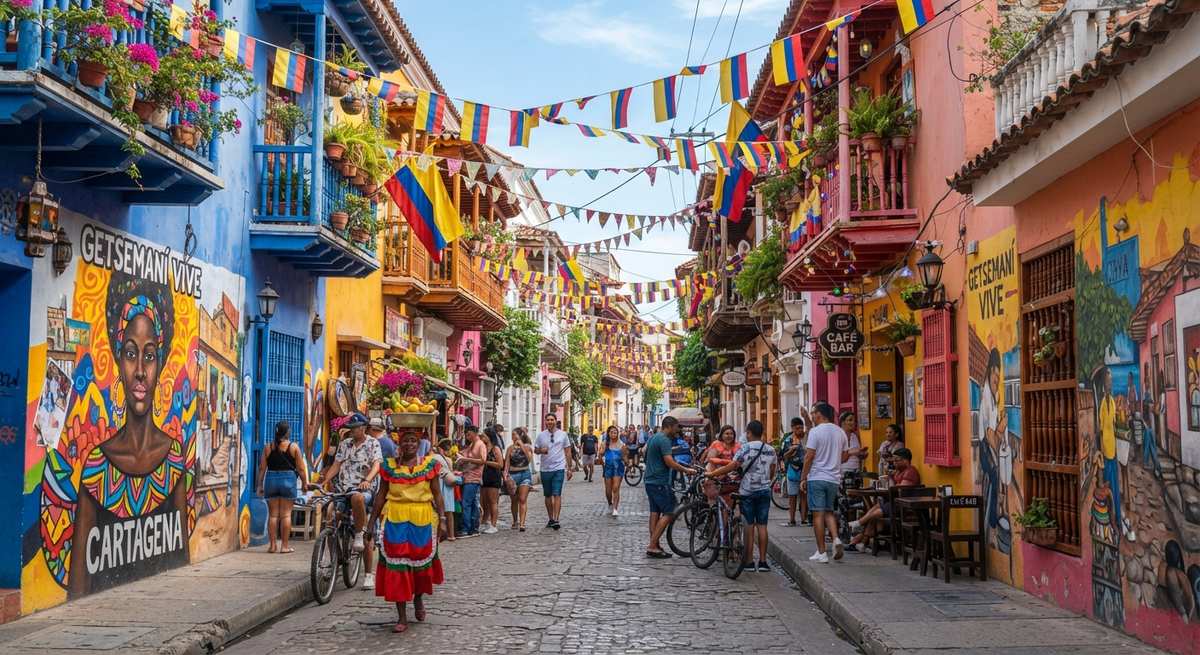
Cartagena is the Caribbean-coast city most people picture, a walled colonial old town, the sea and warmth all year. The warmth is the whole story, in both senses. Average temperatures sit around 28°C with humidity averaging above 80 percent and that is the daily reality rather than a summer peak. Some people thrive in it and would not live anywhere else. Others rule Cartagena out precisely because of the heat and humidity and look instead at milder towns nearby.
The second catch is cost. Cartagena is a tourism-driven city and tourist demand pushes prices in the desirable central areas above what you would pay for equivalent living inland. You are partly paying for the setting. As a place to visit it is hard to beat. As a place to settle it suits a narrower group, those who want coastal tropical life and have the budget and the tolerance for the climate to match.
Bucaramanga — the value pick
Bucaramanga gets far less attention than it deserves. Known as the “city of parks” for its many green spaces, it sits at around 950 metres, which gives it a mild tropical climate averaging about 22°C, cooler day to day than the altitude alone would suggest, a pattern residents commonly put down to wind off the surrounding peaks rather than anything the official climate data itself explains. Residents who have compared it directly with the coastal cities report it as meaningfully cheaper on rent, transport and food, with healthcare they rate as excellent for a city its size, a reputation backed by the Hospital Internacional de Colombia’s ranking among the world’s best cardiology centres.
It suits someone who wants a functioning mid-size city, good value and a comfortable climate without the expat crowds of Medellín. That last point is also the downside, the trade for lower costs and fewer tourists is a smaller English-speaking community and thinner remote-work infrastructure. If you want a ready-made expat social scene on arrival, Bucaramanga is not it. If you are comfortable with some Spanish and want to live more locally, it is one of the better-kept secrets on this list.
The Eje Cafetero — cool, quiet and cheap
The Eje Cafetero, the coffee-growing region spanning Manizales, Pereira and Armenia, comes up again and again as the “undiscovered” alternative for people who find the big cities too big. One thing to understand is that this is not one climate. Altitude varies sharply across the region, Manizales sits high at around 2,100 metres and runs cool, with daytime temperatures near 19 to 20°C, while Pereira and Armenia sit lower at roughly 1,450 metres and run noticeably warmer, closer to 26°C by day. So you can dial in your climate within a single region.
The region draws people who want cool or moderate weather, lower costs, less pollution and a slower pace and it is a recurring favourite among retirees for exactly those reasons. Infrastructure is the limiting factor. The expat and digital-nomad scene here is sparse compared with Medellín, coworking and a large English-speaking community are not givens and some settlers report finding almost no other foreigners nearby. That is the point for some people and a dealbreaker for others.
Cali — warm-climate city life
Cali, Colombia’s salsa capital, offers warm city living in the low-to-mid 20s°C, hot by day, without the coastal humidity of Cartagena. It is a large, culturally distinctive city with a strong dance and music scene that defines daily life there. For settled-expat detail I have less to go on than for the other cities: the community accounts are thinner because Cali attracts fewer foreign residents than Medellín or Bogotá. It suits someone drawn to a warm, energetic Colombian city on its own terms rather than a ready-made expat enclave. As with anywhere, the safety picture is best checked locally and currently rather than taken from reputation, which brings me to the point that matters most across all six cities.
Safety is a neighbourhood question, not a city one
The U.S. State Department’s own advisory makes a similar point at a larger scale. Colombia carries an overall Level 3, “Reconsider travel,” rating, but singles out specific departments, Arauca, Cauca outside Popayán, Valle del Cauca outside Cali and Norte de Santander, plus the area within ten kilometres of the Venezuela border, for the more severe Level 4, “Do not travel.” Bogotá, Medellín and Cartagena all sit under the general Level 3 rating rather than one of those higher-risk designations. Safety and the “best neighbourhood” are block-by-block matters within any Colombian city, not city-wide verdicts and the assumption that the wealthiest area is automatically the safest does not reliably hold. Long-term residents of Medellín will tell you that the most expensive, expat-favoured pockets are not simply the safest by virtue of being expensive and that a comfortable, unremarkable middle-tier neighbourhood can be a better daily experience than the obvious prestige address.
A city’s general reputation, good or bad, tells you very little about the street you would actually live on. Conditions vary by neighbourhood and shift over time, so the useful work is checking a specific area, currently, against current local knowledge, rather than trusting a headline about the city as a whole. Living in Medellín works through this at the neighbourhood level as a concrete example of how granular the picture really gets.
What this comparison cannot do
This is an orientation piece and it has limits I would rather name than paper over. It can narrow your shortlist toward the best place to live in Colombia for your own priorities, but it is not a substitute for going and spending time in the two or three that appeal before you commit to any of them. A week in a place will tell you more about whether you can live with its climate, its pace and its particular character than any article can. Cities also change, Medellín in 2026 is not the Medellín of a decade ago, costs move, neighbourhoods rise and fall and the character of a place shifts with who is arriving. Treat what is here as a current map, not a permanent one and verify the specifics that will actually affect you before you sign a lease or ship your life across the world.
Frequently asked questions
What is the best place to live in Colombia as an expat?
There is no single answer, because the best city depends on what you are optimising for. Medellín is the most common choice thanks to its temperate climate and established expat and remote-work community. Bogotá wins on career opportunity if you can take the cool, high-altitude climate. Cartagena suits those who want coastal warmth and can absorb the humidity and tourist pricing. For lower costs and a quieter pace, Bucaramanga and the Eje Cafetero are strong and underrated. Start from your climate and budget priorities and the shortlist follows.
Is Medellín or Bogotá better for expats?
They answer different needs. Medellín has the larger established expat community, deeper remote-work infrastructure and a mild spring-like climate, which makes it the easier soft landing. Bogotá has the bigger formal job market and more professional opportunity, along with most of the country’s administrative machinery, but its cool, high-altitude climate and scale suit fewer people. If you are working remotely or want community, Medellín usually wins. If you need a local career, Bogotá does.
Where do most expats live in Colombia?
Medellín is the clear centre of expat life, with El Poblado and Laureles the neighbourhoods most foreign residents gravitate toward. Bogotá holds the next-largest concentration, spread across areas like Chapinero and the northern zones. Cartagena draws a smaller, coastal-focused group. The mid-size and coffee-region cities have far fewer foreign residents, which is part of their appeal for some and a drawback for others who want a ready-made community.
Which Colombian city has the best climate?
It depends on the climate you want, because altitude sets everything here. Medellín’s temperate roughly 22°C is the widely loved middle ground. If you prefer cooler, Manizales in the coffee region or Bogotá itself run cool. If you want warmth, the Caribbean coast and Cali deliver it, with the coast adding significant humidity. There is no objectively best climate, only the one that fits how you like to live.
Sources
- Climate and altitude figures for Medellín, Bogotá, Cartagena, Bucaramanga, Manizales, Pereira and Cali: Weather Spark, Colombia climate normals (individual city pages linked in the text above).
- Colombia mobile network reach and internet usage: DataReportal, Digital 2026: Colombia.
- Comparative fixed-broadband and mobile download speeds for Colombia and New Zealand: Ookla, Speedtest Global Index.
- New Zealand fibre network coverage: New Zealand Infrastructure Commission, Ultra-Fast Broadband programme.
- Bogotá’s share of national GDP and its role as Colombia’s formal-economy centre: Bogotá Chamber of Commerce, GDP Bogotá and Colombia 2015–2024 (DANE data).
- Visa applications and document apostille/legalisation being centred on Bogotá: Colombian Ministry of Foreign Affairs (Cancillería).
- Rents rising in Medellín’s most popular expat pockets since 2020: Colombia One, on digital nomads and gentrification.
- Bucaramanga’s “city of parks” reputation and Cali’s “salsa capital” nickname: Colombia’s official tourism board, on Bucaramanga and on Cali.
- Bucaramanga’s healthcare standing: Hospital Internacional de Colombia, on its Newsweek World’s Best Hospitals cardiology ranking.
- Safety and risk varying by region rather than by whole city: U.S. Department of State, Colombia Travel Advisory.
- Expat-neighbourhood concentration in Medellín and Bogotá: Medellín Guru, on Medellín’s neighbourhoods and TheLatinvestor, on Bogotá’s neighbourhoods for expats.

