
Most people who look into retiring in Ireland start from a warm idea and a cold spreadsheet. The idea is the green fields, the slower pace, maybe a family connection a couple of generations back.
Ireland does have a residence route built for retirees and people living off their own means, but it sits behind a financial bar that a typical pension income rarely clears on its own. This piece walks through what that route is, what it demands, where it leads (and where it does not).
The permission at the centre of retiring in Ireland is called Stamp 0 — officially the Ireland Stamp 0 visa. It is worth understanding on its own terms before looking at the money, because a lot of the confusion around it comes from people assuming it behaves like a residence visa in Portugal, Spain or elsewhere in Europe. It does not.
The Ireland Stamp 0 visa: what it actually is
Stamp 0 is a low-level, time-limited immigration permission granted to people who are financially independent and not entitled to access State benefits or services while they live in Ireland on it. According to Immigration Service Delivery’s own stamp categories, it covers people of independent means such as retirees, along with a few other categories like visiting academics and certain elderly dependent relatives of people already settled in the country. The defining feature is self-reliance. You are telling the State that you will fund your own life here and never draw on the public purse.
That self-reliance is not a slogan. It shapes every condition attached to the stamp. You cannot use the public health system, so you must carry private insurance. You cannot work, so your income has to come from pensions, investments or savings. And because the permission is granted a year at a time, you are effectively re-proving your independence every twelve months. My read is that Stamp 0 was designed for a fairly narrow group: people with substantial private wealth who want to spend their later years in Ireland without ever becoming a cost to it.
The financial test for retiring in Ireland
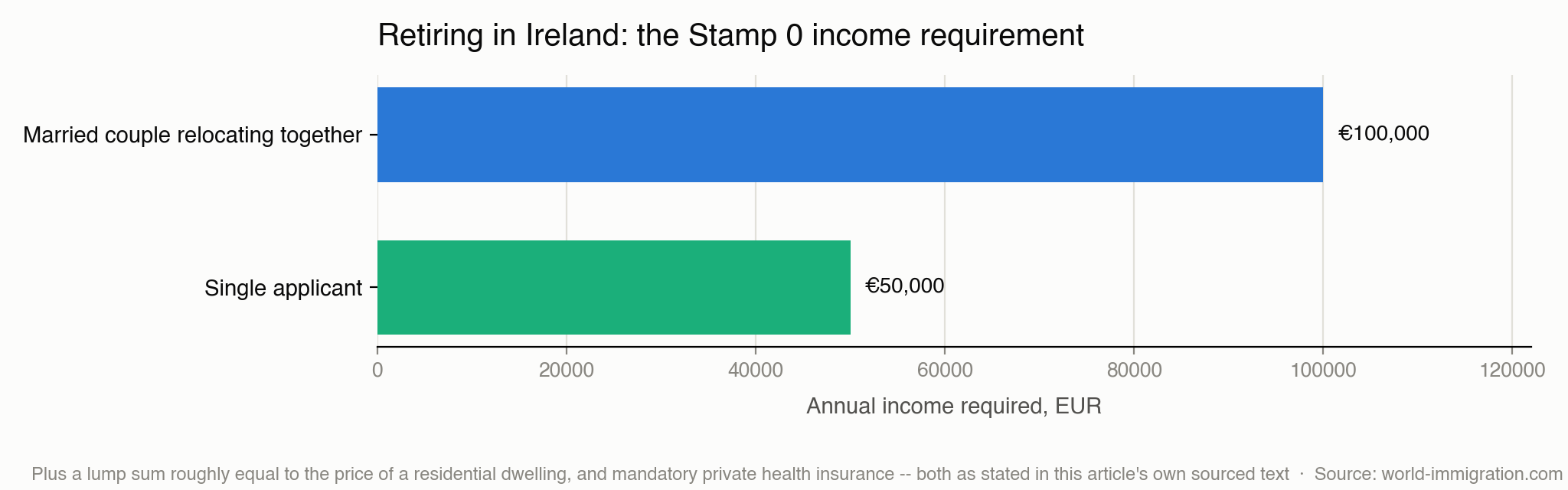
Here is where most plans meet reality. The Irish immigration service sets an income requirement of €50,000 per year for a single applicant and, per Citizens Information, a married couple relocating together needs a combined income of €100,000 (which does not need to be split evenly between the two of them).
On top of that annual income, you must have access to a lump sum large enough to cover a major unexpected expense, described by the service as roughly the price of a residential dwelling in the State. That second condition is easy to skim past and expensive to underestimate, because Irish property is not cheap.
The documentation rules, set out by Immigration Service Delivery, are unusually specific. Your financial evidence has to be presented in spreadsheet form, converted into euros and certified by an Irish accountancy firm that is familiar with overseas banking and accounting documents. That last requirement adds a cost and a lead time to the application, because you are commissioning an Irish professional to vouch for statements from your home bank before you have even moved. If I were mapping out a timeline, I would put finding and briefing that accountant near the front of it rather than treating it as a formality at the end.
It is fair to ask whether there is another option. The general employment permit is the usual way non-EU nationals move to Ireland, but it requires a job offer from an Irish employer and is built around active work. That rules it out for anyone whose plan is to stop working, which is the whole point of retirement. For a person of independent means, Stamp 0 is the route the system points you toward, threshold and all.
How you apply, step by step
The application splits by nationality, then converges, per Immigration Service Delivery’s own application-process guidance. If you come from a visa-required country, you first apply for a “D Reside” long-stay visa before you travel. If you come from a country whose nationals do not need a visa to enter Ireland, you skip that step. What nobody skips is the next one: every applicant, visa-required or not, must apply for and be granted Stamp 0 before arriving in Ireland. You do not turn up and sort it out at the border. Approval comes first, then travel.
Once you land, you register the permission in person with Immigration Service Delivery and an Irish Residence Permit (IRP) card is issued by post, typically within ten working days of registering. That card is your proof of lawful residence. From there, Stamp 0 runs for one year at a time and renews annually, provided you can still show the same income and the same private insurance.
The annual renewal is likely what most people forget to plan for. This is not a set-and-forget residence card. It is a yearly re-audit of whether you still meet the bar you cleared to get in.
Does Stamp 0 lead anywhere?
This is the question I would want answered before committing, because the answer changes the whole calculation. For most immigration routes, years of residence build toward something: permanent residence, then citizenship by naturalisation. Stamp 0 largely does not. Time spent on it does not count as reckonable residence toward Irish citizenship. Only time on Stamps 1, 1G, 3, 4 and 5 counts and Stamp 0 is absent from that list and from the official reckonable-residence calculator.
There is a caveat, some immigration solicitors report isolated cases where Stamp 0 time appeared to be treated as reckonable, even though the stamp does not show up as an option in the official calculator and Ministerial policy is described as silent on the point rather than explicitly closing the door.
That is a grey area, not a pathway. If citizenship is part of your long-term aim, the sensible move is to take specific legal advice on your own circumstances and to treat Stamp 0 as a permission to live in Ireland comfortably, not as the first rung of a settled ladder to a passport. Planning around the exceptions would be a mistake.
Tax residency and what it can trigger
Revenue decides tax residency by day-counting. You become tax-resident if you spend 183 days or more in Ireland in a single tax year, or 280 days or more across two consecutive tax years, with a minimum of 31 days in each of those years. For someone moving over to retire, crossing that line is not an edge case. It is the expected outcome of living there.
Once you are tax-resident, your worldwide income can become taxable in Ireland. There is an important softener for people who are resident but not Irish-domiciled: the remittance basis. Under it, a non-domiciled resident is taxed on Irish income in full, but on foreign income only to the extent it is actually brought into (remitted to) Ireland. Money left offshore and untouched can sit outside the Irish net. Whether that helps you depends entirely on how your income is structured, which is exactly why this needs individual advice.
Pensions get their own treatment through Ireland’s double-taxation treaties. Ireland has agreements with the United States, the United Kingdom, Australia and Canada, among others and these contain tie-breaker rules so the same income is not taxed twice. As a general pattern, private and occupational pensions tend to be taxed in the country where you live, while government and public-service pensions are commonly taxed by the state that pays them, subject to the specific wording of each treaty. Those patterns are a starting point, not a promise. The exact outcome turns on the individual treaty article and on your circumstances.
Inheritance is the part I see people overlook entirely. Ireland charges Capital Acquisitions Tax on gifts and inheritances at a flat 33% above the relevant thresholds. A non-domiciled resident is shielded from CAT on foreign gifts and inheritances only while they have been Irish tax-resident for fewer than five consecutive years. From the sixth consecutive year of residency, that shield falls away regardless of domicile.
Separately, per Citizens Information, any asset situated in Ireland, such as an Irish house, is within the CAT net at 33% no matter where you are resident or domiciled. Ireland has no general wealth tax, so the exposure here is about transfers rather than an annual levy on what you own. Because the five-year clock and the domicile rules interact in ways that depend on your family and estate, this is a section to take to a qualified tax adviser, not to self-diagnose from an article.
Healthcare: private cover is mandatory
Because Stamp 0 holders cannot access the public health system, full private medical insurance is a condition of the permission, not an optional extra. The cover must include hospital and emergency treatment. Travel insurance is explicitly not accepted as a substitute, which rules out the temptation to lean on a holiday policy for the first year. For elderly dependent relatives brought in under the scheme, the insurance has to match a defined standard, described as equivalent to VHI’s Plan D level of cover.
What I cannot give you is a premium figure and I would rather say that than invent one. Health insurance for an older applicant varies enormously by age, health history and the plan chosen and this research did not surface a reliable number for a retiree.
My research has not surfaced a reliable figure for a retiree so I am unable to write a reliable result here. The correct step is to get a direct quote from an Irish insurer for your own age and situation. VHI, Laya Healthcare and Irish Life Health are the three main providers and pricing an equivalent-cover plan from each is a concrete way to turn this condition into a real line in your budget before you commit to anything else.
The number that stops most people: is €50,000 a year achievable?
The €50,000 threshold likely disqualifies a lot of people who assume a decent state pension will carry them. Run the figures against the main Western state pensions and the gap is stark.
- The UK full new state pension for 2025/26 is around £11,973 a year, well under half the threshold once converted.
- The average US Social Security retiree benefit for 2026 sits around US$24,000 to $25,000 a year, with the median closer to $21,000.
- New Zealand Superannuation for a single person living alone is around NZ$33,663 a year gross (the rate effective from 1 April 2026).
- Ireland’s own State Pension (Contributory) is roughly €15,564 a year for a single person at the maximum rate (up from €15,044 before the January 2026 increase), or about €31,128 for a couple where both qualify at the maximum rate.
Not one of those state pensions, taken on its own, clears the €50,000-per-person bar. Ireland’s own contributory pension does not clear its own retirement-visa threshold, which shows Stamp 0 was never calibrated around a typical pension income. It was built for people with substantial income beyond the state safety net.
In practice, the applicants who meet the bar are stacking sources: a state pension topped up with a private or occupational pension, drawdown from investments or savings, rental income, or a spouse’s income counted alongside their own. If your entire retirement plan rests on a single state pension, my view is that Stamp 0 is not built for you and it is far better to learn that now than from a rejected application later. The threshold is a filter and it is doing exactly what it was designed to do.
How long the process takes
Published timeframes vary and you will see anything from six weeks to six months quoted depending on the source. Immigration Service Delivery’s own current figure is an average of four months from the point they receive your application, so for planning purposes I would budget four to six months to cover the slower end and I would apply the same estimate to annual renewals rather than assuming they are quicker. Add the time needed to commission the Irish accountant’s certification and to line up insurance and the practical lead time from decision to landing is best measured in months, not weeks.
This article is part of our Ireland cluster, which covers the full move end to end.
Frequently asked questions
Can I work in Ireland on a Stamp 0 permission?
No. Stamp 0 is a permission for people who are financially independent and self-funding and it does not allow employment or the operation of a business. Your income must come from pensions, investments, savings or other means that do not rely on working in Ireland. Anyone whose plan involves earning an Irish income needs a different permission, such as an employment permit tied to a job offer.
Will years on Stamp 0 count toward Irish citizenship?
As a rule, no. Time on Stamp 0 is not listed as reckonable residence for naturalisation and the stamp does not appear on the official reckonable-residence calculator, where only Stamps 1, 1G, 3, 4 and 5 count. A small number of solicitors report isolated cases that suggest a grey area and Ministerial policy is described as silent rather than explicit, so if citizenship matters to you take individual legal advice. Do not plan on the assumption that Stamp 0 leads to a passport.
Do I need private health insurance from day one?
Yes. Full private medical insurance covering hospital and emergency treatment is a mandatory condition of Stamp 0, because holders cannot use the public health system. Travel insurance is not accepted in its place. Get a direct quote from an Irish insurer such as VHI, Laya Healthcare or Irish Life Health for your own age and health circumstances, since premiums for older applicants can differ widely.
Is a state pension enough to qualify?
For most people, no. The €50,000-per-year individual income requirement sits well above the UK, US and New Zealand state pensions and above Ireland’s own contributory pension. Applicants generally meet the bar by combining a state pension with a private pension, investment or rental income, savings drawdown or a spouse’s income. If a single state pension is your only income, Stamp 0 is unlikely to be within reach.
Sources
- Irish Immigration Service — “I want to retire to Ireland”
- Citizens Information — Tax residence and domicile in Ireland
- Revenue — Resident for tax purposes
- Citizens Information — Capital Acquisitions Tax
- Lewis Silkin — “Stamp 0: Ireland’s visa for retirees or persons of independent means”
- Citizens Information — “Retiring to Ireland”
- Immigration Service Delivery — “Immigration permission/stamps”
- Immigration Service Delivery — “Information on registering your immigration permission for the first time”
- Immigration Service Delivery — Naturalisation Residency Calculator
- Sinnott Solicitors — “Does a Stamp 1G or Stamp 0 count towards Reckonable Residence when applying for Irish Citizenship”
- Expat Taxes — “The remittance basis of tax in Ireland: The dos and don’ts”
- Citizens Information — “Taxation of pensions”
- RBK — “Capital Acquisitions Tax and Temporary Residents: Traps for the Unwary”
- Berkeley Solicitors — “Dependant Parent Applications”
- Citizens Information — “Private health insurance”
- GOV.UK — “The new State Pension: what you’ll get”
- Social Security Administration — 2026 Cost-of-Living Adjustment (COLA) Fact Sheet
- New Zealand Government — “Living alone on NZ Superannuation or the Veteran’s Pension”
- Citizens Information — “State Pension (Contributory)”

